
Origins of AM-2 Planking and SATS Doctrine
Sand dunes along the western shore of the South China Sea shifted constantly under blistering ocean winds, burying survey stakes and stalling heavy earthmoving machinery. Tropical heat pushed daytime temperatures well over one hundred degrees, baking the loose grit into fine powder before seasonal monsoon rains turned the entire coastal plain into thick soupy mud. Marine construction crews battled severe dehydration and salt spray that corroded metal fittings on bulldozers trying to carve basic staging areas out of the swampy scrubland. Standard pierced steel planking salvaged from older supply depots repeatedly failed in these conditions because the heavy perforated steel plates sank directly into the saturated ground under heavy traffic. Heavy perforated steel plates sank directly into the saturated ground under heavy traffic, proving that existing landing mats could never support the crushing ground pressures generated by frontline combat aviation.
Marine planners formulated the Short Airfield for Tactical Support doctrine to replace those failing steel plates with rapidly deployable runways for high performance tactical jets operating from austere forward beachheads. Marine aviation units required an airfield system that naval expeditionary forces could transport by ship, offload across open beaches, and construct in less than thirty days. Modern strike aircraft such as the Douglas A-4 Skyhawk and McDonnell F-4 Phantom imposed extreme physical demands that propeller aircraft of earlier wars had never created. Jet engines blasted landing surfaces with intense exhaust heat, while narrow landing gear assemblies exerted thousands of pounds of concentrated pressure during hard carrier style touchdowns. Naval Air Engineering Center technicians in Philadelphia began developing a purpose built metallic matting system capable of surviving these violent operational stresses.
Aluminum alloy 6061-T6 formed the structural core of this experimental system, extruded into hollow panels measuring 1.5 inches thick. Metallurgists selected this specific aircraft grade alloy because it offered high tensile strength, resisted saltwater corrosion, and weighed roughly half as much as equivalent steel sections. Fabrication plants extruded the material into two standard dimensions, producing full panels twelve feet long and half panels six feet long to allow staggered joint patterns across the runway surface. Factory workers coated the upper wearing surface with a coarse epoxy compound to provide wheel traction during wet weather and protect the bare metal against spilled jet fuel. Lakehurst test personnel subjected experimental mats to simulated wheel impacts from weighted drop carriages, proving that the lightweight alloy could absorb repeated shocks without permanent deformation.
Engineers perfected this structural integrity by designing interlocking male and female hinge edges to transfer rolling wheel loads across the airfield deck. Interlocking hinge profiles ran along the twelve foot sides of each panel, allowing assembly crews to insert a new plank at an angle and rotate it downward until the joint locked flush. Aluminum locking bars slipped smoothly into milled slots along the shorter ends, pinning adjoining rows together into a continuous deck that prevented individual planks from curling loose under landing gear impacts. Construction troops quickly learned to position panels by hand and seat the locking bars with simple pry tools and sledgehammers, achieving rapid installation speeds without heavy machinery. Naval transport vessels loaded crates of the interlocking aluminum panels into cargo holds bound for staging depots across the Pacific, staging the material for immediate combat deployment.
Expeditionary Construction at the Chu Lai Beachhead
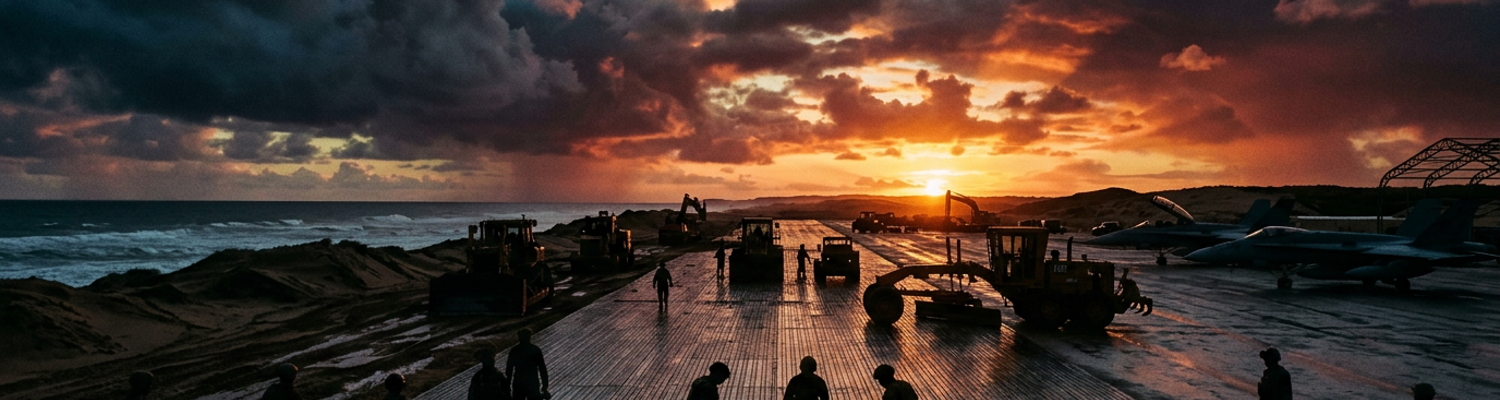
Seabees from Naval Mobile Construction Battalion 10 met those inbound supply ships at the surf line in May 1965, joining Marine Wing Support Group engineers to drag the crated aluminum panels across the Chu Lai beachhead. Heavy transport trucks and rough terrain forklifts sank to their axles in the powdery coastal sand, forcing construction troops to unload the massive wooden pallets by hand under punishing tropical sun. Surveyors staked out a four thousand foot runway corridor across an undulating expanse of shifting coastal dunes that lacked any solid bedrock or natural stone base. Bulldozer operators sheared away thorny brush and shaved the crowns off dry sand dunes, but every pass of a blade stirred up blinding dust that choked engine air filters and settled right back into the excavated cuts. Military planners refused to pause for crushed rock quarrying or long concrete curing periods, ordering the engineering units to surface the bare sand directly with the interlocking aluminum planks to meet strict tactical deadlines.
Sledgehammers pounded against the extruded aluminum edges around the clock as Seabees and Marines levered the interlocking AM-2 panels into place over the loose sand. Crews fitted the male hinges into matching female slots at an angle, pushed each twelve foot plank flat, and drove aluminum locking bars through the end joints before ocean breezes could blow grit into the milled channels. Shifting dune sand constantly shifted beneath the advancing deck, opening hollow voids that caused panels to sag and threatened to rip the locking bars apart under rolling loads. Engineers solved the stability problem by dousing the subgrade with thousands of gallons of salt water, compacting the damp grit with towed rollers, and spreading continuous sheets of rubberized nylon membrane directly beneath the metal planks to seal out the blowing sand. Working parties placed thousands of individual aluminum panels across the coastal shelf in less than a month, anchoring the perimeter edges with steel hold down stakes and stringing arresting gear engines across the runway thresholds.
Steel arresting cables snagged the extended tailhooks of incoming Douglas A-4 Skyhawks on June 1, 1965, when Marine Attack Squadron 225 touched down to execute the first operational combat recoveries on the finished deck. Pilot Colonel John Noble and his wingmen slammed onto the grooved surface, their landing gear testing the interlocking joints as the arresting engines absorbed the carrier speed impact without displacing a single plank. Marine ground crews sprinted onto the shimmering metal deck to pump jet fuel into the tanks and hoist five hundred pound high explosive bombs onto the wing pylons for an immediate strike against hostile positions nearby. Shorter than standard military jet runways, the four thousand foot aluminum strip could not provide enough takeoff roll for heavily laden Skyhawks operating in the thin tropical air. Technicians resolved the distance limitation by clamping four solid fuel JATO rocket bottles to the empennage of each strike aircraft before clearing the runway for departure. Colonel Noble rolled onto the aluminum threshold, ran his turbine engine to full throttle, and ignited the roaring JATO rocket boosters, launching his heavily armed jet off the edge of the dunes to deliver close air support just miles from the beachhead perimeter.
Dynamic Arresting Gear and Carrier Aircraft Loads
Aluminum planks absorbed the searing exhaust heat of those rocket departures, but the landing deck faced an even greater mechanical crisis when the armed strike aircraft turned back to touch down on the truncated runway. Marine recovery crews integrated MOREST M-21 mobile arresting gear engines and heavy deck cables directly onto the AM-2 surfacing to halt inbound jets before they ran out of aluminum. Technicians anchored the rotary hydraulic braking units into the coastal soil beside the runway edges and strung high tension steel cross deck pendants across the matting. Thick steel cables lay flat across the interlocking panels, held slightly off the metal surface by rubber support donuts so tailhooks could snag them cleanly. Each arrested landing transferred immense dynamic shock through the cables, pulling violently at the hold down sheaves and transmitting sharp twisting forces into the surrounding aluminum planks. Interlocking male and female hinges strained under these repeated dynamic arrestments, shifting tiny fractions of an inch as the cables pulled each aircraft to a dead stop within several hundred feet.
Tailhooks dragged across the metal planks at over one hundred knots during these short field recoveries, producing high mechanical fatigue and surface gouging throughout the touchdown zone. Steel hook points slammed into the deck with high sink rates, cutting directly into the thick panels and shaving off deep ribbons of aluminum. Continuous mechanical gouging stripped away the coarse epoxy coating, exposing bare metal to the slick marine air and creating deep jagged burrs on the plank faces. Repeated tailhook impacts generated structural fatigue cracks that spread from the gouged surfaces into the internal hollow ribs and outer hinge joints of the matting. Marine maintenance parties sprinted onto the runway between landing flights to inspect the gouged metal with pry bars and flashlights. Working under scorching heat, the repair teams unlatched shattered planks, levered distorted sections out of the interlocking grid, and pounded fresh aluminum panels into place so the jagged edges would not slash aircraft tires.
Tires bore even heavier punishment when high gross weight ordnance sorties flown by A-4 Skyhawks and F-4 Phantoms began operating from the expeditionary strip around the clock. Fully armed McDonnell F-4 Phantoms weighed more than twenty five tons, and their high pressure tires concentrated immense downward force onto individual planks. Extreme loading induced severe structural flexure along the runway deck, causing the interlocking aluminum sheet to bend and ripple beneath the rolling wheels. The underlying dune sand offered uneven support, deflecting downward under the rolling wheel loads and creating a continuous upward bulge of deformed metal in front of accelerating aircraft. Each heavy takeoff flexed the extruded aluminum panels up and down, bending the male and female hinges beyond their designed elastic tolerances and loosening the aluminum locking bars. Marine pilots fighting the controls felt the runway surface roll beneath them as the heavily armed jets lumbered down the flexing deck toward the launch point.
Sand pumped upward through the flexing hinge joints with every heavy rollout, coating the matting with gritty abrasive powder that accelerated wear inside the interlocking slots. Construction battalions and airfield maintenance crews scrambled to stabilize the sinking subgrade beneath the flexing aluminum deck before structural failure closed the base. Seabees bored through damaged planks, driving steel hold down pins deeper into the coastal earth to pin down the buckled matting edges. Technicians also rigged pressurized hoses to pump liquid cement grout beneath the sagging runway center, filling the hollow subgrade cavities created by the continuous flexure. Marine air commanders responded to the mechanical strain by reducing allowable takeoff fuel weights and mandating rapid engine turnarounds to preserve the battered aluminum strip for essential combat missions.
Monsoon Inundation and Hydraulic Sand Pumping
Torrents of seasonal rain poured over the battered aluminum strip during the northeast monsoon, saturating the unprepared Chu Lai sand foundation in January 1966. Heavy precipitation cascaded off the impermeable metal deck for days on end, pooling along the unpaved sand shoulders and penetrating the porous edges of the runway corridor. Water seeped beneath the rubberized nylon membrane that had been laid to stabilize the foundation, flooding the uncompacted dune sand until it lost all internal shear strength. The coastal earth transformed into saturated muck that could no longer support heavy static weight, drowning the wooden anchoring stakes and dissolving the firm ground base. Standing puddles accumulated along the perimeter ditches, submerging hold down fixtures and leaving the entire four thousand foot runway floating on an unstable bed of liquid mud.
Aircraft tires rolling across the waterlogged aluminum forced the flexible metal planks downward into the liquefied mud beneath. Each accelerating Skyhawk and Phantom drove its high pressure landing gear into the deck, deflecting the interlocking panels downward and compressing the trapped water under tremendous force. Dynamic tire flexure created an intense hydraulic suction effect the instant the rolling wheels passed and the sprung aluminum snapped back toward its resting position. Violent hydraulic action generated extreme negative pressure, forcing liquefied sand and slurry up through the panel hinge joints in pressurized streams. Thick grey sludge erupted across the runway surface with every departure, spraying abrasive grit over the grooved deck and into the landing gear wells of trailing aircraft. Expelled slurry coated the aluminum surface with a treacherous film that severely degraded braking friction and clogged the mechanical rollers of the runway arresting gear.
Sludge eruptions evacuated tons of solid material from beneath the aluminum deck, leaving massive subgrade voids across the primary touchdown zone. Lacking solid bottom support, the AM-2 panels sagged into these hollow cavities under their own weight, producing severe surface undulations that turned the level runway into a series of rolling crests and depressions. Inbound strike aircraft slammed into these rolling dips at landing speeds, pitching violently on their landing gear struts as pilots struggled to hold the centerline. Excessive vertical flexure distorted the extruded aluminum shapes beyond their structural elastic limits, causing locking joint unseating as the aluminum end bars warped and popped clear of their milled retaining channels. Separating male and female hinge joints curled upward across the runway center, creating raised metal lips and loose planks that clattered violently beneath taxiing jets. Jagged aluminum edges along the unseated joints threatened to slice through pressurized aircraft tires on every landing, risking catastrophic blowouts and runway departures at high rollout speeds.
Marine maintenance crews sprinted onto the buckled deck between recovery cycles, driving unseated locking bars back into place with heavy sledgehammers and pry bars. Severe structural failures crippled the aluminum strip at the worst possible operational moment, just as Operation Double Eagle got underway in late January 1966 across the coastal lowlands of southern Quang Ngai Province. Marine infantry battalions hunting enemy main force units in the rain swept terrain required nonstop close air support, but the unseating joints and undulating deck threatened the entire flight tempo of the expeditionary airfield. Air operations officers faced an agonizing choice between shutting down the damaged runway for extensive repairs or risking aircraft crashes on the undulating aluminum planks. Technicians improvised desperate battlefield remedies under continuous tropical downpours, pumping liquid cement grout through drilled access holes to fill subgrade voids while welding steel strap plates across separated hinges. Work details labored around the clock between scrambling flights to swap out distorted planks, keeping the battered aluminum strip operational so Skyhawks and Phantoms could deliver critical firepower to troops fighting through the monsoon mud.
Sub Base Chemical Stabilization and Mechanical Joint Retrofits
Navy Seabees recognized that replacing bent planks provided only a temporary fix while the saturated earth beneath the deck continued to liquefy. Engineering units stripped away hundreds of feet of damaged matting to expose the waterlogged dune sands along the primary touchdown zone. Heavy earthmoving equipment excavated the failed subgrade down to several feet below the operational grade, clearing away tons of soupy mud that had undermined the aluminum panels. Construction teams dumped dry portland cement powder across the freshly cleared cuts, blending the stabilizer directly into the native sand with rotary tillers. Water trucks sprayed measured amounts of moisture onto the mixture while pneumatic rollers compacted the dense soil cement foundation into a solid pad that stopped the downward deflection of replacement planks under heavy aircraft impacts.
Distributor trucks fitted with long spray bars drove across the compacted earth, pumping hot petroleum emulsion directly into the porous sand to saturate the top layer. Liquid Peneprime asphalt soaked several inches into the subgrade, bonding the loose granules together and curing into a continuous crust that shed surface moisture toward drainage trenches. Seabees rolled wide sheets of T-17 elastomeric membrane across the blackened asphalt base, carefully overlapping and sealing the rubberized seams with heavy adhesive tapes. This tough elastomeric membrane formed an impermeable barrier between the soil and the overlying airfield deck, locking out driving rainwater and preventing any remaining groundwater from pumping upward into the matting. Marine construction details followed closely behind the membrane crews, reassembling the AM-2 aluminum planks over the sealed sub base to restore the flight line.
Aluminum locking bars still struggled to absorb the severe longitudinal forces produced whenever heavily loaded jets dropped their tailhooks and stomped on their wheel brakes. Braking friction shoved entire rows of planks forward along the runway centerline, causing standard locking bars to bend, walk out of their retaining slots, and shear clean through their aluminum retaining tabs. Marine machinists and Seabee mechanics devised a permanent field retrofit to halt this forward movement by modifying the locking bars inside runway maintenance tents. Technicians drilled matching holes through the bar flanges and panel ribs, driving hardened steel locking pins directly through the assemblies to physically anchor adjoining panels in place. Welders followed with portable electric arc torches, laying custom weld points along the exposed bar ends to bond the interlocking hardware into a rigid longitudinal spine. Locked joints held the aluminum deck rigidly in place during high speed recoveries, preventing panel displacement and keeping the runway operational for nonstop combat sorties.
Catapult System Integration and High Cycle Thermal Stress
Engineers anchored the land based CE 1-3 catapult system directly across the rigid longitudinal spine to accelerate outbound combat sorties with maximum bomb payloads. Powered by a ground mounted jet engine and heavy reduction gears situated beside the runway, the launcher drove a continuous wire tow cable connected to a wheeled shuttle dolly. Installation crews drilled through the aluminum planking to mount heavy steel guide tracks, tension sheaves, and explosive ground anchors flush with the runway centerline. Operational field trials began as ground personnel hooked Douglas A-4 Skyhawks and McDonnell Douglas F-4 Phantoms to the towing bridle. Catapult shots pulled the tactical jets from a dead stop up to flight speed within a few hundred feet, validating the Short Airfield for Tactical Support concept under actual combat conditions.
Aluminum connectors absorbed extreme horizontal shear forces every time the catapult shuttle fired a twenty ton fighter down the runway. Vertical aircraft weight pushed the extruded panels into the stabilized subgrade, but the sudden forward pull of the launch cable dragged the runway surface longitudinally toward the sea. Male and female hinge joints along the twelve foot panel edges bore the brunt of this longitudinal strain, pinching together and warping under the uneven thrust loads. Locking bars seated along the transverse seams twisted inside their milled channels, stretching the retaining aluminum tabs until structural play developed between adjoining planks. Maintenance specialists discovered that repeated high acceleration launches caused the aluminum hinge flanges to micro crack and elongate, loosening the structural hold of the entire launch corridor. Continuous mechanical tearing threatened to separate the runway panels, requiring ground crews to constantly inspect connectors and hammer displaced locking bars back into alignment.
Jet blast impingement compounded this mechanical joint fatigue whenever combat pilots spooled their engines to full military power on the catapult shuttle. Sustained turbine exhaust struck the grooved aluminum decking at temperatures exceeding one thousand degrees, scorching the metal within seconds of engine run up. Solid fuel JATO rocket exhaust, ignited on specific heavy ordnance sorties, intensified the thermal onslaught by spewing corrosive flame directly onto the runway floor. Concentrated thermal cycling triggered rapid thermal breakdown of the factory applied non skid coating, flaking the gritty epoxy compound off the smooth aluminum base and blowing it away in thick clouds of dust. Bare aluminum beneath the ruined non skid surface quickly polished to a slick finish under spinning aircraft tires, drastically reducing ground friction and making taxiing dangerously unpredictable.
Seabees stripped the heat damaged planks from the launch threshold and rolled fresh coats of non skid epoxy over the bare metal to restore essential wheel traction. Heavy steel blast deflectors were dragged into position behind the catapult hookup area, directing the searing turbine wash upward and away from the delicate aluminum seams. High cycle launch schedules nevertheless continued to burn through the replacement coatings and warp the heat softened aluminum alloy planks. Marine repair teams rotated worn panels to secondary taxiways and stockpiled spare matting crates along the flight line to conduct rapid section rebuilds between morning strike packages. Catapult officers recalibrated launch pressures and towing limits to balance sortie generation against the finite structural lifespan of the expeditionary aluminum deck.
Runway Modernization and Permanent Concrete Transition
Naval commanders recognized that the rapidly expanding air war in Southeast Asia required a permanent airfield facility capable of supporting hundreds of daily sorties without constant structural maintenance. Construction crews from civilian contractor consortium RMK BRJ and military engineering units broke ground on a massive parallel runway located just west of the original matting corridor. Fleets of earthmovers leveled the coastal dunes while paving machines laid deep aggregate sub bases and poured hundreds of thousands of tons of high strength concrete. Technicians completed this permanent ten thousand foot parallel concrete runway in late 1966 to handle sustained heavy operations by fully loaded jet fighters, reconnaissance aircraft, and multi engine cargo transports. Marine jet squadrons immediately shifted their high tempo strike missions to the finished concrete, ending the grueling cycle of catapult launches and rocket assisted takeoffs on the battered beachhead.
Marine combat engineers quickly seized the freed aluminum corridor to reconfigure the entire aviation footprint at Chu Lai. Logistics planners reassigned the interlocking panels to serve as high capacity parallel taxiways, aircraft revetments, and sheltered maintenance pads rather than abandoning the original matting network. Work details pulled damaged planks from the primary touchdown lanes, straightened salvageable sections with hydraulic presses, and relaid the aluminum deck alongside the new concrete runway so jets could taxi smoothly between hangars and the active threshold. Technicians set up wide parking aprons where ordnance crews loaded five hundred pound bombs onto strike aircraft on clean metal surfaces rather than loose coastal dirt. Maintenance crews erected metal canopy shelters over large AM-2 pads, creating dust free staging areas where jet mechanics dismantled turbine engines without contaminating delicate bearings with blowing beach sand.
Forklifts loaded thousands of extra AM-2 planks onto flatbed trailers to push the versatile landing surface deep into the surrounding operational sector. Logistics officers sent these palletized shipments to forward rotary wing operating sites across I Corps, including nearby Ky Ha, where Marine helicopter squadrons operated under primitive field conditions. Construction details assembled the salvaged aluminum panels over scraped jungle clearings and marshy river flats, building level landing pads, refuel stations, and staging decks in a matter of days. Aluminum helicopter platforms prevented heavy transport helicopters and attack gunships from churning dry soil into blinding brownout dust clouds during tactical troop insertions. Combat engineers also laid the interlocking planks over saturated mud to build stable staging aprons, enabling rapid rearming and refueling cycles for medevac missions and emergency troop extractions during heavy monsoon downpours.
Marine Corps planners studied the performance of the aluminum matting through these punishing combat tests, using the lessons of sand pumping, thermal blistering, and catapult shear to refine their operational doctrine. Military evaluators recognized that despite its early maintenance difficulties, the extruded aluminum panel had solved the historic challenge of landing heavy tactical jets on bare coastal ground. Naval aviation commands formally codified AM-2 planking as the enduring baseline hardware for modern Marine Corps Expeditionary Airfield systems, establishing standardized production specifications, anchoring procedures, and maintenance protocols. Logisticians incorporated crated sets of the interlocking aluminum panels into the permanent supply manifests of maritime prepositioning ships and combat engineer units worldwide. Engineering battalions continued to drill runway assembly techniques using the exact same male and female hinge joints, locking bar channels, and aluminum alloys proven under fire on the dunes of Chu Lai.