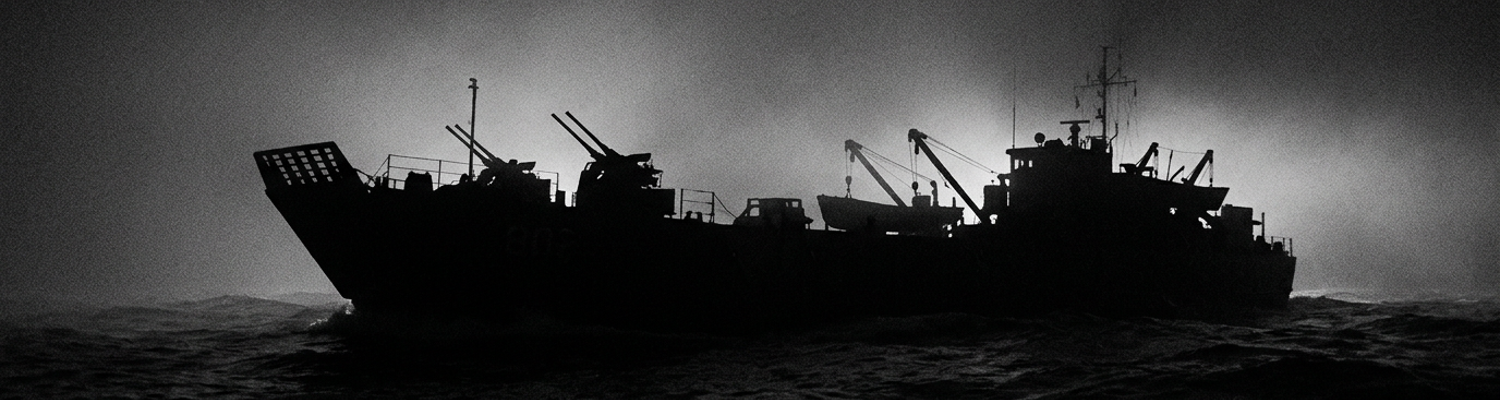

The Convoy T-4 Disaster in Lyme Bay
Amphibious assault training doctrines of 1944 promised soldiers an impenetrable defensive screen. Heavy destroyers and synchronized communication networks were supposed to protect slow moving transport fleets. The actual troops assigned to Exercise Tiger churned through the dark waters of the English Channel at a sluggish five knots. They rode inside unarmored flat bottomed vessels. A single lightly armed corvette accompanied them. Their radio systems were completely disconnected. When examining the historical record of April 28, 1944, the structural collapse of Convoy T-4 reveals a chain of severe administrative and tactical errors. Eight Landing Ships, Tank (LSTs) carrying thousands of American servicemen, Sherman tanks, and heavy engineering equipment formed a vulnerable line stretching several miles across Lyme Bay. Command decisions made hours prior stripped the convoy of its primary defense.
The Royal Navy destroyer HMS Scimitar sustained minor collision damage and remained at port in Plymouth.
This left the World War I era HMS Azalea as the sole escort for the entire formation.
A close review of operational logs indicates that this escort absence occurred simultaneously with a severe communications breakdown. American LST commanders operated their radios on a frequency of 278 kilocycles. British naval authorities transmitted early warning signals regarding enemy surface activity on 271 kilocycles. A typographical error in the planning documents caused this mismatch. Radio operators aboard the American ships never received the alerts. Nine German Schnellboote detected heavy allied radio traffic. These fast attack craft belonged to the 5th and 9th S-boat Flotillas operating out of Cherbourg. They altered their patrol routes toward the coordinates of the training exercise. These wooden hulled vessels possessed top speeds exceeding forty knots. Three supercharged Mercedes Benz diesel engines powered them. They carried highly effective acoustic and straight running torpedoes. The German flotilla commanders approached the transport line under the cover of a moonless night. They identified the heavy silhouettes of the LSTs against the horizon. Attackers maneuvered into firing positions without triggering any alarms aboard the American ships.
At 0203 hours, a pair of torpedoes struck the starboard side of LST-507.
Explosions instantly ignited the heavily loaded vehicle deck. This space contained thousands of gallons of gasoline and tons of high explosive ammunition. Fire rapidly consumed the midsection of LST-507. The heat buckled the steel deck plates. Hundreds of soldiers from the 1st Engineer Special Brigade were trapped below decks. Crew members abandoned the blazing wreck as it settled into the freezing waters of Lyme Bay. German S-boats reloaded their tubes and acquired a second target within the disorganized convoy line. LST-531 absorbed two direct torpedo hits shortly after 0215 hours. Structural damage proved so severe that the vessel rolled over and sank entirely within six minutes. Archival evidence shows that troops thrown into the sea faced water temperatures hovering around forty two degrees Fahrenheit. They were wearing bulky combat gear.
Many soldiers had improperly fastened their inflatable lifebelts around their waists rather than under their armpits.
Field packs weighed heavily on the men. The low center of buoyancy forced them face down into the water. Over 700 Allied military fatalities occurred during this brief engagement. Rescue operations mounted by surviving LSTs and arriving British units recovered 749 bodies from the surface over the following hours. Casualties consisted largely of combat engineers, quartermaster personnel, and medical staff assigned to support the upcoming Utah Beach landings. LST-289 sustained a severe stern hit from a separate torpedo. The crew managed to deploy its lifeboats before limping back toward the English coast. Surviving German attack craft exited the engagement zone at high speed. They avoided the delayed response of Royal Navy motor torpedo boats dispatched from Dartmouth.
German Schnellboot Interception of Exercise Tiger
Standard naval doctrine of the era dictated that heavy transport convoys operating in hostile waters required overlapping radar coverage. Multiple escort destroyers actively pinging sonar were supposed to deter fast attack craft. Servicemen aboard Convoy T-4 instead found themselves completely blind in the English Channel at 0130 on April 28. High speed surface interceptors tracked them. Their single World War I era escort vessel steamed miles ahead in absolute radio silence.
A close review of operational logs indicates that the assault force originated from the heavily fortified concrete pens at Cherbourg on the Cotentin Peninsula. Nine fast attack craft slipped out of the French harbor at 2200 hours on a routine offensive sweep. These vessels belonged to the 5th and 9th Schnellboot Flottillas of the Kriegsmarine. Allied intelligence frequently referred to them as E boats. German naval command dispatched this specific task force to disrupt shipping lanes south of the Isle of Portland. The physical construction of the S-boat made it an exceptionally dangerous interceptor for this exact type of coastal engagement. Shipbuilders at the Lurssen yard utilized a composite hull design. They stretched double planked mahogany over light metal alloy frames. This specific material composition minimized their radar signature. It maximized structural flexibility in rough Channel swells. Three 20 cylinder Daimler Benz MB 501 diesel engines propelled each craft.
This powerplant generated over 6,000 horsepower.
The engines pushed the 114 foot vessels to top speeds of 43.5 knots.
Exhaust systems routed the heavy diesel emissions directly below the waterline. This masked their thermal and visual signatures from aerial reconnaissance. Radar operators at British coastal stations completely failed to detect the interceptors crossing into Lyme Bay. Radio technicians aboard the German craft intercepted the unsecured chatter of the American forces. They adjusted their heading toward the coordinates of Exercise Tiger.
Archival evidence shows that the flotilla commanders positioned their attack groups to exploit the specific environmental conditions of the early morning hours. Heavy cloud cover obscured all ambient starlight across the bay. Pitch black surface visibility severely limited the visual range of the American gun crews stationed on the weather decks of the landing ships. Without the primary destroyer escort HMS Scimitar, the convoy lacked a dedicated surface search radar picket. They had no way of identifying high speed contacts approaching from the flanks. Convoy T-4 steamed in a rigid, linear formation at a constant speed of five knots. They did not execute standard anti submarine zigzag maneuvers. German captains utilized this highly predictable track to calculate precise firing solutions without alerting the target. Attackers cut their primary engines and engaged auxiliary electric silencer motors. They crept within 2,000 yards of the transport line.
No defensive fire materialized from the slow moving American ships.
Gunners manning the 40mm Bofors and 20mm Oerlikon anti aircraft mounts aboard the LSTs could not see the low profile wooden hulls blending into the dark water. When examining the historical record of the engagement sequence, this complete lack of suppressive fire allowed the S-boats to loiter in the target zone. They aligned their strikes with total impunity. Kriegsmarine officers deployed a combination of G7a gas steam torpedoes and G7e electric variants from their forward 53.3 centimeter tubes. Gas steam G7a models left a visible wake of bubbles on the surface. Absolute darkness rendered these trails invisible to the lookouts on LST-507 and LST-531. The German captains fired from extremely short range. This effectively eliminated the margin of error for the unguided weapons. Each warhead contained 280 kilograms of hexanite explosive. These were designed to detonate precisely at the waterline of the flat bottomed landing ships. Hydrostatic blast waves sheared through the half inch steel plating of the LST hulls. Internal bulkheads dividing the troop compartments from the main vehicle decks collapsed instantly under the pressure. Commanders of the 5th Flotilla executed a secondary pass through the center of the formation.
American gunners eventually opened up.
They blindly fired tracer rounds into the empty darkness miles above the actual position of the low riding attack craft.
Communications Mismatches in the Escort Screen
Standard naval amphibious assault manuals of 1944 guaranteed infantrymen a synchronized defensive perimeter. Modern destroyers were supposed to link their early warning radar systems directly to troop transports via secure radio networks. The actual soldiers assigned to Exercise Tiger drifted into Lyme Bay entirely cut off from outside contact. A single under gunned escort protected them.
A close review of operational logs indicates the collapse began hours before the fleet ever reached the open Channel.
HMS Scimitar was scheduled to lead the defensive picket for the transport line. This Admiralty S-class destroyer launched in 1918 carried multiple 4 inch guns and twin torpedo tubes capable of deterring surface threats. On the afternoon of April 27, the 1,075 ton warship collided with an American Landing Craft Infantry vessel. This happened while navigating the crowded anchorages of Plymouth Sound. The physical impact fractured the steel plating near the starboard bow of the destroyer above the waterline. Port authorities ordered the damaged warship to remain docked at the Plymouth repair yards for immediate structural patching. Admiral Ralph Leatham, Commander in Chief of the Plymouth command sector, received the damage assessment report. He assigned no replacement destroyer to the vulnerable transport fleet.
This administrative omission forced the convoy to rely entirely on HMS Azalea.
Lieutenant Commander George Geddes commanded the Flower class corvette. Shipwrights built the 925 ton vessel primarily to hunt submerged U-boats during deep Atlantic crossings. It possessed a maximum speed of just sixteen knots. The ship carried a single 4 inch BL Mk IX naval gun and standard depth charge racks. Azalea completely lacked the rapid fire anti aircraft mounts and heavy surface engagement capabilities of a fleet destroyer. Geddes maneuvered his slow moving corvette into a screening position approximately five miles ahead of the American landing ships.
Nine miles of open water separated the lead escort from the trailing transport vessel in the formation.
Archival evidence shows that this physical distance mattered far less than the complete electronic isolation separating the British corvette from the United States Navy vessels. Joint operational planning documents distributed from the naval command center contained a fatal typographical error regarding signal protocols. American radio technicians aboard the LSTs tuned their primary amplitude modulation receivers to 278 kilocycles. Royal Navy signalmen operating the transmitters aboard HMS Azalea and the coastal defense stations at Portland Bill broadcasted all tactical updates on 271 kilocycles. The standard operating procedure for the exercise strictly forbade the use of unencrypted voice channels. This prevented German eavesdropping. This security measure forced all ships to rely entirely on continuous wave Morse code transmissions sent across the designated frequency band.
Neither allied faction recognized the seven kilocycle discrepancy.
Watchstanders aboard Azalea received early warning intercepts from onshore radar installations. These detailed unidentified fast moving surface contacts heading toward the exercise coordinates. Geddes ordered his radiomen to relay these threat assessments directly to the transport line. British operators transmitted the warnings into a dead frequency band. The heavy SCR-299 radio sets inside the American communications rooms remained entirely silent. Officers on the bridges of the flat bottomed LSTs continued their five knot advance at 50 degrees North, 2 degrees West. They did not order their gun crews to general quarters.
Signalmen on the American ships assumed the radio silence meant the English Channel was clear of enemy activity.
The communications failure extended beyond ship to ship tactical networks. Royal Navy headquarters possessed precise radar tracking data regarding the German S-boat sorties out of Cherbourg. They failed to bypass the standard radio protocols to reach the American commanders. The physical design of the LSTs further compounded the isolation. High steel bulkheads and heavy vehicle loading ramps blocked the line of sight between the individual transport ships. No physical signal lamps or flare warnings deployed from HMS Azalea to alert the trailing vessels. The World War I era corvette continued steaming forward along the designated patrol route. The high speed German attack craft intercepted the rear of the convoy. Radio operators aboard LST-507 sat directly in front of their receivers listening to static. The first torpedo ripped through their starboard hull.
Unfulfilled Radar Assurances and Blind Flanks
Archival evidence shows that high level Allied planners explicitly assured the Western Naval Task Force that coastal radar units would track all Channel traffic throughout the duration of Exercise Tiger. Admiral Alan Kirk commanded the American naval elements for the upcoming Normandy invasion. He received these guarantees during joint planning conferences held at Plymouth headquarters in early April 1944. British officers detailed a comprehensive overlapping electronic surveillance grid. Chain Home Low radar stations positioned at Portland Bill and Start Point generated this grid. These shore based installations utilized Type 271 surface search radar systems. They operated on a 3 gigahertz frequency with a 10 centimeter wavelength. Heavy steel antennas rotated mechanically atop concrete bunkers overlooking the coastline. Technicians manning the Plan Position Indicator displays inside the darkened plotting rooms possessed the equipment necessary to detect small surface contacts up to twenty five miles offshore. The operational briefing promised American transport captains that any German fast attack craft departing the concrete pens at Cherbourg would immediately register as distinct bright returns on the British cathode ray tubes. Planners calculated that the continuous 1.5 megawatt pulses emitted by the coastal arrays would provide a minimum of two hours of advance warning. This would happen before enemy vessels could reach the designated exercise coordinates in Lyme Bay.
The actual performance of the coastal surveillance network fell far short of these administrative guarantees.
When examining the historical record of April 27, the British Admiralty at Whitehall did intercept signals traffic. This indicated that the 5th and 9th Schnellboot Flotillas had sortied into the English Channel. Royal Navy Y-Service listening stations picked up the unencrypted low frequency engine test signals. The German crews broadcasted these before they left the French harbor. Naval Intelligence personnel plotted the estimated trajectory of the nine attack craft heading north toward the 50th parallel. Shore based radar operators at Portland Bill eventually detected faint, intermittent echoes. These reflected off the low profile mahogany hulls of the German vessels as they crossed the 25 mile threshold. Duty officers at the Plymouth operations room compiled this tracking data on their primary plotting table. They generated a high priority threat warning at 2345 hours. Standard operating procedures dictated that this alert be transmitted immediately via teleprinter to all Allied vessels operating within the Lyme Bay sector.
Errors in operational order dissemination prevented United States Navy commanders from receiving these real time British Admiralty warnings.
The administrative breakdown originated at the signals desk inside the Plymouth command bunker. Clerks routing the incoming radar tracking data relied on an outdated distribution matrix. This omitted the specific radio call signs of the American transport division. The typed routing slip accompanying the warning order bypassed the United States Navy liaison officers entirely. Signalmen at the coastal transmission towers broadcasted the threat alert using Royal Navy Typex cipher machines. American communications officers aboard the LSTs utilized the ECM Mark II encryption system. They lacked the corresponding British decryption books required to translate the tactical flashes. Captain John Shea commanded the transport group from the bridge of LST-515. He maintained his designated course while his radio operators listened to encrypted continuous wave transmissions they could not process.
No onshore personnel attempted to verify receipt of the warning.
A close review of operational logs indicates that the physical routing of the message terminated at the radio room of HMS Azalea. The Royal Navy corvette received the full tactical breakdown of the approaching German flotillas at 0030 hours on April 28. Commander George Geddes assumed the trailing American ships had received the exact same Admiralty broadcast from the shore stations. The pre existing frequency mismatch between the British escort and the American transports prevented any secondary relay of the radar data ship to ship. United States Navy officers stood on their open bridge wings seventy feet above the water. They scanned the pitch black horizon with standard 7x50 binoculars. They expected the coastal radar network to alert them to any incoming threats via their primary 278 kilocycle frequency. The final unread warning signal sat on a clipboard in the Plymouth operations center. The first gas steam torpedoes armed their magnetic detonators beneath the surface of the Channel.
Mechanical Degradation of LST Defensive Ordnance
When examining the historical record of the damaged vessels towed back to Dartmouth on the morning of April 28, naval engineers discovered a systemic failure within the American defensive batteries. Subsequent naval post mortems of the surviving ships identified severe salt water corrosion across the 20mm Oerlikon anti aircraft mounts. This was specifically noted on the heavily damaged LST-289. These Swiss designed autocannons relied on an advanced blowback mechanism. They required perfectly smooth internal surfaces to cycle rounds at a rate of 450 shots per minute. The flat bottomed hull design of the Landing Ship, Tank caused the vessels to plow bluntly through the English Channel swells rather than cutting through them. This blunt force displacement threw continuous sheets of heavy, highly salinated spray across the open weather decks. The gun tubs sat exposed to the elements. Water pooled inside the unsealed receiver casings. Over a period of several weeks in April 1944, the trapped moisture initiated a rapid oxidation process on the untreated steel components. Inspectors found the most critical degradation centralized on the firing pins and the heavy recoil springs housed directly behind the breech blocks.
The salt buildup essentially welded the striker points to the inside of the bolt face.
Archival evidence shows that this chemical degradation worsened exponentially due to the demanding operational tempo established by Allied planners. Transport crews assigned to Exercise Tiger underwent rapid exercise turnarounds at the embarkation ports of Brixham and Plymouth throughout the third week of April. Landing craft dropped their ramps on the concrete slips. They loaded hundreds of vehicles belonging to the 1st Engineer Special Brigade. They immediately returned to the staging areas offshore to maintain the strict timetable. Gunner mates required a minimum of four hours to properly strip, clean, and lubricate the Oerlikon and 40mm Bofors mechanisms using specialized mineral oils. The compressed loading schedules allotted less than forty five minutes of idle time between transport cycles. Ship commanders prioritized the complex weight distribution of Sherman tanks and heavy transport trucks over routine weapons maintenance. Gun crews simply draped canvas tarpaulins over the twin barrels. They left the internal mechanisms unattended while they assisted with cargo operations on the main deck.
Thick layers of carbon fouling from previous gunnery drills mixed with the fresh seawater.
This formed a highly abrasive sludge inside the receivers.
A close review of operational logs indicates that this lack of routine maintenance led directly to widespread mechanical jamming of defensive gun batteries. This occurred exactly when the German attack craft initiated their torpedo runs. Gunners aboard LST-507 and LST-531 rushed to their stations at 0200 hours. The initial torpedo detonations from the S-boats shattered the linear convoy formation. Loaders slammed sixty round drum magazines onto the top of the Oerlikon receivers. They pulled back the heavy steel cocking lanyards to chamber the first rounds. When the gunners depressed the trigger paddles, the corroded firing pins failed to strike the primers with sufficient kinetic force. Weapons that did manage to fire a single tracer round into the dark sky immediately suffered catastrophic extraction failures. The abrasive sludge inside the chamber gripped the expanded brass casings. This prevented the blowback cycle from ejecting the spent shells. Gun captains working in total darkness resorted to beating the jammed charging handles with heavy wooden mallets to force the bolts open.
The defensive gun batteries remained completely silent.
The German fast attack craft maneuvered within five hundred yards of the transport line.
Ordnance recovery teams inspecting the sunken wreckage of LST-531 weeks later documented the exact physical state of these weapons. Divers moving through the debris field found the port side 20mm mounts locked in half battery. The heavy steel breech blocks sat jammed halfway along the receiver tracks. Live high explosive incendiary rounds were crushed against the feed lips of the magazines.
Emergency Davit Jams and Hypothermia Casualties
A close review of operational logs indicates the organized evacuation of LST-507 collapsed within seconds of the initial torpedo detonation at 0203 hours. Standard naval architecture of the Landing Ship, Tank platform utilized Welin style gravity davits. These deployed heavily laden Higgins boats and emergency life rafts over the side. These mechanical launch systems relied on a complex arrangement of steel pivot pins, wire rope falls, and heavy grooved sheaves. Gunner mates and deckhands responsible for maintaining these assemblies required standard Grade A marine grease. This kept the trackways functioning smoothly against the corrosive effects of the English Channel. Shipboard maintenance schedules during the rapid turnaround phases of Exercise Tiger completely bypassed this unglamorous task. Heavy salt spray washed over the weather decks during the transit from Plymouth. It penetrated the unsealed block and tackle housings. The trapped seawater initiated aggressive oxidation across the internal ball bearings and the primary release mechanisms. When the order to abandon ship sounded, deck crews rushed to the boat stations. They attempted to knock the heavy steel retaining pins out of the davit arms using heavy sledgehammers.
The unlubricated pivot joints remained totally seized against the structural frames.
Archival evidence shows an identical mechanical failure occurred aboard LST-531 shortly after 0215 hours. The physical impact of the German G7a torpedoes violently warped the starboard hull plating. This induced an immediate twenty degree list. Gravity operated davits on the elevated port side became mathematically useless as the deck angle exceeded their operational design limits. Crews struggling on the sinking starboard side encountered improperly rigged manila ropes securing the life rafts to their deployment cradles. Untrained personnel had previously wrapped these griping lines in tight, unauthorized knots rather than utilizing quick release pelican hooks. Freezing rain and heavy ocean spray soaked the natural hemp fibers. This caused the ropes to swell and harden into solid masses. Frightened soldiers hacked at the tangled ropes with their M3 trench knives in total darkness. Fires from the vehicle deck spread toward the boat stations. The wooden lifeboats remained locked in their steel chocks.
Burning aviation fuel spilling from the crushed Sherman tanks forced the infantrymen to jump directly into the open sea.
When examining the historical record of the ensuing mass casualty event, the specific loading configuration of the American infantry equipment proved fatal in the open water. Soldiers belonging to the 1st Engineer Special Brigade entered Lyme Bay wearing the standard M1926 inflatable life belt. This piece of issued flotation gear consisted of a dual chambered rubber tube activated by squeezing two small carbon dioxide cartridges. Training manuals explicitly instructed troops to position the uninflated belt high under their armpits before boarding any amphibious transport. The men aboard Convoy T-4 ignored this directive due to the physical interference of their combat loads. Heavily burdened soldiers chose to buckle the deflated rubber tubes tightly around their waists. They placed them directly below their cartridge belts and M1910 haversacks. Each man carried approximately seventy pounds of equipment. This included full canteens, entrenching tools, steel helmets, and M1 Garand rifles.
This low center of buoyancy physically inverted the soldiers as soon as the CO2 cartridges inflated the rubber chambers.
The inflated waist belts created a mechanical pivot point against the heavy canvas backpacks. This instantly forced the men face down into the water. Surface temperatures near coordinates 50 degrees 30 minutes North, 2 degrees 55 minutes West registered exactly forty two degrees Fahrenheit on the night of the attack. Rapid thermal drain stripped body heat from the submerged soldiers twenty five times faster than air of the same temperature. Medical post mortems of the recovered casualties detailed the precise physiological timeline of their demise. Cold shock response triggered involuntary gasping reflexes the moment their faces submerged below the chop. This autonomic reaction caused the men to aspirate large volumes of seawater directly into their lungs. Those who managed to keep their heads above the surface lost all manual dexterity in their fingers within sixty seconds. Blood retreated from their extremities to protect their core organs. The freezing troops lacked the motor control required to unbuckle their heavy webbing, discard their helmets, or shift the life belts up toward their chests. Ventricular fibrillation disrupted their cardiac rhythms approximately four minutes after entering the water.
Recovery crews hauling the dead aboard the surviving vessels found the rubber belts still securely fastened around their waists.
Naval Post-Mortem Investigations and D-Day Reforms
A close review of operational logs indicates that the United States Navy convened a highly classified board of inquiry at Plymouth headquarters on May 2, 1944. Admiral Harold Stark and Rear Admiral John Wilkes examined the recovered communications transcripts from the surviving vessels of Convoy T-4. They identified the fatal seven kilocycle gap between the British shore based radar broadcasts and the American transport receivers as the primary structural failure of the engagement. The board documented how the Royal Navy escort possessed the incoming tracking data regarding the German fast attack craft but lacked the physical frequency overlap to warn the trailing ships. Allied command ordered comprehensive radio protocol standardization across all joint amphibious units before June 1944.
The administrative overhaul required immediate physical hardware modifications across hundreds of vessels.
Naval technicians boarded the flat bottomed landing ships anchored at Brixham and Dartmouth to rip out the isolated communication arrays. Engineers installed standardized Talk Between Ships VHF radio sets directly onto the bridge superstructures of the LSTs. This high frequency equipment operated on a unified 60 to 80 megahertz band. It was designed to directly link the Royal Navy escort corvettes with the United States Navy transport captains. The new transceivers featured crystal controlled tuning. This prevented operators from accidentally drifting off the designated command frequencies. Joint communications officers distributed the newly printed Combined Assault Communication Instructions to every signalman in the invasion fleet. This classified manual mandated the integration of cipher matrices to synchronize the American ECM Mark II machines with the British Typex decryption systems. Radio operators from both nations underwent forced cross training at the Britannia Royal Naval College. They memorized the unified frequency tables and emergency distress codes.
Signalmen practiced relaying continuous wave Morse code across the new shared networks until they achieved perfect synchronization.
Archival evidence shows that the physical mechanics of the evacuation failure prompted an equally aggressive structural overhaul of the transport fleet. Inspectors walked the weather decks of the LSTs slated for the upcoming Normandy assault. They documented heavy salt water corrosion across the seized pivot pins of the Welin style gravity davits. Shipyard workers found the block and tackle housings completely oxidized by the heavy Channel spray. Mandated survival training and davit maintenance protocols were implemented across Western Naval Task Force vessels prior to Operation Neptune.
Deckhands received strict quotas of Grade A marine grease.
Quartermasters ordered gunner mates to physically lubricate the heavy grooved sheaves, wire rope falls, and trunnion bearings every forty eight hours. Officers enforced daily inspections of the quick release pelican hooks securing the wooden lifeboats to the deployment cradles. Command staffs required deck officers to submit written maintenance logs verifying the functional status of the gravity trackways before any transport ship could leave port. The tactical preparation of the infantrymen preparing to board these ships underwent a similarly rigid modification. When examining the historical record of the 4th Infantry Division staging for the June landings, battalion commanders instituted mandatory wet drills. These corrected the fatal flotation errors observed in Lyme Bay. Non commissioned officers physically inspected the placement of the M1926 inflatable life belts on every single soldier. Troops stood in full combat gear on the concrete slips at Torquay. Sergeants verified the dual chambered rubber tubes rested high under their armpits rather than tightly around their waists.
Any man found wearing the belt below his ribcage faced immediate disciplinary action.
Soldiers jumped into controlled saltwater pools wearing their seventy pound field packs. They experienced the violent center of buoyancy shift firsthand. Combat engineers from the 1st Engineer Special Brigade practiced discharging the small carbon dioxide cartridges while treading water in full uniform. Instructors timed the men to ensure they could successfully deploy the flotation bladders within five seconds of surface impact. Amphibious planners distributed heavy canvas lanyards designed to secure the M1910 haversacks loosely to the webbing. This specific equipment modification allowed infantrymen to jettison their entrenching tools, steel helmets, and heavy ammunition pouches the exact moment they hit the Channel surface. Medical officers briefed the assault troops on the rapid physiological degradation caused by cold shock response. They emphasized the necessity of keeping their heads above the freezing chop.
Platoon leaders verified the expiration dates stamped on the brass CO2 cylinders.
The Supreme Headquarters Allied Expeditionary Force classified the entire Lyme Bay disaster under the highest security protocols. Survivors received direct orders threatening court martial if they discussed the sinkings with anyone outside their immediate chain of command. Planners feared the loss of three LSTs and over seven hundred specialized troops would signal to German intelligence that the Normandy invasion was imminent. The bodies of the 1st Engineer Special Brigade soldiers were buried in temporary graves across Devon. Their dog tags were removed to obscure their unit affiliations. The rigid adherence to radio silence and administrative compartmentalization had blinded the convoy to an active threat. The subsequent D-Day landings succeeded largely because the fleet adopted the unified communication networks and standardized survival protocols forged directly from the unacknowledged casualties of Exercise Tiger. Ten LSTs crossed the Channel on June 6 equipped with synchronized VHF radios and freshly greased gravity davits. Platoon leaders standing on the weather decks physically checked the placement of every M1926 lifebelt before the ramps dropped into the surf at Utah Beach.