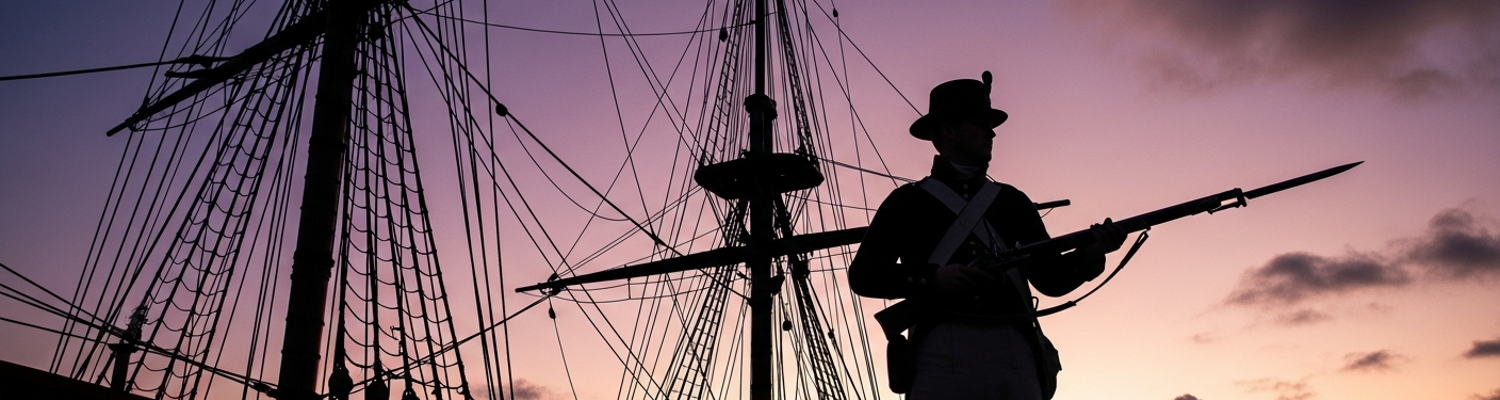

The Iron Hand of Order at Sea
The decks of an American frigate in the early national period were a study in contained chaos. A vessel like the USS Constitution was a city of wood, home to over 450 souls packed into a space barely two hundred feet long. The crew was a volatile mix of seasoned American mariners, landsmen new to the sea, British deserters, Scandinavian whalers, and foreign sailors, many pressed into service against their will. Alcohol, issued as a daily grog ration, often fueled tempers in the cramped, unforgiving environment below decks.
In this floating powder keg, the small, disciplined detachment of United States Marines functioned as the ship captain’s indispensable instrument of control. Their primary mission was not to sail the ship, but to impose order upon those who did.
The logistical challenge was immense. A Marine detachment, typically comprising a lieutenant, sergeants, corporals, and around fifty privates, had to maintain its integrity as a distinct fighting force while fully integrated into the ship’s claustrophobic world.
Their solution was separation. Marines were berthed and messed apart from the sailors, often in the waist of the ship or on the gun deck, physically positioned between the crew’s quarters forward and the officers’ cabins aft. This placement served as a human bulkhead against mutiny.
This physical separation was a logistical manifestation of their unique status. They were soldiers at sea, not sailors, and this distinction was paramount.
Maintaining this separation required its own logistical effort. Marine equipment, from the pipeclayed white leather crossbelts to the polished brass buttons and shako plates, had to be kept in inspection-ready condition amidst a world of tar, salt spray, and bilge water. This constant effort to maintain a soldierly appearance reinforced their distinct identity to themselves and to the sailors they policed.
Sentries were the visible expression of Marine authority. Armed with muskets and fixed bayonets, they stood guard at the captain’s cabin, the spirit room where the ship’s liquor was stored, the powder magazine, and even the ship's chronometer, a delicate and priceless instrument vital for navigation. These were the vessel’s nerve centers, and their security was a Marine responsibility.
The most public and perhaps most vital duty was their role in punishment. When a sailor was sentenced to be flogged, the call for “All hands to witness punishment!” brought the entire crew to the deck. It was the Marines who formed a cordon around the grating, their bayonets a silent warning as the boatswain’s mate administered the lashes with the cat-o’-nine-tails. This was not merely guard duty, it was a ritualized display of state power. The Marines provided the armed muscle that guaranteed the captain’s word was law, turning a brutal act into an ordered ceremony of discipline.
The philosophical underpinning was simple and pragmatic. In an age where mutiny could hand a valuable warship to pirates or an enemy nation, the iron discipline enforced by the Marines was the guarantor of the ship’s operational existence.
Sharpshooters in the Tops and Boarding Pikes Below
When the drum beat to quarters, the Marines’ role transformed from policing to targeted violence. The ship’s structure defined their tactical employment.
While sailors worked the great guns on the decks below, a select group of Marines ascended into the ship’s fighting tops. These small platforms, perched high on the masts, were the premier sniper’s nests of the Age of Sail.
The logistical difficulty of this task was significant. A Marine, laden with his Model 1795 Springfield musket, a nearly ten-pound, .69 caliber weapon, and a cartridge box with dozens of paper cartridges, had to navigate a treacherous web of rigging swaying high above a moving sea.
From this precarious perch, they held a commanding view of the enemy’s deck. Their function was specific: to systematically dismantle the enemy’s command and control. Firing their smoothbore muskets, which were only accurate to about eighty yards, they targeted officers, helmsmen, and the gun crews of the opposing vessel. While the great guns hammered away at the enemy’s hull, the Marines engaged in a more personal, methodical form of combat. A single, well-aimed shot from a fighting top could kill a captain, throw a gun crew into confusion, or sever a key piece of rigging.
During the Quasi-War with France, this capability proved its worth. On February 9, 1799, when the USS Constellation engaged the French frigate L'Insurgente, Marine marksmen under Lieutenant Bartholomew Clinch swept the French ship's decks with musket fire from the fighting tops, contributing significantly to the American victory.
The second specialized combat function saw the Marines transition from sharpshooters to shock troops. Whether repelling an enemy attempt to board or leading a charge onto an enemy vessel, the Marines were the ship’s dedicated infantry. When grappling hooks bit into timber and the two ships locked together, the call “Boarders away!” sent the Marines to the fore. With fixed bayonets on their muskets and armed with pistols and cutlasses, they would storm across the rails, their objective to seize control of the enemy’s deck in a brutal, close-quarters fight. This was chaos defined by steel, lead, and splintered wood.
The first action of the First Barbary War on August 1, 1801, saw the Marines aboard USS Enterprise use disciplined musket volleys and bayonets to repel Tripolitan boarders multiple times, securing a victory for the American schooner.
The tactical philosophy behind this was an acknowledgment of the limitations of naval gunnery. Engagements often occurred at close range, and a decisive conclusion frequently required one ship to physically overwhelm the other. The naval establishment recognized that sailors, occupied with managing sails and guns, were not a substitute for a trained body of infantry. The Marines provided this force, a self-contained unit expert in small arms and bayonet combat, deployable at the most critical moments of a battle.
Their arming and support presented logistical puzzles. Ammunition had to be pre-positioned or carried aloft, flintlock muskets had to be kept functional in spray and rain, and their movements had to be coordinated amidst the bedlam of a full-scale naval engagement.
A Corps Apart Within the Fleet
The very creation of the modern Marine Corps, through the Congressional Act of July 11, 1798, established the foundation for a unique and often tense institutional relationship. The act authorized a corps of marines that could be formed into companies or detachments and specified that the President could direct the corps to do duty on ships or on shore. This gave the Marines a dual nature from their inception.
They were a component of the naval service, yet they were not sailors. Their officers answered to the ship’s captain but also to the Major Commandant of the Marine Corps in Washington, creating a divided chain of command that was a constant source of friction.
Naval captains, the absolute monarchs of their domains, sometimes viewed the Marines as an under-utilized pool of labor and attempted to order them to perform sailors’ duties like hauling lines. Marine officers, protective of their Corps’ distinct role and identity, would resist.
The logistical solution to preserving this identity was to build a separate institutional culture from the ground up. Under the guidance of the first Commandant, William Ward Burrows, recruitment was separate. Training took place at shore-based barracks in Philadelphia or Washington, where men were instilled with infantry discipline before they ever set foot on a deck. Their uniforms, with the high leather stock that would give them the nickname “Leathernecks,” were distinct from those of the sailors, further marking them as a separate caste.
This fierce esprit de corps was the institutional philosophy that allowed the Marines to thrive. It was forged not just in battle, but in the daily struggle to maintain their separateness and professionalism while scattered in small detachments across the globe.
An event like the assault on Derna in 1805 during the First Barbary War became a powerful symbol of this identity. American Naval Agent William Eaton organized a daring overland expedition to overthrow the Pasha of Tripoli. His force consisted of a small detachment of eight Marines under First Lieutenant Presley O’Bannon, alongside a large group of Greek and Arab mercenaries.
They marched 500 miles across the Libyan desert from Alexandria, Egypt. During the trek, the mercenaries mutinied multiple times over pay and provisions, only to be forced back into line by the disciplined resolve and steady muskets of O’Bannon’s Marines.
The subsequent successful attack on the city of Derna, where O’Bannon and his handful of Marines were at the forefront of the charge, was the first time the American flag was raised in victory on foreign soil. This action, a land battle initiated from the sea, perfectly encapsulated the expeditionary spirit the Corps was developing. It was an operation that was not purely naval, nor was it a traditional army campaign. It was uniquely a Marine endeavor, reinforcing their identity as soldiers of the sea.
The Mameluke sword presented to O’Bannon by the grateful allied leader became the pattern for the sword still carried by Marine officers, a lasting physical symbol of this foundational moment.
The Corps’ survival and the cementing of its identity were a triumph of logistical and philosophical determination. By maintaining separate training, a distinct uniform, and a rigid adherence to their role as soldiers, the early Marines ensured they would not be absorbed into the larger naval establishment. They carved out a specific, vital niche for themselves, proving that a warship’s effectiveness depended on both the sailors who worked it and the sentinels who guarded it, fought from its tops, and carried the fight to the enemy. This foundational period defined the Corps’ character for the centuries to come.