
Primitive Aerial Reconnaissance Limitations
During the 47-day Meuse-Argonne Offensive, the American Expeditionary Forces absorbed over 120,000 casualties. 26,277 of those were men killed in action. This amounted to a loss rate of over 2,500 soldiers per day for an advance that pushed the front a mere ten miles.
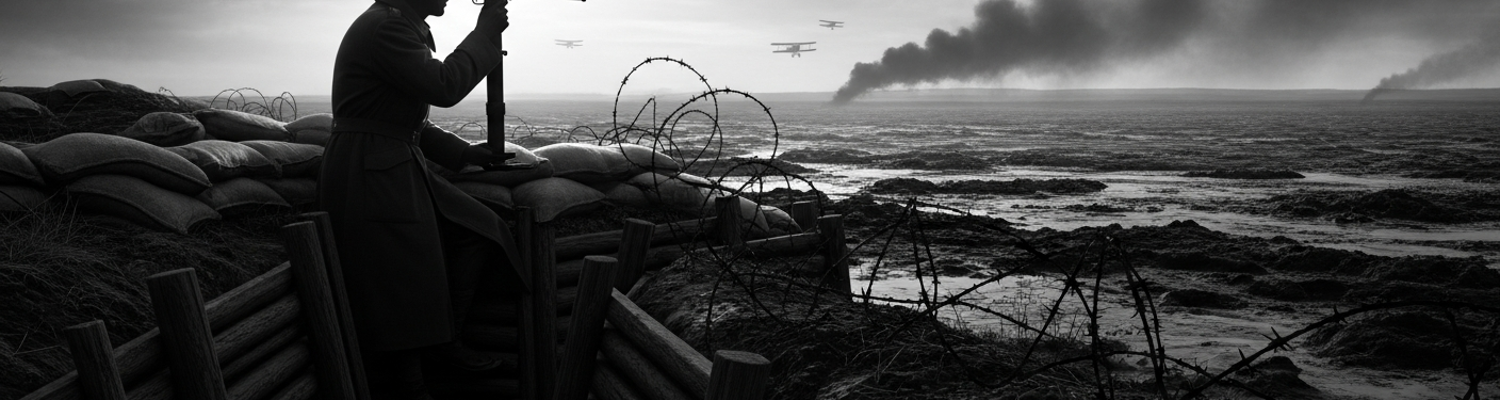
A close review of operational logs (NARA Record Group 120) shows intelligence gathering was a function split between two radically different, yet equally primitive, platforms: the observation balloon and the aeroplane. Tethered hydrogen-filled balloons, carrying one or two observers in a wicker basket, served as static, high-altitude observation posts. Ascending to heights of 1,200 to 1,800 meters, these men could, on a clear day, see deep behind enemy lines. They directed artillery fire in near real-time via a telephone line that ran along the mooring cable. Their value was matched only by their vulnerability. They were stationary, flammable targets, relentlessly hunted by specialized German pilots known as balloon busters. Of the American balloons attacked, 35 were burned and 12 were shot down.
The other intelligence tool was the aeroplane. Typically a two-seat model like the Breguet 14 or Salmson 2A2, it offered mobility at the cost of stability. The pilot’s full attention was on flying the unstable machine. This left the observer to peer over the side, wrestling with maps, pencils, and a bulky, handheld camera. These aircraft were assigned to photograph specific sectors or perform visual reconnaissance. They flew predictable patterns that made them targets for both anti-aircraft fire and enemy fighters.
The intelligence they provided was almost always out of date.
The process of converting an aerial observation into an actionable artillery fire mission was a study in delay. Consider an observer in a Salmson 2A2 spotting a German artillery battery concealed in the woods near Montfaucon. He first had to survive the return flight to his aerodrome, a gauntlet of German Fokker D.VII patrols and increasingly accurate ground fire. Upon landing, the observer would be debriefed by an intelligence officer. If a photograph was taken, the cumbersome glass-plate negative had to be carefully unloaded and transported to a field darkroom. There, it would be developed, fixed, washed, and dried. This sequence could consume hours under ideal conditions, let alone in a damp, mobile tent. Only then could a print be made and handed to a photo-interpreter, who would scrutinize it for evidence of enemy activity. The final intelligence report, once compiled, was sent by motorcycle courier or telephone to the designated artillery command post. This entire cycle, from the moment of observation to the report reaching a gun battery, could take several hours. A German field gun battery could change position in less than one hour.
From an altitude of 5,000 feet, the battlefield was a chaotic, monochromatic landscape of mud, craters, and smoke. An observer in a freezing, open cockpit, buffeted by prop wash and sickened by the fumes of burnt castor oil, had to make sense of this scene. German forces had become masters of camouflage, expertly hiding their guns under netting and building elaborate dummy positions to draw fire. Distinguishing a real battery from a decoy, or an active trench from an abandoned one, was nearly impossible based on a fleeting glimpse from a moving aircraft. Communication with the ground was crude. It often involved dropping weighted message bags that could easily be lost, or using signal lamps that were invisible through the perpetual haze of battle. The observer's view was not a clear, stable picture but a sporadic and deceptive keyhole into an actively hostile and misleading environment.
Air-Ground Radio Communication Gaps
The promise of real-time communication between observation aircraft and artillery batteries was a technological mirage in 1918. A close review of AEF operational logs reveals that while radio technology existed, it was mechanically fragile, functionally limited, and perilously insecure. The standard airborne set issued to American observation squadrons, the SCR-68, was a 21-pound box filled with delicate vacuum tubes. It was powered by a wind-driven generator mounted on the landing gear struts. This entire apparatus, along with its 19.5-pound trailing wire antenna that had to be unspooled to a length of 300 feet, was operated by the observer in the rear cockpit. Communication was not by voice, but by Morse code. This was a slow and cumbersome method requiring a skilled operator to tap out grid coordinates while being buffeted in an open cockpit. The effective range was often less than five miles due to engine interference and atmospheric static, a distance easily exceeded on a typical reconnaissance sortie. Furthermore, these transmissions were broadcast in the clear, without any form of encryption. German signals intelligence units, the Armee-Funkerabteilungen, were exceptionally proficient at intercepting and direction-finding Allied radio traffic. Any transmission risked not only revealing the target data but also the exact location of the observing aircraft and its affiliated ground station. This invited immediate counter-battery fire or fighter attack. Many pilots, unimpressed with the technology’s performance and aware of the risks, had the radios removed entirely to save weight and improve aircraft performance.
This chasm in real-time data transfer forced a regression to more primitive methods.
When radio failed or was absent, observers relied on a clumsy and unreliable system of visual signals to communicate with ground troops. A primary method involved ground crews laying out large white cloth sheets, known as Popham panels, in pre-arranged patterns to ask questions of the aircraft. The aircrew would respond by firing colored signal flares or dropping weighted message bags. These could easily be lost in the cratered and muddy landscape of the Meuse-Argonne. The entire exchange was prone to catastrophic error. Heavy smoke from artillery barrages, persistent rain, and fog frequently obscured the panels from the observer’s view. To even have a chance of seeing the signals, the pilot had to descend to low altitude and fly a predictable, slow pattern. This made the aircraft a simple target for machine-gun fire from the ground. Archival evidence shows that these visual signals were considered a method of last resort, a desperate attempt to bridge an electronic gap that technology had not yet solved.
Every minute that passed between an observer spotting a German battery and that information reaching an American gun crew was a minute the enemy could use to move. A target spotted by an aircraft without a functioning radio was a ghost by the time the pilot returned to base and was debriefed. Even with a Morse code transmission, the process was dangerously slow. The observer tapped the message, the ground station operator received and transcribed it, and a runner or telephone call relayed it to the fire direction center, who then passed the orders to a specific battery. A German field artillery unit, drilled in rapid displacement, could limber its guns, move several hundred meters, and be ready to fire from a new position in the time this cycle took to complete. A review of after-action reports from the Meuse-Argonne Offensive shows a consistent pattern. American artillery barrages frequently pounded empty woods and abandoned positions. The targets had vanished long before the shells arrived.
Forward Observation Post Dangers
With aerial reconnaissance crippled by weather and technology, the burden of finding German targets fell to teams of men on the ground. To be effective, an artillery observer had to see the enemy. This requirement forced the establishment of Forward Observation Posts, or OPs, in some of the most exposed and lethal terrain of the entire Western Front. A close review of operational logs from the Meuse-Argonne Offensive shows that OPs were not safely situated within the main trench systems. They were pushed far forward into the shattered landscape of No Man’s Land or even behind the fluid, poorly-defined German front. An ideal post occupied a position with a commanding view deep into the German rear areas, where the artillery batteries were hidden. This meant occupying the forward slope of a captured ridge, the upper floor of a ruined farmhouse in an abandoned village, or a hastily dug hole in the lip of a shell crater.
These were lonely, desperate places.
The tactical logic was absolute: the better the view, the greater the danger. An observer team from the American 58th Field Artillery Brigade, supporting the 1st Division’s assault near the dreaded Mont Sec, would have sought any elevation possible to peer over the German defenses. Such a position was inherently obvious to the enemy. German doctrine stressed the importance of denying observation to Allied artillery. This made the hunt for OPs a priority for their own observers and snipers. The men in these posts were not just soldiers; they were high-value targets, the forward eyes of guns miles away.
The life expectancy of a forward observer was grim. Artillerymen assigned to this duty were considered to be on a mission of extreme hazard. Casualty rates were exceptionally high, not from grand attacks, but from the daily, attritional business of shelling and sniping. An observer team, typically a junior officer and one or two signalers, was a small, isolated unit operating far from the relative safety of its battery. Their only connection to the guns was a thin, fragile telephone wire spooled out behind them as they advanced. This wire was their lifeline and also a constant vulnerability. A single shell burst could sever communication, leaving the team cut off and unable to direct fire. German patrols and shellfire routinely and deliberately targeted these communication lines. The observers themselves were relentlessly hunted. The glint of a periscope lens, a puff of smoke from their makeshift stove, or the slightest movement could draw catastrophic fire. A German sniper, patient and well-practiced, could keep a post suppressed for hours, while a direct hit from a German 7.7cm field gun would obliterate the position and its occupants entirely.
Maintaining the physical integrity of the observation post was a near-impossible task. Most OPs were not the elaborate concrete bunkers of the static trench lines but were improvised hides, dugouts, or camouflaged scrapes. They were vulnerable to weather and, more critically, to the constant, percussive impact of enemy artillery. A sustained German barrage, even with near misses, could collapse the roof of a dugout, burying the team inside. The observation slit itself, the vital window to the battlefield, was a structural weakness and a magnet for enemy fire. Debris from shell bursts would constantly clog the aperture, forcing the observers to expose themselves to clear it. A review of German counter-battery doctrine from 1918 shows a sophisticated effort to locate and destroy these posts using their own observers and sound-ranging techniques. Any Allied attempt to improve the post, such as bringing up timber for reinforcement or digging a deeper trench, created activity that was easily spotted. This work was typically done at night, but the darkness was illuminated by the random, unpredictable flare of star shells, turning the repair crew into momentary silhouettes for enemy machine gunners. The loss of a single, well-placed OP could effectively blind the artillery batteries it served, rendering them useless until a new team could undertake the perilous journey forward to establish another one.
Telegraph and Runner System Inefficiency
With modern communication methods failing, the arterial system for transmitting targeting data from a forward observer to a gun battery collapsed into two primitive and catastrophically inefficient conduits: the field telephone and the human runner. A close review of U.S. Army Signal Corps logs from the Meuse-Argonne Offensive reveals that the field telephone was the preferred instrument. Models like the 8.2kg EE-4 Camp Telephone, housed in an oak box, connected observers to their command posts. However, the system’s backbone was its greatest weakness: thousands of miles of thin, vulnerable wire. Signal Corps personnel laid this wire, often uninsulated D-8 twisted pair, directly onto the shell-torn earth, through shattered forests, and along the bottoms of communication trenches. This fragile link was constantly severed. A single stray artillery shell fragment from the near-constant German bombardments could cut communications for an entire sector. The treads of a friendly Renault FT tank or the wheels of a supply wagon could grind the wire into the mud, rendering it useless. German artillery doctrine specifically targeted command posts and communication trenches, making these vital lines predictable targets for destruction. Repairing a break was a lethal task for Signal Corps linemen, who had to venture into the open, often under direct fire, to locate and splice the severed wire, a process that could take hours and left the artillery blind.
The system was defined by its consistent failure.
When the telephone line went dead, command reverted to a method unchanged for millennia: the runner. This was not a specialized role but a desperate assignment given to a low-ranking soldier chosen for fitness and an ability to read a map. Equipped with little more than a sidearm and a gas mask, the runner’s job was to physically carry a written message from the observation post to the artillery command, a journey of seemingly short distances that could take an eternity. A review of after-action reports shows that this was one of the most dangerous jobs on the front. Runners had to navigate a zig-zagging maze of trenches and then sprint across open ground that was perpetually zeroed-in by German machine gunners and snipers. The path was a landscape of craters and mud, where a single slip could mean disaster. The message, a slip of paper containing the coordinates of a German battery, was only as secure as the man carrying it. If the runner was killed or incapacitated, the intelligence was lost with him. The casualty rate for this duty was exceptionally high. Commanders often dispatched two or three runners with the same message along different routes, hoping one would survive the gauntlet.
This combination of fragile technology and mortal peril introduced a fatal delay into the targeting process. An observation of a German target was almost always obsolete by the time it reached a gun crew. Consider a realistic timeline from the Meuse-Argonne front: a forward observer identifies a German 7.7cm field gun battery. He tries his EE-4 field telephone, but the line is dead, cut by a shell minutes before. He scribbles the coordinates and hands the note to a runner. The runner’s journey back to the battalion command post, a distance of only a few hundred yards, takes over 45 minutes of crawling through trenches and sprinting across open, fire-swept fields. From there, the information is relayed to the artillery fire direction center, which calculates the firing solution and passes the order to the guns. This entire cycle, from observation to the first shell leaving the tube, could easily exceed an hour. A well-drilled German field artillery crew could limber their guns, move several hundred meters to a pre-planned alternative position, and be ready to fire again in less than half that time. The result was a constant, frustrating pattern recorded in American Expeditionary Forces' reports: massive artillery bombardments falling with precision on positions that were now empty.
Nascent Intelligence Integration Failures
The American Expeditionary Forces’ intelligence apparatus in 1918 was a collection of disconnected and competing functions, not a unified system. A close review of operational records from the Meuse-Argonne Offensive reveals a fundamental failure to combine disparate intelligence sources. Information gathered by aerial reconnaissance and ground observers existed in separate organizational worlds. An aerial photograph taken by a Salmson 2A2 of the I Corps Observation Group showing suspicious activity in the Bois de Cunel would be flown back to the group’s aerodrome, developed, and analyzed by the squadron’s intelligence officer. That resulting report would begin a slow journey up the Air Service chain of command. Simultaneously, a forward observer from an artillery battalion of the 5th Division might spot muzzle flashes from the same woods, reporting it via a fragile telephone line to his own battalion S-2. These two pieces of intelligence, one photographic, one visual, would corroborate each other perfectly, yet they rarely met.
The information streams remained stubbornly separate.
There was no central clearinghouse at the corps or division level with the authority or capability to fuse these reports in real-time. The Air Service intelligence officer and the field artillery intelligence officer operated in different command structures. Their reports were sent up parallel but distinct chains, destined for a Corps-level G-2 (Intelligence) section that was often overwhelmed and focused on collating yesterday’s information for a summary sent to First Army headquarters. The physical separation was also a factor. The aerodrome might be ten miles behind the front, while the artillery battalion command post was only a few thousand yards back. There was no established procedure for a photo interpreter at the airfield to directly contact an artillery fire direction center with an urgent finding. Each piece of the puzzle was held by a different person in a different location, with no shared picture of the board.
This lack of centralized analysis guaranteed that targeting was always reactive and based on incomplete data. The AEF's intelligence structure, adopted from the French system, was theoretically sound, with a G-2 section at each echelon from the General Headquarters (GHQ) down to the division. In practice, during the intense fighting of the Meuse-Argonne, this structure buckled. A critical report from a forward observer or a prisoner interrogation that revealed the location of a German command post would be passed from a battalion S-2 to a regimental S-2, then to the division G-2. At each step, the raw data was filtered and summarized, losing granularity as it climbed the ladder to the I Corps or V Corps G-2. By the time a comprehensive analysis was possible at the corps level, identifying a pattern or a significant enemy concentration, the information was often hours, if not a day, old.
Disseminating this analyzed intelligence back down to the units that needed it was just as broken. Even if the I Corps G-2 successfully identified a major regrouping of German artillery near Romagne-sous-Montfaucon, that critical information had to travel back down the same slow, bureaucratic chain it had just ascended. The corps G-2 would issue an intelligence summary, which was sent by motorcycle courier to the headquarters of the relevant divisions, like the 77th or 82nd. From there, it was passed to the artillery brigades and finally to the battalions and batteries. This entire cycle meant that a comprehensive intelligence product, one that could have guided a systematic counter-battery effort, was perpetually out of sync with the fluid battlefield. Artillery commanders were left to act on the most recent, and therefore most local, information they had, which was often just a single, uncorroborated report from one of their own forward observers.
The result of this disjointed information flow was a fractured and dangerously incomplete understanding of the German defenses. An artillery battery commander supporting the 79th Division’s push towards Montfaucon might receive three conflicting pieces of information in an hour: a target list from brigade based on two-day-old aerial photos, a frantic telephone call from a forward observer about a machine-gun nest that just opened fire, and a runner with a message about a suspected troop assembly seen an hour ago. Without a unified intelligence product that weighed and validated these different sources, the commander was forced to make a choice. The system also failed to integrate other valuable intelligence sources, such as reports from captured German soldiers. Prisoner interrogations, which could yield vital details on unit morale, supply status, and defensive layouts, were conducted by specialized teams at the corps level. The findings were compiled in separate reports that circulated slowly, rarely reaching the gun pits in time to influence a fire mission. This systemic failure to integrate, analyze, and disseminate information from all sources meant the AEF’s powerful artillery arm was often firing blind, pounding empty map coordinates while the true targets operated with near impunity.
Artillery Doctrine Interdiction Failure
A detailed examination of AEF field manuals from 1918 reveals a clear doctrinal intent for the use of artillery: systematic harassing and interdiction fire. The objective was to use the power of guns like the French 75mm and the 155mm howitzer to isolate sections of the battlefield. This would prevent the enemy from moving troops, supplies, or reserves. This doctrine relied on an assumption of accurate, timely targeting information. The functional breakdown of the intelligence and communication chains rendered this assumption invalid. The result was that a large portion of American artillery fire during the Meuse-Argonne Offensive was fired blind at unverified map coordinates. The opening bombardment of the offensive on September 26, 1918, was a prime example. In a three-hour period, Allied guns expended more ammunition than was used in the entirety of the American Civil War. Much of it was directed at suspected, but unobserved, German defensive lines, road junctions, and rear areas. Lacking a confirmed target, the doctrine devolved into a brute-force application of firepower, hoping to destroy through volume what it could not hit with precision.
This inability to translate observation into timely action guaranteed the failure of interdiction. A German infantry company, a supply wagon train, or a fresh battery of 7.7cm field guns moving into a new position in the Bois de Romagne would be spotted by a forward observer. That information, however, began an arduous and time-consuming journey back to the American guns. A runner could be killed, or a telephone line could be cut by the perpetual shellfire. Even if the message arrived, the subsequent process of calculation and relaying fire commands consumed more time. German units, hardened by four years of war, operated on a doctrine of rapid movement and displacement, fully aware of Allied targeting cycles. A review of their operational tempo shows that a field artillery battery could change position in under an hour. The entire American cycle, from observation to the first shell landing, often took longer. The American guns were thus perpetually engaged in chasing ghosts, firing on coordinates where the enemy used to be. The very movements the artillery was meant to interdict were completed long before the first high-explosive shells arrived.
Thousands of shells fell on empty map squares.
The strategic consequences of this failure were profound. They represented a series of massive missed opportunities to cripple the German Fifth Army. A stark example can be found in early October 1918. A close study of unit logs shows that following intense pressure from the American I Corps, German commanders ordered a withdrawal from the Argonne Forest on the night of October 8-9. Units like the 120th Württemberg Landwehr Regiment were able to execute a planned retreat to new defensive positions. This movement occurred directly under the theoretical range of hundreds of American guns whose doctrinal purpose was to make such a maneuver impossible. Yet, the German columns moved with relative impunity. The American batteries, lacking real-time intelligence on the enemy’s routes and timing, continued to execute pre-planned harassing fire schedules on static, and now unimportant, locations. The opportunity to transform an orderly German withdrawal into a catastrophic rout was lost. The AEF’s artillery arm, one of the most powerful in the world, was effectively neutralized by its own blindness, pounding abandoned trenches and empty forests while the enemy slipped away in the dark.
Battlefield Randomness and Morale
The systemic failure to accurately target German positions transformed the act of survival on the Meuse-Argonne front into a matter of pure chance. For the infantryman of the American Expeditionary Forces, the danger came less from aimed enemy fire and more from the arbitrary impact of shells, both friendly and hostile. A close review of soldier accounts and casualty statistics reveals a pervasive sense of powerlessness. Artillery was the single greatest killer on the Western Front, responsible for the majority of all casualties, yet its application was often terrifyingly indiscriminate. An American soldier in a trench near the Argonne Forest was just as likely to be killed by a short round from his own artillery as he was by a German shell. The incident involving the Lost Battalion of the 77th Division, which was bombarded by its own supporting guns due to inaccurate coordinates, stands as a stark example of this lethal chaos. This randomness stripped away any illusion that tactical skill or caution could ensure survival. Life and death were dictated not by training or bravery, but by the statistical probability of where the next shell, fired from miles away at an unconfirmed map reference, would land.
This environment of chance had a deeply corrosive effect on troop morale and the perception of combat effectiveness. AEF infantrymen, pinned down by German machine-gun fire from the heights of Montfaucon, would wait in vain for their own artillery to silence the threat. Instead, they would witness massive, multi-hour bombardments pound empty woods or abandoned trench lines, while the German guns harassing them continued to fire with impunity. A review of after-action reports from units like the 1st and 42nd Divisions shows a recurring frustration among the infantry, who felt their supporting arms were firing blindly. This visible ineffectiveness created a damaging perception that command was incompetent and that their own powerful artillery was useless. The psychological toll was severe, fostering a fatalistic outlook. Soldiers developed symptoms of shell shock, a condition driven by the unending stress of inescapable, random bombardment. The constant threat, combined with the visible failure of their own side to counter it, bred a sense of futility that undermined the aggressive spirit General Pershing sought to instill.
The strategic implications of these persistent targeting failures were profound, directly contributing to the slow pace and high casualty rates of the Meuse-Argonne Offensive. The entire operational concept relied on artillery to perform interdiction, to isolate the battlefield and prevent the Germans from reinforcing, resupplying, or withdrawing. With the intelligence and communication systems broken, this was impossible. A perfect example occurred on the night of October 8-9, 1918, when German units conducted an orderly withdrawal from the Argonne Forest. This movement, involving thousands of troops, took place directly under the guns of the American I Corps. A functioning targeting system would have turned this withdrawal into a rout. Instead, AEF batteries continued firing pre-planned harassing missions on static map coordinates, many of which were now empty. The German Fifth Army was able to shift reserves, evacuate wounded, and establish new, formidable defensive lines like the Kriemhilde Stellung, prolonging the battle by weeks. The failure to hit mobile targets meant the AEF could not exploit breakthroughs or prevent the enemy from stabilizing the front. Each time the infantry managed to seize an objective, they were met by fresh German reserves that should have been shattered by artillery miles behind the lines. This failure turned what was intended as a war of maneuver back into a grinding battle of attrition, costing the AEF over 120,000 casualties to gain a few miles of shattered terrain.