
The Battleship and the Bomber
In the thin air above the Virginia Capes in July 1921, Brigadier General Billy Mitchell’s career peaked. His Martin MB-2 biplane bombers, clumsy by later standards, sent the captured German battleship Ostfriesland to the bottom of the Atlantic. For Mitchell, this event was total vindication. He had demonstrated that aircraft could sink capital ships, a feat many naval leaders had declared impossible. This sinking did not birth a unified air doctrine. It ignited a doctrinal firestorm that defined the U.S. Army Air Corps for two decades. Mitchell and his acolytes saw the future of war in the sky, waged by independent air forces striking an enemy’s industrial heart. They argued that bombers, flying deep into enemy territory to destroy factories and rail yards, could cripple a nation’s ability to fight. This theory of strategic bombing became an article of faith for a generation of airmen. It promised a decisive, almost clinical path to victory, bypassing the bloody stalemate of trench warfare that haunted veterans of the Great War.
This vision ran directly counter to the established hierarchy of the U.S. Army. Ground commanders, who held senior posts and controlled budgets, viewed the airplane as an auxiliary weapon. Its purpose was to support the infantryman. They needed reconnaissance to see over the next hill and attack planes to hit machine gun nests. The idea of an independent air force pursuing its own objectives was not just foreign, it was a direct threat to the Army’s primacy. This schism created two opposing camps. One looked to the heavens, dreaming of strategic victory through airpower. The other remained rooted to the earth, demanding that aviation serve the immediate needs of the front line. The lean interwar years, marked by shoestring budgets and public isolationism, intensified this conflict. There was not enough money to fully fund both visions, forcing a bitter competition for the soul of American airpower.
An Unwanted Child: The Attack Aircraft
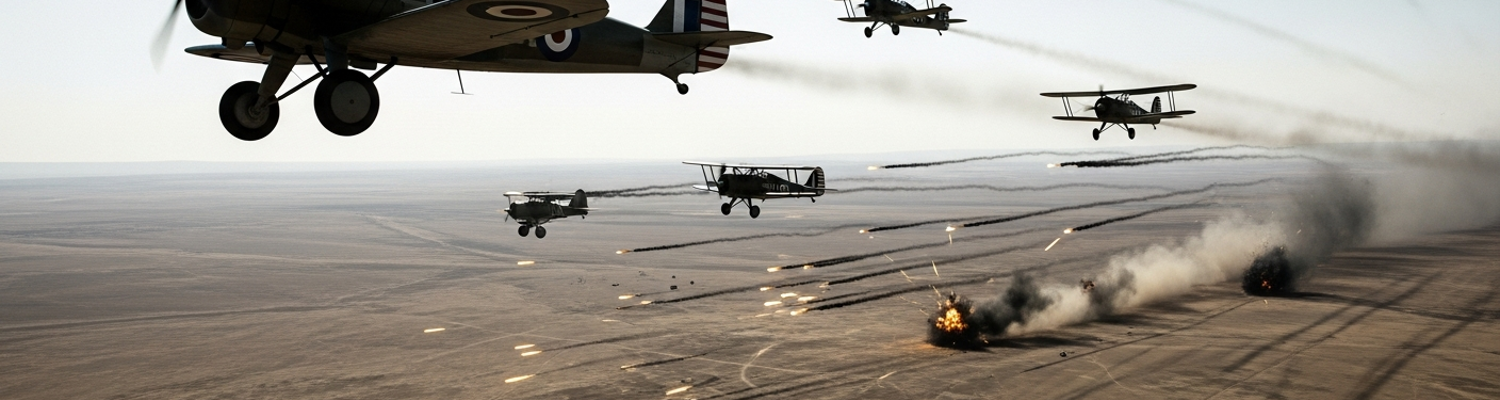
The Curtiss A-3 Falcon, introduced in 1927, embodied the material realities of this doctrinal battle. It was a compromise, a machine built for a mission many Air Corps leaders considered secondary. A sturdy biplane, the A-3 was a direct modification of the O-1 observation aircraft. Its lineage was apparent in its two-seat configuration and metal tube fuselage with fabric-covered wooden wings. Powered by a 435-horsepower Curtiss V-1150 V-12 engine, it could reach a top speed around 135 miles per hour. For its attack role, its armament was improved. The A-3B variant carried four forward-firing .30 caliber machine guns and two flexible guns for the rear observer. It could also carry a meager 200 pounds of fragmentation bombs on underwing racks. The A-3 was a workhorse, not a thoroughbred. Its design prioritized stability for low-level flight and the ability to operate from rough fields. Pilots flying the A-3s in the 3rd Attack Group developed core ground attack techniques, but they did so with an inadequate tool. The aircraft was vulnerable to ground fire and its light bomb load limited its destructive power. Even as the A-3 flew, the Air Corps experimented with other platforms like the Curtiss A-8 Shrike. This 1931 monoplane featured an all-metal construction and a powerful radial engine, but its poor visibility and engine cooling problems made it unpopular with pilots. It highlighted the persistent technical challenges of designing a successful low-altitude attack plane.
Maxwell Field and the Bomber Cult
Far from the political battles in Washington, the intellectual heart of the Air Corps resided first at Langley Field, Virginia, and after 1931, at Maxwell Field, Alabama. The Air Corps Tactical School (ACTS) was established to be the doctrinal center for American airpower. Its unofficial motto, "Proficimus More Irretenti" (We Make Progress Unhindered by Custom), captured its spirit. The instructors and students at ACTS, many of them disciples of Billy Mitchell, became the high priests of strategic bombing. Figures like Haywood S. Hansell and Donald Wilson spent years refining concepts of high-altitude, daylight, precision bombardment against an enemy’s industrial web. This theory consumed the school’s focus and resources. Close air support was not ignored entirely, but it was relegated to a secondary status. The curriculum included hours on attack aviation, formalizing theories for strafing runs and dive-bombing attacks. They conducted map-based war games exploring how airpower could intervene on a fluid battlefield. These studies, however, were often theoretical and occurred in an intellectual vacuum, separated from the ground commanders who would ultimately employ these assets.
Skepticism from the infantry and artillery branches remained high. Ground officers, when they considered airpower at all, often saw it as an unreliable and inaccurate form of artillery. They were reluctant to depend on an asset they did not directly control. The physical distance between the ACTS at Maxwell and the Infantry School at Fort Benning was symbolic of the deep cultural gulf that separated the air and ground arms of the U.S. Army.
Metal Skins and Retractable Gear
By the mid-1930s, aviation technology advanced rapidly. The fabric-covered biplane gave way to the all-metal monoplane. This shift forced a re-evaluation of attack aircraft design. The Northrop A-17, which entered service in 1936, represented a significant leap from the A-3 Falcon. Developed from the Northrop Gamma transport, the A-17 was a sleek, low-wing monoplane. The initial model featured a fixed landing gear encased in streamlined fairings, a compromise to save cost. The subsequent A-17A variant incorporated fully retractable landing gear, a feature that reduced drag and boosted performance. Powered by an 825-horsepower Pratt & Whitney R-1535 Twin Wasp Jr. radial engine, the A-17A could achieve a top speed of 220 mph. Its armament consisted of four wing-mounted .30 caliber machine guns and a fifth flexible gun for the rear observer. Its ordnance capacity was far greater. The A-17 featured an internal bomb bay and could carry a total bomb load up to 1,200 pounds. The inclusion of perforated dive flaps signaled a growing interest in dive-bombing, allowing for steeper, more accurate attacks.
The A-17 equipped units like the 3rd and 17th Attack Groups, offering a glimpse of a more capable ground support future. The existence of such a machine, however, did not alter the Air Corps' strategic priorities. The development of four-engine bombers like the B-17 Flying Fortress, which first flew in 1935, consumed the lion’s share of attention. The A-17 was quickly seen as an interim solution. By 1938, the Air Corps decided future attack aircraft should be twin-engined, rendering the single-engine A-17 obsolete for its own use.
Export and Early War Realities
The A-17's story did not end with its replacement in front-line American units. As war clouds gathered, many A-17s were sold abroad. Re-designated as the Douglas 8A-3N, a batch was delivered to the Netherlands. In May 1940, these supposedly obsolete American attack planes were thrown into desperate combat against the German invasion. Flown by Dutch pilots with immense courage, the 8A-3Ns attacked German ground columns and river crossings, but they were savaged by modern Messerschmitt Bf 109 fighters and concentrated anti-aircraft fire. Their combat debut was a brutal lesson in the lethality of the modern European battlefield. The aircraft, a major step forward for the 1930s Air Corps, proved to be a suicide machine just a few years later without proper fighter escort and air superiority, a concept the ground-support mission had never been afforded.
This international dimension exposed the gap between American interwar theory and European combat reality. The United States entered World War II with this doctrinal confusion still unresolved. The initial Japanese onslaught in the Philippines in December 1941 saw American and Filipino ground forces fighting a desperate, losing battle with almost no effective air support. The P-40 Warhawks available were primarily fighters, and their pilots had little to no training in the specialized art of attacking ground targets in coordination with friendly troops. The failure was a direct consequence of the Air Corps' prewar focus. The lesson was repeated in North Africa. The debacle at Kasserine Pass in February 1943 saw American ground forces mauled by experienced German panzer divisions. A significant factor in the defeat was the complete breakdown of air-ground coordination. Requests for air support went unanswered or were misdirected. The aircraft available, often medium bombers like the B-25 Mitchell, were ill-suited for striking small, mobile battlefield targets. The defeat at Kasserine was a humiliating shock that finally forced the U.S. Army to confront its deep-seated doctrinal failure. The price of the interwar debate was paid in American blood on the desert floor.
The Unlearned Lessons of Peacetime
The interwar period closed with the central question of airpower’s role fiercely debated but operationally unresolved. The advocates of strategic bombing at the Air Corps Tactical School had successfully embedded their theories into the service's DNA. Their war plans, like AWPD-1, focused almost exclusively on the destruction of German and Japanese industrial capacity. The ground-attack mission, while never fully abandoned, was consistently relegated to a lower status. The technical and tactical developments, from the A-3’s first strafing runs to the A-17’s dive-bombing capabilities, had created a nascent close air support competency. Yet, the deep-seated skepticism between air and ground commanders remained. The lack of a unified doctrine and persistent inter-service rivalry meant the United States entered the war without a fully realized concept of how to integrate air and ground power.
The pioneering work provided a foundation, but the final, bloody lessons were learned in the skies over North Africa, Italy, and Normandy. The debate between striking the enemy’s heart and supporting the soldier at the front was not settled in classrooms. It was carried from Maxwell Field to the battlefields of a global conflict, where powerful fighter aircraft like the P-47 Thunderbolt and P-51 Mustang were forced into the attack role out of sheer battlefield necessity, becoming legendary ground-attackers by accident, not by design.