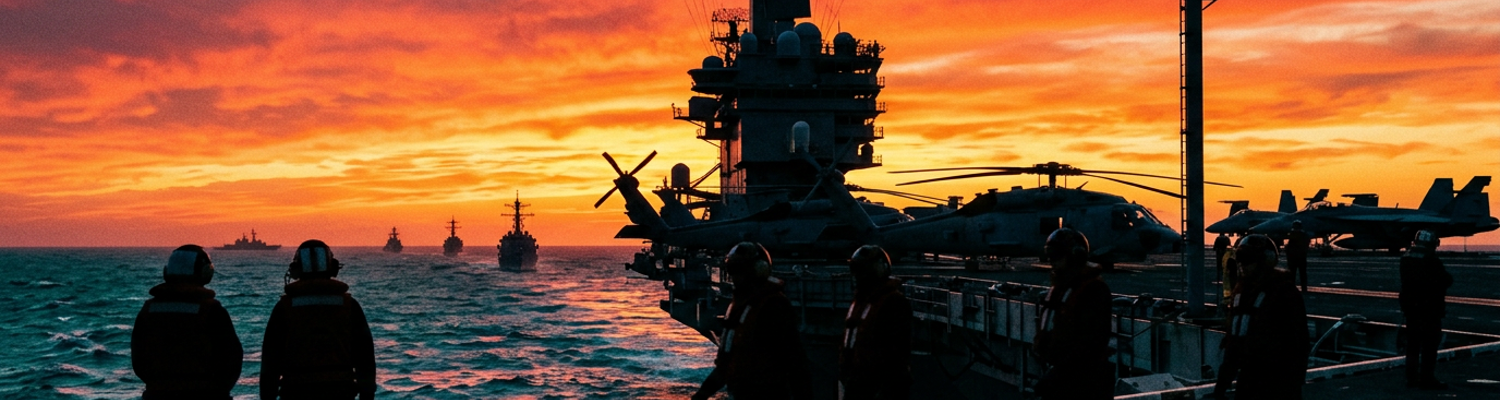

Postwar Sixth Fleet Doctrine and Carrier Dominance
Sailors dragged heavy hydraulic hoses across blistering steel flight decks while enduring eighteen-hour work shifts in the stagnant June heat of the eastern Mediterranean. Freshwater rationing restricted crew showers to ninety seconds every two days, and supply ships struggled to deliver basic replacement parts, aviation fuel, and fresh rations to the forward task group. Boiler technicians labored below the waterline in engine spaces that hovered near one hundred and twenty degrees, nursing high-pressure steam valves and patch-welding condenser lines that leaked under continuous high-speed cruising. Catapult maintenance crews cannibalized copper gaskets and hydraulic seals from decommissioned ground equipment to keep the launch pistons pressurized, fighting chronic sleep deprivation while deck officers pushed flight operations without pause. Fleet command demanded this exhausting operational pace because war plans required the ships to maintain immediate readiness for a massive theater-wide air offensive.
United States Sixth Fleet doctrine relied on assumptions of absolute blue-water air supremacy inherited from Pacific Theater carrier operations and postwar naval aviation war games. Training publications drafted during the previous two decades assured commanders that vast expanses of open ocean would always provide protective maneuvering room, allowing battle groups to outrun land-based reconnaissance and operate beyond the reach of enemy strike wings. Naval aviators trained almost exclusively to launch heavy strike waves into clear skies, fly high-altitude courses hundreds of miles offshore, and return to an open ocean where carrier defenses dominated the entire battlespace. Fleet tactical manuals offered virtually no procedures for operating inside narrow, landlocked seas where coastal radars, surface missile batteries, and hostile patrol boats hemmed carriers against the shore. Staff officers ignored these enclosed operational hazards because their battle plans focused entirely on global atomic warfare on the high seas.
Task Force 60 operated attack carriers USS Saratoga and USS Independence configured primarily for open-ocean nuclear strike profiles and maritime interdiction rather than contested coastal ingress. Below decks, aviation weapons handlers managed massive bomb magazines stocked with heavy nuclear and conventional ordnance meant for deep strategic strikes, leaving the air wings short of the specialized weapons required for close tactical support near crowded shorelines. Flight deck crews wrestled with massive swept-wing aircraft like the twin-engine McDonnell Douglas F-4 Phantom and the Douglas A-3 Skywarrior, which demanded long catapult runs, intense maintenance hours, and large volumes of volatile jet fuel. The eighty-thousand-ton supercarriers drew nearly forty feet of water, preventing them from maneuvering freely through shallow coastal channels and island passages without risking disaster. Each launch cycle forced the deep-draft carriers to turn directly into the prevailing westerly wind and steam on straight courses for miles, creating fixed and predictable tracks in the water.
Destroyers and armed intelligence trawlers of the Soviet Navy shadowed directly in these predictable wakes, aggressively cutting across the carriers launch headings to disrupt flight operations. Combat Information Center radar operators watched their scopes flood with false targets as radar energy bounced off the nearby mountain ridges of Lebanon and Syria, blinding air defense screens to low-flying aircraft. Catapult officers stood on the catwalks holding launch signals while Soviet warships crossed less than one thousand yards ahead of the bow, forcing carrier helmsmen to make emergency rudder corrections to avoid collisions. Flight deck directors ordered alert fighters armed with live missiles pushed onto the catapult shuttles, while captains placed fire control directors on continuous standby to track the trailing Soviet gun mounts. Battle group commanders kept their crews locked at combat stations around the clock, abandoning theoretical open-ocean playbooks as their ships maneuvered in plain view of enemy naval guns.
Operation Kavkaz and Soviet Missile Deployments in Egypt
Officers manning those combat stations soon discovered that the naval standoff was merely the forward edge of a far deadlier operational reality taking shape along the Egyptian coast. CIA Director Richard Helms presented confirmed intelligence at the June 10, 1970 National Security Council meeting establishing that the Soviet Union had deployed four to five operational SA-3 Goa missile regiments and multiple frontline MiG-21 squadrons to Egypt under Operation Kavkaz, upending US Sixth Fleet air superiority assumptions in the Eastern Mediterranean. Photographic reconnaissance canisters flown from high-altitude aircraft and processed in Washington revealed twenty-two separate surface-to-air missile batteries positioned in dense clusters across the Nile Delta. American war planners had spent years believing that carrier air wings could dominate Mediterranean coastal airspace through high-speed flight profiles, but the sheer density of the newly arrived hardware shattered those assumptions. Intelligence analysts identified advanced Low Blow fire-control radars and Flat Face target-acquisition arrays wired directly into regional power grids, giving the Soviet air defense network continuous tracking coverage across the maritime approaches to the North African coast. Logistics manifests tracked by naval intelligence confirmed that Soviet merchant ships had unloaded hundreds of missile reload canisters, mobile generator vans, and heavy radar trailers at the port of Alexandria under cover of night.
Missile crews directly manned the Soviet batteries and flew interception sorties, establishing a surface-to-air missile envelope that covered low-altitude ingress corridors along the Suez Canal and Nile Delta. Technicians in Moscow had shipped entire air defense divisions under strict military secrecy across the Black Sea, bypassing Egyptian military control to keep operational authority exclusively in Russian hands. Crews digging the SA-3 launch positions pushed sand berms around the two-stage solid-fuel missiles to protect the launchers and diesel generators from low-flying strike aircraft. The SA-3 Goa system tracked targets flying as low as one hundred meters, stripping away the low-level flight tactics that Navy pilots routinely practiced to slip under radar beams. Soviet fighter pilots flying stripped-down MiG-21MF interceptors operated on dedicated ground-controlled intercept radio networks, climbing rapidly from dispersal airfields to patrol the airspace above the missile rings. Radar operators on the ground coordinated directly with these airborne fighter pilots through secure communications vans, creating a layered defense zone where incoming strike jets faced missile locks and cannon fire at the same time.
Carrier strike planners aboard USS Saratoga and USS Independence recognized that their preplanned flight routes led straight through these overlapping intercept zones. The presence of active Soviet air defense regiments effectively invalidated standard carrier-based strike routing without risking direct kinetic engagement between superpower forces. Theoretical attack profiles stored in shipboard ready rooms directed Douglas A-4 Skyhawks and Grumman A-6 Intruders to hit coastal targets along straight ingress vectors, but flying those pathways meant either killing Russian radar operators or losing American aircraft to Russian missile crews. Maintenance technicians inside carrier avionics shops lacked the specialized radar-jamming equipment necessary to counter the new Soviet frequency-hopping systems, leaving strike groups vulnerable to guided missile salvoes. Deck crews could not modify the heavy bomb loads already loaded onto the alert strike aircraft quickly enough to match this newly discovered radar network. Navigators wiped their plotting charts clean and drew restricted boundary lines far north of Egypt, forcing Sixth Fleet commanders to pull their carriers back into open water.
Fedayeen Clashes and the Amman Embassy Siege
Helmsmen steered the warships into those northern open-water patrol boxes just as urgent flash traffic reported an armed explosion across the Jordanian border. Palestinian fedayeen fighters launched violent street assaults against royal government positions across Amman on June 10, 1970, turning the Jordanian capital into a chaotic combat zone. Fedayeen gunmen broke into diplomatic housing neighborhoods and assassinated United States Army Assistant Defense Attache Major Robert Perry inside his private residence. Armed militia units simultaneously overran the downtown Intercontinental Hotel, herding sixty American hostages into trapped rooms at gunpoint during the wider siege of foreign guests. Officers on the Joint Chiefs of Staff in the Pentagon immediately opened emergency contingency files to draft combat extraction plans, ordering carrier air groups and amphibious forces to prepare for an urgent tactical rescue.
Diplomats trapped inside the American Embassy compound in Amman found themselves abruptly cut off from Washington rescue planners as urban combat engulfed the surrounding city blocks. Heavy fighting between King Hussein Jordan Arab Army and Palestinian fedayeen factions severed telephone landlines and smashed municipal power relays across the city center. Rooftop radio antennas took direct hits from automatic weapons fire, knocking out primary high-frequency links and silencing long-range military transceivers. State Department officials and military attaches lost all direct communication with Washington, creating an intelligence blackout during tense hostage negotiations with guerrilla leaders. Washington crisis teams stared at dead teleprinters and empty situation boards, leaving military commanders with no clear data on hostage locations, loyalist troop movements, or rebel gun emplacements.
Officers reviewing noncombatant evacuation contingency plans discovered that standard military doctrine assumed a completely permissive airport environment. Peacetime evacuation checklists instructed flight crews to land unarmed transport aircraft on civilian runways, refuel at commercial terminals, and board waiting evacuees under local police protection. That theoretical assumption dissolved as Palestinian militia fighters surrounded the civil air corridors around Amman with heavy machine guns and mortars. Fedayeen gunners zeroed Soviet-built twelve-point-seven-millimeter machine guns and heavy mortar tubes directly onto low-altitude flight paths, threatening to tear apart any transport plane attempting a landing approach. Shrapnel from mortar bursts cratered the civilian runways, while rebel riflemen in perimeter drainage ditches turned civilian air routes into contested kill zones that no unarmed transport could survive.
Ordnancemen aboard USS Saratoga and USS Independence scrambled to replace peacetime evacuation routines with armed combat entry tactics as transport corridors closed. Aviation crews hauled heavy iron bombs and rocket pods up from deep shipboard magazines, unbolting high-altitude weapons racks to reconfigure strike jets for low-level tactical runs. Marine infantry companies aboard nearby amphibious assault ships checked field gear and loaded live ammunition into transport helicopters, preparing for a hot landing directly into hostile urban neighborhoods. Navigators spread wrinkled topographical charts across ready-room plotting tables, tracing ridgelines and built-up city sectors that naval aviators had never practiced attacking in their open-ocean training missions. Pilots strapped into ejection seats on the flight decks with jet engines running on auxiliary power, waiting for launch orders to punch through hostile airspace and pull American hostages out of the burning city.
Joint Chiefs Extraction Planning for Landlocked Interventions
Catapult officers held those strike aircraft at idle while Joint Chiefs of Staff planners evaluated carrier-based A-4 Skyhawk and F-4 Phantom sorties from Task Force 60 to provide close air support over Amman, requiring extended transit over sovereign foreign airspace. Navigators spreading flight charts across ready-room plotting tables recognized that direct routes into Jordan crossed Lebanese, Syrian, or Israeli airspace without diplomatic clearance. Syrian military installations operated Soviet-built radar networks and antiaircraft batteries along the border, while the Lebanese government refused to grant overflight rights for armed American combat jets. Every diversion around these uncooperative boundaries forced strike jets to burn precious fuel before they ever reached the Jordanian capital. Navy flight leaders calculated that once pilots arrived over Amman, low fuel indicators would force them to turn back toward the Mediterranean within ten minutes.
Tanker aircraft aboard USS Saratoga and USS Independence could not solve this fuel shortage because carrier air groups lacked organic aerial refueling depth to maintain continuous combat air patrols over Jordan while simultaneously providing combat air defense over Mediterranean task groups. Flight decks carried only a small number of KA-6D Intruder tankers alongside buddy-store refueling pods mounted under the wings of standard attack jets. Deck crews had to remove bomb racks and rocket pods from combat aircraft to install these fuel-transfer pods, reducing the striking power available for the mission. Distributing that limited supply of aviation fuel between strike jets flying across the desert and fleet-defense fighters tracking nearby Soviet warships pushed the tanker force past its breaking point. Flight planners could not resolve this tactical deadlock, leaving ground forces with almost no reliable air cover if an extraction force moved inland.
Marine Corps battalion landing teams aboard Amphibious Ready Group ships faced a landlocked operational environment over one hundred and fifty miles inland from the Levantine coast without secure transit corridors. Decades of amphibious doctrine had trained these Marines to storm coastal beaches, seize surfside airfields, and fight within the protective range of heavy naval artillery. Amman sat high on an inland plateau far beyond the reach of five-inch naval gun mounts, surrounded by rocky desert wadis and armed militia checkpoints. Transport helicopters such as the CH-46 Sea Knight and CH-53 Sea Stallion had to carry heavy combat loads across foreign borders and mountain ridges at the outer edge of their operational radius. Antiaircraft artillery and heavy machine guns controlled by militia fighters along the mountain passes threatened to tear apart slow-moving helicopters long before the landing teams could set up defensive lines around the embassy.
Helicopter crews aboard amphibious assault ship USS Guadalcanal stripped nonessential armor plating and cargo winches from their airframes to squeeze extra flight range out of the twin turbines. Logistics officers knew that even a single damaged helicopter forced down in the desert would trigger an emergency rescue effort, draining vital medical personnel and escort gunships from the primary objective. Marine officers possessed no trucks or amphibious tractors capable of driving through one hundred and fifty miles of contested roads to deliver extra ammunition, vehicle parts, or fuel to isolated platoons. Pentagon war planners warned civilian leaders that a helicopter assault deep inside Jordan risked drawing Syrian armored units across the northern frontier, turning a rescue into a regional war. Fleet commanders kept the assault ships holding in open waters off the southern coast of Cyprus, refusing to launch the landing teams into the desert interior without clear flight corridors.
European Basing Denials and Fleet Logistical Constraints
NATO allies including Italy, Greece, and Turkey withheld sovereign overflight rights and staging access for combat sorties into Jordan to avoid jeopardizing oil supply agreements and regional diplomatic ties. Italian air traffic controllers turned away American military transports approaching regional hubs, while Greek and Turkish authorities barred Sixth Fleet logistics planes from using coastal air bases as intermediate staging points. European political leaders feared that supporting an armed American military intervention in Amman would trigger immediate Arab petroleum embargoes or dismantle crucial commercial pacts across the Middle East. Naval flight officers mapping out flight routes across the Mediterranean basin discovered that every direct air corridor across southern Europe was blocked by allied diplomatic rejections. Flight planners had to reroute long-range cargo runs across thousands of miles of circuitous water routes, forcing twin-engine transport planes to burn through limited engine flight hours and scarce spare parts simply to ferry communications gear and emergency maintenance kits to the carriers. Strike planners aboard the flagships realized that without European airfields to recover diverted aircraft or stage emergency fuel tankers, every operational mission inland depended entirely on the floating supply ships trailing far behind the carrier formation.
Task Force 60 combat service support ships lacked enough replenishment-at-sea inventory to sustain high-tempo combat flight operations and amphibious supply lines simultaneously beyond several operational days. Riggers and deck crews aboard fleet oilers and ammunition ships worked through heavy swells day and night, running tensioned highline cables across churning gaps of open water to transfer JP-5 aviation fuel, helicopter rotor blades, and heavy bomb pallets to USS Saratoga and USS Guadalcanal. Steam-driven transfer winches jammed and hydraulic pumps overheated under the unbroken strain of swinging thousands of pounds of cargo between rolling ship hulls. Shipboard supply officers tracked their cargo manifests with growing alarm as lower hold inventories plunged far faster than incoming naval transports could replenish them. Logistics planners calculated that if carrier air wings launched continuous strike cycles over Amman while Marine transport helicopters supported a battalion landing inland, the battle group would burn through its specialized aircraft parts, fuel stocks, and guided munitions within three to four operational days. Auxiliary supply vessels had no access to regional European supply depots to refill their empty holds, leaving combat warships on the brink of exhausting their operational endurance in the middle of a hostile naval theater.
Deputy Secretary of Defense David Packard and Admiral Thomas Moorer formally cautioned President Nixon that transatlantic replenishment lines and European basing denials left Task Force 60 carrier aviation and amphibious ready groups without conventional logistical depth to sustain an inland intervention into Jordan without risking superpower confrontation. Packard presented Nixon with detailed operational consumption tables showing that replacement supply convoys sailing from naval supply centers in Norfolk, Virginia, required ten to fourteen days of open-ocean transit across the Atlantic to reach the eastern Mediterranean. Moorer laid out maritime tactical charts demonstrating that if American carrier air wings exhausted their missile reserves during an intervention into Jordan, the fleet would be stripped of defensive air cover against the heavy concentration of Soviet warships and guided-missile submarines shadowing the task group. Naval commanders warned the White House that committing stripped-down air wings to a prolonged inland campaign would invite Soviet forces to challenge American naval dominance directly in the Levantine basin. Nixon accepted the logistical reality presented by his defense leaders, ordering Task Force 60 to hold its strike aircraft on the flight decks while diplomats pursued negotiated avenues to resolve the embassy crisis.
Soviet Fifth Eskadra Counter-Maneuvers in the Levantine Basin
Flight deck crews aboard USS Saratoga chained their strike aircraft to the deck cleats while Soviet warships surged forward to hem in the American formation. Ships of the Soviet Navy Mediterranean Squadron, known as the Fifth Eskadra, shadowed Task Force 60 strike groups with missile cruisers and Kotlin-class destroyers stationed within direct line-of-sight surface weapon ranges. Soviet captains placed their vessels less than two miles off the carrier beam, matching every engine throttle adjustment and course change with aggressive turns of their own, churning up white foam directly across American bow waves. American lookouts on the signal bridge peered through heavy shipboard binoculars and could clearly see Soviet gunners standing beside twin one-hundred-and-thirty-millimeter turret mounts and twin fifty-seven-millimeter antiaircraft batteries pointed across the water. Naval gunners on the American destroyers trained their five-inch barrels back at the Soviet hulls in response, turning the sunlit waters off Cyprus into an unblinking standoff between ships operating too close for comfort.
Technicians inside the carrier Combat Information Centers monitored that surface standoff through the shrill audio tones of hostile targeting pulses filling their headsets. Soviet combatants maintained continuous active-radar fire-control locks against US aircraft carriers, rendering standard multi-layered carrier defensive rings ineffective within the confined Levantine Sea. American tactical doctrine depended on outer destroyer screens and long-range combat air patrols to shoot down incoming threats hundreds of miles from the flagships, but this defense required vast open spaces to work. Fifth Eskadra cruisers like the Kynda-class carried eight heavy surface-to-surface cruise missile tubes aimed directly into the unarmored hulls of USS Saratoga and USS Independence at point-blank distances. Radar operators stared at green phosphor scopes where warning lights flickered red under constant illumination from Soviet fire-control emitters, giving carrier captains less than sixty seconds to react if the Soviets pressed their launch buttons. Damage control teams stacked firefighting foam canisters and unspooled fire hoses along the hangar bays, knowing that an incoming missile salvo launched from five thousand yards away would strike the steel hull before interceptor jets could clear the catapults.
Acoustic operators working in dark compartments below the waterline tracked a third threat that encircled the battle group from the depths. Soviet cruise missile submarines operating in the central and eastern Mediterranean held US capital ships under persistent tracking, transforming carrier maneuvering boxes into potential kill zones. Nuclear-powered Echo-class and diesel-electric Juliett-class boats prowled along the narrow shipping channels between Crete and Cyprus, tracking the rhythmic acoustic signatures of the American carrier propeller shafts through sensitive hydrophone arrays. Soviet submariners tracked the rigid, predictable patrol routes that Sixth Fleet navigators had plotted to keep the carriers within flight range of the Jordanian coast. Destroyers screening the task group dropped dipping sonars and fired active pinging sound waves into the sea, but warm underwater thermal layers in the shallow summer waters bent the acoustic beams and hid the submarines beneath thick blind spots. American carrier helmsmen were forced to steer through these designated patrol corridors knowing that multiple submerged missile batteries were waiting for orders to surface and unleash coordinated salvos against their flight decks.
Operational Aftermath and Naval Power Projection Limits
Communicators inside Task Force 60 message centers copied the urgent flash messages that halted those imminent missile attacks and pulled the carrier battle groups back from direct combat. A fragile Jordanian truce brokered on June 12, 1970, allowed the release of American hostages without military intervention, narrowly averting a carrier strike group deployment into a contested air defense umbrella. Catapult officers on USS Saratoga and USS Independence immediately ordered flight deck crews to vent the steam pressure from the launch pistons and unchain the alert fighters from the shuttles. Aviation ordnancemen unbolted live iron bombs and rocket pods from the strike jets, winching the heavy munitions back down into the shipboard magazines to safe the weapons. Deck hands cleared the flight corridors as the warships turned away from the Levantine coast, avoiding a combat entry into the active missile zones established by Soviet forces in Egypt.
Officers on the carrier strike planning staffs examined the near-disaster and recognized that open-ocean battle playbooks had broken down completely during the standoff. The crisis exposed severe doctrinal deficiencies in carrier task force littoral operations, accelerating internal Navy debates over surface-to-air missile counter-tactics and electronic warfare integration. Flight leaders pointed out that theoretical training manuals written for broad Pacific waters left pilots completely unprepared to fly through the radar blind spots created by coastal mountain ridges. Electronic warfare technicians reported that carrier air wings carried no jamming pods capable of disrupting the Soviet fire-control radars that had tracked their every move. Escort captains added that their destroyers had spent days trapped within point-blank range of Soviet cruise missile tubes without possessing any surface-to-surface missiles to defend the carriers or strike back.
Chief of Naval Operations Admiral Elmo Zumwalt used the logistical vulnerabilities highlighted during the June standoff to initiate Project Sixty, shifting fleet investments toward high-speed sea control escorts and surface-to-surface tactical missiles. Zumwalt argued before defense officials that giant supercarriers were too dependent on fragile fuel lines and too vulnerable in crowded coastal waters to handle modern missile threats on their own. Naval engineers responded by accelerating the development of the Harpoon anti-ship missile so American surface combatants could match the striking range of Soviet vessels. Program managers redirected long-term shipbuilding budgets away from large attack carriers to build smaller Oliver Hazard Perry-class guided-missile frigates and fast patrol hydrofoils. Budget directors also funded new electronic warfare installations and dedicated tactical jamming aircraft to ensure future carrier air wings could suppress integrated radar defenses before launching inland strikes.
Dockyard workers at naval shipyards began stripping obsolete deck guns off existing cruisers and welding anti-ship missile launchers onto their superstructures. Technicians at fleet training centers tore up existing tactical doctrine and installed simulated coastal radar clutter onto combat training scopes. Instructors required carrier pilots to practice high-speed ingress at low altitudes under continuous electronic counter-countermeasures rather than flying standard high-altitude bombing profiles. Helmsmen and tactical action officers aboard Sixth Fleet destroyers adopted aggressive close-quarters maneuvering guidelines designed to block shadowing vessels from obtaining clean firing bearings. Fleet commanders reorganized their eastern Mediterranean patrol stations, ordering battle groups to operate with integrated electronic jamming screens and dispersed surface escorts whenever approaching contested waters.