
Counter Intelligence Corps Screening in Bavarian Camps
Piston rods shattered through the cast iron crankcase of an overloaded Opel Blitz transport truck, spraying scorched motor oil over the exhaust manifold and filling the cab with white smoke. Driver Edmunds Veidemanis kicked the floor pedals, hauled back on the notched emergency brake lever, and steered the skidding three ton chassis off the Bavarian roadway into a shallow ditch. Latvian soldiers tumbled out through the canvas tailgate into the roadside gravel, coughing in the fumes while hot coolant boiled out of the punctured radiator core. Veidemanis grabbed his canvas rucksack from beneath the driver seat and joined hundreds of disorganized soldiers and displaced families walking westward toward American lines. United States Army military police met this exhausted column outside the city limits and directed the travelers into crowded displaced persons assembly centers across Augsburg and Munich. American guards ushered the arrivals through wooden gates and formed long queues outside temporary processing sheds set up inside former German army barracks.
Agents of the Counter Intelligence Corps sat behind rows of folding wooden tables inside these converted barracks, coordinating with the United States European Command to run displaced persons assembly centers across Augsburg and Munich. These intelligence teams faced the massive administrative processing of tens of thousands of Baltic refugees amidst destroyed civil registries and missing personnel files. Bombed municipal archives in Riga and burned military headquarters across Germany left investigators without birth certificates, official conscription rosters, or central personnel databases. Baltic refugees carried only typed camp passes, damaged work booklets, or handwritten affidavits from hometown acquaintances to prove their identities. Counter Intelligence Corps officers needed to identify genuine civilians and political refugees, but the complete lack of official records forced them to build personal histories from direct interviews. Investigators resolved this information blackout by establishing a standardized interrogation system that subjected every adult male to structured individual questioning.
Interrogators conducted these preliminary sessions in partitioned offices, focusing their questions to separate Eastern Front combatants from administrative Nazi functionaries. Case officers cross examined veterans like Veidemanis about their exact induction dates, unit rosters, commanding officers, and operational locations along the northern front lines. Veidemanis explained how German authorities enforced mandatory draft calls in occupied Latvia during 1943, drafting young men directly into combat grenadier formations under threat of severe penal punishment. Examiners compared these testimonies against captured German organizational charts, looking for evidence of voluntary enrollment, police battalion duties, or assignments within civil occupation offices. Combat duty in frontline trenches against the Red Army did not automatically bar a soldier from refugee status, whereas membership in administrative bureaus, political security organs, or concentration camp garrisons triggered immediate arrest and transfer to internment compounds. Officers logged every verified answer into triplicated screening forms, preparing each cleared soldier for the mandatory physical evaluations that followed the spoken interviews.
Surgeons and Waffen SS Tattoo Identification
Corpsmen directed Veidemanis and hundreds of other prospective guardsmen into an unheated dispensary hangar to begin these physical evaluations. Veidemanis stripped to the waist and walked toward raised wooden benches positioned directly under bright surgical lamps. Physicians conducted detailed physical inspections targeting the inner left arm where German military doctors had tattooed recruits with their blood type. This small marking measured roughly seven millimeters across and indicated blood group A, B, AB, or O on the underside of the upper bicep. Doctors ran their fingertips across the skin of the armpit and arm to feel for raised keloid tissue, chemical acid burns, or scalpel scars where individuals had tried to scrape away the dark green ink. Orderlies recorded the exact condition of the inner arm on each man physical record card before passing the file down the processing line.
Inspectors examined these physical record cards to differentiate voluntary ideological recruits from Baltic soldiers conscripted under German occupational decrees. German occupation authorities had imposed mandatory draft orders across Latvia starting in early 1943, forcing young men into the Latvian Legion under threat of execution or long term transfer to punitive concentration camps. German field surgeons routinely bypassed the blood group tattooing procedure for these Baltic conscripts due to severe needle shortages, depleted medical supplies, and chaotic front line conditions during the final stages of the war. Voluntary German Waffen SS soldiers and early political recruits consistently displayed the inner arm tattoo, while thousands of drafted Latvian farmhands, clerks, and factory laborers had completely unmarked skin. American screeners recognized that an absent tattoo supported claims of late war forced mobilization, whereas fresh chemical burns, abrasive scrubbing, or amateur surgical excisions immediately exposed suspects attempting to conceal their true service records. Officers set aside all files marked with suspicious skin abrasions for immediate transfer to Counter Intelligence Corps detention barracks.
Doctors summoned the remaining cleared soldiers back to examination tables to map physical combat trauma directly against their personal service files. Medical officers measured healed bullet paths, shrapnel punctures, grenade fragments, and frostbite scars across torsos, legs, and arms. Counter Intelligence Corps case officers compared these physical injuries to the exact combat sectors and operational dates recorded during earlier interrogations. Veidemanis pointed to jagged shrapnel scars along his upper left shoulder, explaining how Soviet mortar fragments had struck his transport column during the fighting retreat toward the Baltic coast in late 1944. Physicians verified that the scar tissue matched the age, depth, and weapon profile of late war frontline artillery strikes rather than older skirmishes from the early invasion years of 1941. Screeners used this physical confirmation to corroborate service timelines, proving that these conscripts had endured frontline trench warfare rather than serving in rear echelon police units or punitive security details.
Officers gathered these combined medical charts and interrogation records to finalize individual security classifications for each Baltic veteran. Screeners verified that the complete absence of tattoos combined with verified shrapnel trauma proved involuntary conscription under German occupational decrees rather than voluntary political allegiance to the Nazi regime. Clerks stamped individual clearance dossiers with official European Command approval seals, certifying each inspected Latvian soldier for recruitment into civilian labor service companies and unarmed guard detachments. Supply sergeants issued dyed surplus uniforms, heavy work boots, and brass camp identification badges to the newly vetted men outside the dispensary exit door. Veidemanis climbed aboard a canvas topped truck alongside thirty cleared veterans, riding toward American supply depots near Mannheim to begin guard operations behind Allied lines.
Investigators and the Edmunds Veidemanis Dossier
Depot sentries halted the transport convoy at the security gates outside Mannheim so intelligence detachments could verify individual personnel jackets before issuing perimeter patrol assignments. American case officers cross referenced these paperwork packets against the background investigation compiled during the post war internment of Veidemanis in Bavaria. Investigators had conducted thorough residence verification within the Augsburg displaced persons camp, inspecting billet rosters, ration issuance ledgers, and refugee committee registries to track his daily movements. Field agents stationed in Augsburg interviewed neighboring Baltic refugees and camp administrators to verify that he had lived openly as a civilian without using false identities or forged travel passes. Case officers assembled these camp housing records and sworn witness statements into a central security binder, certifying that his postwar conduct within the refugee community remained clean and transparent.
Investigators opened this verified dossier to assess the documented service of Edmunds Veidemanis as a frontline officer in the Latvian Waffen SS from April 1943 until March 1945. Captured personnel rosters and surviving paybooks confirmed that German occupation authorities drafted him during the general mobilization decrees that swept across Latvia in the spring of 1943. Veidemanis had served as a tactical combat officer in infantry trenches along the northern front lines, directing rifle companies under heavy Soviet artillery bombardments and organizing defensive withdrawals through marshland positions. Operational combat logs and unit casualty returns tracked his battalion across the Baltic front line until relentless Soviet offensives and severe blast trauma finally pushed his surviving detachment out of active combat in March 1945. Intelligence evaluators verified that every documented month of his military career took place strictly within frontline combat sectors facing regular Red Army troops rather than rear area administrative districts.
Officers applied formal Counter Intelligence Corps vetting protocols to separate those rear area administrative assignments from tactical frontline combat command, evaluating individual complicity in war crimes. Screeners cross checked the names of German and Latvian regimental officers against master watchlists compiled by the United Nations War Crimes Commission and evidence gathered for war crime trials. Interrogators investigated whether an officer had taken part in punitive security operations, civilian roundups, partisan reprisal executions, or the brutal clearance of regional ghettos. Combat commanders who engaged only in conventional tactical warfare against regular enemy armies met the threshold for clearance, while personnel linked to auxiliary police battalions or concentration camp guard details faced immediate detention and prosecution. Official records confirmed that Veidemanis held no auxiliary police commissions, avoided all civil occupation duties, and led troops only in standard battlefield engagements along the active Eastern Front.
Examiners stamped official clearance certificates into the completed dossier, confirming that this frontline service fulfilled European Command security directives for employment in civilian guard units. Couriers delivered the signed authorization forms directly to depot headquarters, allowing supply officers to enter his name into the active guard roster. Quartermaster sergeants issued Veidemanis a painted steel helmet, a wool coat, and a flashlight before assigning him to a six hour perimeter patrol shift. Veidemanis slung his canvas bag over his shoulder, checked his equipment with the post sergeant inside the depot guardhouse, and walked out into the gravel yard to take up his watch along the supply fence.
Commissioners and the Displaced Persons Exemption
Gravel crunched under the boots of Veidemanis as he marched his post along the perimeter of the supply depot, watching cargo trucks move through the checkpoint while his long term immigration status remained unresolved under federal law. American immigration officials in Washington and Frankfurt continued to enforce Section 13 of the Displaced Persons Act against thousands of Baltic veterans living in the western occupation zones. Lawmakers had originally designed Section 13 as an automatic exclusion clause to block entry to anyone who had belonged to or participated in movements hostile to the United States or its democratic government. Consular agents interpreted this mandate literally, halting visa applications whenever an applicant admitted to wearing a Waffen SS uniform on the Eastern Front. Field officers in the displaced persons centers had to tell cleared guards that military labor service did not guarantee a permanent home across the ocean. Veidemanis paced along the depot boundary line through the night, clutching his issued flashlight and waiting for American authorities to decide his fate.
Commissioners on the United States Displaced Persons Commission addressed this growing administrative problem by initiating a comprehensive legal review of Baltic military formations. Legal teams in Washington and Munich gathered captured operational orders, German draft decrees from 1943, and Counter Intelligence Corps interrogation transcripts to determine the true nature of the Latvian Legion. Staff analysts verified that German authorities had drafted these men by force under threat of severe punishment, while the Latvian soldiers themselves fought solely to prevent a second Soviet occupation of their homeland. The United States Displaced Persons Commission issued a landmark formal ruling on September 1, 1950, resolving years of administrative deadlock across Allied occupation zones. This legal determination classified the Latvian Legion as separate and distinct in purpose, ideology, and activities from the German SS. Commissioners established that these Baltic units did not advocate national socialist ideology, held no responsibility for criminal police actions, and operated strictly as battlefield units resisting Red Army advances.
Officers at the displaced persons processing centers used this legal classification to create a direct exemption for vetted Baltic legionnaires from the automatic exclusion clauses under Section 13 of the Displaced Persons Act. Processing centers throughout Bavaria and Hesse immediately adjusted their visa screening guidelines to distinguish between voluntary German perpetrators and involuntary Baltic conscripts. Consular examiners still required every individual applicant to undergo rigorous intelligence screening, ensuring that no war criminals or auxiliary police collaborators received entry clearance by mistake. Field agents pulled the personnel dossier of Edmunds Veidemanis from the depot archives, verifying his documented combat dates and lack of tattoo markings against the new statutory standards. Case workers stamped official clearance seals onto his immigration paperwork, certifying that his service in the Latvian Legion did not disqualify him from receiving an American visa. Veidemanis signed the final resettlement forms at the Mannheim consulate window, turned in his depot security badge, and boarded a transport bus heading toward the embarkation port at Bremerhaven.
Quartermasters and US Army Labor Service Integration
Passengers aboard the transport bus looked out through dust streaked windows at military supply corridors protected by the very same Baltic guard detachments that Veidemanis had just left behind. United States European Command officers had organized thousands of these cleared Latvian combat veterans into specialized auxiliary formations within the Labor Service to solve critical guard and labor shortages across the American occupation zone. Headquarters staff grouped these vetted Eastern Front veterans into numbered paramilitary units, specifically establishing the 4221st and 8920th Guard Companies alongside companion Baltic detachments. Supply sergeants outfitted the men in dyed olive drab American field jackets, dark work trousers, and distinctive armbands bearing Latvian national colors before issuing reconditioned M1 carbines and wooden riot batons. American company commanders supervised daily marksmanship drills, riot control tactics, and radio communication training at regional staging depots in Mannheim and Grafenwoehr, integrating the auxiliary detachments directly into local garrison defense plans. Depot commanders relied heavily on these seasoned infantrymen because their prior combat discipline eliminated the need for basic training, allowing military authorities to dispatch armed squads to perimeter gates and railway sidings within days of clearance.
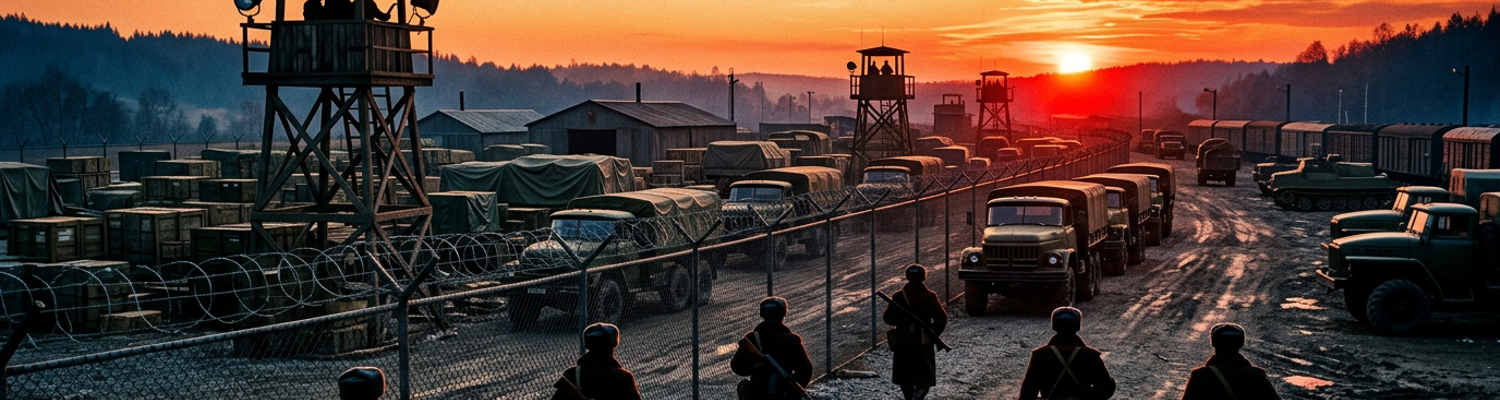
Ammunition depots throughout Bavaria, Hesse, and the Rhine River valley received these armed Latvian guards to protect vital stockpiles of artillery shells, small arms, and high explosives against black market pilferage and armed sabotage. Sentries took up rotating twelve hour shifts atop wooden watchtowers equipped with heavy carbon arc spotlights and field telephones, sweeping the double barbed wire fences and surrounding forest lines for trespassers. Guard details also manned fortified access barriers around major logistical supply hubs that stored bulk aviation gasoline, crated vehicle replacement parts, and dry field rations for thousands of Allied troops. Patrolmen checked shipping manifests, examined stamped travel passes, and used angled inspection mirrors on long poles to search the undercarriages of incoming cargo trucks for concealed contraband or weapons. Riflemen escorted flatbed rail cars carrying sensitive artillery ordnance and mortar rounds between army marshaling yards and reinforced underground bunkers, walking the gravel tracks with chambered rounds through harsh winter weather. Depot commanders noted in daily operational logs that these Latvian guard details prevented organized theft rings from raiding supply yards, enabling American quartermaster battalions to maintain steady distribution schedules.
Nuremberg Palace of Justice provost marshals drew upon this operational reliability to assign Latvian Labor Service personnel to critical security posts during post war tribunal operations. Guards wearing black dyed surplus uniforms, white canvas belts, and steel helmets painted with national red and white insignias formed exterior cordons around the courthouse and the connected prison complex. Sentries stood watch at heavy iron vehicle gates, inspected credentials of international judges and prosecutors, and patrolled stone corridors outside the basement detention cells where major German war criminals were held. Labor Service personnel manned fixed checkpoints along access hallways, searched maintenance workers for concealed tools or contraband, and reinforced American military police squads guarding courtroom entry doors and visitor galleries. Watch teams maintained continuous surveillance over the prison exercise yards, perimeter walls, and rooftop parapets until tribunal judges delivered their final verdicts and military authorities carried out court ordered sentences. American tribunal commanders relieved the guard companies from their courthouse posts only after military police transferred the remaining prisoners to permanent confinement facilities, returning the Latvian sentries to regional depot security patrols.
Tacticians and Cold War Security Reassessment
Patrolmen walking depot fence lines across West Germany soon found their daily security assignments transformed by escalating Soviet American tensions across the divided continent. European Command intelligence officers observed growing friction around Berlin and along the demarcation line, recognizing that Western occupation forces lacked recent, firsthand tactical experience against Soviet mechanized divisions and massed infantry doctrines. Headquarters planners understood that thousands of vetted Baltic soldiers serving in auxiliary labor detachments possessed years of continuous combat experience resisting the Red Army along the Eastern Front. Counter Intelligence Corps detachments pulled screened Latvian veterans from supply depot gates, railway sidings, and watchtowers into secure interrogation facilities to leverage this specialized anti Soviet battlefield knowledge. Intelligence specialists laid out operational maps across briefing tables, instructing former frontline soldiers to break down Soviet combat habits, armored assault formations, and artillery concentrations under real battlefield conditions. American staff officers recognized that these screened veterans possessed direct knowledge of Eastern Front operational reality that could help shape Allied defensive plans in Central Europe.
Interrogators conducted exhaustive tactical debriefings of former legionnaires to harvest practical intelligence on Soviet Red Army operational doctrine along the Courland Pocket. Screened veterans who had manned isolated defensive sectors in western Latvia between late 1944 and the spring of 1945 explained how Soviet artillery commanders organized heavy preparatory bombardments prior to coordinated armor thrusts. Veterans detailed the operating methods of Soviet T-34 and heavy IS-2 tank formations attempting breakthroughs across swampy forests and frozen farmland, identifying critical gaps between advancing lead tanks and trailing rifle echelons. Interrogators recorded detailed sketches of Soviet trench layouts, field command bunkers, night infiltration techniques, and combat engineering methods used to breach barbed wire and dense minefields. Technical intelligence teams cross referenced these accounts against captured Soviet field manuals, validating the Latvian observations regarding Soviet radio discipline and supply convoy vulnerabilities on muddy roads. American analysts compiled these eyewitness debriefings into formal tactical bulletins, distributing the finished threat assessments to United States Army armored cavalry and infantry regiments patrolling the inner German frontier.
Caseworkers coordinated the logistical transition of screened Latvian personnel from temporary military labor duty into permanent Western resettlement pipelines once intelligence and security debriefings reached completion. Occupation authorities gradually deactivated auxiliary guard companies throughout Bavaria and Hesse as West German civilian police detachments and regular Allied garrison units assumed perimeter security over military depots. Displaced Persons Commission representatives worked alongside international refugee officials to process formal immigration visas, medical clearance certificates, and travel manifests for thousands of vetted veterans and their dependents. Latvian soldiers stood in quartermaster lines to surrender their issued M1 carbines, dyed work uniforms, and depot identification badges, picking up civilian wool suits and stamped consular travel packets in exchange. Stevedores loaded crated personal belongings and wooden footlockers into the cargo holds of United States Navy transports and chartered commercial ships berthed at Bremerhaven and Hamburg. Harbor tugs pulled the loaded passenger vessels away from the German docks into the North Sea shipping lanes, carrying the former combatants toward new civilian lives in American, Canadian, and Australian industrial centers.