
Mahan's Shadow: Early Carrier Integration
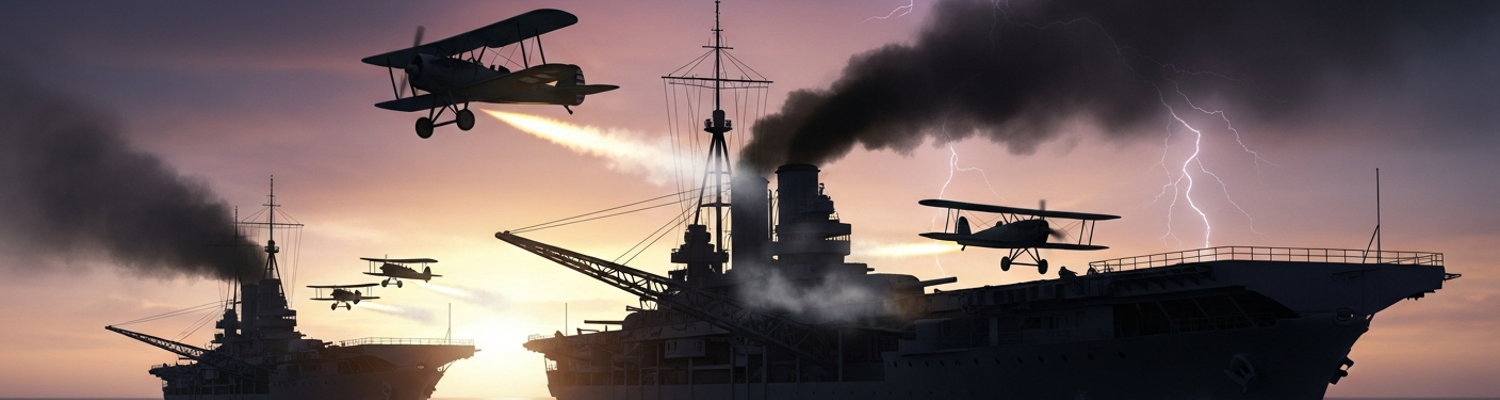
In the decade following the Great War, the United States Navy remained a fleet dominated by the disciples of Alfred Thayer Mahan. Naval strategy was welded to the battleship. The battle line, a steel spine of concentrated firepower, was the ultimate arbiter of sea control. Mahan's ghost haunted the halls of the Naval War College, his theories emphasizing a decisive clash between concentrated capital ship fleets as the only path to victory. Into this rigid doctrinal world, the aircraft carrier was born an awkward and uncertain child. The first American carrier, USS Langley (CV-1), was a converted collier, the former USS Jupiter. Commissioned in 1922 and affectionately nicknamed "The Covered Wagon," her flight deck was a crude wooden platform bolted atop the old hull. The Langley was an experimental vessel, a floating laboratory for the dangerous and unproven concepts of naval aviation. Early operations were fraught with peril, as pilots wrestled with primitive arresting gear and the unpredictable physics of landing a biplane on a moving ship.
Initial doctrine reflected the battleship’s primacy. The carrier was not envisioned as a weapon in its own right, but as a support asset. Its aircraft were the "eyes of the fleet," tasked with scouting and reconnaissance. They would locate the enemy battle line for the American dreadnoughts to engage and destroy. This thinking was a direct extension of Mahanian theory. The carrier's planes would also spot the fall of the battleships' 16-inch shells, correcting fire to improve accuracy. The offensive striking power remained vested entirely in the gun.
The Washington Naval Treaty of 1922, designed to prevent a costly naval arms race, ironically accelerated carrier development. The treaty placed strict tonnage limits on capital ships, allotting 135,000 tons for aircraft carriers to the United States and Great Britain, and forced the cancellation of numerous battleship and battlecruiser construction programs. A special provision, however, allowed signatories to convert two existing capital ship hulls under construction, up to a displacement of 33,000 tons each, into aircraft carriers. The U.S. Navy seized this opportunity. It transformed the massive hulls of the canceled Lexington-class battlecruisers into USS Lexington (CV-2) and USS Saratoga (CV-3). These ships were giants, their hulls retaining the fine lines and powerful propulsion of their battlecruiser origins. Their turbo-electric drive plants, generating a staggering 180,000 shaft horsepower, pushed them to speeds over 33 knots. They were fast enough to operate with the main battle fleet, a key requirement for their designated scouting role. Even with these powerful new assets, the established doctrine held firm. The carriers' speed and size were seen as defensive, allowing them to keep up with and escape threats, not as tools for independent offensive action.
Fleet Problem IX: The Panama Canal Assault
The annual Fleet Problems were the grand strategic laboratories of the U.S. Navy, massive-scale exercises designed to test doctrine, technology, and leadership. In January 1929, Fleet Problem IX commenced with the objective of testing the defenses of the Panama Canal, the strategic artery connecting the Atlantic and Pacific. The scenario pitted the attacking Black Fleet against the defending Blue Force. Each side was assigned one of the Navy’s new large carriers, Saratoga for the attackers and Lexington for the defenders. Commanding the Black Fleet’s carrier element was Rear Admiral Joseph M. Reeves, a battleship officer who had fully embraced the potential of naval aviation. Known as "Bull" for his tenacity, Reeves was a demanding innovator.
Reeves had previously commanded the Langley and relentlessly drilled its crew to increase the tempo of flight operations, recognizing that a carrier’s power was useless if its planes were stuck on the deck. For Fleet Problem IX, Reeves devised a radical plan. He broke with the established doctrine of keeping carriers close to the battle line for protection. He convinced the Black Fleet commander, Admiral William V. Pratt, to detach Saratoga with only a single light cruiser, the USS Omaha, for escort. While the main body of the Black Fleet feinted north to draw attention, Reeves took Saratoga on a wide, high-speed southern arc into the Pacific, maintaining strict radio silence. His objective was a surprise air attack on the Panama Canal’s vital locks. The gamble was immense. Operating alone, Saratoga was highly vulnerable to discovery and destruction by Blue Force destroyers or submarines.
On the morning of January 26, 1929, having reached a launch point 140 miles from the coast, Reeves ordered the attack. In the pre-dawn darkness, Saratoga's flight deck roared to life. At 0548, the ship began launching a 70-plane strike of Keystone bombers and Vought observation planes. The aircraft arrived over the Panama Canal shortly after 0700, achieving complete surprise against the defenders. The umpires for the exercise ruled that the simulated bombing runs successfully "destroyed" the Gatun and Miraflores locks, rendering the canal inoperable. The strategic objective of the entire exercise was achieved in a single, audacious stroke. Though Saratoga was later found by Blue Fleet surface forces and ruled "sunk" multiple times over, the point had been made with shocking clarity. The demonstration of the carrier as a long-range, independent offensive weapon was undeniable. Admiral Pratt, initially skeptical, was converted. Fleet Problem IX was the conceptual turning point. It did not instantly overturn decades of battleship-centric thought, but it planted a seed of doctrinal revolution that would grow throughout the next decade in the war colleges and fleet exercises.
Forging the Air Arm: Aircraft and Doctrine
The conceptual breakthrough of Fleet Problem IX required new tools and refined tactics to become a battlefield reality. The 1930s saw a rapid evolution in naval aircraft design, moving from fabric-covered biplanes to the all-metal monoplanes that would fight World War II. These new machines were the instruments that would allow the carrier to fully realize its offensive potential. A key development was the Douglas TBD Devastator torpedo bomber, which entered service in 1937. The TBD was a landmark aircraft for the Navy. It was the service’s first widely used carrier-based monoplane, featuring an enclosed cockpit and hydraulically folding wings. With a crew of three, it could carry a single Mark 13 torpedo or a 1,000-pound bomb. Its operational range of 435 miles with a torpedo represented a significant leap in striking distance.
Paired with the new torpedo bombers were specialized dive bombers. The technique of dive-bombing, which offered far greater accuracy against moving ships than level bombing, had been under development by the Navy and Marine Corps since the 1920s. The Curtiss SBC Helldiver, the Navy's last combat biplane, served as a transitional aircraft. It was soon followed by the Douglas SBD Dauntless. The Dauntless was designed for steep, near-vertical dives to deliver bombs with pinpoint accuracy. Its most distinctive feature was its perforated, split dive brakes, which allowed the pilot to control the aircraft's speed during a dive, ensuring a stable bombing run. This technical innovation made the Dauntless a legend. For fleet defense, the Navy relied on a series of rugged Grumman biplane fighters, like the F3F, which were nimble and tough, but the service was already looking toward monoplane fighters like the Brewster F2A Buffalo and Grumman's own F4F Wildcat.
This new generation of specialized strike aircraft prompted a fundamental shift in the organization of the carrier’s airpower. The formal establishment of Carrier Air Groups in 1938, each with a designated commander (CAG), unified the fighter, bombing, scouting, and torpedo squadrons embarked on a carrier into a single tactical entity. Before 1938, squadrons were more loosely associated with their host ship. The new structure facilitated integrated training and the development of coordinated strike tactics. The concept of the "deck-load strike," a single massive attack comprising all of a carrier’s offensive aircraft, began to emerge. Planners and pilots practiced complex, multi-squadron attacks designed to overwhelm a target’s defenses. Fighters would suppress anti-aircraft fire, followed by near-simultaneous attacks by dive bombers from high altitude and torpedo bombers at low level. This doctrinal shift, practiced relentlessly in the fleet problems of the 1930s, transformed the air group from a collection of individual aircraft into a cohesive and devastatingly powerful long-range weapon. The construction of the Yorktown-class carriers, designed from the keel up based on the lessons of the 1920s and 30s, provided the ideal platforms for this new way of war. The carrier was no longer just scouting for the battleships. It was becoming the main battery of the fleet.