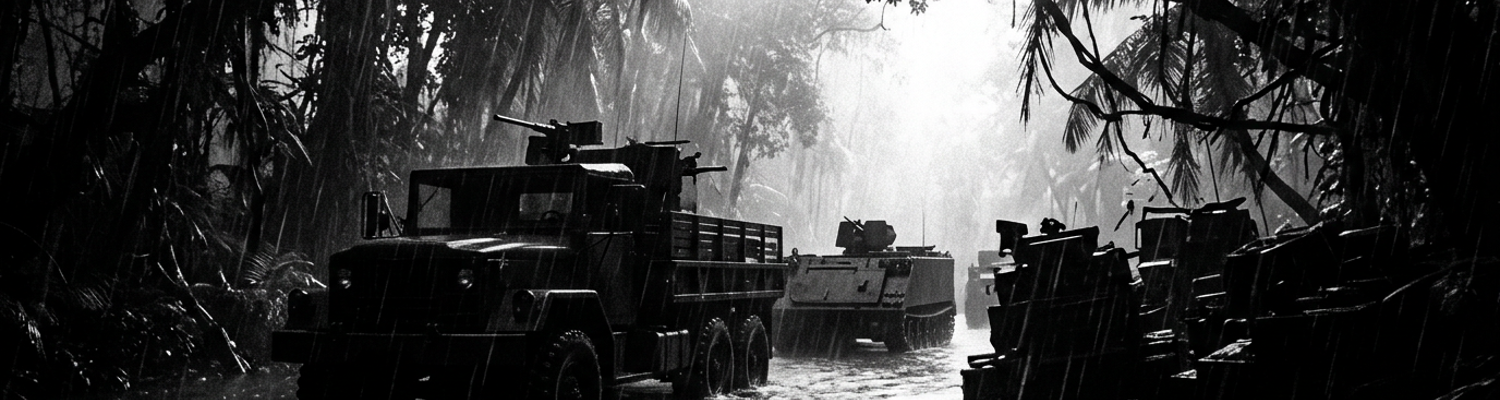

Deployment to the Barike River Mangrove Morass
Operational planners allotted Major General John R. Hester less than ten days to land his forces. They expected a rapid advance across trackless jungle to capture the fortified Japanese airfield at Munda Point. South Pacific Command based this schedule on aerial reconnaissance maps. These maps misidentified primary jungle as flat ground. On July 2, 1943, elements of the 43rd Infantry Division initiated the main assault phase of Operation Toenails. Troops disembarked from landing craft at Zanana beachhead on the southern coast of New Georgia. Transports ferried these units from bases in the New Hebrides and Guadalcanal directly into a torrential equatorial downpour.
A close review of operational logs indicates that logistical units faced disaster within hours of touching the coral sand.
Offloading ramps jammed with rations and 105mm artillery pieces. The designated beachhead measured barely sixty yards deep. Sheer walls of primary rainforest hemmed in the sand. Tractors drowned their carburetors in the surf. Infantrymen shouldered sixty-pound pack loads along with their issue M1 Garand rifles and Browning Automatic Rifles. Men stepped off the coral into waist-deep black mud before establishing a perimeter.
The division schedule collapsed on the surf line.
Archival evidence shows that the 169th and 172nd Infantry Regiments were ordered forward on July 5. They moved along two parallel native tracks toward the Barike River. This tidal waterway cut directly across the divisional axis of advance. Five miles of tangled mangrove swamp separated the landing area from the river. Salt water mixed with inland runoff. Roots formed dense above-ground arches three to five feet high. This created an impenetrable lattice over black sulfurous silt. The mud swallowed soldiers up to their thighs. Pack mules collapsed under standard loads. Their legs snapped in the root cages. Commanders abandoned the animals and converted combat infantrymen into human pack trains.
Field engineers attempted to employ pneumatic tools and chain saws to cut a workable supply track. Dense sap clogged the blades. Exhaust fumes pooled in the stagnant windless air. Infantrymen struggled to maintain compass bearings in an enclosed canopy that blocked all daylight. Each company crawled at a rate of less than two hundred yards an hour. Soldiers stripped off canvas gear soaked in rot-inducing mud. Their SCR-284 radio batteries degraded from the extreme moisture.
Standard army doctrine disintegrated in the mud.
When examining the historical record of the 169th Infantry lead battalions reaching the eastern bank of the Barike on July 8, forward momentum stopped entirely. Japanese defenders belonging to the 229th Infantry Regiment had spent months preparing interlocking defensive zones along the river crossing. Colonel Satoshi Tomita commanded these units. These positions consisted of low-profile bunkers constructed of coconut logs layered with crushed coral and volcanic rock. Living ferns and mangrove saplings camouflaged the structures. American scouts walked within five yards of the gun ports without identifying them. Lead platoons of Company F attempted to wade through the chest-deep river mud. Concealed Type 92 heavy machine guns opened fire from flanking positions. Standard 7.7mm rounds tore through the unarmored soldiers trapped in the silt.
Snipers strapped high into banyan trees picked off squad leaders and radio operators. The Americans were unable to return aimed fire into the dense foliage above. Hester forward artillery spotters could not direct battery fire from the 103rd Field Artillery Battalion. Radios malfunctioned. Visible terrain reference points did not exist. By nightfall, two entire American regiments were pinned in wet depressions. They suffered heavy casualties without identifying a single concrete target.
Trench Fortifications in Waterlogged Terrain
The 169th and 172nd Infantry Regiments attempted to establish defensive perimeters along the Barike River. Standard field manuals required the immediate excavation of slit trenches. The physical environment rendered this doctrine impossible. The water table sat less than twelve inches below the surface of the mangrove swamp.
Digging produced immediate flooding.
A close review of operational logs indicates that entrenching tools struck brackish water after three scoops of mud. Soldiers attempted to construct flooded sap lines to connect squad positions. These shallow ditches filled with a mixture of salt water and rotting vegetation. Infantrymen sat submerged to their waists in the dark water. The mud walls collapsed inward continuously. Troops tried to reinforce the sides of their slit trenches using cut mangrove roots and coconut logs. Chopping wood drew immediate Japanese machine-gun fire.
Soldiers abandoned their axes. They used their steel helmets to bail water out of the holes.
The water seeped back in faster than it could be removed.
Archival evidence shows that the 229th Infantry Regiment maintained constant small-arms pressure on these waterlogged positions. American troops could not raise their heads above the mud without drawing fire. They remained trapped in the flooded trenches for days. The stagnant water dissolved their uniforms and degraded their weapons. M1 Garand operating rods rusted shut. Ammunition clips became coated in abrasive silt.
Field engineers from the 118th Engineer Battalion attempted to bring up sandbags. The native bearer trains could not transport the heavy canvas bags through the root lattice. Infantrymen resorted to filling their own discarded ration boxes with mud to create low parapets. These makeshift defenses dissolved in the daily torrential downpours. The 43rd Division found itself paralyzed in a morass of its own making.
There was no dry ground.
Exposure to Japanese Knee Mortar Barrages
Archival evidence shows that beginning on the night of July 9, 1943, the 1st and 3rd Battalions of the 169th Infantry Regiment came under uninterrupted indirect fire. This occurred along the track east of Horseshoe Hill. Imperial Japanese Army gunners from the 229th Infantry Regiment deployed Type 89 50mm grenade dischargers. They fired from concealed reverse-slope revetments barely two hundred yards away. American troops incorrectly labeled the weapon a knee mortar. The 10.4-pound launcher was braced against roots or solid ground. It utilized an adjustable internal firing pin and threaded range control rod to regulate gas pressure inside its rifled ten-inch barrel.
Japanese crews operated in teams of three.
They dropped 1.7-pound Type 89 high-explosive propellant shells down the tube at sustained rates exceeding twenty rounds per minute. The propellant charges burned smokeless cordite. The short tubes produced only a dull mechanical pop. American listening posts could not triangulate the firing positions through the heavy rain. Forward observers with the 43rd Division reported that the barrages fell on fixed coordinates at ten-minute intervals without pause for thirty-six hours. These strikes saturated grid squares measuring barely one hundred yards wide.
The shells gave no audible whistle before arrival.
A close review of operational logs indicates that the physical composition of the canopy magnified the lethality of every fired projectile. Massive ironwood trunks and dense Philippine mahogany trees dominated the old-growth rainforest east of the Barike River. Branch networks extended eighty feet above the jungle floor. Japanese mortarmen elevated their dischargers past forty-five degrees. They deliberately angled rounds to intersect this overhead timber ceiling.
The sensitive instantaneous point-detonating fuzes on the Type 89 shells struck thick branches. They detonated high above the swamp floor rather than burying themselves in the mud below.
Each mid-air blast created an airburst effect that bypassed terrain defilade. Jagged iron fragments from the pre-grooved projectile casings sprayed downward in a sixty-degree cone. Hundreds of shattered hardwood shards accompanied this metal spray. These wooden splinters functioned as secondary shrapnel. They measured up to eighteen inches in length. The shards pierced web gear, helmets, and canvas shelter halves.
Standard entrenchments offered zero protection from downward blasts.
When examining the historical record of the 169th Infantry casualty clearing stations, the physical consequences of remaining static in open-topped holes become clear. American doctrine mandated digging two-man slit trenches immediately upon halting. The water table sat less than twelve inches beneath the surface. Every excavation filled with stagnant mud and rotting vegetation within minutes. Soldiers sat submerged to their waists. They pressed against wet ditch walls with their ponchos pulled over their heads to keep rain off rifle actions.
Overhead cover did not exist.
Using axes to fell logs drew immediate machine-gun bursts from Japanese positions. Downward-driving shrapnel inflicted catastrophic wounds to the unprotected scalps, shoulders, and upper backs of men crouched in these waterlogged depressions. Litter teams attempting to evacuate punctured men found that field dressings were instantly contaminated by black swamp water. This introduced anaerobic bacteria into deep tissue wounds before patients even reached Zanana. Company C alone lost forty-two men to mortar fragments in a single twelve-hour period without firing an aimed round in return.
Perimeter Paranoia and Jungle Night Warfare
Blackout conditions in the New Georgia interior stripped infantrymen of all visual perception the moment the sun dropped below the tree line.
Archival evidence shows that elements of the Japanese 229th Infantry Regiment exploited this total darkness to execute systematic psychological warfare against the waterlogged perimeter of the 169th Infantry. Small infiltration teams crawled on their stomachs beneath the dense undergrowth. They stripped away web gear and clothing to slip through tripwires strung with ration cans. Japanese scouts crept directly to the margins of American fighting pits. They threw stones and clods of hard coral against shelter halves to draw fire and identify crew-served weapon positions.
These infiltrators spoke English phrases learned prior to deployment.
They called out American surnames, asked for medical aid, or mimicked the distinct clicks of M1 Garand clip ejections. Soldiers of the 229th rolled Type 97 fragmentation grenades into perimeter holes from point-blank distances. They vanished into the swamp before the delayed four-second fuzes detonated. Other teams deliberately rattled mess kits or cut telephone wire pairs connecting forward platoons to the battalion command post at Horseshoe Hill. This isolated squad sectors and left enlisted men entirely without situational awareness.
No one slept.
A close review of operational logs indicates that the physical environment induced acute sensory distortion among troops. These men had remained pinned in water-filled trenches for over seventy-two continuous hours. The dense mahogany canopy blocked all starlight. This produced absolute visual deprivation where soldiers could not see their own hands held two inches before their eyes. Deprived of sight, the brain amplified ambient swamp acoustics into immediate physical threats. Heavy raindrops striking giant taro leaves sounded identical to footsteps approaching through wet vegetation.
Land crabs scuttling over mangrove roots created clicking noises. Exhausted riflemen interpreted these sounds as rifle bolts cocking in the dark.
Falling branches snapped with the sharp report of sniper rifles. Medical officers in the 43rd Division clearing stations recorded widespread instances of auditory hallucinations. Combat infantrymen reported hearing phantom Japanese voices whispering from empty root clusters or seeing tree trunks shift position across the mud.
Terrified sentries shot at the noise.
When examining the historical record of the 169th Infantry operations between July 9 and July 13, the majority of night casualties east of the Barike River stemmed directly from friendly fire. Regimental standard operating procedures dictated that any individual moving above ground between dusk and dawn was to be shot on sight. Zero challenges were permitted. Panicked soldiers emptied full eight-round en bloc clips from their M1 rifles and triggered sustained bursts from Browning Automatic Rifles into neighboring foxholes whenever a noise broke the silence.
Grenades were hurled blindly into the blackness. They struck hanging lianas, bounced backward, and exploded inside American entrenchments. Men who climbed out of waterlogged pits to relieve dysentery or escape rising floodwater were cut down by their own squad mates. In Company F, sentries engaged in sustained rifle duels across a thirty-yard sector of the perimeter for three hours. They expended hundreds of rounds against adjacent American positions before daylight revealed there were no Japanese bodies in the beaten zone. Field aid stations treated dozens of through-and-through bullet wounds and shrapnel perforations inflicted entirely by standard-issue American weapons.
Physical Disintegration from Immersion and Disease
Archival evidence shows that standard Army Quartermaster equipment suffered catastrophic structural failure within seventy-two hours of sustained submersion in the New Georgia swamplands. Infantrymen of the 169th and 172nd Regiments wore standard olive-drab wool-serge trousers, herringbone twill fatigue jackets, canvas M-1938 dismounted leggings, and chrome-tanned leather field service shoes. Wool fabrics absorbed up to three times their dry weight in brackish moisture. This trapped abrasive volcanic silt directly against the thighs and groin.
Stagnant swamp water dissolved the vegetable-tanned leather fibers of standard issue boots. The water was saturated with rotting vegetation and organic acids.
The cotton stitching holding the uppers to the synthetic rubber composite soles decayed completely. The boot tops separated from the soles after three to four days of continuous wading. Canvas leggings shrank and tightened around swollen ankles to restrict arterial circulation. The steel laces and eyelets corroded into solid lumps of rust. Enlisted men severed shredded leggings with combat knives to relieve the constricting pressure. This exposed bare skin to mangrove thorns, submerged coral heads, and leeches.
Uniforms rotted into sodden ribbons of cloth while still clinging to the soldiers.
When examining the historical record of the 43rd Division forward companies, non-battle physical breakdown exceeded combat casualties before lead elements reached the Japanese defensive perimeter at Horseshoe Hill. Prolonged contact with stagnant ninety-degree swamp water produced warm-water immersion foot. This acute neurovascular syndrome was characterized by white heavily wrinkled plantar skin that sloughed away in sheets when soldiers attempted to strip off their rotted socks. Open fissures extended through the dermal layers down to subcutaneous tissue. These created entry points for severe secondary bacterial infections.
High humidity and mud accelerated virulent outbreaks of jungle rot.
These included weeping streptococcal ulcers, tropical phagedenic ulcers, and extensive tinea cruris that covered the inner thighs, armpits, and buttocks with burning purulent sores. Acute bacillary dysentery spread through every frontline company. Shigella flexneri contamination caused this outbreak. Trapped in two-man fighting pits under constant Japanese knee-mortar interdiction, infantrymen could not leave their positions to dig straddle-trench latrines. Soldiers emptied their bowels directly into the waist-deep water where they stood, slept, and handled their weapons.
Human waste floated directly inside the fighting positions.
A close review of operational logs indicates that the division logistical apparatus failed to bridge the five-mile gap between Zanana beachhead and the forward battalions along the Barike River. The 43rd Quartermaster Company possessed no tracked amphibious vehicles or functional pack animals capable of traversing the flooded mangrove roots. Native bearer trains organized by British Solomon Islands protectorate officers carried only limited quantities of rifle ammunition. This left zero transport capacity for replacement clothing, blankets, or canvas dry goods.
Rations reached the forward rifle companies as waterlogged crates of K-ration units. The cardboard cartons dissolved in transit. Wax-paper packages soaked in foul mud contaminated the hard biscuits and canned meat.
Forward units ran out of potable water within forty-eight hours of crossing the Barike. Solar stills and bulk lyster bags sat stranded on the beach. Chemical halazone water purification tablets failed to neutralize amoebic cysts or chemical taints in the stagnant runoff. Dehydrated riflemen filled their aluminum canteens directly from the brown oily water surrounding their entrenchments. They actively reinfected their gastrointestinal tracts with pathogenic bacteria.
By July 14, field clearing stations operated by the 118th Medical Battalion admitted over one hundred and twenty gastrointestinal cases per day. Forward platoons in Company B of the 169th Infantry were reduced to fewer than thirty effectives capable of carrying a rifle.
Acute War Neurosis and Mass Evacuations
Archival evidence shows that by the third week of July 1943, acute neuropsychiatric casualties crippled the combat effectiveness of the 43rd Infantry Division far more rapidly than Japanese small-arms fire. Medical clearing stations operated by the 118th Medical Battalion at Zanana beachhead recorded an unprecedented flood of non-battle casualties displaying total psychological collapse. Over fourteen hundred soldiers were evacuated from New Georgia with formal diagnoses of combat exhaustion, psychoneurosis, or acute war neurosis. This represented nearly twenty percent of the frontline assault battalions in the 169th and 172nd Regiments.
Company commanders found that whole squads ceased to acknowledge verbal commands.
Junior officers themselves broke down under the strain of continuous perimeter alerts. Hester staff made the administrative decision to prioritize neuropsychiatric evacuations onto homeward-bound Higgins boats and tank landing craft. They routed incapacitated infantrymen directly into the casualty stream alongside men with shattered limbs and abdominal shrapnel wounds. Regimental rosters reflected rifle companies reduced to skeleton strengths of forty to fifty men. Combat exhaustion accounted for more absent effectives than confirmed enemy gunshot trauma.
Men lost the capacity to hold their rifles before their ammunition clips were empty.
A close review of operational logs indicates that these acute breakdowns stemmed directly from unrelenting sleep deprivation. Four to six days of static confinement inside flooded foxholes compounded this exhaustion. Trapped under sustained Type 89 knee-mortar interdiction and terrified of nighttime infiltration, infantrymen endured ninety-six continuous hours without restorative sleep while sitting submerged in stagnant water. Deprived of normal cognitive recovery, the central nervous systems of front-line personnel disintegrated into severe functional pathologies.
Field surgeons documented pervasive gross tremors.
Soldiers shook so violently that litter bearers had to physically strap them down during transport to prevent self-injury. Other soldiers exhibited hysterical blindness, aphonia, and sudden conversion paralysis. They lost all motor control over their legs despite showing no spinal or orthopaedic injuries. Dozens of men slipped into catatonic unresponsiveness. They sat motionless in knee-deep swamp silt with unblinking eyes, completely detached from nearby artillery detonations.
Squad leaders attempting to distribute rations found enlisted men weeping uncontrollably or screaming at phantom voices in the dark. They were unable to cock an M1 Garand or adjust a radio frequency dial.
Prolonged terror in total darkness systematically shut down the rational brain.
When examining the historical record of South Pacific Command medical services, the sheer volume of psychological casualties overwhelmed all existing divisional clearing facilities. This forced an immediate operational overhaul of rear-area medicine. Field tents at Zanana lacked both the physical space and the silence required to stabilize convulsing men under active Japanese counter-battery fire. Medical planners routed incoming casualty barges across the Blanche Channel to newly designated neuropsychiatric clearing annexes established near Koli Point and Henderson Field on Guadalcanal.
Army psychiatrists transformed elements of the 48th Station Hospital into specialized psychiatric wards shielded from combat noise.
Medical officers immediately administered massive doses of sodium amytal and paraldehyde to force seventy-two hours of uninterrupted chemically induced narcosis. Once patients emerged from heavy sedation, hospital attendants provided four thousand daily calories of hot field rations, sulfur baths to eradicate fungal infections, and fresh dry twill uniforms. Despite these aggressive protocols, less than thirty percent of the evacuated soldiers ever recovered sufficient neurological stability to rejoin front-line infantry units. The remaining eight hundred and fifty men were designated permanently unfit for combat. They were assigned to service command warehouses or transferred to naval convalescent facilities in New Zealand.
Signal Photographic Company Field Documentation
Archival evidence shows that field cameramen from the 165th Signal Photographic Company were thrust into the Barike swamp perimeter alongside forward assault companies of the 169th Infantry. Operating as two-man teams carrying 35mm Bell and Howell Eyemo motion picture units and 4x5 Speed Graphic press cameras, these technicians moved through the saturated tracks connecting Zanana to Horseshoe Hill. What confronted their viewfinders was completely detached from standard army representations of tactical engagement.
Soldiers appeared severely emaciated.
Their uniforms were reduced to waterlogged rags hanging loosely over ribs made prominent by acute caloric deficits and parasitic infection. Bacillary dysentery and seventy-two hours of pinned perimeter defense had hollowed out facial features. This left sunken cheeks, cracked lips, and fixed stares directed at nothing. Photographers documented riflemen who sat motionless in knee-deep silt, too spent to brush flies away from ulcerated sores covering their forearms. These cameramen exposed thousands of feet of nitrate and safety film detailing infantrymen shaking uncontrollably from acute malaria chills and physical exhaustion. The men slumped over wet tree roots with their rifles dropped into the mud.
The cameras documented profound somatic ruin.
A close review of operational logs indicates that the physical environment destroyed the photographic hardware within forty-eight hours of debarkation. Sustained relative humidity levels exceeding ninety percent and continuous torrential rainfall produced disastrous mechanical failures inside the equipment. Airborne fungal spores invaded the optical assemblies of both Kodak Ektar and Carl Zeiss lenses. These spores germinated into branching fungal networks that etched the glass coatings and liquefied the organic Canadian balsam cementing internal elements together.
Condensation fogged internal prism assemblies and optical viewfinders beyond use.
Rubberized cloth focal-plane shutters inside the Speed Graphics stiffened, lost spring tension, and tore during exposure cycles. Internal aperture leaves rusted solid from saline moisture. Chemical breakdown ruined standard film stocks before cameramen could trip the shutter. The gelatin emulsion layers on Eastman Kodak Super-XX safety film softened in the equatorial heat. They liquefied into a glue that fused rolls into solid unspoolable masses inside metal canisters. Unexposed sheet film stuck fast to paper interleaving inside holders. This stripped the photosensitive silver halides off the cellulose acetate base when operators attempted to pull the dark slides. Metal tins of silica gel desiccant saturated with ambient swamp moisture within hours. Technicians had no field ovens to bake the chemical granules dry.
Field development was an impossible proposition.
When examining the historical record of footage and negatives routed back to the South Pacific Area headquarters in Noumea, the visual record depicted systemic operational collapse rather than conventional military heroics. Staff officers anticipated visual proof of aggressive infantry movements, captured Japanese defensive artillery, and resolute squads advancing through cleared paths. The 165th contact sheets and raw motion picture reels presented the opposite. Exposed frames depicted catatonic nineteen-year-old soldiers curled into tight positions inside flooded slit trenches. Combat infantrymen wept without tears while clutching jammed weapons. Medical orderlies wrapped contaminated dressings around gangrenous ankles.
Motion footage caught four emaciated litter bearers collapsing under the weight of an amputee. The entire group sank into chest-deep black swamp water without the physical strength to raise themselves. Bureau of Public Relations censors immediately impounded these deliveries. They stamped whole negative strips as restricted to prevent transmission to domestic news syndicates. War Department officials classified the footage under tight military restrictions. They routed the film cans into sealed archival storage at the Army Pictorial Center in Long Island City.
South Pacific Theater Press Censorship Protocols
The military information blackout began before the film canisters even reached the transport docks.
Archival evidence shows that South Pacific Area censors stationed at the naval operating base in Noumea enacted an immediate seizure protocol for all visual records generated during the advance on Munda airfield. Courier planes delivered raw negative rolls and exposed 4x5 celluloid sheets from the 165th Signal Photographic Company. Intelligence officers from the theater Counter-Intelligence Corps examined every frame against rigid security directives. Any negative displaying physical trauma, trench despondency, unburied American dead, or soldiers visibly shaking in triage clearings was physically excised using razor blades.
Censors confiscated personal cameras smuggled ashore by enlisted men of the 169th Infantry.
They impounded thirty-five-millimeter Argus C3 and folding Kodak instruments at the Zanana supply dump. Confiscated film packs were submerged in chemical acid baths or locked in zinc-lined transit chests marked for permanent classified retention in New Caledonia. Field press correspondents representing civilian news syndicates had their photographic credentials revoked if they attempted to document the mass neuropsychiatric clearing wards on Guadalcanal. Naval intelligence officers stripped accredited journalists of their darkroom access in Tulagi. They ensured that not a single graphic exposure of the division frontline disintegration bypassed the theater censor desk.
No photographic evidence of the breakdown reached the wire services.
A close review of operational logs indicates that theater postal authorities instituted systematic correspondence suppression to mask plunging morale from families across New England. Army Postal Unit 43 operated out of soggy pyramidal tents on Guadalcanal. They routed all outbound V-mail and hand-written letters through a multi-tier screening system staffed by military intelligence officers. Censors applied black carbolic ink across entire pages of soldier correspondence. They obliterated all accounts of friendly-fire rifle duels, sleepless perimeter panic, and rampant dysentery.
When letters contained direct expressions of hopeless demoralization or descriptions of officers losing their minds under shellfire, postal inspectors did not simply redact the sentences.
They implemented official non-response holding actions. They quietly shelved thousands of outgoing envelopes in rear-area warehouses for up to ninety days. South Pacific Command forbade company commanders from answering direct written inquiries sent by relatives seeking information about hospitalized personnel. Adjutant General detachments routed incoming civilian letters into dead-file storage. They issued standardized postcard notices that confirmed an infantryman remained on active service while omitting his evacuation to rear-echelon psychiatric wards.
Silence replaced the casualty lists.
When examining the historical record of War Department press communiques issued in Washington throughout July and August 1943, the public narrative presented a frictionless offensive. The Bureau of Public Relations acted on sanitized cable dispatches vetted by Admiral William Halsey staff. They systematically scrubbed all references to the 43rd Division functional paralysis east of the Barike River. Press releases described National Guardsmen from Maine, Vermont, and Connecticut executing deliberate textbook maneuvers through dense foliage against stubborn Japanese bunkers. Not a single public statement acknowledged that over fourteen hundred men had collapsed from psychiatric breakdowns. They also hid that Major General John R. Hester had suffered an administrative removal from command after the offensive stalled in the mud.
Wire dispatches attributed all frontline pauses to torrential weather patterns and difficult terrain rather than the physical and psychological failure of two full infantry regiments. Washington syndicates printed front-page accounts of determined riflemen pressing forward with bayonets. Entire companies were incapacitated in the swamp without having fired a shot at a visible enemy.