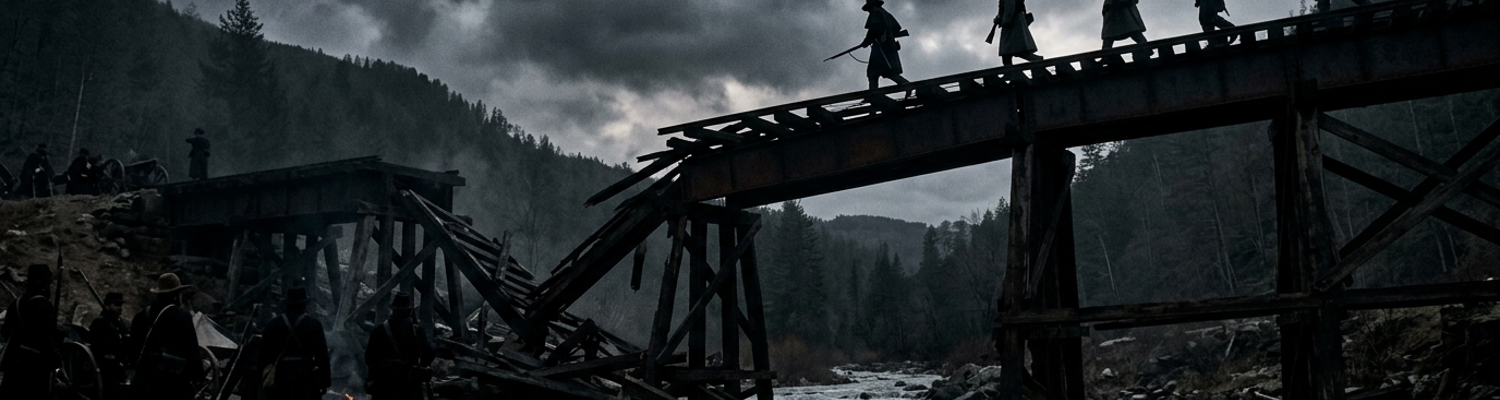

Tullahoma Campaign Logistics and the Elk River Crossing
02 JULY 1863, 1430 HOURS LOCAL, COORDINATES 35.267 N, 86.117 W.
Archival evidence shows Major General William S. Rosecrans based his regional strategy around the Nashville and Chattanooga Railroad. This 150-mile, five-foot broad-gauge track operated as the primary logistical backbone for Union army operations. Sixty thousand infantrymen required hundreds of tons of hardtack, salt pork, artillery shells, and forage every single day. Supply trains pulled by twenty-five-ton, wood-burning steam locomotives groaned southward from Nashville depots.
Saboteurs watched the tracks.
Trains carried these stores over iron T-rails spiked directly into untreated wooden cross-ties. The 4-4-0 engines consumed massive quantities of water and cordwood during transit. This required regular, stationary resupply stops. These stops presented easy targets for mounted raiders. Confederate cavalry units targeted this single-track line continuously. They tore up rails, burned water tanks, and destroyed track switches. Union engineers responded by establishing fortified blockhouses at regular intervals to protect the rolling stock. A close review of operational logs indicates that keeping the trains moving required constant, localized track repair under threat of ambush.
Any disruption to the rail schedule degraded combat readiness on the front lines.
Union forces during the 1863 Tullahoma Campaign required a secure rail crossing over the Elk River to maintain forward momentum. General Braxton Bragg ordered his retreating Confederate Army of Tennessee to destroy all infrastructure in their wake. Rearguard detachments systematically torched the main railroad bridge spanning the Elk River near Estill Springs. Fourteen consecutive days of heavy rain had swollen the waterway into a fast-moving, debris-filled hazard. The original masonry piers stood empty. Charred remnants of the wooden superstructure smoked in the current.
Colonel William P. Innes and the 1st Michigan Engineers and Mechanics arrived at the site with orders to restore rail traffic.
They faced a gap measuring exactly 450 feet across. The track bed sat forty feet above the floodwaters. Standard pontoon bridges could not support the sheer weight of a loaded freight train. The engineers initiated a large-scale construction effort using locally sourced green timber. Felling oak and pine trees in the surrounding dripping forests, the men used broadaxes and crosscut saws to shape the raw wood into twelve-by-twelve-inch square timbers. They had to construct a multi-tiered trestle bridge from scratch. Sections of the bridge, known as bents, were framed on the muddy riverbanks using traditional mortise and tenon joinery. Workers drilled deep holes with hand augers and hammered thick wooden pegs into the joints to secure the heavy framing. Mud coated every tool and piece of wood. The slippery conditions made handling the two-ton timber assemblies exceptionally dangerous.
Men waded waist-deep into the rushing river.
They positioned the first tier of foundational supports by hand. They rigged thick hemp ropes through block and tackle pulley systems anchored to large stumps on the shoreline. Teams of soldiers and draft horses strained against the ropes to hoist the massive timber bents into a vertical position. The uneven, rocky riverbed presented a severe engineering problem. Builders had to quickly measure the depth of the water at each specific contact point. They custom-cut the bottom legs of every bent so the top cap would sit perfectly level. The swift river current threatened to wash away the unanchored wooden bents before the upper stringers could lock them together. Engineers weighed down the base of the submerged trestles with loose rock hauled from the riverbanks in heavy canvas sacks. Once a bent stood upright on the riverbed, carpenters scrambled up the wet wooden beams. They locked the longitudinal stringers into place.
Enfilading Fire and Expedient Riverbank Fortifications
04 JULY 1863, 0615 HOURS LOCAL.
The 1st Michigan Engineers and Mechanics operated completely exposed forty feet above the Elk River floodwaters.
A close review of operational logs indicates that the noise of heavy construction masked the initial crack of incoming rifle fire. Soldiers wrestled with two-ton, green oak bents using hemp ropes and wooden A-frame derricks. Confederate partisan snipers had infiltrated the dense foliage along the southern embankment during the pre-dawn hours. These irregular marksmen utilized .577 caliber Enfield rifled muskets to target the Union builders systematically from concealed positions approximately four hundred yards away. The sharp report of black powder discharges was entirely drowned out by the roaring river current and the rhythmic thud of ten-pound iron sledges driving track spikes into wooden cross-ties. Bullets began splintering the freshly cut timber right next to the working men.
One heavy lead projectile struck a load-bearing block and tackle system suspended from a gin pole.
The kinetic impact shattered the wooden pulley housing and severed the main hoisting line. This sudden mechanical failure caused a partially lifted diagonal cross-brace to snap backward. The heavy timber crashed onto the lower trestle tier and fractured a freshly driven mortise joint. Men immediately dropped their broadaxes and flattened themselves against the wet, slippery wood. The exposed elevation of the bridge deck left the engineers with zero natural cover against the enfilading fire. Enemy fire pinned the construction crews directly over the rushing water.
Archival evidence shows Colonel Innes immediately halted all framing operations to address the tactical vulnerability.
He ordered Company A and Company D to retrieve their Springfield Model 1861 rifled muskets from the northern riverbank staging area. The engineers had to transition instantly from heavy construction to infantry combat. Innes deployed these armed pickets in a wide semicircular perimeter extending three hundred yards into the thick brush on the southern side of the crossing. The remaining builders began rapidly constructing temporary field defenses to secure the immediate work zone. They dragged loose iron T-rails and stacked them horizontally across discarded, defective wooden bents to create bulletproof parapets along the riverbanks. Workers filled empty canvas grain sacks with wet river mud and piled them tightly around the vulnerable base of the stationary steam engines powering the circular saws.
They wove flexible willow branches cut from the shoreline into tall cylindrical gabions.
Men packed these woven baskets with heavy rocks and positioned them at the bridgehead to shield the vulnerable tool depots. They assembled a makeshift blockhouse from raw railroad ties in less than two hours. The improvised fortifications provided rigid cover for the specialized carpentry teams. Sharpshooters from the 1st Michigan took up prone firing positions behind the stacked mud sacks and interwoven iron rails. They continuously scanned the opposite tree line for the telltale white smoke of black powder rifles. Whenever a partisan sniper fired at the bridge, Union pickets returned concentrated volley fire into the specific coordinate of the muzzle flash. This aggressive suppression tactic forced the Confederate irregulars to constantly shift their firing positions backward into the deeper woods. The increased distance severely degraded their accuracy against the narrow wooden targets of the trestle bents. Engineers crawled out onto the unfinished bridge deck on their stomachs to resume bolting the longitudinal stringers into the mortised joints. They pushed thick oak planks ahead of them as mobile shields while manipulating heavy iron wrenches and threading square nuts onto three-quarter-inch wrought iron bolts.
Quartermaster Disputes and Contraband Labor Strikes
Archival evidence shows the rapid reconstruction of the Elk River trestle depended entirely on the physical exertion of hundreds of formerly enslaved men. These laborers had fled nearby plantations to seek refuge within the lines of the Army of the Cumberland. Colonel Innes integrated these men into the 1st Michigan Engineers to handle the heavy earthmoving and lifting required for the bridge. Conflicting War Department orders regarding the legal status of these contraband laborers generated immediate administrative paralysis at the construction site. Washington had issued overlapping directives under the Confiscation Acts and the Militia Act of 1862. Local quartermasters at the Estill Springs supply depot could not determine if the men should be classified as confiscated enemy property, free civilian contractors, or formal military pioneers.
Standard Army Regulations required disbursing officers to log every laborer on Quartermaster Form 22 before issuing daily rations.
The chief paymaster for the division refused to process the localized paperwork. He cited a lack of clear authorization from Major General Rosecrans regarding the specific compensation rate for contraband work details. Stacks of incomplete vouchers piled up inside the damp canvas tents. Bureaucratic confusion meant supply clerks refused to release basic sustaining provisions to the workforce. The local quartermaster immediately secured the supply wagons with heavy iron padlocks and halted the distribution of salt pork to the unclassified men. Disputes over pay authorization and official labor status halted critical work details directly at the bridge site. The Army of the Cumberland had tentatively set contraband compensation at ten dollars per month, deducting three dollars for issued clothing. Disbursing officers at the Elk River crossing demanded written proof of this pay scale from the War Department before opening their iron lockboxes.
Officers from the 1st Michigan Engineers submitted hand-written rosters documenting the exact hours worked by the laborers.
The paymaster rejected the ledgers. He argued the forms lacked the required regimental countersignatures for civilian employment. Broadaxes and two-man crosscut saws lay abandoned in the wet clay. The laborers realized they would receive neither wages nor food for their highly dangerous work over the flooded river. They stopped hauling the thick hemp ropes. Two hundred men abandoned the block and tackle stations and sat down in the deep riverbank mud. A close review of operational logs indicates this sudden labor strike caused an immediate, severe mechanical crisis on the river. Engineers were in the middle of hoisting a three-thousand-pound green oak bent into a vertical position. Sudden loss of manpower on the hauling lines left the heavy timber frame suspended at a forty-five-degree angle over the floodwaters.
A single frayed rope held the massive wooden structure against the pull of gravity.
A handful of enlisted soldiers scrambled to wrap the slipping rope around a primary anchor stump. Friction burned through their leather work gloves. The heavy wooden bent groaned under its own weight. Thick hemp fibers of the main hoisting line began to snap one by one under the uncompensated strain. Innes rushed down from the command tent to assess the failing rigging. He found his construction schedule entirely derailed by a paperwork dispute occurring a hundred yards away. Diagonal cross-braces of the suspended bent twisted violently out of alignment. Snapping the main rope would send the entire wooden assembly crashing backward into the staging area, shattering the custom mortise joints. The engineering officers had to execute desperate administrative troubleshooting to restart the physical construction. Innes bypassed standard quartermaster requisition channels entirely. He ordered his company clerks to cross out the printed heading on a stack of standard infantry supply manifests. Clerks manually reclassified the unclassified workers as emergency regimental teamsters.
This specific designation fell under a completely different operational budget authorized directly by the cavalry corps.
Local disbursing officers accepted the modified forms. Quartermaster deputies unlocked the supply wagons and issued backlogged rations of cornmeal and pork. Hungry men consumed the cold food directly on the muddy banks. They returned to the block and tackle stations to take up the slack on the failing ropes. Combined hauling teams leaned backward into the mud and pulled the heavy oak bent fully upright. Carpenters quickly drove temporary wooden wedges into the base to lock the timber against the uneven riverbed.
Ordnance Bureau Requisitions and Mechanical Deficits
A close review of operational logs indicates that the physical construction of the Elk River trestle stalled primarily due to administrative failures originating eight hundred miles away. Bureaucratic interference from Washington delayed official tool shipments and hardware requisitions required by the 1st Michigan Engineers. The War Department had recently revised its standard procurement protocols for specialized engineering equipment. Clerks in the capital demanded that all requests for heavy felling axes, two-man crosscut saws, and one-inch hand augers be submitted on a newly printed Ordnance Bureau form. Colonel Innes had transmitted his urgent supply needs via military telegraph to the Nashville depot using the older documentation standards.
Desk officers in Washington intercepted the wire and placed a hard hold on the entire freight manifest.
They refused to authorize the release of three thousand wrought iron bolts and square nuts until the regimental quartermaster filled out the updated paperwork in triplicate. The required blank forms had not yet been printed or distributed to the western theater. The federal supply chain froze completely over a missing piece of paper. Engineers on the riverbank faced a severe mechanical deficit as their existing equipment began to fail under heavy use. Shaping wet, unseasoned oak timbers rapidly dulled the cutting edges of standard issue broadaxes. Wooden handles on heavy iron sledges splintered and snapped from the constant impact against thick track spikes. Regimental blacksmiths attempted to forge replacement parts using portable field anvils and charcoal fires.
They melted down bent horseshoes to cast makeshift drill bits for the hand augers.
Improvised iron lacked the high carbon content of factory-produced steel and bent uselessly against the dense grain of the river timber. Carpenters resorted to burning holes through the structural bents using red-hot iron rods. This crude method consumed hours of labor for a task that a sharp auger could complete in minutes. Work crews exhausted their supply of hemp ropes as the friction of lifting two-ton wooden frames tore the natural fibers apart. Men tried to splice the broken lines back together using raw horsehair. Local quartermaster officers struggled to clear supply bottlenecks amidst conflicting departmental directives. Boxcars loaded with replacement block and tackle pulleys sat locked on the rail sidings at Murfreesboro.
Major General Rosecrans had issued standing orders for all available rolling stock to transport artillery shells and hardtack exclusively to the front lines.
The regional logistics command classified engineering tools as secondary priority cargo. Quartermasters guarding the Murfreesboro switchyards refused to couple the tool cars to southbound locomotives without explicit written clearance from the Army of the Cumberland headquarters. Innes sent riders back up the rail line to negotiate directly with the depot commanders. Supply officers cited conflicting regulations regarding the distribution of specialized hardware to mixed units containing contraband laborers. They demanded formal infantry unit designations before unlocking the heavy wooden crates. The engineering train remained stranded thirty miles north of the bridge site. Archival evidence shows the 1st Michigan officers abandoned official procurement channels to keep the bridge project moving.
Specialized foraging details pushed into the surrounding Coffee County countryside to scavenge mechanical hardware from civilian farms.
Soldiers dismantled local gristmills to salvage heavy iron gears and thick leather drive belts. Blacksmiths repurposed the leather into hoisting straps for the A-frame derricks. Work crews ripped iron hinges off barn doors and carried them back to the riverbank for the forge fires. A cavalry detachment located an abandoned Confederate field forge hidden in a ravine. Draft horses hauled the heavy bellows and anvils back to the northern bridgehead. The engineers stripped iron tires from broken supply wagons scattered along the muddy turnpike. Metalworkers cut the circular bands into flat strips and hammered them into reinforcing plates for the wooden trestle joints.
Green Timber Harvesting and Draw-Bored Joinery
Archival evidence shows the 1st Michigan Engineers and Mechanics faced a severe material deficit upon surveying the ruined Elk River crossing. All pre-cut lumber reserves had burned. Colonel Innes ordered work details into the dense oak and hickory forests lining the northern embankment at coordinates 35.267 N, 86.117 W. Men armed with heavy felling axes and two-man crosscut saws began dropping mature hardwood trees directly into the rain-soaked soil. Harvesting unseasoned green timber introduced immediate mechanical complications to the salvage operation. Freshly cut oak retains massive amounts of water and sap within its cellular structure. This internal moisture increased the weight of a standard twelve-by-twelve-inch beam by nearly forty percent compared to kiln-dried wood.
The extra tonnage snapped ropes.
Draft horses sank to their knees attempting to drag the saturated logs through the floodplain. Soldiers established a rudimentary open-air sawmill on a relatively flat plateau thirty yards from the rushing water. They constructed elevated saw pits from salvaged railroad ties to process the raw trunks into usable structural spans. Men standing in the muddy pits pulled long whipsaws downward through the wet, fibrous grain. The high sap content constantly bound the steel blades. Friction halted the cutting. Workers stopped every few minutes to coat their tools with rendered pork fat. Heavy broadaxes swung in rhythmic arcs to square off the round logs. Shaping the raw wood required intense physical exertion from the specialized carpentry teams. They produced hundreds of individual replacement components entirely by hand.
The lack of proper drying kilns forced the engineers to build the bridge deck using timber that was still biologically alive.
Leaves stayed attached to the uncut branches. A close review of operational logs indicates the engineers processed over two hundred raw logs during the first forty-eight hours of continuous labor. Field officers recognized that standard architectural plans would fail when applied to this heavy, unseasoned lumber. Green wood shrinks, twists, and warps unpredictably as it dries under the harsh summer sun. Captain John B. Yates, commanding the forward construction companies, improvised entirely new timber framing techniques to compensate for these raw material deficiencies. He ordered his carpenters to deliberately overcut the mortise pockets by a quarter of an inch. This specific geometric modification allowed the adjoining tenon joints to swell and shift without fracturing the load-bearing oak columns.
The lack of standardized iron hardware forced further technical deviations.
Supply trains carrying wrought iron threaded bolts sat stalled thirty miles to the north. Yates directed his men to abandon standard bolting procedures entirely. The engineers compensated by drilling offset holes through the intersecting timbers. They hand-carved oversized wooden pegs from straight-grained hickory branches. These were known as trunnels. Men drove these thick wooden pins deep into the offset holes using heavy iron mallets. The intentional misalignment of the drill holes forced the mortise and tenon joints to pull tightly together as the peg entered the wood. This technique locked the massive bents together through pure mechanical tension. Draw-boring replaced factory hardware. The improvised joinery altered the entire load-bearing geometry of the trestle. Yates directed his crews to install double diagonal cross-braces on the lower tiers to counteract the inherent flexibility of the green wood. They cut deep, angled notches directly into the vertical support columns.
Carpenters wedged the green cross-braces into these notches before securing them with the hand-carved hickory spikes.
The wet horizontal beams sagged under their own weight when lifted by the A-frame derricks. Construction crews countered this downward deflection by forcing an upward camber into the longitudinal stringers using heavy iron pry bars. They wedged flat river stones between the joining surfaces to maintain the artificial arch. Workers held the tension on the pry bars. Carpenters quickly drove the hickory pegs into the modified joints. The unseasoned structural spans groaned audibly as the wood fibers compressed. Raw timber leaked sap down the vertical columns into the rushing floodwaters below. The engineers left the rough bark intact on the undersides of the secondary beams to save processing time. They constructed a forty-foot-tall wooden framework completely devoid of factory-milled lumber. Heavy locomotives weighing twenty-five tons later rolled directly over these sap-covered joints. The untreated green wood absorbed the kinetic shock of the passing iron wheels.
Scrap Iron Forging and Trestle Tension Rods
A close review of operational logs indicates the green timber framework began deflecting dangerously before the bridge deck was even finished. Unseasoned oak and hickory bents lacked the rigid tensile strength required to support moving freight. Lateral sway threatened to snap the hand-carved trunnels securing the forty-foot vertical columns. Colonel Innes faced a severe mechanical deficit directly over the rushing floodwaters. Standard wrought-iron tension rods remained locked in boxcars thirty miles north of the Estill Springs site. Engineers turned to the ruined Nashville and Chattanooga track bed scattered along the muddy riverbanks. Confederate rearguard detachments had previously heated and twisted the iron T-rails around tree trunks to destroy the line. Blacksmiths from the 1st Michigan Engineers hauled these discarded sections back to their field forges.
Teams of draft horses dragged the heavy scrap metal directly into the glowing charcoal pits.
Archival evidence shows the metalworkers repurposed the mangled rails into heavy-duty structural braces through intense physical labor. Heating the thick iron required operating the salvaged bellows at maximum capacity for several continuous hours. Once the metal glowed bright orange, soldiers pinned one end of the 300-pound rail under a massive field anvil. Work crews attached thick hemp ropes to the opposite end and commanded the draft horses to pull forward. This brute-force mechanical leverage straightened the warped tracks back into linear segments. Blacksmiths then swung ten-pound sledges to flatten the ends of the rails into flush mounting plates. They drove hardened steel punches through the hot iron to create custom bolt holes. Carpenters hoisted these newly formed tension rods up the wet wooden bents using block and tackle pulley systems. Men bolted the flat iron plates diagonally across the green oak columns, anchoring them directly into the load-bearing mortise joints.
The heavy iron rails locked the swaying wooden trestles into a rigid geometric grid.
When examining the historical record, this hybrid construction method directly solved the flexibility problem of the unseasoned lumber. Salvaged iron T-rails absorbed the lateral shearing forces generated by moving railcars. Green timber handled the downward compressive weight while the metal prevented the bents from buckling outward. On July 8, 1863, the first Union supply train approached the completed Elk River crossing. A twenty-five-ton wood-burning locomotive rolled onto the southern edge of the bridge at a walking pace. Engineers stood in the knee-deep mud below to watch the joints under active mechanical stress. Unseasoned oak timbers groaned audibly and compressed downward under the heavy iron wheels. Sap squeezed out of the mortise pockets and dripped into the river.
The repurposed rails held the diagonal tension perfectly.
Freight cars loaded with artillery shells and salt pork followed the engine across the 450-foot gap. Vibrations transferred from the cross-ties down through the wet wood and dissipated directly into the reinforced iron braces. The iron tracks prevented the green wood from twisting under the asymmetric weight distribution of the swaying boxcars. Track alignment remained completely level as the train reached the northern embankment. Quartermasters immediately dispatched three more fully loaded supply trains across the improvised structure. Soldiers fed cordwood into the fireboxes and kept the steam pressure high to maintain forward momentum. The hybrid iron and timber framework supported hundreds of tons of rolling stock continuously over the next forty-eight hours. Mechanics inspected the structural braces after every crossing. They found zero instances of sheared bolts or fractured oak columns. The improvised tension rods distributed the kinetic load evenly across the entire forty-foot elevation of the trestle. Water levels in the Elk River began to recede, exposing the rock-filled canvas sacks anchoring the base of the bents. The rigid iron T-rails forced the drying timber to maintain its exact vertical alignment.
Kinetic Load Testing and Sustained Rail Operations
Archival evidence shows the immediate resumption of rail traffic over the Elk River at coordinates 35.267 N, 86.117 W saved the Army of the Cumberland from immediate starvation. Major General William S. Rosecrans had pushed sixty thousand infantrymen deep into the Middle Tennessee topography with only three days of marching rations in their haversacks. The rapid reconstruction of the Elk River trestle restored the primary supply artery connecting the massive Nashville depots to the forward staging areas. Colonel Innes and the 1st Michigan Engineers and Mechanics finished the 450-foot span just as the frontline quartermasters reported completely empty grain sacks. Supply trains instantly began crossing the hybrid iron and green timber framework. Boxcars packed with heavy twelve-pounder artillery shells, salt pork barrels, and wooden crates of .58 caliber Minie balls moved southward at a continuous walking pace.
A twenty-five-ton wood-burning locomotive rolled across the unseasoned oak deck on July 8, 1863.
Soldiers fed cordwood into the locomotive fireboxes while engineers stood in the knee-deep mud below the tracks to monitor the load-bearing joints. The unseasoned wooden bents groaned under the asymmetric weight distribution of the swaying freight cars. Heavy iron wheels ground against the rails. Active kinetic force tested every hand-carved trunnel and draw-bored mortise connection on the forty-foot vertical columns. Sap squeezed out of the rough joints and dripped directly into the receding floodwaters. A close review of operational logs indicates that continuous field-level technical troubleshooting prevented a major logistical collapse during the immediate advance toward Chattanooga. The sheer kinetic shock of the passing 4-4-0 steam engines caused the wet horizontal stringers to deflect downward by several inches under the active load. This sudden sagging threatened to derail the heavy supply trains before they could reach the southern embankment.
Captain John B. Yates scrambled his specialized carpentry teams back onto the wet scaffolding underneath the active tracks.
Men worked just inches below the spinning iron wheels of the locomotives. They drove thick wedges of seasoned hickory directly into the failing joints using ten-pound iron sledges. The dense replacement wood forced the sagging stringers back into a level horizontal alignment. Vibrations from the passing trains shook heavy tools directly out of their hands. Mechanics noticed the heavy iron T-rails beginning to separate from the wooden cross-ties near the center of the river span. The untreated green wood was shrinking rapidly in the severe July heat, loosening the grip of the iron track spikes. Engineers immediately initiated an improvised shimming operation along the entire 450-foot deck. Workers crawled on their stomachs along the outer edges of the trestle. They hammered thin plates of salvaged scrap metal between the rails and the shrinking wood to maintain a perfectly level track bed. Blacksmiths heated replacement spikes in portable field forges set up on the northern riverbank.
Runners carried heavy canvas buckets of these glowing iron spikes out to the track crews.
The men drove the hot metal deep into the oak ties, searing the wet wood fibers to create a tighter mechanical grip. Track crews repeated this localized repair process after every single train crossing. Rosecrans required hundreds of tons of daily freight to push the Confederate Army of Tennessee completely out of the region. The improvised engineering solutions at Estill Springs kept the Nashville and Chattanooga Railroad fully operational during the summer offensive. Quartermasters logged over forty heavily loaded supply trains crossing the modified Elk River trestle within the first seventy-two hours of its completion. Train crews maintained high steam pressure to push through the temporary speed restrictions over the bridge. Engineers constantly tightened the hand-carved wooden pegs and adjusted the salvaged iron tension rods to counteract the lateral sway generated by the moving boxcars. Track alignment held firm as the front lines moved steadily southeast toward the Tennessee River. Infantry units received their daily shipments of hardtack and black powder directly from the restored railcars.