
A Mandate Forged in Conflict
The United States formally authorized a survey of its coasts on February 10, 1807. President Thomas Jefferson, a surveyor himself, signed the act which requested a comprehensive charting of the nation’s shores, islands, and shoals. The mandate’s initial momentum, however, quickly dissipated. Political opposition, rooted in concerns over federal expense and states' rights, stalled the ambitious project. Ferdinand R. Hassler, the Swiss geodesist chosen to lead the effort, traveled to England to procure specialized scientific instruments unobtainable in America. The outbreak of the War of 1812 and a British embargo trapped him there, effectively shelving the entire enterprise. The war itself then provided a brutal, undeniable argument for the survey’s necessity. The Royal Navy established a punishing blockade along the American seaboard, exploiting its superior knowledge of coastal waters. American naval forces and commercial shipping found themselves hamstrung by a profound lack of reliable charts for their own territorial waters. British warships navigated with comparative ease, while U.S. vessels like the frigate USS Congress frequently ran aground or were cornered in poorly understood bays and inlets. This stark navigational deficiency exposed a critical vulnerability in national defense and crippled maritime commerce.
Following the war, the arguments for a comprehensive coastal survey were overwhelming. The national government, having felt the sharp sting of ignorance, resurrected the project. Hassler, finally returned from Europe with his precision instruments, was reappointed as superintendent in 1832. This came after years of political infighting and a brief, unsatisfactory period where the task was assigned to the U.S. Army's Topographical Bureau. The Army's methods, focused on rapid reconnaissance, proved ill-suited for the permanent, high-precision geodetic work required for maritime safety. The organization, formally named the U.S. Coast Survey in 1836, was established as a civilian agency under the Treasury Department. This decision would shape its character and its complex relationship with the military for decades. Hassler, a man described as brilliant but politically abrasive, insisted on a methodology of extreme scientific rigor. He envisioned not just a series of charts, but a complete geodetic network, a foundational triangulation of the entire coast that would serve as the immutable basis for all future mapping. This approach clashed with politicians who demanded immediate, practical charts for key harbors. Despite the pressure, Hassler laid the scientific groundwork that defined the Survey for the next century, prioritizing uncompromising accuracy over political expediency.
The Science of Sovereign Control
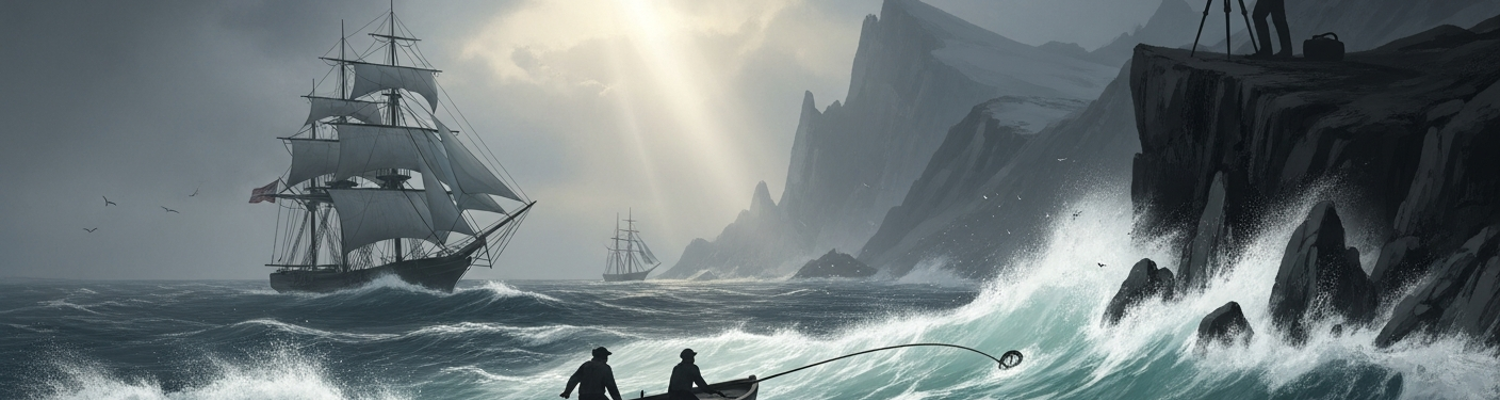
The work of the Coast Survey was a complex and arduous synthesis of terrestrial geodesy and at-sea hydrography. The process began on land. Survey teams, lugging heavy and delicate instruments, hacked their way to the tops of coastal hills and promontories to establish stations. The foundational method was triangulation. Surveyors would first measure a baseline, a perfectly flat stretch of land several miles long, with painstaking precision using standardized bars within a protective apparatus to negate thermal expansion. From the ends of this baseline, they used a theodolite, a complex telescopic instrument on a tripod for measuring horizontal and vertical angles, to sight a third distant point, forming a large triangle. By calculating the lengths of the triangle’s sides, they could establish the exact position of that third point. This process was repeated, building a web of interconnected triangles that stretched down the coastline, creating a rigid geodetic framework. Astronomical observations, using zenith telescopes to measure star positions against the meridian, were required to precisely determine latitude and longitude at key points, anchoring the entire network to the globe. The field work was punishing, exposing teams to harsh weather, disease, and difficult terrain for months on end.
Only after the shore was mapped could the hydrographic work begin. This was the most dangerous phase of the operation. Small schooners, such as the Gallatin and the Silliman, were specially designed or acquired for the task. They were crewed by a mix of civilian surveyors and U.S. Navy officers and sailors. The Navy’s involvement was a practical necessity, providing skilled seamen and officers experienced in ship handling. It also created a persistent, low-grade rivalry between the civilian scientists and the military men. The command structure was often tense, with a Navy lieutenant commanding the vessel and its crew, while a civilian chief of party directed the scientific mission. From these schooners, smaller survey boats were dispatched into the shallows. Here, the primary tool was the lead line, a weighted rope marked at fathom intervals. A leadsman would cast the lead forward, letting the line run free until the weight struck bottom. As the boat drifted over the spot, the leadsman would read the depth from the line’s markers, crying out the sounding for a recorder. A hollow at the base of the lead weight, armed with tallow, would bring up a sample of the sea floor, sand, mud, or shell, providing vital information for anchoring. This was physically demanding, repetitive, and perilous work, performed in open boats exposed to sudden squalls, treacherous currents, and the constant risk of capsizing on the very shoals they were tasked to find. Thousands upon thousands of these soundings, each one a single point of data, were meticulously plotted onto field sheets, slowly revealing the hidden topography of the seabed before being sent to Washington for engraving.
Instruments of Blockade and Invasion
The strategic value of the Coast Survey’s work was tested and proven in conflict. During the Mexican-American War, the Survey’s charts were indispensable. When General Winfield Scott planned his amphibious assault on Vera Cruz in 1847, a critical operation, he relied on a detailed chart of the approaches. The chart was created by a Coast Survey team led by Lieutenant Commander Samuel Phillips Lee of the U.S. Navy, working from the brig USS Washington. This reconnaissance, conducted under the potential gaze of enemy forts, allowed the U.S. Navy to identify the ideal landing beaches south of the city and navigate the transport flotilla safely. This directly contributed to the successful capture of Vera Cruz. The Survey’s second superintendent, Alexander Dallas Bache, a politically astute scientist and the great-grandson of Benjamin Franklin, understood the importance of demonstrating the Survey’s military utility. He actively promoted the use of his agency’s products by the armed forces, solidifying its budget and political standing.
This policy reached its ultimate expression during the American Civil War. At the war’s outset, the Union’s naval advantage was significantly hampered by a lack of accurate charts for the southern coastline. The Confederacy controlled thousands of miles of shoreline riddled with inlets, barrier islands, and shifting sandbars, a nightmare for any blockading force. Bache, a staunch Unionist, immediately placed the full resources of the Coast Survey at the disposal of the War Department. Surveyors, ships, and, most importantly, the entire archive of charts and maps of the southern states were mobilized. Bache and his cartographers produced hundreds of maps for military use, including the “Historical Sketch of the Rebellion” series, which visually tracked Union progress. The Survey published secret “Notes on the Coast,” detailed guides for Union naval officers containing specific sailing directions, intelligence on tides and currents, and descriptions of coastal defenses, all derived from their pre-war work.
These charts were the operational key to the Anaconda Plan, the Union’s grand strategy to strangle the Confederacy by blockading its ports and controlling the Mississippi River. When Flag Officer Samuel Du Pont planned his pivotal 1861 attack on Port Royal, South Carolina, he did so using the Coast Survey’s detailed chart of the harbor. Surveyors sailed with the fleet, placing buoys to mark the safe channel for the warships on the eve of the assault. The precise knowledge of water depths and shoals provided by the charts allowed Du Pont’s squadron to maneuver with confidence, bypass Confederate defenses, and secure a vital deepwater port for the blockading fleet. Similar scenes played out repeatedly. The capture of Hatteras Inlet in North Carolina was enabled by charts that revealed a viable channel for Union warships. Admiral David Farragut’s daring run past the forts into Mobile Bay in 1864 relied on hydrographic intelligence provided by Survey personnel. Throughout the war, from the Mississippi Delta to the inlets of the Outer Banks, the Union Navy projected its power using charts created by the hydrographic guardians of the Coast Survey. Their painstaking pre-war scientific labor became a decisive instrument of national military strategy, fundamentally reshaping America’s ability to control its maritime frontier and project power from the sea.