
Convoy HX-212 North Atlantic Peril
October 18, 1942. Forty-five merchant ships departed New York, forming Convoy HX-212. Their manifests were a cross-section of the Allied war machine: fuel, munitions, and men bound for Liverpool. The safe arrival of this cargo was a strategic requirement, factored into the highest levels of Allied planning for Operation Torch, the imminent invasion of North Africa. The loss of a single ship meant fewer tanks, less fuel, and a tangible delay in prosecuting the war.
The convoy’s route was a direct path into the most dangerous waters of the Atlantic. German U-boat command under Admiral Karl Dönitz had refined its wolfpack tactics, or Rudeltaktik, into a deadly science. U-boats no longer hunted alone but in coordinated groups, forming picket lines across anticipated convoy routes based on intelligence and radio intercepts. October 1942 was a period of intense activity, with U-boats sinking 93 Allied ships. Over 100 U-boats were active in the Atlantic, allowing the Kriegsmarine to prosecute a relentless campaign.
The most feared section of the journey was the “Black Pit.”
This was a gap in the mid-Atlantic beyond the range of land-based Allied air cover from Canada, Iceland, or the UK. In this zone, convoys were deprived of their most effective defense. The handful of surface escorts were left to fend off multiple attackers from all directions. Without aircraft to spot submerged U-boats or force them to stay down, wolfpacks could operate with near impunity.
Among the ships of HX-212 was the USS Samuel Chase (APA-26). This was not a standard 11-knot Liberty ship. The Samuel Chase was a faster, more specialized Arthur Middleton-class attack transport. Commissioned in June 1942 with a U.S. Coast Guard crew, its primary purpose was to carry assault troops into battle. On this voyage, it served as the flagship for the landings at Algiers, a key component of Operation Torch. Its holds were packed with troops and equipment for the 2nd Battalion, 30th Infantry, and it carried staff for the Western Task Force Headquarters. Its presence in the convoy was as a command-and-control asset whose loss would jeopardize a cornerstone of the North Africa invasion.
SCR-299 Communication Blackout
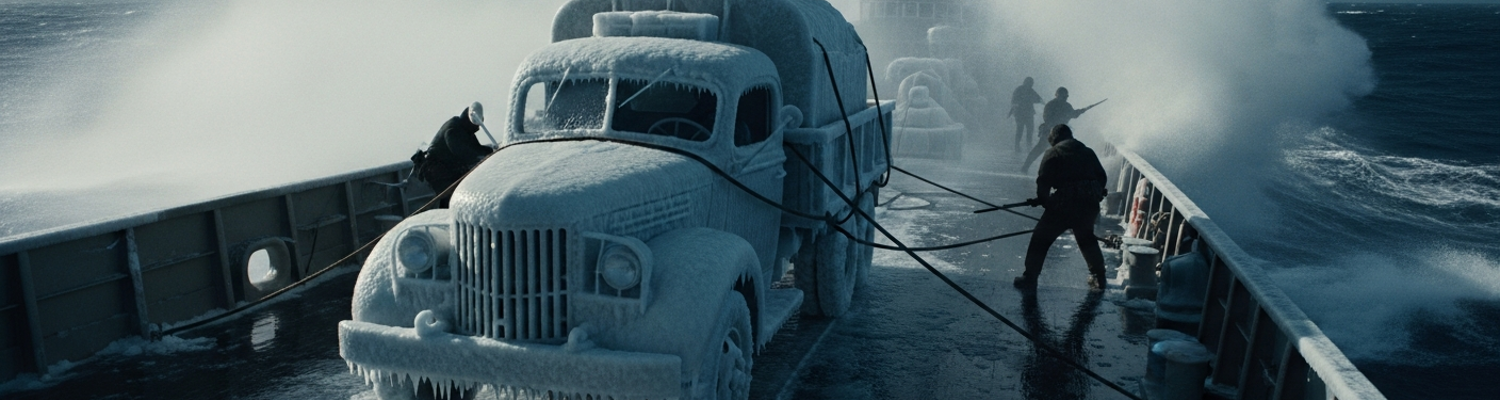
The North Atlantic gale struck with unrelenting force. A mixture of rain and ocean spray, supercooled by arctic wind, began to accrete on every exposed surface. On the deck of the USS Samuel Chase, lashed down against the violent pitching of the ship, was a K-51 van truck. It contained the ship’s primary long-range communications asset: an SCR-299 radio set. Archival reviews of its technical specifications show its components were not intended for sustained exposure to these specific maritime conditions.
Freezing spray began to encase the entire truck. The antennas, either a 15-foot whip or an auxiliary wire, became laden with hundreds of pounds of ice. This altered their electrical characteristics and threatened to snap their moorings. Ice worked its way into coaxial cable connections and the insulators for power lines running from the separate K-52 trailer that housed the PE-95 power generator. Technical manuals for the equipment warn that moisture and compromised insulation could lead to dangerous electrical arcing and power shorts.
Inside the van, the heart of the SCR-299, its BC-610 transmitter, relied on large, sensitive vacuum tubes. These included a 250TH tube for the final power amplifier, which were susceptible to thermal shock and voltage fluctuations. The combination of ice loading the power systems, moisture ingress, and the violent motion of the ship created a cascade of failures. Power to the transmitter became unstable.
Then it failed completely.
One moment, the operators were in contact with naval command. The next, nothing. The high-frequency carrier wave that connected the Samuel Chase to the outside world vanished. A review of operational logs from the period indicates that ships like the Samuel Chase, serving as flagships, had a strict communications schedule. Her role as the command vessel for the Algiers landings meant she was a critical node. The operators worked frantically, checking connections and attempting to diagnose the fault in the BC-610 transmitter and its BC-614 speech amplifier. A missed check-in would not go unnoticed. At naval command in London, the silence from the Samuel Chase would be interpreted through the brutal calculus of the U-boat war. An unscheduled loss of contact with a high-value asset in the “Black Pit” often meant one thing: torpedoed and sunk.
The convoy was now blind. This single equipment failure magnified the danger for all forty-five vessels. The loss of the SCR-299 severed the convoy’s only reliable, high-powered link to the Admiralty’s U-boat tracking room. This chamber was the nerve center of the Battle of the Atlantic, using a network of shore-based High-Frequency Direction Finding (HF/DF or “Huff-Duff”) stations to triangulate the positions of German U-boats. This intelligence allowed the Admiralty to reroute convoys away from known wolfpack concentrations. Without it, the convoy escort commander could only react to threats his own lookouts detected. The entire convoy was forced to plow ahead on its last known heading, straight into waters where U-boat patrol lines were known to be gathering.
Signal Detachment Technical Failures
The equipment problems that plagued the SCR-299 went far beyond the accumulation of ice. A close review of the radio’s design reveals a cascade of internal component failures. The heart of the BC-610 transmitter’s final radio frequency amplification stage was a large 250TH power triode vacuum tube. Its delicate internal structure of filaments, grids, and plates was suspended within a glass envelope. Technical specifications show these tubes were vulnerable to mechanical shock and vibration, a constant reality on a ship tossed by a gale. The unceasing, high-frequency vibrations, combined with violent jolts as the ship crested waves, placed immense stress on the tube’s internal welds and glass-to-metal seals.
The extreme cold made the glass envelope brittle. As operators attempted to power the set, the thermal shock of the filament heating up against the sub-zero ambient temperature caused repeated expansion and contraction. Eventually, a micro-fracture would have propagated, causing a catastrophic loss of vacuum and instantly destroying the tube.
This was not a single point of failure. The power source for the radio system was a PE-95 generator in a separate K-52 trailer. Its lubricants were not prepared for the arctic conditions. Standard mineral-based engine oils of the 1940s had a high viscosity and would congeal as temperatures dropped. In the sub-zero environment, the oil in the PE-95’s crankcase transformed into a thick, waxy sludge. This coagulated lubricant would fail to circulate, placing an impossible strain on the starter. If the engine could be forced to turn over, the lack of flowing oil to bearings and pistons would cause friction, overheating, and rapid mechanical failure.
Compounding every mechanical issue was a logistical nightmare. The absence of critical replacement parts was a systemic problem. When the 250TH vacuum tube ruptured, the Signal Corps technicians aboard the Samuel Chase had no recourse. Their onboard spares were limited. A request for a highly specific component like a power triode would have to enter the vast and overburdened Quartermaster supply system. Signal Corps supplies, being technical and specialized, were often not prioritized with the same urgency as bulk cargo. A requisition would have to be transmitted, approved, and sourced from a depot in the United States or the UK. It would then have to compete for space on a westbound convoy. The reality for the operators on the Samuel Chase was that help was weeks, if not months, away.
Field Improvisation and Cannibalization
The Signal Corps technicians faced a dead BC-610 transmitter and a seized PE-95 generator. With no hope of replacement parts, their only option was to create solutions from materials at hand. Signal Corps training manuals from the era (per NARA Record Group 111-SC) accepted the necessity of field expedient repairs. The first problem was the generator. The congealed lubricating oil had to be thinned. The most direct method available would have been the application of heat. This was a profoundly dangerous proposition. Using an open flame was unthinkable. Their most plausible course of action would be to use the ship’s own systems, carefully routing a low-pressure steam line from the engine room to the deck and wrapping it around the generator’s oil sump.
A secondary, more desperate technique involved diluting the sludged oil with a volatile liquid. Gasoline from the generator’s own fuel tank or kerosene from the ship’s stores could lower the viscosity enough to allow the engine to turn over. This would destroy the generator’s engine bearings, but it would provide a brief window of electrical power.
They were in a race against entropy.
With the generator providing unstable power, attention turned to the BC-610 transmitter. The failure of the 250TH final amplifier tube was a seemingly insurmountable obstacle. A shattered vacuum tube must be replaced. With no spare 250TH tubes, the technicians would have initiated a methodical process of cannibalization. Their first target would be any other electronic equipment on the ship that might use a similar high-power triode. The Samuel Chase was equipped with multiple radio systems. The technicians would have systematically reviewed the schematics for every piece of radio gear aboard, searching for a tube with comparable plate voltage and filament requirements. A direct equivalent was unlikely. A cross-reference of military vacuum tube designations shows that the 250TH was also known as the VT-220; technicians might have looked for other tubes in the same family.
Failing that, their salvage efforts would have shifted to more fundamental components. A review of the BC-610’s schematic shows a complex architecture of capacitors, resistors, and transformers. The ship’s public address system, crew entertainment phonographs, and even non-critical motor control circuits were potential parts depots. Using handheld multimeters, they would test salvaged capacitors and resistors. Copper wire could be painstakingly stripped from decommissioned wiring looms to bypass a burned-out trace. The work would have been conducted in the cramped, freezing K-51 van, with the constant risk of high-voltage electrical shock from the transmitter’s power supply, which could deliver a lethal charge even when switched off.
Operator Psychological Erosion
A review of historical records on combat fatigue reveals the intense psychological pressures faced by men in the Battle of the Atlantic. For the Signal Corps detachment, this pressure was magnified by their specific, technical failure. The continuous, unseen threat of U-boat attack was the foundation of this mental decay. The first sign of an attack was often the percussive blast of a torpedo striking a nearby ship, a sudden eruption of flame and smoke. For the operators inside the K-51 van, every creak of their own ship’s hull could be the prelude to their own destruction.
It was a fear with no release.
The knowledge that their broken radio was the direct cause of the convoy’s blindness added a layer of personal responsibility to the generalized fear. Layered on top of the enemy threat was the physical assault of the environment. The North Atlantic in late 1942 was a region of persistent gales. The SCR-299 technicians’ world was a freezing metal box, isolated on the weather deck and subject to the violent motion of the ship. The simple act of holding a soldering iron steady became a monumental task. Prolonged exposure to these conditions induced a state of deep physical and mental fatigue. Medical logs from the period note that such prolonged stress led to apathy and an inability to perform basic tasks.
The psychological burden on the Signal Corps operators was unique. Unlike the merchant mariners or the naval escort crews, their primary function had failed completely. A review of Signal Corps operational doctrine shows an emphasis on success and efficiency, leaving little room for the kind of catastrophic equipment failure they were experiencing. This created a profound sense of professional inadequacy. They were surrounded by thousands of men whose lives depended on their ability to solve a problem for which they had no parts and inadequate tools. This led to what was then termed “combat fatigue,” with symptoms ranging from tremors and slower reaction times to indecision and a disconnection from one’s surroundings.
This combination of factors created a downward spiral. The fear of imminent death, the grinding physical misery, and the weight of their specific responsibility eroded their mental resilience. Studies of combat stress from the period show that this state could lead to a near-vegetative condition. Auditory hallucinations were common among men under such duress. Fine motor skills, essential for delicate electronic work, would have degraded from the combined effects of cold, stress, and exhaustion. They were trapped in a feedback loop: the stress made the repairs harder, and the difficulty of the repairs increased the stress.
An Unorthodox Communication Gambit
The Escort Commander, the officer in tactical command of the convoy’s warships, faced a catastrophic intelligence failure. A close review of operational logs from Escort Group A-3, the unit responsible for HX-212, shows their primary responsibility was the immediate defense of the convoy. The loss of the high-powered SCR-299 aboard the Samuel Chase severed their link to the Admiralty’s U-boat tracking plot. The commander’s remaining assets were tactical, not strategic. His destroyers and corvettes were equipped with short-range, line-of-sight VHF radiotelephones, the TBS (Talk Between Ships) system, useless for contacting shore. Standard Allied communication doctrine for this scenario was unequivocal.
Maintain strict radio silence.
The commander made a decision that violated the core tenets of these established procedures. It was a calculated gamble born of desperation. The plan was a flagrant breach of every rule. The commander ordered the implementation of an unsanctioned communication relay. A study of the period’s technical capabilities suggests a daisy chain of destroyers would have been positioned at the extreme edge of the convoy, pushing the limits of their TBS radio range. Each escort vessel would act as a repeater. A coded message, originating from the Escort Commander, would be spoken over the low-power TBS, received by the first ship, and then immediately re-transmitted to the next. The final ship, many miles from the main body of the convoy, would be ordered to use its own medium- or high-frequency transmitter to broadcast the message, hoping a friendly station in Iceland or Newfoundland might hear it. This broke doctrine on multiple levels. It required multiple ships to transmit, creating numerous signals for German direction-finding stations to locate. It extended the electronic footprint of the convoy by miles.
The rationale for this violation rested on a brutal calculation of risk. The standing orders to maintain radio silence were designed to prevent a U-boat from getting a fix on a convoy’s position. But the Escort Commander was operating under the assumption that wolfpacks were already converging on their route. The German B-Dienst, their signals intelligence service, was known to be adept at breaking convoy codes and predicting routes. Sailing silently and blindly ahead was likely a course into a prepared ambush. The commander was choosing between the possibility of being detected by breaking radio silence and the probability of being annihilated by sailing into a trap he could no longer be warned about. The primary function of the lost SCR-299 was to receive the Admiralty’s “U-boat Situation” reports. Losing this intelligence meant the convoy could not be evasively routed. The commander’s gambit was an attempt to trade the tactical risk of radio detection for the chance to regain this strategic-level awareness.
Post-Mission Doctrine Scrutiny
The unorthodox relay worked. A review of Admiralty records indicates that the fragmented message, passed ship-to-ship and finally broadcast by a distant escort, was received by an Allied listening station. The signal was weak and garbled. It was enough. For the first time since the SCR-299’s failure, the strategic nerve center of the Battle of the Atlantic knew where Convoy HX-212 was and that it was sailing blind. New routing instructions were formulated and transmitted via the high-powered BAMS (Broadcast to Allied Merchant Ships) system. The order was for a significant course correction to steer the convoy away from the known patrol line of the U-boat wolfpack Veilchen, which was concentrating for an attack. While HX-212 would still suffer losses from other U-boats, this re-established link prevented a potential mass-casualty ambush. The survival of the convoy’s core, including the USS Samuel Chase, was a direct result of the commander’s breach of protocol.
It was a success that guaranteed a formal inquiry.
Upon arrival in the United Kingdom, the Escort Commander of Escort Group A-3 was subjected to severe post-mission scrutiny. A Royal Navy board of inquiry was convened. The central charge was the flagrant violation of standing orders regarding radio silence. Allied communication doctrine was explicit: aside from short-range, line-of-sight TBS voice radio, all other transmissions in the mid-Atlantic were forbidden. The reasoning was based on hard-won experience. A single medium- or high-frequency transmission could be pinpointed by land-based direction-finding stations, giving away a convoy’s precise location. The commander’s daisy-chain relay had not just created one signal for the enemy to find, but multiple, advertising the convoy's presence.
The commander’s justification was a cold lecture in risk assessment. An analysis of after-action reports shows his defense was not an apology, but a stark operational calculation. He argued that the principle of radio silence assumed the convoy’s position was unknown to the enemy. He operated under the opposite assumption. Given the convoy’s schedule, its last known heading, and the known effectiveness of German B-Dienst intelligence, he believed discovery was not a risk but an approaching certainty. The loss of the SCR-299 had blinded him to the Admiralty’s strategic U-boat plot. His choice, as he presented it to the board, was between the high probability of sailing directly into a prepared ambush and the lower probability of being detected by a brief, improvised transmission. He chose to trade the tactical risk of detection for the chance to regain strategic awareness, a gamble he felt was necessary given that his cargo included the command-and-control ship for a central element of the impending Operation Torch invasion.