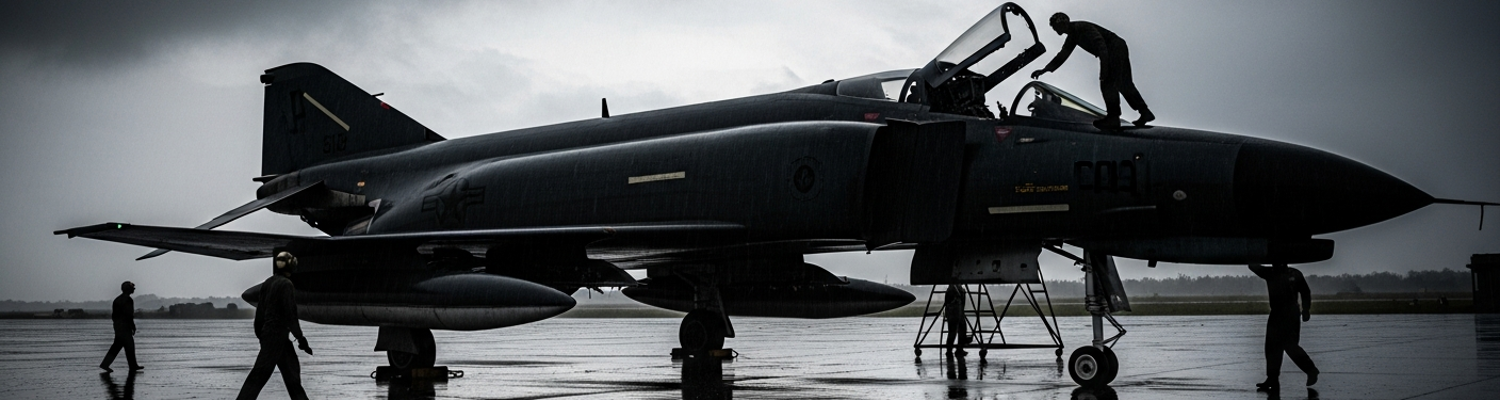

The air over I Corps was still, thick with humidity. Below, the jungle canopy hid firebases and infiltration routes. On the flight line at Da Nang Air Base, the air crews of Marine Fighter Attack Squadron 122 (VMFA-122) prepared their machines under the South Vietnamese sun. The squadron, known then as the Crusaders, had deployed from MCAS El Toro, arriving in-country in August 1967 and commencing combat sorties on September 1st. By 1968, they were a seasoned component of Marine Aircraft Group 11, tasked with protecting Marines on the ground.
Their operational orders were direct. The primary mission was close air support for infantry and artillery units locked in combat across the northernmost provinces of South Vietnam. This required being on-call to strike enemy positions, break up ambushes, and provide aerial cover for units in contact. A review of operational logs shows secondary tasks included armed reconnaissance and interdiction strikes against supply lines. Throughout early 1968, their focus was absolute, particularly during the siege of Khe Sanh. In February alone, the squadron flew 629 combat sorties, delivering 1,300 tons of ordnance in support of the besieged garrison. They would operate from Da Nang until a rotation to Japan in September 1968.
Air-to-air combat was not the priority.
The central tool for this effort was the McDonnell Douglas F-4B Phantom II. Originally designed as a high-altitude fleet defense interceptor for the U.S. Navy, the F-4B was a study in force. Its two General Electric J79 engines could push the 30,000-pound airframe to over twice the speed of sound, carrying an ordnance load of up to 18,650 pounds. This payload capacity made it a formidable ground-attack platform. Archival evidence shows the F-4B was a machine of its time, saddled with design choices that would plague its crews. The most glaring omission was an internal cannon. Prevailing strategic thought dictated that future air combat would occur at long range with missiles, rendering guns obsolete. This left pilots reliant on early-generation AIM-9 Sidewinder and AIM-7 Sparrow missiles, whose performance was often degraded by the jungle climate and rules of engagement that required visual identification before firing. The J79 engines, for all their power, produced a thick, tell-tale trail of black smoke, making the Phantom easily visible for miles and a target for ground fire.
The daily existence for a VMFA-122 pilot in 1968 was a world away from high-altitude dogfights. The common perception among aviators was that the Phantom was a MiG killer, and many arrived in theater expecting to engage North Vietnamese fighters. The strategic situation for a Marine squadron based at Da Nang, however, was dictated by the ground war. The primary threat was not a supersonic MiG-21, but the dense network of 37mm and 57mm anti-aircraft artillery (AAA) sites hidden in the jungle. The mission was not air superiority over Hanoi, but the delivery of napalm, high-explosive bombs, and cluster munitions in direct support of grunts in places like Khe Sanh and the A Shau Valley. An analysis of sortie data from this period confirms the overwhelming majority of missions were air-to-ground. Encounters with enemy aircraft were extraordinarily rare for Marine aviators in I Corps. Most air-to-air action occurred far to the north, handled by U.S. Air Force and Navy units. The war for VMFA-122 was a low-altitude affair against terrain, weather, and a largely unseen enemy on the ground.
American aircrews had been conditioned to expect threats from two distinct domains: radar-directed anti-aircraft artillery and turning engagements with MiG-17s and MiG-21s at low to medium altitudes. North Vietnamese Air Force (VPAF) doctrine, heavily influenced by Soviet ground-controlled intercept (GCI) tactics, was well-understood. VPAF pilots were vectored by controllers on the ground into advantageous positions, typically to ambush bomb-laden F-105 formations. The engagements were almost always close-range maneuvering below 20,000 feet, where nimbler MiGs could exploit their turning advantages against the heavier Phantoms. The F-4’s strength was its powerful engines and missile armament, giving it an energy advantage. Combat reports from Navy and Air Force squadrons flying over the heavily defended Route Packages in the North consistently described engagements that started with high-speed passes and often devolved into swirling, close-range maneuvering.
This was the established pattern.
By mid-1967, a new tactical evolution began to emerge from the VPAF. Intelligence briefings, trickling down to squadrons like VMFA-122, started to include fragmented reports of a different kind of enemy contact. These were not ambushes from behind mountains or head-on passes through the haze. They were high-speed, high-altitude attacks executed with chilling precision. American strike packages flying well above 30,000 feet began reporting MiG-21s appearing seemingly from nowhere, diving from the thin, cold air above 45,000 feet. For an F-4B crew, the physical reality of operating at these altitudes was demanding. The Phantom felt sluggish, its controls less responsive in the rarified atmosphere. Its two General Electric J79 engines produced smoke trails that made it visible for miles, yet at extreme height, their thrust was fighting against physics, making aggressive maneuvering a high-risk gamble. The aircraft’s combat maneuverability was significantly degraded compared to its performance in denser air.
The VPAF had deliberately used altitude as a tactical advantage, creating a problem for which there was no immediate solution. An analysis of these engagements reveals a consistent methodology. VPAF GCI controllers would vector their MiG-21 interceptors to a perch altitude, sometimes as high as 60,000 feet, far above the American formations. The lightweight, purpose-built MiG-21 was suited for this environment. From this perch, the VPAF pilot held a massive potential energy advantage. They would wait, invisible to the F-4’s upward-looking radar and visually undetectable against the blackness of the high sky, until the American aircraft were directly below. The attack was a supersonic dive. The MiG pilot would roll in, convert altitude into speed, and close to within firing parameters for his K-13 Atoll heat-seeking missiles. After launching a missile at the unsuspecting Phantom’s exhaust, the MiG-21 pilot would continue the high-speed dive to disengage, often before the F-4 crew registered the attack.
This new threat was unnerving. It subverted the known rules of engagement and exploited a weakness in the F-4’s performance envelope. Accounts from pilots who survived these attacks describe a feeling of vulnerability. The enemy was no longer a visible bandit to be engaged in a contest of skill, but an invisible opponent striking from a sanctuary where the Phantom could not effectively fight. This tactical shift forced a desperate re-evaluation of equipment and procedures. The F-4B’s official service ceiling was over 50,000 feet, but its effective combat ceiling, the altitude at which it could meaningfully maneuver to attack or defend, was considerably lower.
The designated tool for countering the new high-altitude threat was the AIM-7E Sparrow missile. On paper, it was the weapon for the job, a medium-range, all-aspect missile designed to destroy aircraft from beyond visual range. It was the reason the F-4 Phantom, in its original conception, lacked an internal cannon. For the engineers and weapon systems officers (WSOs) tasked with making it work, the Sparrow represented a sophisticated and problematic piece of technology.
The system was a complex chain of dependencies.
A review of operational manuals from the period details the intricate sequence required for a Sparrow launch. The process began with the Phantom’s Westinghouse AN/APQ-72 radar. After the WSO acquired a target, the radar had to be locked on, at which point a separate transmitter, the AN/APA-128, would begin to illuminate the target with a focused beam of continuous-wave (CW) radar energy. The AIM-7 missile was a semi-active radar homing weapon, meaning it carried no transmitter. A seeker head in the missile’s nose was designed to detect the specific frequency of CW energy being reflected off the illuminated target and guide the weapon toward that source. From launch to impact, the F-4 crew could not break their radar lock or maneuver; they were tethered to the target by an invisible beam of energy. Any interruption to this illumination would cause the missile to lose guidance and fly ballistically.
In the thin, frigid air above 45,000 feet, this chain shattered. Archival analysis of missile performance data (NARA Record Group 218) reveals a cascade of failures specific to the high-altitude environment. The Sparrow’s guidance relied on four hydraulically actuated fins to make course corrections. In the rarified atmosphere, these control surfaces had drastically reduced authority, making the missile sluggish and often unable to execute the sharp terminal maneuvers needed to hit a fast-moving MiG. The extreme cold, often dipping below -60 degrees Fahrenheit, affected the missile’s 1950s-era electronics. The vacuum tubes and early solid-state components within the guidance and fuzing systems were not consistently reliable under such temperature shocks. Reports from maintenance crews indicate that the hydraulic fluid for the control fins could thicken, slowing response times, while the rocket motor, optimized for performance in denser air, sometimes failed to ignite or burned erratically. The missile’s seeker was notoriously prone to premature detonation. The complex physics of radar propagation in the upper atmosphere could introduce noise that the primitive seeker logic would misinterpret as a target, causing the warhead to detonate thousands of feet from its objective.
This catastrophic unreliability had a corrosive effect on pilot confidence. Aircrews assigned to high-altitude patrols knew their primary weapon was likely to fail. Combat reports show that pilots developed a deep-seated mistrust of the Sparrow. This lack of faith led directly to the unofficial tactic of ripple-firing, launching two, or sometimes all four, of a Phantom’s Sparrows at a single target, hoping one might guide true. This practice wasted ordnance and limited a flight’s combat endurance. During a high-altitude intercept against a diving MiG-21, a failed Sparrow shot was a tactical disaster. The F-4 crew would have held a steady, predictable course to maintain radar lock, making themselves a target, only to have their missile fly erratically into empty space. With the enemy now aware and often holding an energy advantage, the Phantom was left exposed with no effective weapon to counter the attack.
The failures of the AIM-7 Sparrow at high altitude dropped a new requirement directly onto the ordnance teams of VMFA-122 at Da Nang. These teams, composed largely of young enlisted Marines and NCOs, were officially tasked with loading bombs, rockets, and missiles onto aircraft around the clock. Their purpose was to safely and efficiently arm the F-4B Phantoms for their next sortie. This mission left no room for error and little time for rest, especially during the height of operations in support of Khe Sanh. Marine aviation doctrine from the period reveals an unwritten but essential expectation placed upon these units. They were not just armorers; they were the squadron’s first and last line of mechanical problem-solvers. The ordnance technicians possessed a hands-on understanding of the complex weapon systems that far exceeded the knowledge of the pilots.
This was troubleshooting under fire.
The core of the Sparrow’s high-altitude problem was traced to thermal instability in the seeker head’s guidance section. Pre-flight preparation of the AIM-7 required connecting the missile to ground support equipment that would pre-cool its sensitive electronics. This was necessary to stabilize the components before they were subjected to the temperature shock of a rapid climb from the Vietnamese heat to the sub-zero conditions above 40,000 feet. At Da Nang, the specialized ground cooling carts were frequently out of service, victims of the environment, constant use, and a spare parts supply chain that stretched halfway across the world. Without this pre-cooling, the seeker’s circuitry would not function reliably. Faced with a non-functional primary weapon system, the VMFA-122 ordnance team engineered a solution. Archival accounts of flight line operations describe the creation of jury-rigged cooling units. These ad-hoc devices were assembled from scavenged parts. The central component was often a Freon-based air conditioning compressor and condenser unit, cannibalized from a damaged transport aircraft or a derelict ground support vehicle.
The armorers then fabricated a delivery system. Using scrap sheet metal, they constructed crude shrouds designed to fit over the nose of an AIM-7 while it was mounted on the F-4’s fuselage pylon. Flexible hoses were clamped to the compressor on one end and the metal shroud on the other. Powered by a portable generator, this improvised system would blow chilled air directly onto the missile’s seeker head section for a proscribed period before flight, accomplishing the thermal stabilization that the regulation equipment could no longer provide. This solution was not authorized by any technical manual. The use of non-standard parts was a direct violation of protocol, but it was driven by operational need. A close examination of maintenance and logistics records from I Corps in 1968 shows a constant struggle with equipment shortages, forcing units to become self-sufficient. The AIM-7 cooling apparatus was a prime example. Every part of the device was sourced locally. The fabrication was performed by Marines using basic tools, relying on their own ingenuity to weld, cut, and assemble the components. This ad-hoc fix became an unwritten but mandatory step in the pre-flight checklist for any F-4 assigned to a high-altitude combat air patrol. Analysis of subsequent combat reports from squadrons employing these field modifications showed a measurable increase in the percentage of successful Sparrow guidance locks, validating the ordnance team’s unorthodox engineering.
The decision to counter high-altitude MiG-21s with gun attacks introduced a new layer of mechanical complexity. For Marine F-4B squadrons like VMFA-122, the only available gun was the SUU-16/A 20mm cannon, carried in a 1,650-pound centerline pod. This weapon was a stopgap measure, adopted to compensate for the Phantom’s lack of an internal gun. A review of the SUU-16/A’s design reveals a system ill-suited for the demands of high-G aerial combat. The M61A1 Vulcan cannon within the pod required electrical power from a ram-air turbine (RAT). This small propeller would deploy into the airstream to spin a generator, meaning the gun could only fire if the aircraft was flying above a minimum speed, generally cited as over 300 miles per hour.
Its performance was a direct function of airspeed.
The core of the jamming problem lay in the mechanics of the ammunition feed system when subjected to the forces of a dogfight. Inside the pod, a linkless conveyor system moved the 20mm shells from the 1,200-round drum to the cannon’s six rotating barrels. In straight-and-level flight, this system worked. When a pilot initiated a high-G turn to gain a firing position, the g-forces would pull and contort the flexible feed chutes. This distortion would cause the ammunition belt to bind, leading to a stoppage. The rounds could become misaligned, jamming the transfer unit that fed them into the gun’s breech. The result was a weapon that had a reputation for jamming after firing only a handful of rounds. For a pilot in a swirling engagement, the gun’s unreliability was a tactical disaster. A brief window of opportunity for a kill shot would be lost, the silence of the jammed cannon as damning as a failed missile motor.
The solution came not from an engineering depot, but from the flight line at Da Nang. Operational records from VMFA-122 in 1968 attribute a turnaround in gun reliability to the work of the squadron’s ordnance technicians. These armorers, intimately familiar with the weapon, began a process of unauthorized but effective field modification. They understood that the jamming was a mechanical tolerance issue. The primary fix involved meticulously disassembling the feed systems and hand-tuning them.
This was artisanal gunsmithing under wartime conditions.
The armorers would manually adjust the spacing and tension of the ammunition conveyors, ensuring a smoother flow of rounds under load. They focused on lubricating key components within the feed mechanism with a precision that went far beyond standard maintenance schedules. It was a process of trial and error, making small adjustments and then gathering feedback from pilots after combat sorties. Another modification involved the electrical and pneumatic systems. The armorers would reinforce connections and ensure that the systems that controlled the gun’s firing and clearing cycles were functioning at peak performance, reducing the chance of a stoppage caused by an electrical fault under g-load. These were not fixes found in any manual. They were insights gained from handling broken guns, clearing jammed rounds, and listening to the frustrated accounts of returning aircrews. VMFA-122 even experimented with a three-gun-pod configuration on at least one F-4B, creating a platform that demanded perfectly functioning pods to be effective.
The results of this ground-level effort were profound. Historical accounts from squadron personnel note that the average number of rounds fired between stoppages increased dramatically. Where other units considered ten rounds before a jam to be typical, the ordnance team of VMFA-122 managed to increase this to an almost unbelievable 14,000 rounds between failures. This transformation turned the SUU-16/A from an unreliable piece of equipment into a dependable weapon. The squadron’s confidence in their guns grew to the point that they became a primary tool for both air-to-air and air-to-ground attack. Logbooks show VMFA-122 expended over 43,000 rounds of 20mm ammunition in May 1968 alone.