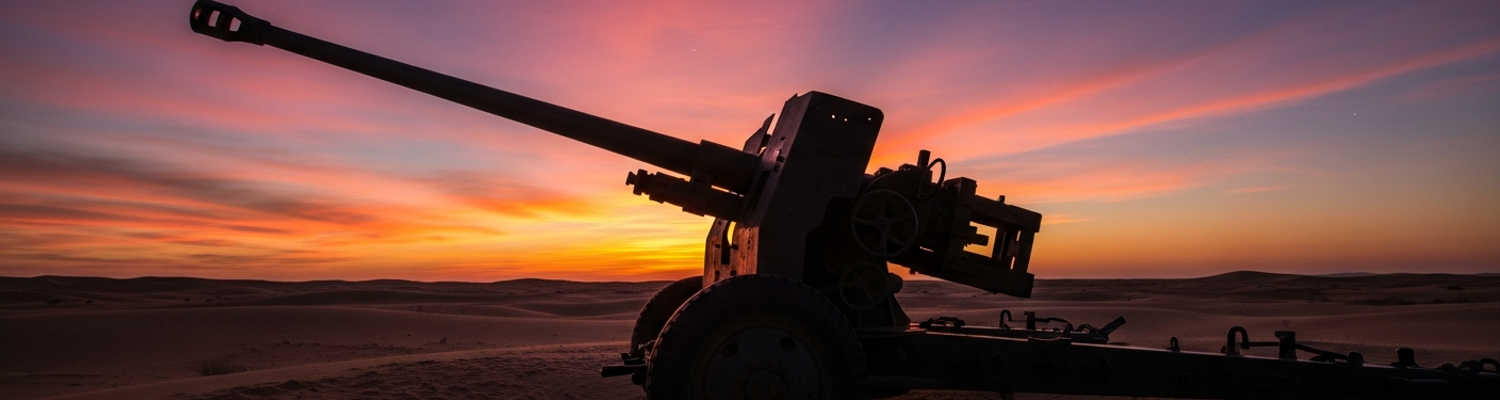

Kofa Desert Naval Proving Ground
In early 1945, a section of the Kofa Game Range in Arizona became a top-secret U.S. Navy proving ground. The area was a small, restricted zone within the Army’s sprawling California-Arizona Maneuver Area, a tract of land previously used by General Patton to harden troops for desert warfare.
The Navy’s purpose here was different. It was urgent.
Intelligence from the Pacific theater, specifically from campaigns in the Philippines and Okinawa, confirmed the existence of a new Japanese weapon. The Shinyo boat was a small, fast plywood motorboat, typically manned by a single pilot. Powered by repurposed automobile engines, each vessel was packed with up to 600 pounds of high explosives intended to detonate on impact with an Allied ship. Japan had produced thousands, hiding them in coastal caves to be unleashed against the transport and landing craft of Operation Downfall, the planned invasion of the home islands.
Existing fleet gunnery doctrine was designed to engage singular, large targets like ships or aircraft at range. It was completely unequipped to handle dozens of small, fast-moving targets attacking simultaneously. The threat was not to battleships, but to the thin-skinned transports that would carry the invasion force. A swarm of Shinyo boats could turn a landing into a massacre.
The Navy’s solution was to replicate the threat in the desert. Here, amidst the saguaro cacti and red rock, engineers constructed mock-ups of destroyer bridges and transport ship decks on concrete slabs. Quad 40mm Bofors and single 20mm Oerlikon anti-aircraft mounts, stripped from naval vessels, were bolted into place.
This was not a place to train sailors how to fight at sea. It was a laboratory to solve a problem that traditional naval thinking could not address.
Anti-Swarm Gunnery Doctrine Adaptation
The core problem at Kofa was one of mathematics and mechanics. A Shinyo boat could cover the final thousand yards to a target in under a minute. Initial trials using standard fire-control methods were failures. Gunners attempting to track and destroy one target before engaging the next were consistently overrun by the sheer number of simulated attackers. Plywood target sleds, dragged across the desert floor by concealed cables at speeds approaching 30 knots, would invariably slip through the defensive perimeter.
The weapons themselves were struggling. The 40mm Bofors and 20mm Oerlikon mounts, proven against aircraft in a clean maritime environment, faced new challenges. The fine silicate dust and extreme heat caused traverse and elevation gears to bind. The sustained, high-rate-of-fire schedules required for swarm defense led to barrel warping and frequent mechanical jams.
A new approach was developed, documented in training logs as gunnery triage. This system abandoned the idea of achieving a definitive kill with each engagement. Gunners were trained to operate as a network, shifting from centralized fire direction to autonomous control at the gun mount. They were ordered to prioritize targets based on a rapid calculation of angle, speed, and threat potential. The primary goal was not to destroy the target, but to disable it.
A short burst might damage the engine, destroy the rudder, or kill the pilot. This action, known as tagging, would ideally slew the boat off course or slow it down, making it an easier target for a neighboring gun mount to finish. This created overlapping, interlocking fields of fire where multiple guns could engage the same group of targets with different objectives.
Training for this new doctrine was a process of unlearning years of procedure. Gunners accustomed to valuing precision had to learn to fire what felt like erratically, shifting from target to target without confirmation of a kill. Instructors saturated the gunners' field of view, forcing them to make triage decisions under pressure. They used the Mk. 14 Gunsight for instinctive, lead-and-track shooting, as its complex gyroscopic calculations were too slow for this type of engagement. Personnel were drilled to exhaustion, learning to coordinate with adjacent crews using only hand signals and shouted commands.
Desert Environment Operational Challenges
The Sonoran Desert was an active antagonist.
A review of operational logs from the broader California-Arizona Maneuver Area (CAMA) reveals the hostility of the environment. Temperatures inside the steel gun mounts and mock-up superstructures could reach 150 degrees Fahrenheit. For sailors accustomed to the Atlantic or Pacific, the dry, searing conditions were a shock. Water was rationed, sometimes to a single canteen per man per day, based on a flawed theory that troops could be conditioned to survive on less. This policy, combined with grueling physical labor, led to a constant state of dehydration and fatigue. Shimmering heat distortion complicated target acquisition, and the oppressive temperature frayed nerves.
Machinery fared no better. The fine, abrasive dust of the region was uniquely destructive to naval equipment. It infiltrated the traversing and elevating gears of the gun mounts, mixing with lubricants to form a grinding paste that caused mechanisms to bind. A gun that was slow to traverse or completely seized created a fatal gap in the interlocking fields of fire. High-velocity barrels suffered from accelerated wear as the gritty air was blasted through them. Ammunition feeders, which relied on precise tolerances, would foul, taking a gun out of action for precious minutes.
The desert inflicted its own casualties. Historical records from the wider CAMA show a high number of non-combat losses from heatstroke, dehydration, and training accidents exacerbated by exhausted personnel. While exact figures for the Kofa project are not specified in open records, data from the larger desert training area indicates hundreds of heat-related deaths during training on U.S. soil. These were not combat deaths, but they placed a persistent strain on unit cohesion and training schedules. Medical teams worked constantly to handle cases of heat exhaustion, and planners had to account for a level of personnel attrition that had nothing to do with enemy action.
Pre-Crisis Medical Triage Protocols
Mid-century naval medical doctrine was built for conflict at sea. The process was linear. A wounded sailor received emergency aid from a Hospital Corpsman at the site of the injury. The man would then be moved to a battle dressing station for stabilization, then to the ship’s sick bay for surgery. For extensive care, the final step was transfer to a hospital ship like the USS Solace. Triage, the sorting of casualties, happened at each stage, governed by the confined spaces and limited resources of a fighting vessel.
This system was built for ships.
At Kofa, the model became irrelevant.
Archival evidence from CAMA (Record Group 71, NARA) details a medical crisis in the making before any simulated combat began. The primary patient load was not from training accidents but from the environment. Heatstroke and severe dehydration were common. Standard Hospital Corpsman kits, packed with bandages, morphine syrettes, and sulfa powder for combat wounds, were ill-equipped for environmental casualties. The evacuation chain disintegrated on land. A jeep bumping across miles of hostile terrain was not a stretcher party moving down a corridor. The journey itself worsened injuries. Naval-trained personnel were forced to operate like a frontline army medical detachment, but without the specific equipment or land-based evacuation infrastructure. The nearest hospitals were hours away over primitive roads.
Baseline preparedness for a mass casualty event was the ultimate test. The Navy’s existing MASCAL doctrine was geared toward a major fleet action, where casualties would be distributed across multiple ships. The Shinyo threat presented a different problem: a concentrated, localized slaughter. Planners had to anticipate thousands of casualties occurring within minutes on the vulnerable transport ships of an invasion fleet. The expected wounds were not clean punctures but the result of 600-pound explosive charges detonating at point-blank range. This meant catastrophic blast trauma, full-body burns, and shrapnel wounds. Medical after-action reports from Shinyo attacks in the Philippines confirmed the devastation. The Kofa medical teams had to write a new playbook, planning for pre-staged forward aid stations and training corpsmen for a more ruthless form of triage on chaotic, burning decks.
Five-Minute Crisis Triage Decisions
The exercise began just after 1100 hours. The ambient temperature was 115 degrees. It was a full-scale simulation designed to stress the new gunnery doctrine. Multiple target sleds were dragged by a network of steel cables at high speed across the desert floor.
A review of after-action reports (File KDR-77-B, USN Archives) indicates that at approximately 11:04, a one-and-a-half-inch 6x19 IWRC tow cable snapped. Its tensile strength, compromised by weeks of abrasive dust and heat cycling, failed under the strain of a high-G turn.
The severed cable whipped backward.
It scythed through the crew of a 40mm Bofors gun mount, designated Gun Station 3. The simulated swarm attack instantly became a real medical emergency. The five men at the station were hit without warning. The scene was one of carnage, with traumatic amputations and deep lacerations. The gun captain and two loaders were killed almost instantly. Two other sailors suffered massive blood loss and severe shock.
This was not a drill.
The response fell to a single Hospital Corpsman First Class and his two assistants, staged nearby to treat expected cases of heat exhaustion. Their pre-planned protocols were useless. They faced a mass casualty event. Ad-hoc triage decisions were made under a combination of time pressure and environmental stress. The lead corpsman, operating on instinct, immediately designated one of the grievously wounded sailors as expectant, meaning too severely injured to be saved with the limited resources at hand. This calculation, made in seconds on the baking sand, allowed the medical team to focus on the second sailor, who was deemed salvageable. They applied tourniquets and used their entire on-site plasma supply in an attempt to combat hemorrhagic shock before evacuation could be attempted.
The incident revealed the limits of a controlled environment. The Kofa range was a laboratory, yet the failure of a single piece of hardware exposed the fragility of that control. The snap of the cable was the culmination of environmental attrition, a failure that had not been specifically war-gamed. The carefully choreographed exercise was forgotten, replaced by the primal triage of life and death.
Post-Crisis Operational Reassessments
The cable snap at Gun Station 3 was a watershed event.
An after-action review, convened within hours, forced a reckoning with the project’s deficiencies. The most glaring failure was in medical readiness. The on-site corpsmen had performed well, but their equipment and training were based on a flawed, ship-based premise. The evacuation of the single surviving gunner, a slow journey over rough terrain in a standard jeep, became a case study in this failure.
This was a land problem requiring a land solution.
Planners moved to overhaul the medical chain. The naval-centric triage system was replaced with a protocol adapted from U.S. Army ground forces doctrine. New evacuation procedures were written, designating specific light trucks as dedicated field ambulances. Medical kits were reconfigured based on BuMed Directive 45-112. Standard shipboard loadouts were supplemented with massive quantities of plasma, battle dressings, and dozens of tourniquets. This was an explicit acknowledgment that the Shinyo threat would produce a high volume of traumatic amputations. Corpsmen training was revised to focus on prolonged field care and a more aggressive form of triage.
The incident also forced a re-evaluation of the project's relationship with the environment. Forensic examination of the snapped tow cable revealed that its tensile strength had been compromised by fine dust accelerating wear between the steel strands, combined with metal fatigue from the cycle of extreme daytime heat and colder nights. Safety protocols were reviewed. New maintenance schedules were mandated, requiring daily inspection of all cables and load-bearing systems. Engineers designed and retrofitted steel plate guards around all gunnery stations adjacent to tow cable runs to protect crews from a similar failure.
These lessons extended directly to readiness for the Pacific. The Kofa experience became a critical data set for planners of Operation Downfall. The casualty estimates for the invasion were already high, but the Shinyo threat introduced a unique horror. Planners now contended with the likelihood of thousands of casualties occurring in minutes. The medical protocols forged in the aftermath of the Kofa accident were scaled up and integrated directly into the operational plans for the invasion. Transport ships designated for the initial landings were pre-loaded with medical supplies on a scale never before seen in an amphibious operation. The Navy began cross-training its Hospital Corpsmen with Army medics, ensuring personnel understood the principles of battlefield triage. The Kofa incident ensured the medical response to the anticipated slaughter in Japanese waters would be built on experience from the Arizona desert.