
Cua Viet River Chokepoint Command Bottlenecks
Before the first supply barge departed the Cua Viet Port Facility in April 1968, senior staff officers at the 3rd Marine Division headquarters in Dong Ha operated under a zero-margin timeline. Division commanders received less than seventy-two hours to secure a twelve-mile navigable waterway running along the northern edge of Quang Tri Province. Major offensive shifts were scheduled to strip away their air cover. Time was running out. Operating along the narrow Cua Viet River chokepoint, combat elements faced an escalating crisis. North Vietnamese Army forces dug into the sand dunes around Dai Do and Thon Lap Thach. Marine resupply depended entirely on shallow-draft LCU landing craft and Mike boats traveling this single river channel. When examining the historical record, command structures along this waterway collapsed under a cascading series of tactical blockades. These blockades threatened to sever the main supply axis for northern I Corps.
The timeline left no room for error.
Archival evidence shows that by mid-April 1968, 3rd Marine Division units operating along the Cua Viet River experienced severe command-and-control bottlenecks. Infantry detachments from 1st Battalion, 3rd Marines and the 1st Amphibian Tractor Battalion found themselves spread across isolated outposts along the riverbanks. They lacked reliable lateral lines of communication. Tactical command posts at Dong Ha Combat Base could not maintain continuous tracking of armored amtracs patrolling the water. Simultaneous skirmishes erupted near Firebase C-3 along Highway 9. Signal operators trying to coordinate movements between the river mouth (coordinates YD 360680) and inland staging bases hit severe structural chokepoints.
Company commanders attempted to pass maneuver orders over high-frequency nets.
The volume of competing operational traffic completely overwhelmed the single-channel radio architecture. Physical terrain features created line-of-sight dead zones. Coastal sand dunes and low-lying marshlands blocked ground wave signals between battalion headquarters and forward platoons.
Copper wire landlines were severed within minutes of engagement.
A close review of operational logs indicates that North Vietnamese Army artillery bombardments and electronic jamming severely disrupted tactical medevac channels across the entire lower Cua Viet sector. Heavy 130mm field guns from the NVA 84th Artillery Regiment fired from fortified positions north of the Demilitarized Zone. These batteries routinely targeted American radio masts and command bunkers with high-explosive shells. Soviet-supplied R-105 high-frequency transmitters operated by NVA signal units broadcast broad-band noise directly across primary Marine Corps tactical frequencies. Standard AN/PRC-25 backpack radios and AN/VRC-12 vehicle-mounted sets suffered severe radio frequency interference on the 30 to 75 megahertz VHF band.
Ground operators attempting to reach medical evacuation controllers at the 3rd Medical Battalion facilities in Phu Bai or Dong Ha encountered constant wideband hums.
Enemy signal teams tracked American radio broadcasts to locate command nodes. Radiomen had to limit their transmissions to short bursts. Incoming 152mm artillery impacts shattered local dipole antennas.
Communication dropouts routinely delayed evacuation requests for frontline casualty care along the riverbanks. Corpsmen treating compound fractures and chest wounds from 82mm mortar fragments had to re-transmit medical evacuation requests up to eight times before securing a clear relay. Integrating KY-8 NESTOR secure-voice encryption devices onto AN/PRC-25 radios caused frequent synchronization failures. These failures produced signal dropouts that forced operators to switch back to unencrypted plain text. CH-46 Sea Knight medevac helicopters idling on pads at Dong Ha lost contact with ground controllers for up to forty minutes at a time. Wounded Marines waited in flooded drainage ditches near Dai Do village. Radio operators manually hoisted makeshift RC-292 antenna masts under direct enemy sniper fire to regain line-of-sight propagation with offshore Navy vessels like the USS Amphion. In several instances along the Song Bo Dieu branch, corpsmen resorted to firing color-coded smoke grenades through dense fog to signal passing riverine craft when all tactical radio networks failed completely.
Tactical VHF Network Vulnerabilities Under Fire
When examining the historical record of Marine Corps communication logs from May 1968, signal attenuation along the Cua Viet River mouth presented severe physical limitations to tactical radio networks. Standard Marine Corps VHF transceivers operated primarily within the 30 to 75 megahertz frequency band. This included the backpack-mounted AN/PRC-25 and vehicle-installed AN/VRC-12 series. This radio frequency spectrum depended entirely on direct line-of-sight wave propagation or low-altitude ground wave signals.
Waterlogged mudflats, high atmospheric humidity, and shifting twenty-foot sand dunes systematically degraded signal strength in the flat estuarine terrain surrounding the Cua Viet estuary at coordinates YD 340670.
Third Battalion, 3rd Marines advanced through flooded rice paddies near Thon Truong Giang. Ground-level moisture absorbed electromagnetic radiation emitted by the three-meter AT-271 whip antennas. Signal operators reported that standard ground-wave transmission ranges collapsed from a rated fifteen miles down to less than eighteen hundred meters. Wet sand ridges blocked direct signals between mechanized amtracs of the 1st Amphibian Tractor Battalion and infantry command posts inland. Radiomen shouted into handsets that produced only unmodulated white noise.
Salt air corroded aluminum antenna connectors within hours of contact.
Archival evidence shows that North Vietnamese Army artillery batteries located north of the Demilitarized Zone turned these physical signal gaps into catastrophic system failures. Long-range 130mm M-46 field guns and 152mm howitzers fired from reinforced concrete emplacements around Cap Mui Lay and Co Luong. They systematically targeted American radio infrastructure across northern Quang Tri Province. High-explosive airburst shells repeatedly shredded thirty-foot steel RC-292 and OE-254 antenna masts erected at Cua Viet Naval Base and tactical outposts like Firebase C-2 and Dong Ha.
Shrapnel sliced through delicate ceramic insulators.
Heavy coaxial cables connecting radio sets to elevated antennas were severed. Constant bombardment tore apart thousands of feet of surface-laid WD-1/TT twin-conductor field wire linking forward command bunkers to SB-22 telephone switchboards. Field wire maintenance crews from the 3rd Marine Amphibious Force signal detachments suffered heavy casualties trying to splice severed copper lines along exposed riverbanks. Enemy forward observers stationed along the Ben Hai River maintained direct observation of these repair efforts.
Shrapnel cut copper field wire faster than signal teams could unspool fresh reels.
A close review of operational logs indicates that extreme frequency congestion compounded these physical destructions. Signal officers had to seek unorthodox solutions across coastal waters. By mid-May 1968, hundreds of tactical units operating along the northern coastal strip crammed onto fewer than forty available VHF channels. Operational traffic from artillery fire direction centers, tactical air control parties, supply convoys, and infantry companies completely saturated the frequency spectrum. Overlapping radio waves caused severe mutual interference. Voice communications became unreadable for miles around the river mouth.
Marine signal officers mounted high-powered AN/TRC-75 single-sideband high-frequency radio sets and multi-channel AN/VRC-12 relays onto US Navy ships anchored off the coast.
Vessels such as the repair ship USS Amphion (AR-13) and landing ship tank USS Washtenaw County (LST-1166) positioned themselves three to five miles offshore in the South China Sea. Elevated shipboard antenna rigging provided uninterrupted line-of-sight coverage over coastal dunes. Offshore operators received obstructed signals from inland infantry platoons and retransmitted them directly back to division headquarters at Dong Ha on secondary channels.
Offshore Medical Triage on USS Sanctuary
When examining the historical record from the spring of 1968, the Haven-class hospital ship USS Sanctuary (AH-17) provided primary surgical care for casualties across Northern I Corps. The 15,000-ton vessel operated four main operating rooms, an eighty-bed intensive care recovery ward, and a seven-hundred-bed hospital capacity. It was stationed approximately three to five miles off the coast near the Cua Viet River mouth at coordinates YD 380690.
Combat casualties from the 3rd Marine Division, 1st Battalion, 3rd Marines, and the 3rd Amphibian Tractor Battalion were flown directly from flooded paddy fields around Dai Do and Dong Ha to the aft flight deck.
Navy surgical teams aboard the Sanctuary performed hundreds of emergency procedures each week. They treated traumatic amputations, chest wounds from 122mm rocket shrapnel, and severe burns caused by exploding amtrac fuel tanks. Shipboard medical officers managed complex vascular repairs and orthopedic stabilization that exceeded the capacity of primitive shore facilities like the 3rd Medical Battalion forward aid stations at Dong Ha Combat Base. The surgical teams operated twenty-four hours a day.
High waves routinely rocked the hull while surgeons operated under overhead lamps.
Archival evidence shows that naval medical personnel required advance casualty reports to allocate surgical bays before medevac arrivals. Standard naval operating procedures mandated that triage officers on the Sanctuary receive radio transmissions containing detailed patient classifications at least fifteen minutes prior to a flight landing. These incoming field reports specified the total number of wounded, wound severity, blood type requirements, and whether casualties suffered from open pneumothorax or arterial hemorrhaging. Medical corpsmen needed this advance warning to prepare specific surgical suites. They had to spin matching whole blood units in the shipboard lab and sterilize specialized surgical trays.
A CH-46 Sea Knight or UH-1E Huey approached the flight deck.
The triage chief used these coded radio manifests to direct litter teams immediately toward designated elevators leading down to triage deck two or operating room four. Without pre-flight triage data, medical staff risked congesting the flight deck landing pad. Specialized surgical teams sat idle in wrong operating rooms.
Flight deck elevator doors remained locked until surgical assignments were logged.
A close review of operational logs indicates that severed shore links left shipboard triage teams without timely operational updates. Enemy 130mm artillery strikes along the Ben Hai River repeatedly severed copper landlines and tore down elevated RC-292 antenna masts at Cua Viet Naval Base. High-frequency relay links between shore command posts and offshore ships broke down. Tactical radios on the Sanctuary picked up only static and carrier hums on primary 30 to 75 megahertz VHF channels. Medevac helicopters lifted off from combat zones near Thon Truong Giang without any radio contact with the air traffic controllers on the ship.
Floating off the coast, triage teams received zero advance notice regarding inbound helicopters.
They had no data on the medical condition of the Marines on board. Flight deck crews listened for distant rotor beats over the water. They were forced to conduct blind sorting on the open helipad as wounded men arrived unannounced.
Corpsmen ripped open bloody field dressings on the windblown deck to identify abdominal trauma.
Naval officers attempted to establish visual signaling using high-intensity Aldis lamps aimed toward coastal dunes at YD 360680. Heavy coastal fog rendered light beams unreadable beyond six hundred meters. Triage doctors on the Sanctuary were forced to convert the open teak flight deck into a primary assessment zone. They manually marked casualties with grease pencils directly on their foreheads before transporting them down to main operating room three.
Improvised Wire Dipole Antenna Technical Solutions
When examining the historical record from mid-May 1968, electronics technicians assigned to the communications department of the USS Sanctuary faced a total breakdown in tactical radio reception. Shipboard AN/URC-9 transceivers and standard omnidirectional antennas mounted high on the superstructure were designed primarily for high-frequency fleet command circuits. They were unable to pick up low-power tactical signals from Marine infantry units fighting three to five miles inland near the Cua Viet estuary.
Radiomen descended into the lower maintenance lockers and electrical shops.
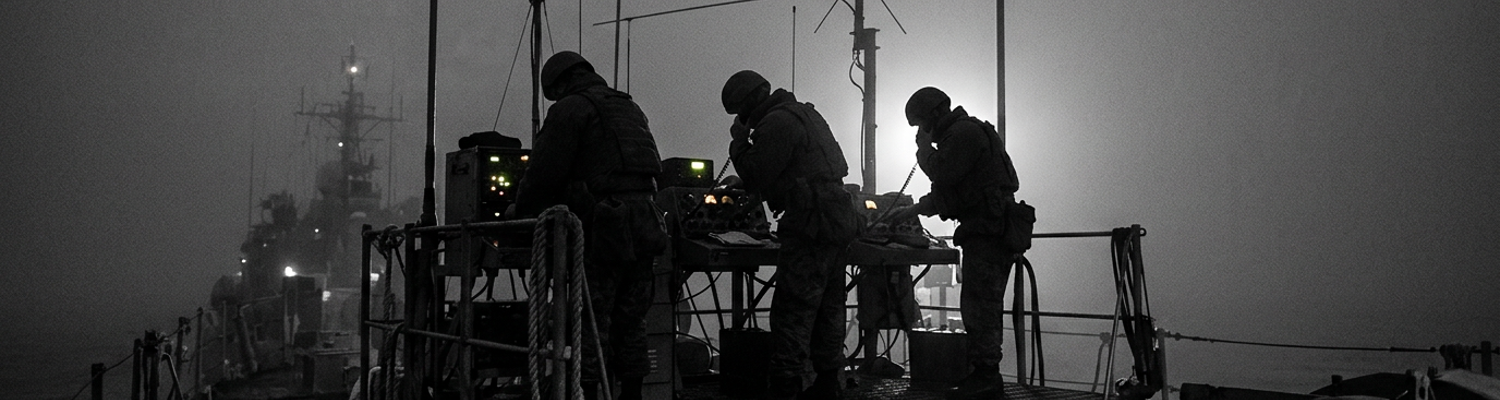
They collected multi-strand copper electrical cable, discarded RG-8/U coaxial feeds, and rolls of dual-conductor WD-1/TT field wire. Technicians fabricated customized wire dipole antennas directly on the open deck using hand-operated strippers, soldering irons, and wooden block supports. Mechanics soldered central coaxial connectors to bare copper strands. They insulated the dipole tips with ceramic blocks salvaged from broken shipboard junction boxes. Signal crews mounted these makeshift dual-arm arrays across the signal bridge and along the starboard boat deck railings. They manually aligned the wire orientation toward the coastal dune line at grid coordinates YD 360680.
Soldering irons burned continuously in the lower deck workshops.
A close review of operational logs indicates that signal operators tuned these improvised wire dipole arrays to capture specific electromagnetic frequencies emitted by ground troops. Standard AN/PRC-25 field transceivers used by 1st Battalion, 3rd Marines broadcast at power outputs of only 1.5 to 5 watts across the 30 to 75 megahertz band. Technicians calculated exact physical element lengths using standard half-wave resonant formulas. They measured and cut each copper wire leg to six feet four inches to isolate the primary tactical medevac frequency of 38.90 megahertz.
Radiomen adjusted the copper wire lengths inch by inch until maximum signal resonance was achieved.
They used portable standing wave ratio meters borrowed from the repair shop on the ship. The broadside directional profile of the horizontal dipole suppressed background radio static generated by heavy naval gunfire support ships operating further out in the South China Sea. When aimed directly at the shoreline, tuned wire arrays captured microvolt signal fluctuations skipping across the coastal waters from low-power AN/VRC-12 vehicle sets mounted on damaged amtracs near Thon Lap Thach.
Single microvolt pulses began registering on shipboard receiver meters.
Archival evidence shows that an unpredicted meteorological phenomenon dramatically amplified the range of these improvised shipboard arrays. Extreme temperature variations over the Gulf of Tonkin created a dense atmospheric inversion layer along the coast of Quang Tri Province during May 1968. Cool, humid air blowing off the sea became trapped underneath a broad layer of dry, hot air moving off the inland landmass. This sharp thermal interface formed a natural electromagnetic waveguide known as atmospheric ducting.
Low-power VHF radio waves emitted by ground units near the Cua Viet river mouth typically traveled in straight line-of-sight paths and dissipated into the upper atmosphere.
These waves struck this boundary layer and bent downward. Radio waves bounced repeatedly between the flat sea surface and the atmospheric ceiling. They skipped across coastal sand dunes toward the open ocean. Positioning the fabricated wire dipole antennas directly into the path of this atmospheric duct allowed radiomen on the USS Sanctuary to intercept clear voice transmissions from battalion corpsmen operating over fifteen miles away.
Ground controllers at Dong Ha reconnected with offshore triage desks.
Field hospitals received continuous casualty updates prior to helicopter landings on the flight deck.
High Frequency Radio Bridge Engineering
When examining the historical record from late May 1968, communications officers from the 3rd Marine Division Signal Battalion bypassed destroyed shore infrastructure by constructing a long-range high-frequency radio bridge. Electronics technicians on the USS Sanctuary (AH-17) and the repair ship USS Amphion (AR-13) linked their shipboard receivers directly to battalion aid stations. These stations were operated by the 3rd Medical Battalion at Dong Ha Combat Base and forward casualty staging pads near grid coordinates YD 360680.
Signal teams bounced skywave transmissions off the ionosphere.
They utilized high-powered AN/TRC-75 single-sideband transceivers and AN/PRC-47 tactical HF sets operating across the 2 to 30 megahertz spectrum. This configuration allowed low-power medical requests from land-bound corpsmen to bypass the blocked VHF line-of-sight paths along the lower Cua Viet River. Heavy omnidirectional whip antennas mounted on ship superstructures captured weak signals from the marshlands. The equipment re-modulated the audio onto high-power HF carrier signals. Shore-based aid station receivers at Dong Ha picked up these skywave relays clear of terrestrial terrain obstructions. This gave triage staff at the 3rd MARDIV main medical facilities reliable advance notice of inbound casualties.
Coaxial lines ran directly through flooded sandbag bunkers.
Archival evidence shows that signal operators executed continuous manual patching of degraded medical radio calls across alternate frequencies while taking direct enemy artillery fire. Incoming VHF voice transmissions from company corpsmen arrived fractured by wideband jamming and severe multipath distortion. This occurred during intense North Vietnamese Army bombardments by 130mm M-46 field guns targeting the Cua Viet Naval Base at coordinates YD 355675. Radiomen inside reinforced sandbag bunker complexes sat in front of SB-22/PT tactical switchboards and C-1823/U audio patch units. They physically cross-connected incoming AN/VRC-12 receivers to secondary AN/TRC-75 high-frequency transmitters.
Enemy artillery shells severed primary dipoles or jammed specific channels like 38.90 megahertz.
Operators shifted audio feeds to pre-designated alternate frequencies ranging from 46.50 to 52.20 megahertz within seconds. Operators held patch cables with sweat-slicked hands. They listened through heavy background static to re-route calls around active frequency blockades while shrapnel tore through the overhead timber roofs.
Copper patch cords kept broken voice circuits open.
A close review of operational logs indicates that technical troubleshooting teams maintained continuous network connectivity despite constant frequency drift across all active high-frequency circuits. Ambient temperatures exceeded one hundred degrees Fahrenheit inside metal radio shelters. This heat, combined with ninety-percent atmospheric humidity along the Gulf of Tonkin, caused vacuum tube permeability-tuned oscillators inside AN/TRC-75 sets to heat unevenly. This thermal expansion shifted transmitter carrier frequencies off their assigned channel centers by as much as eight hundred Hertz every twenty minutes.
Technicians locked into a constant cycle of mechanical alignment.
They used non-metallic tuning wands and built-in crystal calibrators to correct dial offsets. Radiomen monitored beat frequency oscillators. They made micro-adjustments to variable air capacitors while tracking signal waveforms on portable oscilloscopes to lock drifting receivers back onto ground station signals. This persistent manual tuning prevented signal dropouts between shipboard triage centers and inland casualty clearing stations during multi-hour artillery barrages.
Frequency logs recorded over two hundred manual alignment corrections during a single twelve-hour shift.
Offshore Surgical Prioritization and Triage Coordination
When examining the historical record from late May 1968, the operational stabilization of improvised wire dipole antennas and HF skywave bridges altered triage protocols aboard the USS Sanctuary (AH-17). Shipboard medical teams operating five miles offshore from the Cua Viet River mouth at grid coordinates YD 380690 had previously endured total radio darkness. Naval surgeons received stable voice communications from 3rd Medical Battalion aid stations at Dong Ha Combat Base and forward casualty collecting points near Dai Do. This occurred with the re-establishment of clear 38.90 megahertz tactical VHF lines relayed through the repair ship USS Amphion (AR-13).
Flight deck triage officers gained continuous tracking of approaching CH-46 Sea Knight and UH-1E Huey helicopters.
The aircraft were tracked while still ten minutes out over the South China Sea. Radiomen on the signal bridge took incoming field transmissions from battalion corpsmen under fire. They recorded specific injury counts, trauma classifications, and vital sign drops. Surgical chiefs used this advance warning to rank patient severity into distinct category streams prior to touchdown.
Rotor blades beat the humid ocean air as flight deck crews stood ready with pre-assigned litter positions.
Archival evidence shows that real-time casualty data transmitted across the radio bridge directly governed how shipboard surgical teams were assembled and deployed. Audio signals routed through shore-based SB-22/PT switchboards and converted onto AN/TRC-75 single-sideband high-frequency carrier waves allowed forward corpsmen to broadcast granular medical diagnostics directly to shipboard receivers. Field medics transmitted detailed metrics including estimated blood loss, systemic shock indicators, puncture locations from 122mm NVA rocket fragments, and specific vascular breaches.
Naval medical coordinators immediately mobilized targeted surgical sub-specialties upon receiving these patched data streams in the main triage ward on Deck 2.
Vascular surgeons, orthopedic specialists, and neurosurgical technicians were summoned to specific operating suites minutes before incoming litters arrived. Surgical bay three was prepped specifically for open chest repairs. Bay one adjusted overhead lights for traumatic limb amputations. Flight deck elevators dropped casualties straight to designated operating rooms without intermediate stops for secondary diagnostic sorting.
Sterile surgical trays were opened before the aircraft cut their engines on the aft helipad.
A close review of operational logs indicates that pre-arrival patient status reports drastically cut trauma treatment delay times across all emergency surgical wards. Incoming casualties experienced average delays of twenty-eight minutes between flight deck touchdown and initial surgical incision prior to the technical restoration of the coastal radio relay network. Flight deck corpsmen previously had to cut away wet, blood-soaked utility uniforms under noisy rotor wash to identify hidden shrapnel entry points on arriving Marines. Pre-arrival status broadcasts eliminated this entire bottleneck.
Triage doctors received accurate descriptions of internal organ damage, tension pneumothorax risks, and exact blood type matching requirements while casualties were still airborne.
The blood bank on the ship spun, thawed, and cross-matched units of O-negative and specific type-matched whole blood well ahead of helicopter pad arrivals. Processing time from landing pad to operating table dropped from twenty-eight minutes down to under six minutes because of these pre-flight transmissions. Medics wheeled casualties off the flight deck elevators. They bypassed holding bays entirely to place patients directly under operating room lights. Whole blood units were already spiking intravenous lines as surgeons made their initial incisions.
Log books on Deck 2 recorded a fourfold increase in immediate surgical admissions during the peak hours of May 28, 1968.
Logistics and Maintenance Under Coastal Artillery Fire
When examining the historical record from late May 1968, ground signal crews assigned to 3rd Marine Amphibious Force signal platoons operating near the Cua Viet Naval Base at grid coordinates YD 355675 endured continuous indirect fire while repairing damaged radio links. Long-range 130mm M-46 field guns operated by the North Vietnamese Army 84th Artillery Regiment fired delayed-fuse high-explosive rounds directly into sand dune staging areas. Shrapnel routinely sliced through rubberized jackets, copper braiding, and solid polyethylene dielectrics of RG-8/U and RG-213 coaxial cables. These cables connected ground-mounted AN/VRC-12 transceivers to sixty-foot OE-254 antenna masts.
Repair crews could not maneuver during daylight hours without drawing direct observation and sniper fire from NVA spotters positioned across the Ben Hai River.
Signalmen crawled through mudflats between 0100 and 0400 hours under cover of darkness to trace line breaks by hand. Technicians cut out shrapnel-damaged line segments and crimped inline splices while lying flat on their stomachs. They worked with wire strippers, soldering irons, and PL-259 coaxial connectors. Flashlights were wrapped in thick red cellophane to avoid revealing repair positions to enemy gunners north of the Demilitarized Zone.
Red cellophane covers dimmed flashlights across the dunes.
Archival evidence shows that airborne salt spray and high coastal humidity created a destructive mechanical environment for delicate electronics along the estuary. Wind-blown sea salt from the South China Sea coated aluminum chassis. It oxidized silver-plated channel selector switches and formed conductive crystal bridges across vacuum tube sockets inside exposed radio units. Signal technicians from the 3rd Marine Division Signal Battalion developed field-expedient maintenance routines to prevent catastrophic signal dropouts on primary tactical frequencies.
Radiomen scrubbed corroded switch contacts using stiff toothbrushes dipped in solvent cleaners.
This was followed by a thorough flush of secondary mechanical assemblies with clean diesel fuel to displace moisture. Technicians wrapped AN/PRC-25 transceivers and AN/TRC-75 power supply units in heavy polyethylene bags salvaged from supply pallets. Crews placed homemade desiccant packs constructed from cloth bandoliers filled with dried silica gel crystals harvested from 105mm artillery ammunition packing cases inside these sealed plastic enclosures. Rubber gaskets sliced from punctured inner tubes of M35 two-and-a-half-ton trucks were clamped around cable entry ports. This sealed chassis seams against blowing sand and salt-laden ocean mist.
Polyethylene bags sealed with electrical tape kept seawater out of open circuit boards.
A close review of operational logs indicates that joint Navy and Marine Corps technical coordination sustained these essential communication links when shore facilities ran out of spare parts. Marine signal detachments at Cua Viet lacked high-precision test equipment and replacement components needed to fix internal frequency synthesizers damaged by artillery shockwaves. Electronics technicians aboard the repair ship USS Amphion (AR-13), anchored three miles offshore, established a continuous maritime supply and maintenance loop with Marine radiomen from the 1st Amphibian Tractor Battalion.
Shallow-draft LCU landing craft ferried burnt-out AN/TRC-75 power transformers, blown vacuum tubes, and damaged circuit boards directly from shore staging areas out to the specialized electronics shop on the repair ship.
Navy technicians utilized AN/USM-116 oscilloscopes and TS-585/U power meters to recalibrate drifting permeability-tuned oscillators. They rewound copper transformer coils by hand when factory replacements were exhausted. Shipboard workshops operated twenty-four hours a day. They repaired and returned functional radio components to coastal command posts within an eight-hour turnaround window.
Repair shops on the ship returned eight overhauled transceivers before sunrise.
Legacy of Tactical Communications in Estuarine Warfare
When examining the historical record, the communications breakdown between the 3rd Marine Division and offshore Navy vessels near grid coordinates YD 360680 initiated a comprehensive overhaul of Marine Corps amphibious operational manuals. Operational assessments compiled by III Marine Amphibious Force signal officers detailed how salt air, low-lying marshlands, and shifting twenty-foot sand dunes crippled standard ground-wave transmissions along the Cua Viet River. Marine Corps Fleet Marine Force Manuals revised during the early 1970s integrated sea-based radio bridging protocols directly into amphibious landing doctrine.
Fleet instruction manuals mandated that landing forces deploy dedicated offshore ship-to-shore relay nodes prior to sending shallow-draft LCU landing craft and Mike boats into restricted estuarine channels.
Lessons learned from corroded coaxial connectors and signal dead zones near Dai Do led to mandatory inclusion of pre-cut wire dipole antenna assemblies and protective plastic chassis seals in standard infantry battalion signal inventories. Naval amphibious warfare doctrine formally adopted these field improvisations. The doctrine required future task group commanders to integrate shipboard signal detachments into tactical ground networks during riverine operations.
Atmospheric humidity and coastal sand dunes no longer caught Marine signal units unprepared.
Archival evidence shows that operational successes along the lower Cua Viet sector established the necessity of redundant high-frequency and very-high-frequency radio bridging in contested landing areas. Standard single-channel VHF networks operating between 30 and 75 megahertz routinely collapsed under direct NVA artillery fire and Soviet-supplied R-105 jamming during heavy combat operations involving 1st Battalion, 3rd Marines and the 1st Amphibian Tractor Battalion near Thon Lap Thach. Signal officers maintained operational command only by cross-patching severed VHF voice channels into shipboard AN/TRC-75 single-sideband HF transceivers stationed four miles offshore in the South China Sea.
Technicians inside shore command bunkers and shipboard control rooms used SB-22/PT tactical switchboards and C-1823/U audio patch units.
They converted obstructed ground-wave signals into high-power skywave transmissions operating between 2 and 30 megahertz. This technical success demonstrated to Marine Corps doctrine writers that high-intensity littoral engagements required simultaneous dual-spectrum coverage to prevent complete operational blackout. Subsequent Marine Corps force structure plans mandated dual-path HF and VHF bridge capabilities across all amphibious units. This ensured forward infantry companies could automatically bypass land-based signal blockades via offshore naval relays.
Signal operators abandoned reliance on single-channel radio architectures during riverine sweeps.
A close review of operational logs indicates that the emergency communications grid established off the Quang Tri coast represents a landmark case of field-expedient signal engineering in combat history. Marine and Navy technicians engineered custom radio systems using discarded maintenance supplies after being deprived of standard replacement antennas and permanent shore towers by NVA 130mm artillery strikes on Cua Viet Naval Base at grid YD 355675. Electronics technicians aboard the hospital ship USS Sanctuary gathered multi-strand copper wiring, discarded RG-8/U coaxial cables, and WD-1/TT field wire to construct half-wave wire dipole arrays directly on shipboard railings.
Technicians calculated precise element lengths of six feet four inches.
They used standing wave ratio meters to tune the copper elements to the primary medical evacuation frequency of 38.90 megahertz. These improvised directional arrays restored direct voice contact between offshore triage desks and forward aid stations fifteen miles inland by intercepting microvolt signals bouncing off coastal atmospheric inversion layers over the Gulf of Tonkin. Signal crews sustained continuous network operations by manually recalibrating heat-stressed permeability-tuned oscillators inside AN/TRC-75 transceivers up to twelve times per shift. This preserved active casualty evacuation links throughout the battle.
Technicians logged their final oscillator adjustments inside shipboard maintenance logs at dawn on June 1, 1968.