
PC-577 Disappearance Hinchinbrook Island
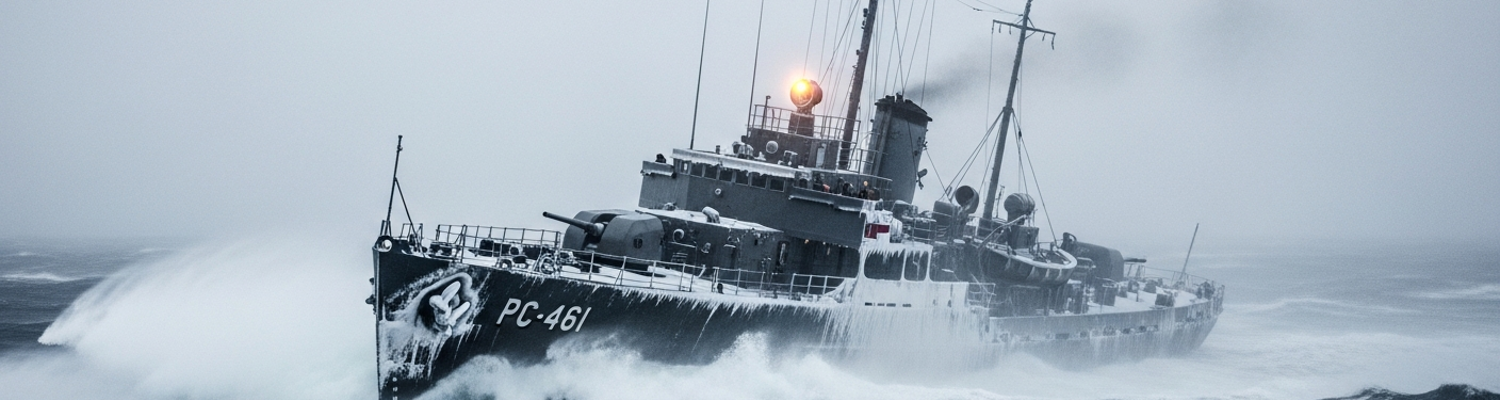
Compressed patrol schedules were the standard by autumn 1943. With the Aleutian Campaign officially over, naval commanders in Kodiak maintained a state of high alert against Japanese submarine activity. Maintenance windows were shortened and crews were pushed to their operational limits. For the men aboard United States Navy Patrol Craft PC-577, this meant an accelerated series of anti-submarine sweeps through the waterways of Prince William Sound. Their vessel was a PC-461 class submarine chaser, a 173-foot steel-hulled ship displacing 450 tons. Its design emphasized economy of production, not survivability in extreme conditions. Powered by two diesel engines, the class was known to roll heavily in rough seas, and its top speed near 20 knots was often reduced by mission equipment. The PC-577 was a workhorse tasked with covering an inhospitable area under a command structure hundreds of miles away.
A close review of operational logs indicates the last confirmed communication from PC-577 was a routine, partially garbled voice radio message logged on the evening of October 25th, 1943. The ship was executing a search pattern along the southern coast of Hinchinbrook Island, a rugged, 370-square-mile landmass at the eastern entrance to Prince William Sound. This area is a known navigational challenge with cliff-lined shores and few safe anchorages. The patrol route required the vessel to operate perilously close to the shoreline, a necessary risk to detect any enemy submarine using the island's terrain for concealment.
Weather records for that period are sparse. Analysis of regional patterns and accounts from other vessels point to the sudden onset of a violent katabatic windstorm, a williwaw. These storms form when cold, dense air from coastal mountain ranges spills down to the sea, generating hurricane-force gusts that can exceed 120 knots and build immense, erratic waves with little warning. For a vessel like PC-577, navigating without modern surface-search radar in near-zero visibility, such a storm would present a terminal threat.
Silence followed.
The command at Kodiak Naval Operating Base was slow to react. Standard radio silence procedures, intended to prevent enemy direction-finding, meant a vessel could be out of contact for up to twelve hours without causing alarm. When PC-577 failed to make its next scheduled report, the initial assumption was a simple radio malfunction. It was only after a full 24 hours had passed that the first serious inquiries were made. By then, the same storm system that likely struck the patrol craft was still active across the Gulf of Alaska. It grounded any potential air search assets, including the PBY Catalinas based at Kodiak. Commanders stared at charts of Prince William Sound that showed only the last known position of the ship, a single pinprick on a map.
The geography of the disappearance was unforgiving. Hinchinbrook Island’s southern coast is a brutal interface of rock and water, facing the full fetch of the North Pacific. A ship overwhelmed by a williwaw would have had minutes before being driven onto the rocks or capsized. The waters of Prince William Sound are deep and cold, with strong, unpredictable currents. Any wreckage from the steel-hulled patrol craft would have sunk quickly, scattered across a wide and inaccessible area of the seafloor. Without a confirmed final position or any debris, search efforts were unfocused. The loss of PC-577 and its 65-man crew was officially declared on November 10, 1943. Its final moments and exact location were unknown.
Garbled Intercepts and Incomplete Weather
Archival evidence shows the search for PC-577 began not with a location, but with faint sounds. The initial effort was predicated on a handful of sparse, distorted radio signals picked up by listening posts. The standard radio equipment for PC-577 was the TCS transmitter and receiver, a rugged but technologically limited system relying on high-frequency AM voice transmission. In the electromagnetic environment of the Gulf of Alaska, these signals were exceptionally vulnerable. The mountainous terrain of the Chugach range created radio shadows and signal bounce. Auroral activity common at high latitudes filled the airwaves with static. A transmission from the patrol craft would arrive at Kodiak as a faint whisper buried under atmospheric noise. For days, radio operators sat in shifts, straining to isolate a single intelligible word from the hiss.
This hunt for auditory signals created a tactical problem for the command staff in Kodiak. A review of operational logs from the first 72 hours reveals a pattern of confusion and redirection. The map in the operations room was not a coherent search grid but a sprawling web of possibilities based on the flimsiest of evidence. A radio operator’s conviction that he heard a number could divert a destroyer for an entire day. Another listener’s belief they heard the name of a geographic feature would send PBY Catalina search planes on hours-long sorties over the wrong stretches of coastline. Commanders were not directing a search based on intelligence; they were plotting points on a chart derived from static and dispatching assets into a vast wilderness. This process burned irreplaceable fuel and wasted the window when the discovery of debris or survivors was most probable.
The second element of the command’s blindness was the stream of incomplete weather data. The information feeding the Kodiak headquarters trickled in from isolated Army Signal Corps outposts. These stations were never intended to function as a comprehensive naval meteorological network. They were often just two or three men whose primary duty was to support local Army operations, not provide sophisticated maritime forecasts. Their equipment was basic: a barometer, a thermometer, and an anemometer often skewed by the very structures it was meant to serve.
The storm was invisible on their charts until it struck.
A report radioed from a station on Montague Island might show moderate winds, while another from Cordova, less than 70 miles away, reported only light chop. No integrated system existed to combine these disparate points of data into a coherent map of the weather system. Commanders lacked weather radar or satellite imagery. They could not see the formation of the williwaw, a phenomenon born of cold air spilling from high-altitude ice fields down narrow mountain valleys. They made decisions about aircraft safety and vessel deployment based on a dangerously incomplete picture of the operational environment. The PBY pilots and destroyer captains sent to find PC-577 were flying and sailing into unknown conditions. Their own reports of un-forecasted sea states often provided the only real-time intelligence available.
Alaskan Naval Station Fuel Shortages
The war effort in the North Pacific ran on Diesel Fuel Marine. By autumn 1943, the supply lines feeding the naval stations at Cordova and Seward were fraying. An examination of station manifests from the period reveals a persistent and operationally restrictive shortage. These outposts were at the end of a long logistical chain stretching from California. Tanker convoys, already stretched thin by the demands of the main fleet in the Central Pacific, were frequently delayed or rerouted. The Alaskan theater was a lower priority. The hastily constructed fuel depots at Seward and Cordova were part of the problem. Comprised of small, often un-baffled steel tanks with limited capacity, they could not maintain a strategic reserve. A single storm in the Gulf of Alaska delaying a convoy for a week could bring local naval activity to a halt.
This fuel deficit forced a difficult calculation upon the search and rescue effort. The few available assets were hamstrung before their engines started. Operational logs show vessels like the USS YP-229 being dispatched on patrols known from the outset to be inadequate. The YP-229 was a 67-foot wooden-hulled Yard Patrol craft, part of a vessel class composed of converted private yachts and fishing boats. It was never intended for sustained operations in the Gulf of Alaska. Pressed into service, its twin diesel engines were thirsty. With the fuel tanks at Seward holding barely enough for defensive patrols, there was little to spare for a wide-area search.
The hunt for survivors was rationed.
Patrols executed by YP-229 and similar small craft were drastically abbreviated. Instead of conducting a multi-day, expanding box search into the suspected drift path of wreckage, the vessel was restricted to short, 12-to-18-hour sweeps. Its patrol track was dictated more by the fuel gauge than by tactical necessity. It was a constrained loop hugging the coastline near the entrances to Prince William Sound. The ship’s log would have shown the captain ordering a return to base not when a search sector was cleared, but when the diesel fuel remaining dropped to a calculated minimum for a safe return. This meant vast swaths of the most probable search area, further out in the Gulf where currents could have carried debris, were never physically examined by any surface vessel. Commanders at Kodiak signed off on these truncated search plans, aware they were committing their men to a search with a low probability of success, a direct consequence of the fuel drought.
SAR Vessel Engine Failures
The surface search for PC-577 was impeded by pervasive mechanical weakness. The vessels assembled for the effort, mostly Yard Patrol craft and militarized local fishing boats, ran on engines ill-suited to the Alaskan environment. Maintenance logs from Cordova and Seward paint a picture of constant engine failures. The frigid, highly saline seawater of the Gulf of Alaska was exceptionally corrosive. For the engines in these smaller craft, many of which were variants of the General Motors 6-71 diesel, this water was destructive. These engines often relied on direct, raw water cooling, pulling seawater through the engine block and heat exchangers. In the cold Alaskan waters, salt crystallized within narrow cooling passages, creating blockages that led to overheating. Galvanic corrosion, an electrochemical reaction accelerated by saltwater, attacked the dissimilar metals within the engine systems. Iron blocks, bronze pumps, and copper-nickel heat exchanger tubes were eaten away.
Operational records show SAR vessels like the YP-341 departing Seward for a 48-hour search pattern, only to return to port in less than a day on a single engine after a cooling system failure. Exhaust manifolds would crack from thermal stress. Seawater pumps, their brass impellers eroded by the abrasive water, would fail without warning. The men in the engine rooms fought a constant battle with failing machinery.
This plague of mechanical failures was compounded by a shortage of spare parts. The Alaskan theater was at the end of a tenuous supply chain and was consistently a low priority compared to main fleet actions in the Pacific. Supply requisitions from the Kodiak Naval Operating Base show repeated, urgent requests for basic engine components that went unfilled for weeks. The specific parts needed to keep the SAR fleet operational, items like injector nozzles, high-pressure fuel lines, replacement water pumps, and new gaskets, were not available in the required quantities. The Navy’s logistical system was built to supply standardized fleets, not the motley collection of converted boats pressed into Alaskan service.
A single failed part could sideline a vessel for the entire search window.
Mechanics at the small workshops in Cordova and Seward became inventive. Maintenance reports detail the process of cannibalization, where parts were stripped from one disabled vessel to get another running. A functional fuel injector might be pulled from YP-341 to repair YP-345. This practice kept one hull in the search at the cost of ensuring the other remained derelict. It created a fleet of vessels tied to the docks, useful only as a source of scavenged components. The hunt for PC-577 was a race against the internal collapse of the very machinery tasked with conducting the search. For every hour a PBY Catalina searched from the air, a surface vessel sat idle, its engine block open to the freezing air, awaiting a single valve that was thousands of miles away.
Seattle Command Peacetime Protocols
The directives that constrained the search for PC-577 originated hundreds of miles away in the offices of the Thirteenth Naval District headquarters in Seattle. A review of the district's administrative history reveals a command structure disconnected from the Alaskan theater. Until April 1944, Alaska fell under the purview of the Thirteenth District, a bureaucratic arrangement that proved disastrous. Seattle was a massive logistical hub focused on the macro-level problems of loading troopships and supplying the main fleet. The Alaskan Sector was a peripheral concern. Communications between Kodiak and Seattle were formal and slow, relying on teletype messages that could take hours or days to receive a response. For the supply officers in Seattle, the emergency in Prince William Sound was an abstract series of reports, another line item in a day filled with logistical challenges.
The system was not designed for speed.
The failure lay in Seattle’s rigid enforcement of peacetime requisition protocols. Archival analysis of naval supply procedures shows a system built for fiscal accountability, not operational agility. Any non-standard request for equipment, particularly high-cost items, required the completion of a multi-part S-142 form. This document had to be signed by a department head in Kodiak, transmitted to Seattle, and then routed through multiple offices for approval. A Bureau of Ships liaison officer reviewed the technical justification. A supply corps officer checked it against inventory and tables of allowance. A fiscal officer had to approve the expenditure. A request for a replacement seawater pump for a YP boat could be delayed for weeks because the existing pump had not yet met its designated service life, or because the form lacked a sufficiently detailed justification for an emergency expenditure.
This bureaucratic friction had a direct, debilitating effect on the search. Operational logs from Kodiak are filled with notations of vessels being unavailable for patrol pending repairs. These repairs were often held up by the supply chain managed from Seattle. When search crews discovered their standard signaling lamps were ineffective in the dense fog and driving snow, an urgent request was put in for high-intensity searchlights and specialized pyrotechnic flares. The request was denied by Seattle. The justification, found in a teletype message dated three days after the search began, stated that existing equipment met the fleet-wide standard and the request was not in alignment with current conservation directives.
This remote management, filtered through a lens of peacetime thrift, meant that men on the front line were denied necessary resources. Commanders in Kodiak, aware of the engine troubles, put in a blanket request for a strategic reserve of engine overhaul kits to be staged at Seward and Cordova. The request was amended by the Thirteenth Naval District supply command. Instead of the 50 kits requested, they approved the shipment of 10, with a note that further kits could be requisitioned on a case-by-case basis, pending a full report on the failure of each specific engine. This forced mechanics in Alaska into the exact cycle of cannibalization and stopgap repairs that was already hobbling the fleet.
Delayed High-Frequency Direction Finder
The search was conducted without effective electronic intelligence. While listeners strained to pull meaning from atmospheric chaos, the one piece of technology that could have given the distorted radio intercepts geographic meaning sat hundreds of miles away. A high-frequency direction finder, or HF/DF, was the only tool that could translate the faint signals into a line of bearing on a map. The US Army Signal Corps possessed a semi-mobile AN/GRD-2 HF/DF unit at Fort Richardson, near Anchorage, as part of the Alaskan Defense Command’s monitoring apparatus. This was a complex system of Adcock antenna arrays, a delicate goniometer, and specialized receivers designed to pinpoint the source of a high-frequency transmission. A bearing on the calls believed to be from PC-577 would have narrowed the search area from thousands of square miles of ocean to a single line. A second bearing could have provided a near-exact location. The AN/GRD-2 remained at Fort Richardson.
An examination of inter-service message traffic reveals a catastrophic, three-week delay in its deployment.
The request from the Kodiak Naval Operating Base was sent within 48 hours of the patrol craft’s disappearance. A review of the logs of the Army’s Alaskan Defense Command Signal Detachment shows it was met with resistance. The unit was considered a strategic intelligence asset, not a naval search and rescue tool. The initial request was denied, pending a formal appeal up the chain of command of the ADC, commanded at the time by Simon Bolivar Buckner, Jr. By the time authorization was granted, a full week had been lost. When Army technicians went to prepare the AN/GRD-2 for transport, they found the primary rotator assembly for the main antenna mast had seized. Exposure to the Alaskan freeze-thaw cycle had allowed moisture to penetrate the housing and shatter a critical thrust bearing. The part was not in stock in the Alaskan Department. A priority requisition was sent to the main Signal Corps depot in New Jersey. The replacement part was then bumped from an air transport flight out of Seattle in favor of a shipment of aircraft engines. It was finally loaded onto a naval supply vessel, adding another ten days to its journey north. By the time the bearing was replaced and the equipment was recalibrated for transport, twenty-two days had elapsed since PC-577 sent its final message.
By then, the airwaves were silent.
With no HF/DF capability, the search continued as an exercise in futility. The PBY Catalina flying boats and small Yard Patrol vessels were given impossibly large areas to cover, their patterns based on little more than guesswork and the last known position from days prior. The search was officially called off with the vessel's location still a complete mystery. The inability to deploy a single piece of hardware in a timely manner, a failure of both bureaucracy and machinery, guaranteed that the final resting place of the submarine chaser would remain unknown.