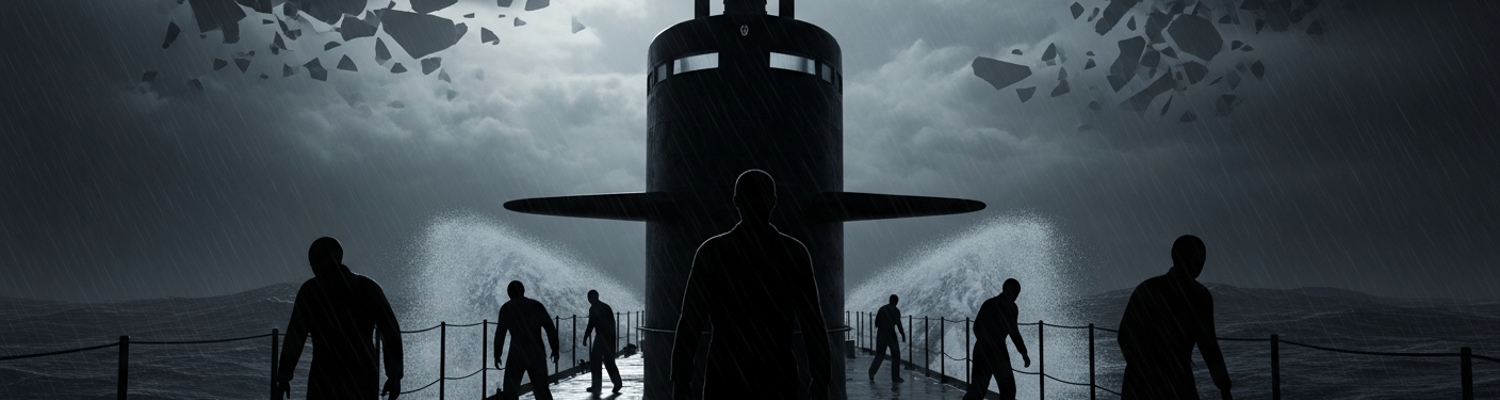

Post-Mission Debriefing and Mental Strain
The immediate aftermath of a covert psychological warfare mission was defined by a ferocious, clinical intensity. The captain’s post-mission debriefing was not a singular event but a continuous, rolling process that began the moment the submarine cleared the immediate threat zone. Every officer and enlisted specialist involved, from sonar technicians who monitored target responses to radiomen who managed transmission frequencies, was isolated for a structured data dump. These were not conversations; archival evidence shows these sessions were multi-hour ordeals.
The command staff, often led by the executive officer, used detailed checklists derived from standing naval doctrine. The captain’s personal involvement elevated the procedure. He would cross-reference crew recollections against the submarine’s own sensor logs, demanding precise timelines. Any discrepancy between a sailor’s memory and the ship’s recorded data was dissected. What was the exact time of the target’s course change? What was the precise wording of the second-phase broadcast script? This process was designed to strip away emotion and distill the operation down to verifiable facts, a raw dataset for future analysis.
The emotional impact of such operations rippled through the confined space of the hull. Unlike conventional combat, there was no visceral release, only the unnerving silence that followed a broadcast into the ether. Junior sailors, not always privy to the high-level strategy, knew only that they were transmitting messages designed to erode an enemy’s will. It was an abstract and insidious task. Studies of submariners on long-duration patrols consistently document elevated rates of anxiety, and a PsyOps mission compounded this baseline stress. Sailors reported a sense of contamination, a feeling that the duplicitous nature of their task had seeped into the very atmosphere of the boat. In the quiet hours after, this manifested in observable behaviors. Men would repeatedly clean their stations, a compulsive need for order in the face of moral ambiguity. Others became withdrawn, avoiding conversation in the mess. These were not signs of indiscipline but symptoms of a crew grappling with an unfamiliar form of warfare. The ship’s hospital corpsman, trained to spot psychological distress, saw a marked increase in requests for sleep aids and consultations for headaches and fatigue, all classic physical symptoms of unresolved stress.
This psychological tension existed alongside a frantic effort to record every unprocessed lesson. The military maxim that lessons are paid for in blood is an institutional religion in the submarine service. Before the formal After-Action Report could be compiled, a process that could take weeks, the captain demanded an immediate hot wash of all relevant data. This involved handwritten logs and voice recordings made by department heads while memories were still sharp. The engineering officer would document the exact power fluctuations on the battery systems during the high-power transmission. The navigation officer would record the minute adjustments made to maintain a stealthy posture. These were not polished narratives but raw streams of technical data and personal observations. A sonar supervisor might note a slight change in the acoustic signature of a target’s propellers minutes after the broadcast, a detail that could be vital for assessing effectiveness. These immediate, unfiltered records were considered the most valuable artifacts of the mission. They were a defense against the fallibility of human memory.
USS Ray and the Tarakan Beachhead
Operational logs for the USS Ray (SS-271) during its seventh war patrol reveal the severe mechanical and navigational constraints of its assigned task. The Gato-class submarine, having just completed an overhaul at Mare Island Naval Shipyard, was tasked with a high-risk special mission. Its orders were to transport and insert a party of Allied operatives onto the Japanese-held island of Tarakan. This required the submarine to navigate into the shallow, reef-strewn, and heavily patrolled waters off the coast of Borneo. The Ray, a vessel designed for deep-water combat with a test depth of 300 feet, was forced to operate at the edge of its performance envelope. Submerged travel was dictated by tidal flows and the constant threat of uncharted shoals. Surface running was restricted to an absolute minimum to avoid detection by shore batteries. The boat’s logs detail the strain on its electric motors and battery banks, which were not designed for the prolonged, low-speed maneuvering required to hold a stationary position for the insertion. A previous incident during the submarine’s sixth patrol, where a conning tower hatch failed to secure properly during a crash dive, had heightened command sensitivity to any operational risks.
The human cargo was an eight-man party from the Australian Z Special Unit, an elite special forces group. This reconnaissance, codenamed Operation Slipper, was a direct precursor to the main Allied invasion of Tarakan, Operation Oboe One. The team’s objective was to survey proposed landing beaches and identify Japanese defensive positions. They were specialists trained to operate independently, their equipment minimal and specialized. It consisted primarily of folboats (collapsible kayaks), silenced weapons, radios, and survey equipment. The entire operation depended on the submarine’s ability to deliver them undetected to a precise point on the coast.
The insertion took place on the night of April 30, 1945. With the main invasion force scheduled to land the next day, the window for reconnaissance was perilously short. The USS Ray surfaced in the pitch-black, moonless night, a mere 800 yards from the designated beach. The crew worked in near-total silence, launching the folboats from the deck. The commandos paddled away into the darkness. The submarine could not linger. Having discharged its passengers, the Ray immediately submerged and began the dangerous process of extracting itself from the coastal shallows before dawn and the start of the main invasion’s naval bombardment.
Electronic Severance and Physical Isolation
Logs from the USS Ray for the night of April 30, 1945, detail the finality of the mission’s transition. Once the eight Australian Z Special Unit operatives had paddled their folboats clear, a deliberate silence descended. This was a core tenet of submarine special operations. The risk of a radio transmission giving away the submarine’s position was absolute. The operatives carried no radios for communicating with the submarine. They were electronically severed from their transport. Onboard the Ray, this severance created a specific, controlled tension. Lookouts and sonar operators strained for any sign of detection from the shore, listening for a Japanese patrol boat engine or a shout across the water, not for any signal from the men they had just delivered.
The plan was irrevocable.
For the Z Special Unit team, this isolation was total. Their world shrank to the dimensions of their kayaks and the sound of their own paddles. A gap of only 800 yards separated them from the shore, but it was a perilous journey across water illuminated by starlight. Their first moments on land were a frantic battle against terrain and the clock. The designated landing zone was a line of dense, muddy mangrove swamps. Archival analysis of Tarakan’s geography shows the coast was a tangle of roots and deep mud, a natural obstacle complementing man-made defenses that included extensive minefields. The operatives had to physically drag their boats into the thick vegetation, conceal them from aerial observation, and establish a defensible perimeter, all in near-total darkness. The transition from the sterile, steel interior of the submarine to the humid, insect-infested jungle was a severe sensory shock.
The USS Ray could not linger to confirm success. Its survival depended on a rapid departure. The moment the commandos were clear, the order was given to submerge. This maneuver was among the most dangerous a submarine could perform. Operating in coastal shallows, the Gato-class boat was in constant danger of running aground on uncharted shoals or striking a mine. Navigational records from similar operations show the pressure on the boat’s navigator and diving officer, who had to execute a submerged withdrawal using unreliable charts and dead reckoning. The threat was twofold: detection by Japanese anti-submarine patrols and being caught in the impending Allied pre-invasion bombardment. The submarine was forced to retreat at its best possible submerged speed, its electric motors drawing heavily on the batteries, the crew maintaining absolute silence as sonar operators listened for the propeller sounds of enemy patrol craft.
The Shinano Kill and Its Hidden Cost
Operational logs for the USS Archerfish (SS-311) following its fifth war patrol reveal a vessel returning to port with a historic success and mission-ending systems failure. The submarine departed Hawaii on October 30, 1944, under Commander Joseph F. Enright, with its primary duty being lifeguard service for B-29 raids on Tokyo. On the night of November 28, the Archerfish encountered a massive Japanese warship leaving Tokyo Bay. After a six-hour surface pursuit, Enright submerged and fired a full spread of six torpedoes from his forward tubes. His target was the 72,000-ton supercarrier Shinano, the largest warship in the world, on its maiden voyage. The attack was a success; the fatally wounded carrier capsized hours later.
The Archerfish did not emerge unscathed. The act of firing its torpedoes inflicted critical damage upon itself, creating a form of “ghost cargo”—an invisible but burdensome liability. The submarine limped back to base, arriving in Guam on December 15, 1944, after 48 days at sea, celebrated for its kill but operationally compromised.
The mechanical cost was concentrated in the submarine’s primary offensive systems. A post-patrol inspection uncovered significant damage to the forward torpedo tubes. The hydraulic force generated by launching six torpedoes in rapid succession had warped the outer doors of the tubes. These doors were essential for maintaining the watertight integrity of the bow. With the doors failing to seal properly, the forward torpedo room was rendered unusable. This effectively disarmed the Balao-class submarine from the front, leaving Commander Enright with only the four stern tubes for offense. This unseen damage was the core of the submarine’s ghost cargo, a defect hidden within an outwardly intact hull.
Compounding the mechanical failures was the simple, attritional problem of supply. Standard patrol endurance for a fleet submarine was roughly 60 to 75 days. Having already been at sea for weeks, the Archerfish’s crew was running low on provisions. The return journey to Guam consumed precious remaining stores and fuel. Upon arrival, the crew was sent to a rest camp while the Archerfish underwent a necessary refit under Submarine Division 102. The combination of torpedo tube damage and depleted stores meant the submarine could not be turned around for another immediate patrol. The triumph over the Shinano had cost the Archerfish its own combat readiness, forcing it off the front line.
Component Failures and Phantom Readiness
A close review of operational logs from the Pacific theater reveals a submarine force constantly strained by its logistical tether. The impact on covert mission capability was direct. A planned psychological warfare operation in late 1944, intended to broadcast demoralizing messages to Japanese garrisons, was compromised before the first submarine left Pearl Harbor. The mission required a specialized, high-frequency transmitter that drew abnormal power, necessitating a set of newly developed carbon-pile voltage regulators. Archival evidence from Submarine Force Pacific (SUBPAC) command shows that only a dozen of these regulators had reached the forward areas, distributed between repair facilities at Pearl Harbor and submarine tenders at Majuro and Ulithi. Before the mission, the USS Tinosa (SS-283) reported catastrophic failure of two regulators during pre-patrol checks, their internal plates cracked by the shock of a previous depth charging. With no replacements available at the depot, technicians were forced to cannibalize parts from the transmitters allocated to the other two submarines assigned to the mission, the USS Seahorse (SS-304) and USS Thresher (SS-200).
The operation was subsequently reduced from a three-boat coordinated broadcast to a single-vessel mission. Its intended psychological impact was drastically diminished. The core concept, to create the illusion of an omnipresent Allied voice, was rendered impossible by the absence of a fifty-dollar part.
The concept of ‘ghost cargo’ became a persistent headache for SUBPAC planners. It described the unseen liabilities carried by a submarine returning from patrol, turning a theoretically combat-ready vessel into a non-asset. The case of the USS Archerfish (SS-311) provides a textbook example. While celebrated for the kill, the submarine returned to Guam with its forward torpedo room effectively destroyed. Post-patrol inspection reports detail how the hydraulic shock of firing a full six-torpedo spread had warped the outer doors for tubes one through six. It arrived in port as a ghost, listed on the operational roster as a full-strength fleet boat but in reality a crippled vessel needing extensive time in a floating dry dock. This phantom readiness created significant problems. Planners allocating forces for the upcoming Iwo Jima and Okinawa campaigns would see the Archerfish as an available unit, only to have their calculations upended by the detailed damage report revealing weeks of required repairs. The ghost cargo was the deficit between a ship’s perceived strength and its actual capacity to fight.
Combat stress directly translated into a measurable degradation of naval logistics. The psychological toll of a long war patrol manifested in crew fatigue and inattention that had tangible supply consequences. An examination of requisitions from submarine tenders like the USS Proteus (AS-19) shows a consistent pattern: boats returning from high-stress patrols logged an uptick in requests for easily damaged minor components. These included smashed gauges, stripped bolts on inspection plates, and blown fuses in electronic gear, all indicative of a crew whose fine motor skills and attention to detail were frayed. One documented incident aboard the USS Batfish (SS-310) after a difficult patrol saw a torpedoman, suffering from prolonged stress, improperly seat a gasket on a compressed air flask. The resulting slow leak went unnoticed for 48 hours, bleeding off a significant portion of the high-pressure air reserved for surfacing and torpedo launching. This loss forced the boat to spend an extra day alongside the tender, running its own compressors to replenish the air banks, consuming fuel and delaying its refit schedule. The crew’s exhaustion had become a direct logistical burden.
Equipment Failure and Cryptic Intercepts
Operational logs for the USS Dace (SS-247) during the closing weeks of its sixth war patrol in January 1945 reveal a submarine stretched to its limits. The Gato-class boat was operating in the congested shipping lanes of the South China Sea. The crew was already worn from a punishing patrol that had begun in early December 1944. Archival evidence shows the patrol included hazardous mine-laying operations and a violent encounter with enemy escorts that saw the Dace severely shaken by depth charges. Having sunk the Japanese collier Nozaki on December 28th, the crew was in a state of heightened tension and fatigue as they navigated towards Saipan for fuel.
The boat was breaking down.
The physical abuse the submarine had endured translated directly into equipment failures. The SJ surface-search radar, the submarine’s electronic eyes, began exhibiting severe intermittency. Technicians’ reports from the period describe the plan position indicator scope becoming a blizzard of false returns, a symptom of failing vacuum tubes and vibration-loosened connections. At other times, the system would fail entirely. Compounding this was the degradation of the WCA sonar. The hydrophones, mounted externally on the hull, had sustained damage from the depth charge concussions. This manifested as a loss of sensitivity and an inability to hold a clear bearing on distant contacts. The captain was now fighting in one of the world’s most dangerous environments with unreliable senses, forced to depend on periscope observations and the straining eyes of lookouts.
While contending with these mechanical failures, the Dace’s radio intelligence team began to log disturbing Japanese naval communications. A pattern emerged from low-grade KANA code traffic. The intercepts, translated aboard the submarine, contained references to specific grid sectors in the South China Sea that corresponded with unnerving accuracy to the Dace’s recent operational areas. One transmission logged on January 7, 1945, detailed a patrol route for a submarine chaser that cut directly across the area where the Dace had been shaken just days prior. Another spoke of reinforcing air patrols in a sector suspiciously close to the submarine’s planned route toward Saipan. Historical analysis of Japanese naval intelligence from this period confirms they operated direction-finding stations capable of getting rough fixes on submarine radar transmissions. The dilemma for the Dace’s command was acute. There was no way to know if the Japanese had a precise fix, if their codes had been compromised, or if the enemy was engaging in a sophisticated bluff. The captain, already fighting blind, was now forced to assume the enemy could see his every move. This forced an immediate order for absolute radio and radar silence, isolating the boat entirely.
The Extraction Calculus in a Kill Zone
An examination of the captain’s tactical log in the hours following a PsyOps broadcast reveals an operational environment defined by an absolute lack of reliable intelligence. The submarine, having transmitted its psychological barrage, was now submerged in a profound sensory void. The SD air-search radar was silent to prevent detection. The passive JT sonar array offered only ambiguous information. Technicians logged faint, intermittent propeller noises on a bearing of 085 degrees, but the acoustic signature was too distorted by thermal layers to be classified. It could be a Japanese Type 13 submarine chaser investigating, or it could be a neutral fishing trawler. Radio intelligence operators, scanning the frequency bands used by the local Japanese garrison, intercepted only routine KANA administrative traffic. There was no spike in communications. For the captain, this absence of data was more stressful than a direct counter-attack. He was forced to make decisions based on pure conjecture.
This ambiguity fed directly into the mission’s most dangerous contingency: the potential extraction of a two-man special operations team. Standing orders dictated that should the team, designated “Sandman,” fail to signal their own successful exfiltration by 0400 hours, the submarine was to assume they were compromised and required emergency retrieval. The captain was now forced to weigh the hypothetical risk of this retrieval against the certain danger to his vessel and its 82-man crew. A review of operational charts shows the designated emergency extraction point was a small cove surrounded by navigational hazards. The approach required traversing a channel less than 40 fathoms deep, well within the known operating depth of Japanese Type 93 moored mines. Shore-based radar, identified by signals intelligence as a Type 22 surface-search unit on a nearby cape, had the entire approach under its theoretical coverage. Executing a surface extraction to recover two men would mean exposing the submarine for a minimum of twenty minutes in a known kill zone.
Technological breaking points began to manifest. The high-power broadcast had placed an unprecedented load on the submarine’s electrical systems. Post-mission engineering logs document the failure of a key carbon-pile voltage regulator for the port-side main bus. This single failure created a cascade effect. The boat could no longer reliably tie its battery banks together, limiting the amperage available for a high-speed submerged sprint. The Chief Engineer reported that a full-power dive would now risk a catastrophic overload of the starboard bus, potentially leaving the submarine dead in the water. This mechanical failure placed a severe psychological burden on the command team. The captain’s primary escape mechanism, speed, was now compromised. He was faced with a tactical dilemma created by his own mission’s equipment: his sonar was providing questionable data, his engine room was reporting critical power limitations, and the clock was ticking towards the 0400 decision point for the Sandman team.