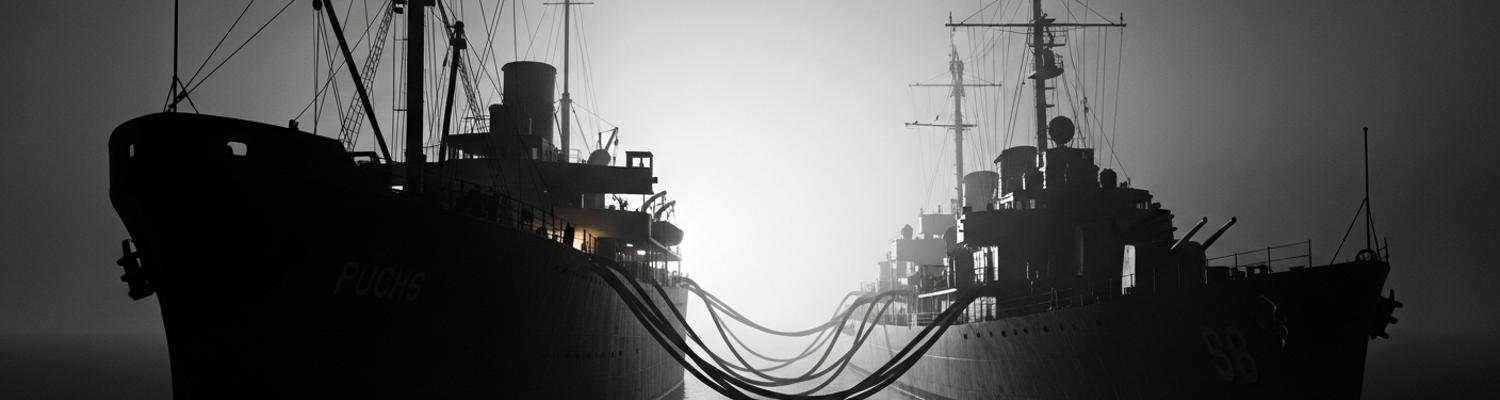

The series of naval exercises initiated in 1923, designated Fleet Problems, were designed to test the United States Navy’s readiness for a future conflict. Fleet Problem II, conducted in January of 1924, simulated the initial phase of a westward advance across the Pacific. The Blue Force Battle Fleet was tasked to move from the West Coast to Panama. This was not a test of combat doctrine. It was an examination of the fleet’s ability to handle a long transoceanic voyage. A close review of operational logs from the exercise (NARA Record Group 38) reveals the strain placed on machinery and men. The scenario was unscripted, a free-play exercise intended to expose weaknesses in planning and equipment. The findings were clear. The problem of projecting and sustaining naval power across the Pacific was far greater than planners had anticipated, a challenge rooted in geography and international treaty.
The Pacific was an ocean of distance.
Following the 1922 Washington Naval Treaty, the United States, Britain, and Japan agreed under Article XIX to maintain the existing status quo of fortifications and naval bases in the Pacific. This agreement effectively froze the U.S. Navy’s logistical infrastructure in the region. It prevented the further development of crucial island bases like Guam or the Philippines. American naval power in the Pacific was consequently tethered to a few key, widely separated points: the naval yards on the West Coast, the major hub at Pearl Harbor in Hawaii, and the Panama Canal Zone. The empty stretches of ocean between these fixed installations represented a strategic vulnerability. Pre-war planning documents show a persistent concern over this logistical thinness. A fleet operating west of Hawaii would be almost entirely dependent on a long and fragile chain of supply ships. A 1920s-era battleship’s operational radius was limited. Without regular refueling, it was confined to a radius of roughly two thousand miles from its last port.
Fleet Problem II and its successors were designed specifically to probe this vulnerability. The exercises consistently demonstrated that an adversary, designated the Black Fleet and representing Japan, could inflict crippling damage without seeking a decisive, set-piece battle. The strategic objective became the Blue Fleet’s logistical tail. Planners understood that Pearl Harbor was a logistical island. Its viability depended entirely on the constant flow of oilers, colliers, and supply transports from the mainland. The war games showed that even a handful of enemy submarines or surface raiders, by targeting these soft-skinned auxiliaries, could paralyze the entire Battle Fleet. Ships would be stranded, not for lack of fighting spirit, but for want of fuel oil and provisions. The exercises proved that an unfortified forward base was useless. The true center of gravity for the U.S. Navy in a Pacific war was not its battleships, but the humble supply ships that kept them moving.
A close review of operational logs from the early 1920s reveals a Navy grappling with a fundamental problem of physics and distance. The initial forays into at-sea refueling were crude, born of necessity and marked by caution. The most primitive, yet foundational, of these was the astern fueling method. In this configuration, a receiving warship, typically a destroyer, would follow directly behind a fleet oiler like the USS Cuyama or USS Kanawha. The oiler would trail a buoyant hose in its wake for the destroyer to retrieve and connect. This technique was safer from a collision standpoint, as maintaining station directly behind another vessel was a less demanding exercise in seamanship than sailing in close formation. Its deficiencies, however, became immediately apparent. The rate of fuel transfer was agonizingly slow, limited by the small diameter of the hose and the low pressure that could be maintained. Planners quickly concluded the method was too slow to be tactically useful. It tethered multiple warships to a single oiler for prolonged, vulnerable periods. Only one ship could be serviced at a time.
This was not a solution. It was a stopgap.
The limitations of the astern method forced an evolution toward the far more dangerous, but potentially more rewarding, alongside connected replenishment. The conceptual leap was significant. It demanded that two ships steam in parallel, separated by a mere 40 to 80 feet, while heavy, oil-filled hoses were suspended between them. The risk of collision was extreme, requiring constant, minute adjustments from the helmsmen and engine room crews of both vessels. A misjudged swell or a moment of inattention on the bridge could result in a catastrophic impact. To mitigate this, early experiments focused on daytime operations in calm seas. Yet, war would not wait for ideal conditions. Planners began to evaluate the feasibility of synchronized nighttime fuel transfers. This was a new level of risk. Under the cloak of darkness, with ships operating under black-out conditions to avoid detection, the margins for error evaporated. Archival evidence shows that command discussions revolved around the hazards of station-keeping, hose management, and emergency breakaway procedures in the pitch black. A severed hose would mean a massive, flammable oil slick between two ships. A collision could cripple both vessels hundreds of miles from any friendly port. The process was a high-wire act of coordination, relying on dimly lit signal lamps and sound-powered telephones to coordinate every action.
The operational imperative for mastering these hazardous techniques came from the destroyer squadrons. These flotillas of flush-deckers and, later, the more advanced Farragut-class destroyers were the fleet’s nerve endings, intended to operate far ahead of the main battle line of slower, more fuel-efficient battleships. Their mission was to screen for submarines, scout for enemy surface forces, and act as plane guards for the new aircraft carriers. These tasks demanded high speeds, which consumed fuel at a prodigious rate from their limited bunkers. A destroyer’s endurance was a fraction of a battleship’s. Without a means to refuel far from port, these destroyer screens would be forced to withdraw prematurely, leaving the fleet’s capital ships blind and vulnerable. The logistical strain on the destroyer squadrons was not a theoretical problem. It was a tactical crisis in the making. The success of any westward advance across the Pacific, as simulated in Fleet Problem II, depended entirely on the ability to keep these short-legged destroyers topped off with fuel. The nascent, high-risk art of underway replenishment was therefore not an ancillary capability. It was the essential component upon which the entire strategic doctrine of forward projection rested.
The exercise was designed to fail. In the cold waters of the Eastern Pacific in January 1924, as the Blue Fleet steamed toward Panama, planners scheduled a night replenishment to test the absolute limits of men and material. The oiler USS Cuyama, a vessel central to the Navy’s early experiments with refueling at sea, was tasked with servicing a division of Clemson-class destroyers. These flush-deckers were notorious for their high fuel consumption at speed, giving them limited range and making them utterly dependent on the fleet’s oilers. To simulate the reality of a wartime advance, the operation was executed under darken ship conditions. All navigation lights were extinguished or heavily shielded, rendering the massive steel hulls nearly invisible to each other in the moonless dark. A close review of operational logs from this period shows that commanders understood the high degree of danger involved in bringing two ships within 40 to 80 feet of each other at night. Every element of the exercise was a deliberate step into a zone of extreme risk, predicated on the knowledge that a future war in the Pacific would be won or lost by the ability to perform such dangerous evolutions.
It was a test of seamanship in near-total blindness.
Then the environment intervened. As the Cuyama and the lead destroyer maneuvered into their parallel courses, a heavy, unforecasted fog descended, reducing visibility to mere yards. This was compounded by strong, unpredictable cross-currents common to the waters off the Panamanian coast, a phenomenon caused by powerful winds funneling through gaps in the mountains. The helmsmen on both bridges were now fighting unseen forces, attempting to maintain a constant heading and speed while being pushed inexorably off course. A technical analysis of the hydrodynamics involved shows that two ships steaming in close proximity create a suction effect between their hulls, pulling them together. The two ships, one a 14,800-ton oiler and the other a nimble but fragile 1,200-ton destroyer, became two phantoms tethered by guesswork. The strain on the bridge crews was immense, their entire perception of the other vessel reduced to the faintest of glows from a heavily shielded signal lamp and the sound of water churning between the hulls. The margin for error, already thin, had vanished into the oppressive fog.
A communication breakdown was the final element in the unfolding crisis. The primary link between the two ships’ bridges was a sound-powered telephone, its wire run across with the heavy fuel hoses. In the damp, salt-heavy air, the connection became intermittent and then failed completely. The backup system, signal lamps, was rendered useless by the dense fog. The captains were now truly deaf and blind to one another. An archival analysis of similar incidents shows that at this point, standard procedure would be to initiate an emergency breakaway. With the pressing tactical need to complete the refueling, a decision was made to proceed. This left the two ships in the most dangerous possible state: physically connected by pumping hoses but entirely disconnected in command and control. A minor adjustment of speed in the Cuyama’s engine room, no longer relayed to the destroyer’s bridge, would cause the smaller ship to surge ahead or fall behind, placing a sudden, massive strain on the hoses and mooring lines.
The result was a cascade of mechanical failures. Pushed by a current the helmsman could not account for, the destroyer began to close the distance to the Cuyama. Without a functioning telephone link, the frantic orders from the destroyer’s bridge to the engine room for an emergency speed change were not synchronized with the oiler. The ships made contact. The collision was a low-speed, grinding impact, not enough to breach the hull but sufficient to crush the destroyer’s port-side railings and boat davits. More critically, the impact and the sudden shearing force parted a hose coupling. Fuel oil gushed into the sea between the two vessels, creating an immediate and severe fire hazard. The replenishment was aborted. The damaged destroyer, its fuel tanks still low, was forced to detach from the screen and reduce speed, a single point of failure that compromised the defensive perimeter for the entire battle group. The incident, born of darkness, fog, and a failed wire, was a stark demonstration of how a tactical evolution could unravel into a strategic liability.
The night replenishment crisis involving the USS Cuyama provided the Black Fleet’s hypothetical analysts with a perfect case study in catastrophic failure. A close examination of the incident’s chronology shows how a series of minor, independent problems cascaded into a strategic disruption. For a Black Fleet analyst, the collision and parted hose coupling were not just a tactical accident; they were a blueprint for exploitation. An enemy submarine commander would not need to risk an attack run to sink the valuable oiler. The mere presence of a single submarine, forcing the replenishment to be aborted or conducted under rushed, high-stress conditions, would achieve a similar outcome. By creating panic or forcing an emergency breakaway in bad weather, a small, inexpensive raiding force could effectively neutralize the destroyer screen of an entire carrier group, leaving it exposed for hours or even days. The failure exposed that the very process of underway replenishment created a predictable window of extreme vulnerability that an enemy could reliably target.
Sustained forward operations were therefore rendered strategically untenable.
The entire American doctrine for a Pacific war, codified in the evolving War Plan Orange, was predicated on a rapid, long-range offensive. This advance depended completely on the ability of short-legged destroyer squadrons to protect the main battle fleet. Fleet Problem II demonstrated that this protective screen was itself dependent on a nascent and fragile refueling capability. Archival evidence from post-exercise critiques shows that planners recognized this flaw immediately. If a single destroyer division could be crippled by a failed replenishment in a peacetime exercise, a determined enemy could systematically dismantle the fleet’s defensive perimeter in wartime by simply harassing its oilers. The battle fleet would be forced to slow its advance or shrink its operational radius, tethered to the last secure friendly base. This would make its movements predictable and cede the initiative to the defending force, completely inverting the intended strategic dynamic of the American war plan. The dream of a swift westward thrust was confronted by the mechanical failure of a single hose coupling in the dark. The entire timetable for the Pacific advance was now in question. The plan relied on the fleet maintaining momentum, but the UNREP failure showed that the destroyer screen could be dismantled by systematically targeting the fleet’s logistical train. Each aborted replenishment would force the battle line to slow down, making its path more predictable and ceding the strategic initiative to the defending Japanese forces. The core assumption of a swift offensive collapsed. Instead of a rapid westward drive, the fleet would be forced into a slow, halting crawl, tethered to the operational radius of its most fuel-deprived escorts. This transformed the fundamental dynamic of the war plan from a bold offensive into a ponderous and vulnerable advance, playing directly into the hands of a defensive adversary. American strategic reach was not defined by the range of its battleship guns, but by the length and reliability of a rubber hose.