
Forging the Tools of Invasion
The ghost of Dieppe haunted the halls of Allied planning. The disastrous 1942 raid on the French coast served as a bloody memorandum that attacking a fortified port head on was a recipe for slaughter. German defenses were built around ports. The lesson, seared into the minds of commanders, was that the next invasion, the real invasion, would have to succeed over open beaches. This presented a massive engineering problem. A modern mechanized army is a ravenous beast. It consumes hundreds of tons of supplies per division, per day. Sustaining an army of millions put ashore on exposed sand required a logistical system of unprecedented scale and ingenuity. It demanded the construction of a causeway to victory, built not of stone, but of steel, concrete, and raw nerve. The challenge fell to the Allied naval and army engineers, who, between the interwar years of strained budgets and the pressure cooker of global conflict, developed the specialized tools to breach Hitler’s Atlantic Wall and sustain the armies that poured through the gap. This is the story of their solutions, the instant ports, the strange tanks, and the undersea pipeline that fed the liberation of Europe.
Designing the Whale Road
The concept of a portable harbor was not new. Winston Churchill himself had mused on the idea as early as 1917. But it took the stark failure at Dieppe to transform the notion from a theoretical curiosity into an urgent operational requirement. A committee was formed. Ideas were solicited. Vice Admiral John Hughes-Hallett, a witness to the Dieppe catastrophe, became a powerful advocate. The project, codenamed 'Mulberry', began to take shape under a thick veil of secrecy, coordinated by Brigadier Sir Harold Wernher. The final plan was a work of modular genius, a collection of massive, prefabricated components designed to be towed across the English Channel and assembled off the Normandy coast. Each harbor would be the size of the port of Dover.
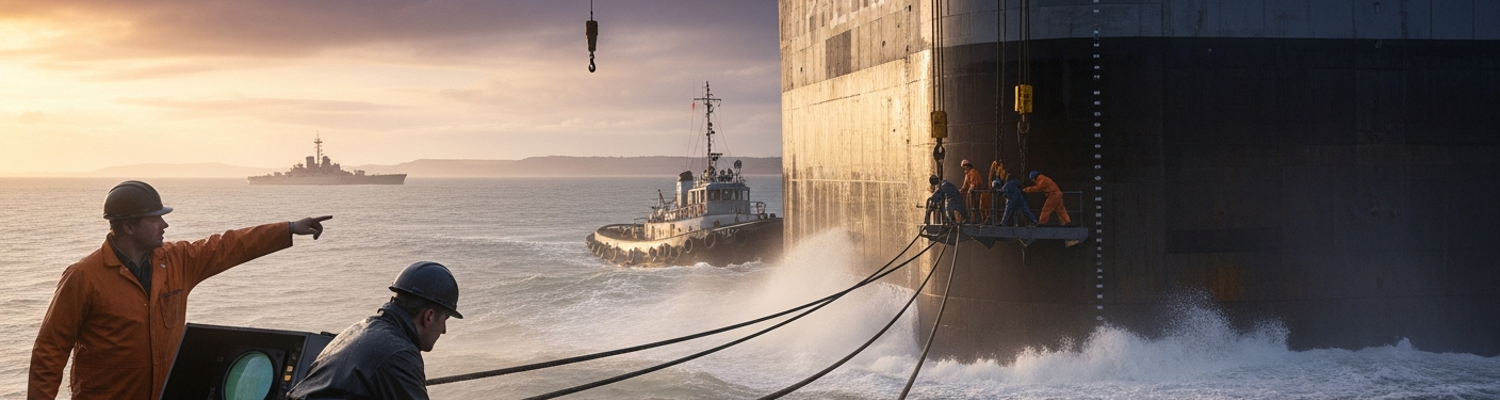
The core of the Mulberry was its breakwater. This was a multi layered defense against the sea. The outermost line consisted of floating steel breakwaters called 'Bombardons'. Inside this, a line of 'Gooseberries' composed of 70 obsolete merchant ships, sailed to Normandy under their own power and then scuttled in precise locations, would form a secondary, solid barrier. The main breakwater, however, was the 'Phoenix' system. These were colossal, hollow concrete caissons of varying sizes, the largest displacing over 6,000 tons. Built in hastily constructed dry docks and along riverbanks around Britain, from the Thames Estuary to Clydeside, by a workforce of 45,000 people, these concrete behemoths were designed to be floated across the channel with skeleton crews aboard, then flooded and sunk to form the harbor walls. They stood up to 30 feet above the water at low tide, creating a vast area of calm water.
Within this sanctuary, the 'Whale' roadways provided the connection to the shore. These were flexible steel bridge spans, designed by engineer Allan Beckett, that floated on steel or concrete pontoons called 'Beetles'. This design allowed the roadway to rise and fall with the tide, a critical feature for 24 hour operations. The roadways terminated at 'Spud' pierheads, large platforms with legs that could be jacked up and down to rest on the seabed, creating stable unloading docks in deep water. The entire operation was a monumental feat of civil engineering, repurposed for war. Construction of the 212 Phoenix caissons alone consumed 330,000 cubic yards of concrete and 31,000 tons of steel.
Two harbors were planned. Mulberry A for the American forces at Omaha Beach, and Mulberry B for the British and Canadians at Gold Beach near Arromanches. The design was British, a product of the War Office and Royal Engineers. The on site assembly, however, highlighted the complexities of inter allied operations. The Royal Navy and Royal Engineers were responsible for Mulberry B. The US Navy’s Civil Engineer Corps, the 'Seabees', were tasked with constructing Mulberry A from the British made parts. On June 6, 1944, the components began their journey. Over 400 towed sections, weighing a combined 1.5 million tons, set sail for France. Within twelve days, both harbors were operational.
Then, on June 19, disaster struck. The worst storm to hit the Channel in forty years descended on the invasion coast. For four days, ferocious winds and waves battered the fledgling ports. Mulberry B at Arromanches, better sheltered and perhaps more securely anchored, was badly damaged but survived. Mulberry A at Omaha Beach was completely destroyed. The US Seabees had faced immense challenges, working with unfamiliar components and a British design that some American commanders viewed with skepticism. The storm's fury was the final blow. The wreckage was so complete that the harbor was abandoned. Salvageable parts were used to repair Mulberry B. The Americans adapted, perfecting a system of landing supplies directly onto the beach using Landing Ship, Tank vessels, a method made tenable only by the partial shelter offered by the remaining 'Gooseberry' blockships. Mulberry B, later christened 'Port Winston', became the single most important port for the Allied armies in the months that followed. For ten months, it was the lifeline. Over 2.5 million men, 500,000 vehicles, and 4 million tons of supplies were landed through this triumph of engineering.
Breaching the Atlantic Wall
While naval engineers were solving the problem of seaborne supply, army engineers were tackling the immediate, violent challenge of the beach itself. The Atlantic Wall was a lethal network of mines, anti tank obstacles, and concrete bunkers. Standard tanks were vulnerable. They could be stopped by a ditch, immobilized in soft sand, or destroyed by a single mine. The lessons of Dieppe had been learned here, too. The answer came in the form of a bizarre menagerie of specialized armored vehicles known as 'Hobart’s Funnies'.
These machines were the product of the 79th Armoured Division, a unique British formation commanded by Major General Percy Hobart. Hobart, a brilliant but cantankerous pioneer of armored warfare who had been forced into retirement before the war, was recalled by Churchill to create solutions for the invasion. Working with Royal Engineers, Hobart's division did not function as a standard combat unit. Instead, its specialized brigades were parceled out to other units to provide specific capabilities. They took existing tank chassis, primarily the British Churchill and the American Sherman, and adapted them for combat engineering tasks.
One of the most critical was the Duplex Drive or 'DD' tank. A Sherman tank was fitted with a collapsible canvas flotation screen and twin propellers driven by the tank’s engine. Launched from landing craft several miles offshore, these tanks could 'swim' to the beach, drop their screens, and provide immediate fire support to the first waves of infantry. Other vehicles addressed different obstacles. The 'Crab' was a Sherman tank equipped with a rotating flail of heavy chains on its front, designed to thrash the ground and detonate mines in its path, clearing a safe lane for following troops. The Armoured Vehicle, Royal Engineers (AVRE) was a Churchill tank adapted to carry a 290mm spigot mortar, the 'Petard', which fired a 40 pound charge nicknamed the 'flying dustbin', capable of demolishing concrete fortifications. Other AVRE variants carried massive bundles of wood called 'fascines' to drop into anti tank ditches, laid canvas 'carpets' from a 'Bobbin' to create a roadway over soft sand, or deployed a Small Box Girder bridge to span gaps.
The employment of these 'Funnies' on D Day revealed a critical divergence in Allied doctrine. Montgomery had insisted on their use, and the British and Canadian beaches at Gold, Juno, and Sword saw the full range of Hobart’s creations in action. They flailed paths through minefields and smashed bunkers, significantly reducing casualties and speeding the advance inland. The Americans, however, were skeptical. General Bradley was offered the use of the 'Funnies', but his staff declined all but the DD tanks. The consequences of this decision were felt acutely at Omaha Beach. The DD tanks launched there were released into seas that were too rough. Many swamped and sank, depriving the initial assault waves of vital armored support. The infantry and combat engineers on Omaha were left to face the German defenses with rifles, Bangalore torpedoes, and hand placed demolition charges under withering fire, paying a heavy price in blood for tasks that Hobart’s machines were clearing with relative ease on the British beaches.
The Undersea Lifeline
The capture of a beachhead and the initial breakout were only the first steps. As the armies advanced deeper into France, their logistical tail stretched ever longer. The demand for one commodity above all others became paramount, fuel. A mechanized army without petroleum is just a collection of static pillboxes. Planners knew that conventional tankers would not be enough. They were vulnerable to weather and U boat attack, and would clog the precious space in the Mulberry harbor and on the beaches. The solution was audacious, a pipeline under the ocean, codenamed Operation PLUTO.
The idea, championed by Admiral Louis Mountbatten, was developed by Arthur Hartley, the chief engineer of the Anglo Iranian Oil Company. Two main designs emerged from a massive industrial effort involving firms like Siemens Brothers and Pirelli. The first, 'HAIS' (Hartley, Anglo Iranian, Siemens), was essentially a modified underwater telegraph cable. It had a 3 inch diameter extruded lead core, reinforced with layers of steel tape, jute, and galvanized steel wire. It was flexible and could be laid by conventional cable laying ships. The second design was the 'HAMEL' (Hammick and Ellis, the engineers who designed it). This was a more rigid but simpler 3 inch steel pipe. Because it was too stiff to be coiled on a ship, it was manufactured in long sections, flash welded together, and wound onto enormous floating drums called 'Conundrums'. These massive spools, some 50 feet in diameter and 90 feet wide, weighed 1,600 tons when full of pipe and were towed across the Channel, unreeling the pipe as they went.
This was another clandestine triumph of engineering. Pumping stations were disguised in innocuous buildings along the English coast, including bungalows, garages, and even an ice cream shop on the Isle of Wight to evade aerial reconnaissance. The first pipeline was laid in August 1944, stretching 70 miles from the Isle of Wight to the newly captured port of Cherbourg. The operation was not without its difficulties. Initial attempts failed due to faulty couplings and pipes breaking on sharp seabed rocks. The first operational lines delivered less fuel than anticipated, and there were debates at high levels about whether the project was worth the resources. However, as the Allies pushed east, a second, shorter pipeline route was established from Dungeness to Boulogne. This network of 17 pipelines proved its worth. By the time Germany surrendered, Operation PLUTO had delivered 172 million gallons of fuel to the continent, feeding the armored columns that raced towards the Rhine. It was a vital artery that kept the Allied advance from stalling due to fuel starvation, a fate that had crippled German offensives earlier in the war.
The engineering feats of 1944 were decisive. The Mulberry Harbors, Hobart's Funnies, and Operation PLUTO were not abstract concepts but tangible, material solutions to the brutal realities of amphibious warfare. They were born from the hard lessons of past failures and brought to life by the collaboration, and sometimes friction, between Army and Naval engineers. This causeway to victory, constructed from ingenuity and industrial might, ensured that when the soldiers of the line breached the Atlantic Wall, they did not do so alone. Behind them flowed a torrent of steel, fuel, and supplies that would prove unstoppable.