
Civil-Military Advisory Teams in Northern I Corps
Infantry battalions of the North Vietnamese Army and local Viet Cong guerrilla cadres anchored their defensive networks across the steep karst ridges and flooded coastal plains of Military Region 1. Joint CORDS advisory teams moved directly into contested sectors of Quang Tri and Thua Thien provinces, where hostile mortar crews and sniper teams controlled the tree lines encircling every population center. Thick red mud swallowed the axles of transport trucks trying to move supplies up Highway 1, while monsoon rain regularly filled irrigation canals that insurgent fighters used as concealed avenues of approach. Advisers discovered that local farmers worked their rice fields under constant observation from enemy forward observers hidden in the jungle foothills to the west. Every district compound in these northern border areas sat within range of heavy Soviet-built artillery and 82-millimeter mortars dug into fortified positions across the nearby Demilitarized Zone. Teams had to fortify their living quarters with double layers of timber logs, corrugated steel sheets, and hand-filled sandbag barriers before they could attempt any civil projects.
MACV infantry officers shared these cramped sandbag bunkers with civilian specialists from the United States Agency for International Development to run district-level pacification headquarters. This combined command structure paired seasoned army captains with agricultural economists, public health technicians, and Foreign Service officers to rebuild local administrative networks. Military members carried M16 rifles and managed perimeter security, communications radios, and tactical coordination with local South Vietnamese Regional Forces. Civilian advisers focused on distributing fertilizer bags, repairing drainage culverts, vaccinating village cattle, and reopening primary schools shut down by guerrilla attacks. The two groups had to coordinate every move, since a simple truck run with cement bags or medical crates required armed escort platoons and air-support call signs. Nightly mortar barrages repeatedly collapsed their newly poured concrete foundations and punctured fuel drums stored in open motor pools.
Vietnam Training Center instructional manuals offered no practical methods for repairing shattered concrete foundations or patching fuel drums under direct artillery fire. Civilian specialists had spent months in air-conditioned classrooms memorizing administrative flowcharts, village council election codes, and economic theories designed for stable rural populations. That theoretical curriculum assumed that field teams would work in secure hamlets where local farmers willingly attended town meetings and accepted central government authority. Contested villages in Thua Thien and Quang Tri instead presented destroyed irrigation gates, booby-trapped hedgerows, and targeted assassinations of newly appointed hamlet chiefs. Insurgent cells routinely executed village elders who accepted American aid bags, forcing advisory personnel to shift from community development lectures to basic survival routines. Classroom lectures on economic self-sufficiency dissolved whenever teams had to spend their daylight hours clearing punji-stick pits and repairing blown bridge timbers.
Advisers adapted to the destroyed crossings and mined roadways by welding scrap steel plates onto the floorboards of their utility trucks and mounting heavy machine guns behind the cab. Civilian agricultural workers learned to strip and clean weapons alongside MACV sergeants during evening stand-to drills along the district perimeter wire. Field teams also began stashing spare diesel water pumps, crates of hand tools, and medical bandages inside reinforced underground bunkers rather than open warehouse sheds. When insurgent sappers breached district perimeters at night, USAID officers grabbed carbines to help man bunker firing slits while army radio operators directed helicopter gunships onto the wire. Morning light regularly revealed shrapnel in village tractors, charred seed stocks, and newly planted rice paddies churned into mud craters by incoming rocket artillery. District advisers used their remaining daylight to distribute corrugated steel roofing directly into the hands of village families before organizing armed patrols to secure the outer irrigation canals.
Hamlet Evaluation System Metrics and Viet Cong Infrastructure
Advisers returning from the dark canal dikes set down their rifles inside the district bunker to complete the monthly compilation of computerized Hamlet Evaluation System scoring cards. Standardized paper scoring sheets required advisory teams to evaluate eighteen separate indicators of local developmental and security status, assigning letter grades from A down to E for every settlement within the operational boundary. Advisory captains and civilian specialists answered dozens of detailed multiple-choice questions evaluating village administrative stability, medical dispensary operations, agricultural trade volumes, and the combat readiness of local South Vietnamese militia platoons. Clerks bundled these completed paper forms and delivered them to automated data centers in Da Nang, where punch-card technicians fed the numerical entries into mainframe computers to generate province-wide pacification progress printouts. Processing algorithms converted fluid counterinsurgency combat into neat columns of mathematical security indexes, treating the loyalty of rural villagers as an engineering problem that technicians could solve with checkmarks in printed boxes. Clerks loaded the finalized punch cards onto transport flights bound for Saigon headquarters, where staff officers used the rising statistical numbers to draft optimistic progress briefings.
Viet Cong cadres ignored those optimistic progress briefings and operated an entrenched network of shadow governance throughout hamlets carrying favorable security ratings on paper. Known to intelligence officers as the Viet Cong Infrastructure, these underground party committees, political commissars, and village tax collectors lived in concealed bunker networks dug directly beneath family kitchens, pigsties, and bamboo hedgerows. Insurgent administrators slipped out of their underground hiding holes after sunset to extract grain taxes and cash levies from the same farming families who had gathered American sheet metal and seed bags that morning. Party organizers gathered young villagers in central meeting yards to deliver political lectures, establish courier rings, and forcibly recruit teenage boys into local guerrilla combat squads. Squads of armed shadow enforcers executed government-appointed village chiefs and regional militia sentries who attempted to block these nocturnal sessions, dumping their bodies along cart tracks to terrify the local population. Favorable card scores kept flowing into automated data banks while insurgent political officers exercised undisputed authority over village life from their concealed underground tunnels.
Commanders in Da Nang and Saigon disregarded those concealed underground tunnels and exerted intense administrative pressure on district senior advisers to submit inflated pacification metrics to higher headquarters. Senior headquarters officers treated any downward revision of hamlet security scores as proof of advisory team incompetence rather than an accurate report of persistent enemy infiltration. Visiting staff colonels regularly cross-examined captains who documented insurgent tax collection or militia desertions, warning junior officers that low grades halted career advancement and ruined pacification charts displayed during command briefings. District senior advisers realized that reporting the genuine D and E security conditions of contested river hamlets provoked angry administrative reprimands while changing nothing on the physical battlefield. Advisers coped with this intense command pressure by revising their scoring sheets upward, checking off fabricated improvements that transformed guerrilla-dominated hamlets into nominally secure category C and B zones. Weary captains signed the altered evaluation cards, loaded the courier bags onto departing helicopters, and immediately walked out to the perimeter sandbags to check heavy machine guns and trip flares for the coming night assault.
Material Shortages and Signal Bottlenecks at Outposts
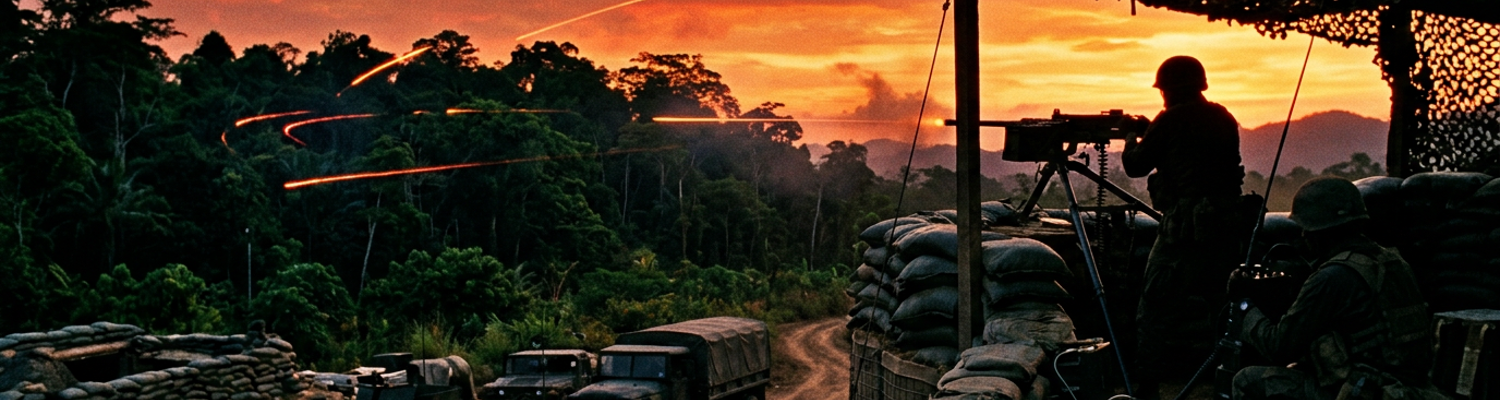
Sandbags stacked along the defensive trenches crumbled under daily downpours, spilling loose soil across the machine gun positions because logistics depots in Da Nang failed to ship fresh burlap sacks. Classroom doctrine from the military training schools assumed that district headquarters and outlying forts would receive standardized engineer supply packages containing everything needed to erect fortified redoubts. Reality along the coastal plains and foothills contradicted those administrative schedules, as chronic delivery delays left field compounds waiting months for structural timber, heavy concertina wire, and basic sandbags. Heavy transport trucks carrying bulk building materials regularly bogged down in flooded roadway bypasses or halted altogether when monsoon rains washed away fragile wooden bridge spans along Highway 1. Insurgent road-mining teams took advantage of these bottlenecks by planting buried explosives along the unpaved detours, destroying the few engineer vehicles that attempted to move forward. Advisory personnel had to scavenge splintered ammunition pallets, flatten discarded metal ration tins, and splice together short strands of rusty telephone wire to construct crude blast walls around their mortar pits and living quarters.
Sentries from isolated Popular Force platoons suffered the immediate consequences of these fortification shortages while guarding remote agricultural hamlets across the district perimeter. Field manuals prescribed double aprons of concertina wire, trip-flare networks, and interlocking fields of fire for every village defense post, but local militia compounds made do with single strands of cattle fencing and chest-high mud berms. Insurgent sappers and local Viet Cong squads exploited this substandard perimeter security to carry out devastating localized nocturnal ambushes against the exposed garrisons. Hostile squads crawled undetected through wide gaps in the defensive perimeter, hurled canvas satchel charges into open sleeping shelters, and fired automatic weapons through unreinforced bunker doorways before the defenders could organize a counterfire drill. Local militia platoons had neither the heavy weapons to suppress the attackers nor the fortified trenches needed to survive prolonged mortar bombardments. Surviving militia recruits frequently abandoned these damaged earthen posts at first light, refusing to reoccupy peripheral compounds that higher authorities left completely unprotected against night raids.
AN/PRC-25 tactical radios represented the only remaining tool for encircled militia squads to call for defensive artillery fire or medical evacuation helicopters, but severe supply shortages of BA-386 batteries caused critical communication disruptions during these nocturnal battles. Wet season dampness and prolonged transmission hours drained the chemical charge inside these heavy zinc-carbon battery blocks far faster than theoretical supply tables predicted. Forward advisory teams submitted emergency requisitions for replacement batteries each week, only to learn that regional supply warehouses had exhausted their stocks or rerouted incoming crates to regular American combat divisions. Radio operators resorted to scraping corrosion off lead contacts, drying damp cells next to kerosene stoves, and wiring truck batteries directly into radio power sockets to coax out enough electrical current for short transmissions. Insurgent raiding parties timed their attacks to coincide with these signal blackouts, overrunning peripheral garrisons while radio operators frantically turned power switches back and forth against dead terminals. Static filled the airwaves as dying radio batteries cut off voice contact between district advisory centers and beleaguered outposts, forcing American captains to fire unguided illumination shells into the dark while waiting for the next ground assault.
Doctrinal Breakdown During Regular Offensives
Magnesium flares drifting down from the overcast sky exposed thousands of North Vietnamese Army regular soldiers advancing in disciplined columns rather than the small insurgent squads that advisory manuals had prepared teams to fight. Entire conventional divisions crossed the Demilitarized Zone and pushed through peripheral river valleys like the Cam Lo and Ba Long with tracked armored vehicles and heavy logistics convoys. Soviet-built 130-millimeter field guns and 122-millimeter rocket batteries positioned north of the Ben Hai River opened fire on district compounds across northern Quang Tri Province, pulverizing concrete watchtowers and collapsing protective revetments in minutes. Standard counterinsurgency doctrine had taught CORDS personnel that patience and village diplomacy would isolate rural guerrillas, but those classroom theories collapsed instantly against the massed firepower of regular army infantry and mechanized armor. Artillery shells cratered the district airstrips, severed buried landline cables, and pinned the advisory teams inside their lowest underground command bunkers while enemy motorized regiments bypassed isolated outposts and directed heavy artillery fire into the province capitals.
Steel fragments from those incoming artillery rounds shredded the metal equipment sheds and demonstration fields that CORDS teams had spent years establishing to introduce modern farming techniques. Civilian civic action and agricultural development programs halted immediately as experimental plots of high-yield rice, community health clinics, and newly dug irrigation canals vanished under sustained conventional bombardment. Farmers abandoned their diesel tractors and irrigation pumps in the fields to flee south alongside thousands of civilian refugees walking down Highway 1 under a relentless rain of mortar fire. Warehouses stacked with hybrid seeds, chemical fertilizers, and corrugated roofing sheets burned openly after direct hits ignited nearby fuel bladders, sending dense toxic smoke across the destroyed rural hamlets. Administrative paperwork, local development budgets, and rural election ledgers turned into useless clutter on bunker floors as district personnel burned their civilian files to prevent operational records and village census rolls from falling into enemy hands.
Agronomists and civilian public administrators abandoned the burning file cabinets and grabbed operational grease pencils, transforming instantly into emergency tactical coordinators inside smoke-filled operations bunkers. Advisers who had been trained to manage livestock breeding and road maintenance now hunched over topographical maps alongside South Vietnamese officers to plot defensive fire coordinates for outgunned artillery crews. Civilian and military team members took turns operating tactical radio headsets, shouting coordinate numbers into crackling receivers to direct 105-millimeter and 155-millimeter howitzer salvos onto advancing infantry companies assaulting the outer wire. Forward air controllers circling overhead in light observation planes relayed target coordinates directly to these underground advisory coordinators, who cleared strike lanes for jet fighters dropping napalm canisters and heavy demolition bombs within yards of district trenches. Burned jet fuel and cordite replaced the smell of damp earth as these improvised tactical coordinators guided airstrikes and naval gunfire onto enemy assembly areas until their radio batteries died and their bunker antennas took direct hits from mortar shrapnel.
Machine gunners along the sandbagged parapets fired continuous bursts into the smoke as advisory staff worked to splice severed antenna wires under relentless sniper fire. Captains and civilian field workers hauled heavy wooden ammunition crates up bunker stairwells by hand, feeding belts of 50-caliber cartridges to surviving militia gunners while mortar rounds tore apart the inner compound yard. Wounded soldiers and fleeing rural police officers packed into the medical bunkers, where agricultural advisers applied field dressings and tourniquets between urgent radio calls for tactical air strikes. District teams used their last operational frequencies to coordinate desperate delaying actions, calling down defensive artillery rings onto their own perimeter berms to break up massed ground assaults. Commanders ordered advisory teams to smash their remaining cryptographic devices with sledgehammers, drop thermite grenades onto the sensitive radio components, and begin an armed withdrawal south along the road toward the coast.
Tactical Air Strikes and Developmental Destruction
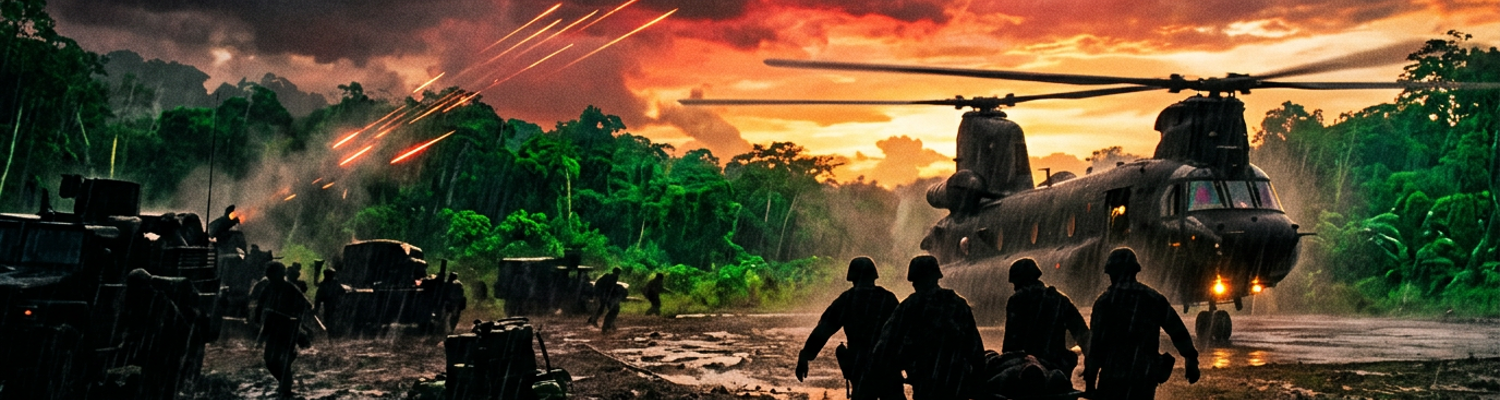
Thermite grenades melted through the steel radio casings inside the district operations room as American advisers and South Vietnamese Regional Force soldiers scrambled out of the burning command bunker into the trench line. Mortar fragments tore through the remaining sandbag revetments, forcing the retreating garrison to abandon heavy machine guns and run toward the asphalt of Highway 1. Truck tires spun uselessly in deep artillery ruts, leaving two armor-plated supply vehicles wedged crosswise across the ditch while infantrymen moved south on foot. North Vietnamese mortar crews walked 82-millimeter high-explosive shells down the road shoulders, scattering civilian refugees and militia recruits into water-filled irrigation cuts. Advisory captains took turns carrying wounded South Vietnamese sergeants while keeping their remaining portable radios tuned to the tactical air support frequency. UH-1 helicopters skimmed low over the tree lines under intense anti-aircraft fire, touching down on exposed roadway stretches to carry out emergency tactical evacuations of advisory personnel from the compromised district headquarters alongside retreating regional forces. Overloaded helicopter skids dragged through roadside brush as pilots pulled pitch through sheets of heavy machine gun fire, leaving the burning compound perimeter completely in enemy hands.
Pilots inside circling observation aircraft looked down through rising black smoke at North Vietnamese regular platoons swarming across the abandoned perimeter walls and digging into the trenches. Advisory officers aboard airborne command helicopters keyed their radio handsets to direct emergency aerial bombardment and high-explosive artillery strikes directly into the recently built hamlet infrastructure surrounding the headquarters. Navy destroyers offshore and army 175-millimeter gun batteries answered these target coordinates by firing salvo after salvo into the reinforced masonry dispensaries, agricultural warehouses, and new schoolhouses that CORDS teams had spent months constructing. Forward air controllers marked targets with white phosphorus rockets, guiding flight after flight of strike jets into low-level attack runs across the settlement. Air Force strike jets dropped five-hundred-pound demolition bombs directly onto the concrete irrigation pumping stations and metal grain silos to deny the invading units fortified cover and stockpiled rations. High-explosive detonations collapsed brick clinic walls, shattered corrugated steel roofs, and blew apart the model administrative offices that field manuals had designated as permanent proof of government progress. Shockwaves ripped through the newly paved village squares, collapsing underground water cisterns and leaving smoking craters across the demonstration rice paddies.
Concrete rubble from the pulverized schoolhouses and clinics choked the drainage canals, marking the permanent operational and material collapse of civic pacification investments throughout the northern border districts. Mechanized combat forces and sustained artillery barrages reduced diesel tractors, hybrid seed depots, deep-well water pumps, and portable electrical generators into charred scrap metal along the coastal plain. Village administrative cadres, agricultural technicians, and local militia survivors abandoned their posts entirely and joined thousands of civilian refugees walking south toward Da Nang. Government record books containing land titles, census counts, and agricultural loan ledgers burned inside the ruined offices or blew across the bomb craters in torn, ash-covered fragments. Advisory supply officers at rear depots canceled all pending delivery manifests for building timber, fertilizer sacks, and corrugated metal sheets destined for the northern sectors. Regional commanders redirected the remaining logistics trucks to haul ammunition boxes and artillery shells to conventional defensive perimeters forming along the My Chanh River.