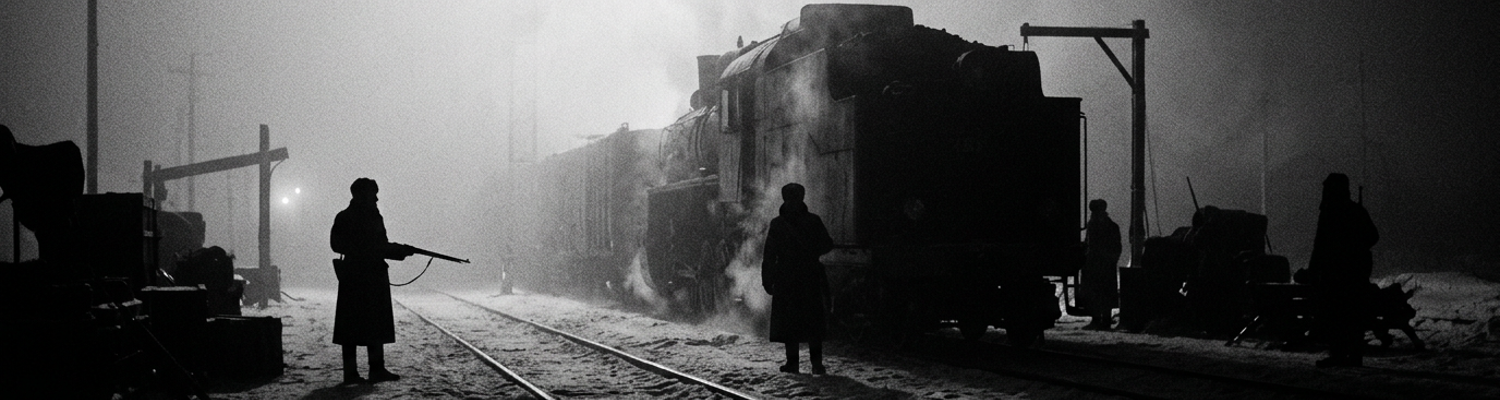

War Department Casualty Logs and Expeditionary Attrition
Metal scraped against displaced steel rail spikes east of Ugolnaya. The lead boxcar derailed off the frost-heaved ballast. Splintered birch timbers and crates of field rations spilled across frozen snowdrifts. The overhead telegraph wire snapped. Sparks showered the roadbed as the steel chassis twisted. The locomotive boiler ruptured. Scalding steam instantly crystallized in the minus-forty-degree air. Inside the War Department building along the Potomac weeks later, staff clerks traced this mechanical disaster across carbon-copied ledger pages (Record Group 120, Box 44). The operational plan to maintain an uninterrupted supply line to the Suchan coal mines failed.
The expedition broke down physically before ever meeting the enemy.
When examining the historical record of the Thirty-First Infantry, field hospital registers reveal extensive physiological deterioration across the ranks long before the summer skirmishes around Novitskaya. The regiment had transferred directly from tropical garrison duty in the Philippine Islands. They disembarked at the port of Vladivostok from the transport ships Merritt and Logan carrying lightweight summer uniforms and worn footwear. Archival evidence shows that regimental surgeons documented hundreds of cases of advanced tissue necrosis and peripheral nerve damage. Third-degree frostbite cases filled the medical tents during the initial winter deployment along the Suchan branch line. Doughboys assigned to guard open-air flatcars and uninsulated water towers suffered severe cold injury. Standard-issue woolen overcoats stiffened into brittle sheets in the gale-force winds off the Sea of Japan. Daily field rations failed to deliver the caloric volume required to survive sub-zero duty. Canned hash and corned beef froze into solid blocks inside tin containers. Soldiers of Company A and Company B chipped away frozen tallow with bayonets. They burned scarce railroad ties to thaw food. This produced an outbreak of acute gastrointestinal enteritis and early-stage scurvy. General malnutrition effectively crippled entire companies without a single shot fired.
Sentry posts were abandoned only when doughboys collapsed from exposure.
A close review of operational logs indicates that War Department staff officers in Washington raised sharp objections to the attrition rates arriving by maritime dispatch. Analysts inside the Office of the Chief of Staff scrutinized expeditionary files. They flagged the abnormal ratio of non-effective troops under Major General William S. Graves. Expedited administrative inquiries went directly to the War Plans Division. These inquiries demanded explanations for why frontline infantry strength eroded so rapidly without corresponding combat reports from the Maritime Province. Staff examiners cross-referenced troop ship rosters against field hospital admissions. They discovered that non-combat exposure and cold injuries accounted for over eighty percent of all medical evacuations recorded between August 1918 and early 1919. General staff officers challenged the justification for garrisoning isolated coal branches. Entire platoons were incapacitated simply by maintaining guard duty along damaged rail lines. The paper trail reflects mounting institutional anger over supply failures. Clerks specifically highlighted requisition delays for arctic boots and heating stoves. Snow-clearing equipment never arrived. Remote rail detachments remained immobilized in the wilderness.
By May 1919, Washington clerks filed three hundred requisitions for replacement limbs alongside casualty rosters listing zero combat wounds.
The March 1920 Vladivostok Embarkation and Evacuation
When examining the historical record of the final withdrawal, maritime records reveal severe mechanical gridlock under gale-force northwesterly winds. The physical loading of the United States Army Transports Great Northern and Sheridan took place at the commercial wharves of Egersheld peninsula. Sea ice three feet thick choked Golden Horn Bay. The ice jammed the hull of the Sheridan against the timber pilings of Pier 2. Harbor tugs struggled to keep the docking lanes clear of drifting floes. Deck crews wrestled with cargo derricks. Hydraulic lines and steam-powered winch gears froze solid the moment salt spray washed over the forecastles. Loading details from the Thirty-First Infantry hauled water-cooled Browning machine guns and crates of .30-06 ammunition by hand. They dragged frozen canvas bedrolls up steep wooden gangways slick with black ice. Below decks, the transport engine rooms burned low-grade bituminous coal dredged from the Suchan rail cars. Dense clinker deposits choked the boiler tubes. Steam pressure dropped below the operational minimum required to heat troop compartments.
Pier 2 became an open-air depot of abandoned iron.
Archival evidence shows that dockside rail congestion compounded the embarkation delays throughout the first three weeks of March 1920. Five separate standard-gauge troop trains operated by the Russian Railway Service Corps sat stalled along the waterfront tracks. Their axle journals seized by congealed grease after sitting stationary in temperatures dropping below twenty degrees below zero. Quartermasters directed elements of the Thirty-First Infantry and attached medical personnel to jettison damaged rolling stock directly into the harbor shallows. This opened clear trackage for the incoming echelon carrying the regiment's Second Battalion. Onboard the Great Northern, shipwrights thawed frozen ballast tanks with portable blowtorches. Twenty-two hundred doughboys and engineers were assigned to wooden berths built into cargo holds formerly used for bulk freight. Armed Japanese soldiers from the 14th Division manned checkpoints less than fifty yards from the gangways. They trained Type 38 rifles and tripod-mounted heavy machine guns on the embarkation sheds. Company commanders counted their men up the ramps.
Every soldier carried his rifle bolt in his pocket to prevent sabotage.
A close review of operational logs indicates that the Headquarters AEF Siberia War Diaries maintained a minute-by-minute accounting of the administrative friction during this closing phase. Daily operational summaries filed between March 1 and March 31 recorded the systematic liquidation of expeditionary assets across Vladivostok. Staff tracked the transfer of thousands of Springfield rifles and telephone switchboards to the Inter-Allied Railway Committee. Captains staffing the assistant chief of staff sections logged escalating armed friction between partisan guerrillas and Japanese detachments along the rail perimeter. They noted sixteen separate mortar and small-arms firefights within earshot of the docks during ship loading operations. Staff entries documented the precise tracking of rail car serial numbers entering the Egersheld yards. They accounted for forty-two missing carloads of winter uniforms diverted or looted along the line between Nikolsk-Ussuriysky and the harbor. General William S. Graves signed daily entries verifying troop headcounts down to individual sick-bay transfers. Sixty-four doughboys suffering from terminal typhus or gangrene had to be hoisted aboard the Sheridan on litter slings rigged to the aft cargo boom.
The last carbon copies recorded an inventory of dumped cartridge casings.
War diary summaries recorded that at 1415 hours on March 30, the final detachment of the Thirty-First Infantry cleared the Egersheld customs gate. Harbor lines were cast off from the frozen bitts forty minutes later. The twin screws of the Great Northern beat through harbor slush toward the Tsugaru Strait. Two hundred tons of unserviceable motor transport chassis remained abandoned on the quay.
Allied Mine Guard Operations at Suchan Coal Pits
Locomotives running the Ussuri rail line burned forty tons of Suchan coal every eight hours.
When examining the historical record of the American Expeditionary Force Siberia, rail transit reports show that the coal fields east of Vladivostok formed the single operational center of gravity for the entire Maritime Province. The mines near the Suchan River sat roughly seventy-five miles inland within steep mountain valleys. They produced the only domestic bituminous fuel capable of firing the Russian Railway Service Corps locomotives running between the coast and Nikolsk-Ussuriysky. Allied naval transports anchored in Golden Horn Bay drew fuel directly from these extraction shafts. Municipal water plants and district electrical grids relied on the same supply. If coal deliveries ceased, locomotive fireboxes went cold across twelve hundred miles of track. This trapped troop trains and cut civilian food distribution. It also blocked the evacuation of sixty thousand soldiers of the Czechoslovak Legion along the Trans-Siberian corridor. Inter-Allied Railway Committee records from the spring of 1919 documented that stockpiles at the Vladivostok terminal had dropped to less than a five-day supply. Major General William S. Graves faced direct diplomatic pressure from British and Japanese representatives. They demanded American soldiers deploy into the interior to secure the extraction points. This forced infantry units into static garrison duties that Graves had initially tried to avoid.
Without fresh coal shipments, every Allied troop train in the Maritime Province halted within forty-eight hours.
Archival evidence shows that in May and June 1919, Colonel Frank H. Albright assigned the Thirty-First Infantry to fortify Suchan Mine Number 1 and Mine Number 2 against partisan sabotage. Major Ralph R. Glass led elements of the Third Battalion into the mining settlements. Company M and Company L found the industrial works positioned along low terraces flanked by forested ridgelines. Both mine installations depended on exposed infrastructure. This included wooden headframes, coal-washing tipples, narrow-gauge tram lines, and steam-operated hoisting engines. Partisan groups led by local revolutionary committees targeted these mechanics. They destroyed steam boilers and cut telegraph lines. They detonated black powder charges under the timber bridges of the narrow-gauge rail spur. Doughboys excavated firing trenches into the shale hillsides. They erected split-larch log breastworks. They positioned Browning Model 1917 machine guns on wooden platforms overlooking the sorting yards and shaft entrances. Company mechanics repaired damaged narrow-gauge hopper cars. They mounted round-the-clock armed guards on the steam-driven sump pumps. These pumps cleared thousands of gallons of subterranean runoff every hour.
Water runoff flooded underground galleries whenever saboteurs cut electric transmission lines.
A close review of operational logs indicates that the physical separation between Mine Number 1 and Mine Number 2 created severe tactical vulnerabilities for the guarding garrisons. Two miles of exposed rail track separated the two mineheads. Infantrymen patrolled along ballast rock hemmed in by sheer rock cuts and dense cedar brush. Partisan riflemen concealed in the tree line fired into the sentry redoubts from distances exceeding six hundred yards. This wounded American sentries and disrupted mine worker shifts. Doughboys walked the rail spurs with fixed bayonets every ninety minutes. They inspected joint bars and checked timber culverts for dynamite fuses. They escorted labor details clearing dirt blockages along the rail line to Kangauz. Glass repeatedly sent written dispatches to regimental headquarters detailing the wear on weapons mechanisms caused by perpetual coal dust and heavy summer rains. Mud contaminated water-cooling jackets and seized the feeding levers of the automatic rifles. Guard outposts could not maintain mutual rifle coverage across the terrain. Isolated squads relied on hand-cranked field telephones. These routinely went silent whenever partisan raiders chopped through the wire runs along the tracks.
By July 1919, Company M expended eight hundred rounds of .30-06 ammunition per week repelling sniper fire directed at the Number 2 coal breaker.
Partisan Sabotage and Suchan Rail Spur Ambush Tactics
Rail sabotage cut the Suchan branch line thirty-seven times in June alone.
When examining the historical record of the Thirty-First Infantry along the Suchan branch line, engineer reports reveal a systematic campaign of railway interdiction. Red partisan detachments operated out of the Sikhote-Alin mountain foothills. Partisans used forged steel claw bars to rip out track spikes. They unbolted splice bars along reverse curves where heavy freight locomotives ran blind around steep granite outcroppings. Explosive teams packed fifty-pound charges of black blasting powder and salvaged naval dynamite under timber bent pilings. These pilings supported the wooden trestles across the Tsimukhe and Suchan river drainages. Whenever a trestle collapsed, whole supply runs carrying timber shoring and replacement locomotive boiler flues tumbled forty feet into swollen ravines. Saboteurs simultaneously severed bare copper telegraph wires using insulated pole-hooks. They pulled down hundred-yard segments of wire and threw the dead ends across iron rails to ground regional circuit lines. Local switchboards at Kangauz and Sitsa repeatedly lost battery potential without warning. Stationmasters could not notify armed patrol trains of displaced rails ahead.
Repair crews traveled under the protection of flatcars mounted with sandbagged water-cooled machine guns.
Archival evidence shows that the bloodiest breakdown of railway security occurred at dawn on June 25, 1919, near the settlement of Romanovka. Platoon elements of Company A, Thirty-First Infantry, numbered seventy-four enlisted men and three officers under Lieutenant Lawrence P. Butler. They bivouacked in pyramidal tents pitched in an exposed meadow roughly two hundred yards south of the main rail embankment. At 0415, approximately three hundred partisan riflemen commanded by local leader Nikolai Kalinichenko swept down from the surrounding wooded bluffs. They opened fire from three sides with Russian Mosin-Nagant Model 1891 rifles and Maxim machine guns before sentries could fire warning shots. Steel-jacketed 7.62x54mmR rounds shredded the thin duck canvas of the sleeping shelters. Butler received a jaw wound during the first thirty seconds. He directed his men into irrigation ditches running alongside the railway bed. Sergeants organized squad-level fire teams with Model 1903 Springfield rifles. They returned aimed fire through dense morning fog while partisan groups advanced within fifty yards of the company cook tent.
Over half of Company A fell before the partisan line broke.
A close review of operational logs indicates that the defense stabilized only when American soldiers brought two automatic weapons into action from behind an earth mound fronting the rail ballast. Gun crews cleared jammed feed mechanisms by hand after fine coal dust fouled the receiver groups. They fired continuous bursts into the brush to pin down the flanking partisan squads. Hand-to-hand combat developed near the picket line. Doughboys used rifle butts and M1905 bayonets to prevent saboteurs from reaching the railway bridge support bents with incendiary kerosene cans. The engagement lasted less than two hours. Partisan raiders retreated into the taiga around 0600 as an armed railcar carrying reinforcements from the Twenty-Seventh Infantry approached from the west along the intact track segment. Butler's platoon suffered nineteen men killed or mortally wounded and twenty-seven wounded. This represented a sixty-two percent casualty rate for the single company detachment. Staff surgeons at the evacuation hospital in Vladivostok later pulled unjacketed lead fragments and jagged shrapnel from the chests of thirty-eight wounded soldiers transported in unheated boxcars.
General William Graves and State Department Friction
Major General William S. Graves kept President Woodrow Wilson's Aide Memoire folded inside his tunic pocket throughout twenty months in Siberia.
When examining the historical record of the expeditionary headquarters in Vladivostok, operational dispatches show that Graves treated Wilson's diplomatic policy document as an inflexible military general order. Secretary of War Newton D. Baker had delivered the sealed envelope personally at a Kansas City train depot in August 1918. He instructed the general to avoid taking sides in Russia's domestic upheaval. The written instructions limited American military action to three strict objectives. These included securing military supply dumps at Vladivostok port, guarding the Trans-Siberian railway infrastructure, and facilitating the safe transit of sixty thousand troops of the Czechoslovak Legion eastward toward the Pacific. Graves forbade regimental commanders of the Twenty-Seventh and Thirty-First Infantry from pursuing Bolshevik partisan detachments beyond their assigned railway guard perimeters. British Major General Alfred Knox and French General Maurice Janin repeatedly demanded American offensive sweeps into the Amur basin. Graves refused to deploy a single platoon without written instructions from the War Department. American sentries stationed at track switches and water towers were ordered to hold fire unless fired upon. They maintained a strict policy of armed neutrality even when Red partisans and anti-Bolshevik units engaged in firefights within rifle range of American company tents.
Neutrality along the rail spurs angered Allied field commanders.
Archival evidence shows that this strict interpretation provoked immediate bureaucratic conflict with the United States Department of State. American Consul General Ernest L. Harris in Omsk and Ambassador to Japan Roland S. Morris pushed aggressively for active military support of Admiral Aleksandr Kolchak's self-proclaimed White Russian government. Kolchak's headquarters demanded that American forces suppress peasant uprisings, police civilian towns, and seize railway control points from hostile trade unions along the eastern corridor. Graves countered that Kolchak operated as an autocratic military dictator whose forces survived through arbitrary executions, forced peasant conscription, and extortion. State Department representatives cabled Washington demanding Graves be recalled for obstructing anti-Bolshevik operations. The general submitted field reports documenting atrocities committed by Kolchak's allied Cossack warlords, Ataman Grigory Semyonov and Ataman Ivan Kalmykov. Kalmykov's Ussuri Cossacks routinely abducted railway workers, executed town officials without trial, and looted freight cars under the protection of Japanese machine guns. Graves ordered the Thirty-First Infantry to disarm Kalmykov's raiders if they interfered with American track sections. This directly defied State Department directives urging appeasement.
The War Department refused to bend to diplomatic pressure.
A close review of operational logs indicates that the friction escalated into an armed confrontation at Verkhneudinsk and Chita during the autumn of 1919. Semyonov mounted armored trains equipped with naval guns and Maxim mounts along the Trans-Siberian main line. He cut off coal trains and threatened American telegraph crews. Acting on Graves' standing order, Captain Joseph C. Morrow deployed two companies of the Twenty-Seventh Infantry across the tracks. They trained water-cooled Browning machine guns and 37mm trench guns directly on Semyonov's lead locomotive until the Cossack commander backed down. Harris sent urgent diplomatic cables to Washington accusing Graves of aiding the Bolshevik cause by paralyzing White Russian troop movements. Inside the War Department, Chief of Staff Peyton C. March and Secretary Baker systematically rejected every State Department complaint. They confirmed that Graves possessed sole operational authority over American military personnel in the Maritime Province. Kolchak's collapse in late 1919 along the Ob River left American diplomatic officials stranded in Irkutsk. The Thirty-First Infantry continued guarding isolated coal sidings under the exact non-intervention guidelines Graves carried from Washington.
Psychological Strain of Isolated Sub-Zero Railhead Garrisons
At forty degrees below zero, lubricated rifle steel fractured on contact with firing pins.
Archival evidence shows that weapon failures paralyzed Thirty-First Infantry detachments guarding the rail sidings near Sitsa and Tigrovaya throughout December 1918 and January 1919. Standard-issue sperm oil and petroleum lubricants congealed into hard amber sludge inside the bolt raceways of Model 1903 Springfield rifles. This arrested striker pins before primers could ignite. Water-cooled Browning Model 1917 machine guns failed constantly. Gun crews poured mixtures of grain alcohol and glycerin into the jackets. The fluids separated in severe drafts. This burst the brass casing walls and rendered the heavy weapons useless during dawn partisan alerts. Sentries stationed on the railhead switch points walked fifteen-minute beats before relief details pulled them back into uninsulated watch huts. Prolonged physical immobility produced deep numbness within minutes. Men wore heavy felt valenki boots requisitioned from local Russian stores. The lack of moisture escape caused sweat to freeze around woolen socks. This produced blackened, necrotic foot tissue during routine eight-hour watch rotations. Deep snow drifts along the track cuts immobilized ground movements entirely. Patrols crawled over frozen ballast rock where any slip cracked shinbones against iron rails.
Sentry watches dropped from two hours to twelve minutes to prevent soldiers from freezing to death on their feet.
When examining the historical record of Company E and Company G, medical reports reveal severe psychological breakdown inside the converted rolling stock serving as static strongpoints. Detached squads lived inside teplushkas. These were standard Russian twenty-ton boxcars reinforced with double-planked timber walls and sandbags packed with frozen river silt. These railbox redoubts held sixteen men each around a single cast-iron stove burning sulfurous Suchan lignite coal. Toxic smoke accumulated under the unventilated roofs. This caused persistent carbon monoxide headaches, bloodshot eyes, and violent coughing fits among soldiers trapped indoors for days at a time. The physical space remained so tight that infantrymen slept in three-hour shifts on raw hemlock boards without removing their field coats. Every railbox sat in utter tactical isolation. Partisan fighters systematically severed the single-strand copper telegraph lines strung along the tracks between Novitskaya and Kangauz. They threw grounding hooks over the wires and stripped sections of telephone line out of reach. Battery cells for the Signal Corps Service Buzzer sets froze dead in the drafts.
Silence across the telegraph circuit meant a squad was cut off or dead.
A close review of operational logs indicates that this total sensory deprivation produced severe forms of garrison neurosis across the Suchan branch. Doughboys lived in constant anticipation of unseen night assaults. They listened to the metallic groaning of frost-contracted rails that sounded identical to footsteps on iron spikes. Sleep deprivation degraded reaction times. Squad leaders reported men hallucinating figures in the taiga cedar brush. They fired off precious .30-06 ammunition clips into empty snowbanks. Confined to an iron-plated enclosure forty feet long by ten feet wide, doughboys developed acute paranoia directed at their own comrades. This led to fistfights, insubordination, and instances of self-inflicted gunshot wounds aimed at securing transport back to the base hospital in Vladivostok. Regimental surgeons logged forty-one cases of acute functional neurosis along the railhead detachments in the first quarter of 1919 alone. They evacuated eighteen enlisted men who had slipped into catatonic stupors inside their frozen boxcar bunkers.
Winter Railhead Withdrawal and Final Siberian Extraction
Orders to abandon the Suchan branch reached the Third Battalion at midnight on January 8, 1920.
When examining the historical record of the Thirty-First Infantry, field telegrams reveal that the tactical evacuation of Suchan Mine Number 1 and Mine Number 2 began under immediate partisan encirclement. Temperatures fell past thirty-five degrees below zero. Major Ralph R. Glass directed the systematic collapse of the outlying garrison network. He ordered Company L and Company M to disable heavy stationary machinery before boarding waiting boxcars. Doughboys used sledgehammers to fracture the cast-iron steam cylinders of the mine ventilation fans. They dropped iron bars down the main shaft hoisting tubes. This denied the coal works to incoming Bolshevik forces. Packing lists compiled by battalion supply sergeants show soldiers loading water-cooled Browning machine guns, sixty thousand rounds of rifle ammunition, and portable field kitchens onto eight flatcars cleared of frozen timber. Axle boxes on two boxcars froze solid during the loading process at Mine Number 1. Mechanics directed blowtorch flames against the wheel hubs while sentries kept up suppressive rifle fire into the eastern tree line. Company detachments pulled back along the single-track branch line in leapfrog bounds. They burned track shacks and blew small wooden drainage culverts with quarter-pound TNT blocks to delay pursuit toward Kangauz.
Track switches froze open every eleven minutes.
Archival evidence shows that the rail movement down the Suchan valley degenerated into a slow running engagement. The American echelon crawled fifty miles toward the main junction at Ugolnaya. Partisan fighters stripped fishplates and pulled dog spikes along reverse curves near Tigrovaya. Train crews ran an unarmored work engine three hundred yards ahead of the troop cars to test track integrity. At every unscheduled stop, squads from Company A deployed along the frozen rail bed with Model 1903 Springfield rifles. They established perimeter defense in hip-deep snow drifts while engineer details spiked replacement rails by hand. Condensation inside the locomotive steam lines froze repeatedly. This dropped boiler pressure below eighty pounds per square inch and stalled the convoy on an ascending two-percent grade west of Kazun. Enlisted men offloaded frozen pine logs from lineside woodpiles by hand. They tossed timber directly into the locomotive firebox to build enough head of steam to crest the pass. Operating logs indicate that the Third Battalion completed the tactical retrograde without losing a single rolling chassis. They entered the fortified railyards at Nikolsk-Ussuriysky fifty-six hours after vacating the mine perimeters.
Washington gave Graves twenty-one days to hand over the railway.
A close review of operational logs indicates that General William S. Graves coordinated the direct railhead turnover through joint liaison conferences held inside the Inter-Allied Railway Committee headquarters. American stationmasters relinquished track control, signal towers, and water pumps at Ugolnaya, Kangauz, and Nikolsk-Ussuriysky in direct sequence to units of the Czechoslovak Legion and the Imperial Japanese 14th Division. Japanese Major General Inagaki demanded instant transfer of all locomotive sheds and Suchan fuel stockpiles. He deployed armed Japanese platoons directly onto station platforms before American property manifests could be formally signed. Czech staff officers under General Jan Syrovy secured transit priority for sixty-two eastbound trainloads carrying the Czechoslovak Second Division. They worked alongside American dispatchers to clear stalled rolling stock between Spasskoye and Vladivostok. Quartermasters signed transfer ledgers passing thirty-eight standard-gauge locomotives, two hundred flatcars, and five thousand tons of mined coal directly to Japanese railway engineers on February 14. American officers turned over the switchboard keys at the Ugolnaya junction box at 1630 hours. They left armed Japanese pickets to set up machine-gun sandbags around the depot water tanks.
The last American rail detachment pulled out of the Ugolnaya yard on a lone flatcar at dawn the following morning.