
Aerial Observation of Armored Mobility Breakdown
Rainwater flooded the coastal lowlands of Quang Nam Province, transforming hard dirt trails and terraced fields into saturated mud several feet deep. Cold downpours beat relentlessly against Marine infantrymen and vehicle crews who wore grease stained rain ponchos while working in flooded drainage cuts and sodden ditches. Tidal estuaries pushed salty sea water inland across the low sandy beaches, mixing directly with agricultural runoff to create a thick heavy slurry over the entire operational area. Saturated earthen dikes that separated the rice fields collapsed beneath any heavy pressure, removing the only solid footpaths between rural hamlets. Heavy armored units attempting to support operations along the coastline found that the ground simply could not bear the physical load of multi ton steel vehicles moving away from paved surfaces.
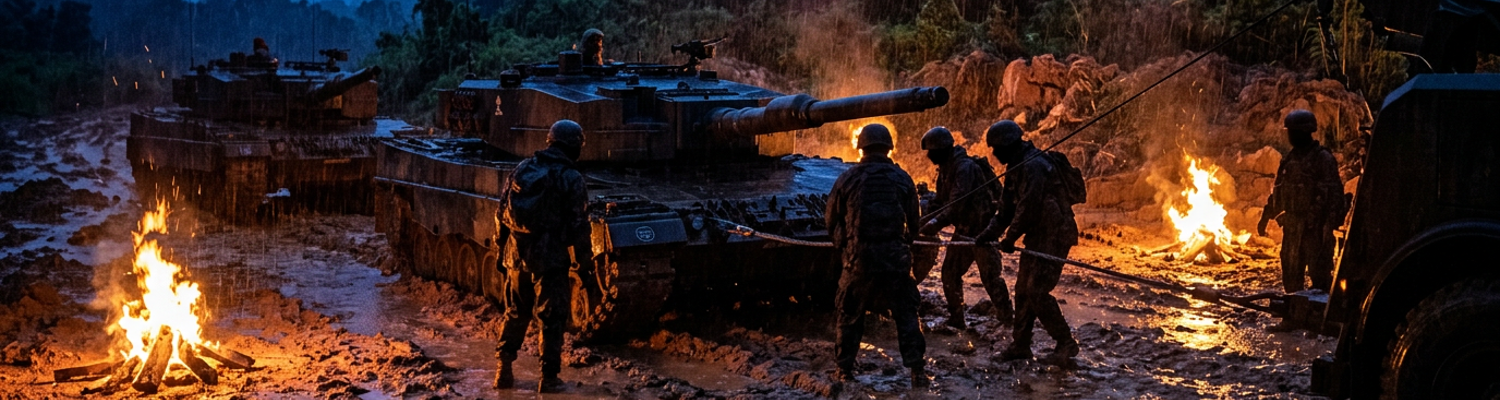
Pilots flying tactical reconnaissance aircraft over the coastal plain looked down at these multi ton M48A3 Patton tanks and M50 Ontos vehicles immobilized in deep rice paddy mud. Aviators peered through broken cloud layers to see the fifty two ton Patton tanks sunk down to their steel belly plates, completely unable to gain traction in the soft ground. Beside them, the much lighter M50 Ontos anti tank vehicles had broken through the top layer of sod, leaving their multiple recoilless rifles pointing harmlessly toward the sky as their chassis rested flat on sunken banks. Marine crews climbed out into the cold rain and hooked heavy steel tow cables between the trapped machines, but the pulling vehicles only dug themselves deeper into the water filled holes. Tank drivers gunned their diesel engines to break suction against the clay, causing the steel tracks to spin wildly without moving the hulls forward an inch. This continuous full power spinning generated intense mechanical stress across every component of the drive assemblies.
Steel drive sprockets packed solid with sticky clay and shell sand cracked under this extreme torque as crews tried to force the tracks to turn. Coarse grit wedged between the sprocket teeth and the track shoes, pushing the metal guide horns out of alignment and grinding away the internal fittings. Track pins sheared under the violent lateral pressure, splitting the continuous track loops and dropping hundreds of pounds of loose metal links into the mud. Coastal patrols along the sandy corridors suffered rapid mechanical attrition from these breakages long before finding any hostile targets, stranding entire platoons of medium armor and light tank destroyers in exposed terrain. Marine mechanics waded through waist deep water with heavy sledgehammers, struggling to pound out bent metal pins by hand in pouring rain.
Recovery vehicles from the Third Tank Battalion attempted to haul the immobilized tanks toward solid ground while mechanics hammered at the broken pins, but the deep mud trapped the recovery equipment as well. Winch cables snapped under the strain of pulling vehicles that were held fast by wet clay up to their track guards. Supply lines failed to deliver the required volume of replacement track pins, drive sprockets, and suspension arms needed to repair the growing list of casualties across the battalion. Ground commanders realized that mechanical breakdown caused more immediate losses than enemy action, forcing them to halt forward movement across coastal zones. Maintenance officers pulled working vehicles back toward gravel roads and ordered crews to anchor heavy winch lines to trees and concrete culverts to drag the immobilized armor out of the flooded paddies. Crews spent the night guarding the stuck machines in the rain while waiting for additional heavy engineering assets to arrive from the rear depot.
Command Fragmentation Under Lieutenant Colonel Raphael
Wreckers from the rear depot never rolled out to assist those stranded crews because Lieutenant Colonel Milton L Raphael assumed command of the Third Tank Battalion just as assets faced widespread operational dispersal. Marine infantry regiments pushing across the coastal lowlands demanded armored protection for their own isolated perimeters, pulling tank platoons away from their parent organization to serve as local security guards. Tactical commanders assigned armored fighting vehicles in small detachments to guard bridges, supply dumps, and road intersections rather than concentrating them for massed cross country offensive strikes. Mechanics and heavy recovery gear that normally operated under direct battalion control were split up alongside the combat vehicles, stripping the battalion headquarters of its reserve recovery capability. Tank crews stuck in the sodden paddies received radio messages stating that no central engineering columns were available to pull their hulls out of the mud.
Armor companies were divided among isolated enclaves at Da Nang and Chu Lai alongside offshore Special Landing Force float platoons, scattering the battalion across water and sand instead of forming central engineering columns. Detachments sent southward to Chu Lai operated nearly fifty miles away from battalion headquarters with no secure overland highway connecting the two coastal bases. Marine crews assigned to the Special Landing Force lived aboard amphibious transport ships in the South China Sea, keeping their M48A3 tanks lashed down inside cargo holds while waiting for amphibious assault orders. Tank platoons remaining around Da Nang answered directly to local infantry colonels who placed armored hulls into fixed sandbag revetments along the airfield perimeter. Crews spent entire weeks standing watch behind static machine gun mounts while rain filled their hull wells and corroded their electrical harnesses, entirely detached from any regular battalion servicing schedule.
Lieutenant Colonel Raphael discovered that this geographic fragmentation eliminated centralized battalion level maintenance echelons and diluted direct operational command over his dispersed vehicles. Battalion maintenance officers at Da Nang could not inspect vehicles, deliver heavy replacement parts, or enforce preventive upkeep across distant coastal outposts. Company supply sergeants hoarded track pins, road wheels, and oil filters inside their own perimeter wire because replacement shipments from the main supply depots took weeks to arrive by sea. Mechanics stationed with isolated platoons lacked hydraulic jacks, heavy overhead booms, and machine tools, forcing them to attempt complicated engine and transmission repairs directly in the dirt. Cannibalization of disabled tanks became standard operating procedure as mechanics stripped road wheels and electrical components from immobilized hulls to keep a handful of machines running.
Tanks stripped of their drive sprockets and suspension arms remained sunken in waterlogged paddies while infantry units pushed deeper into contested territory. Infantry officers refused to tie down rifle companies to guard broken armor, ordering crews to destroy sensitive radios and abandon submerged vehicles in the mud. Pilots flying overhead watched salvage crews work with hand winches and shovel blades under sniper fire, attempting to extract multi ton steel machines before tidal currents buried them completely. Recovery crews attached steel cables to damaged hulls and dragged them onto gravel berms, only to watch suspension bogies tear loose from hulls held fast by deep suction. Tank officers conceded that the dispersed battalion could no longer sustain prolonged cross country maneuvers, leaving armored warfare in the coastal sector frozen by supply starvation and physical isolation.
Infrastructure Collapse Across the Quang Nam Littoral
Tank drivers redirected their surviving combat vehicles onto the raised earthen corridors that linked isolated farming hamlets, attempting to bypass the flooded paddies entirely. Narrow coastal causeways collapsed into saturated mud morasses, trapping lead armor and blocking movement corridors for entire following platoons. Marine crews watched the compacted dirt shoulders shear away under the heavy vibration of running engines, dropping massive track assemblies into deep water filled drainage ditches. Trapped lead tanks could neither advance through the liquefied soil nor reverse along the single lane dikes, pinning follow on armored vehicles and supply trucks in exposed lines between the paddies. Column commanders radioed back to forward operating posts that the raised coastal routes had disintegrated into slurry, halting company movements across the entire coastal belt.
Bridges across the tidal waterways collapsed as soon as trapped columns attempted to bypass the ruined roadbeds. Unreinforced wooden bridge spans and concrete culverts failed under the fifty two ton combat weight of M48A3 Patton tanks as drivers pushed their machines onto the timber crossings. French era road builders had designed these rural crossing points decades earlier for light civilian carts, small buses, and foot traffic rather than modern armored combat vehicles. Heavy timber stringers splintered with loud cracks as soon as steel tracks rolled past the abutments, dropping forty foot sections of planking into the rushing creek beds. Cylindrical concrete drainage pipes beneath the road embankments shattered under the downward pressure, crushing internal drainage channels and creating gaping sinkholes directly across the main avenues of advance.
Engineers from the Third Engineer Battalion brought forward heavy timber balks and steel treadway bridge sections to span the fractured gaps, but the soft soil along the canal banks offered no firm footing for heavy construction equipment. Bulldozers attempting to push earth ramps toward the broken bridges sank past their track guards into the tidal silt, requiring tank recovery vehicles to haul the earthmovers out of the mud before bridging work could even begin. Pioneer crews laid down layered logs and steel mesh along the approaches, yet the violent churning of fifty two ton tank tracks chewed through the wooden decking within minutes of contact. Saltwater tides surged through the ruined culverts twice a day, dissolving the fresh gravel fill that road crews dumped into the craters and sweeping base materials directly into the surrounding paddies. Maintenance teams could not route fuel tankers or ammunition trucks past these broken crossings, cutting off forward armor crews from essential supplies of diesel, engine oil, and replacement tracks.
Pilots watched long convoys of armored fighting vehicles stall along the dissected causeways, forming static lines that stretched for miles across the coastal marshlands. Aviators peered through low cloud cover at Marine crews who abandoned their submerged hulls along the washed out roads to establish perimeter security positions around the broken bridge sites. Ground commanders canceled planned sweep operations through the coastal villages because heavy armor could no longer traverse the shattered infrastructure to support the advancing infantry battalions. Salvage teams worked with hand operated winches and heavy tow shackles in the driving rain, attempting to extract trapped Patton tanks from crumbled stone culverts before rising tidal waters flooded their electrical systems. Tank crews attached multiple recovery cables to the submerged hulls, but the dead weight of waterlogged steel snapped the braided wire and left the vehicles anchored firmly in the collapsed roadbeds.
Armor Degradation During Operation Piranha Engagements
Steel tow lines whipped through the air across the flooded causeways, forcing Marine recovery teams to abandon the trapped hulls just as elements of the Third Tank Battalion received orders to support amphibious landings on the Batangan Peninsula during Operation Piranha in September 1965. Tactical commanders detached platoons from Company B and Company C to join the amphibious assault force twenty three miles south of Chu Lai. Marine crews loaded their M48A3 tanks aboard naval utility landing craft and mechanized landing craft in the open ocean, securing the vehicles on pitching metal decks under low coastal skies. Aerial observers in spotter planes watched the landing craft assemble in formation and motor through heavy surf toward the rocky shoreline. Naval landing craft dropped their bow ramps into the breaking waves, discharging fifty two ton M48A3 tanks directly onto narrow beachheads that offered only a single passage inland between tidal inlets and towering sand ridges.
Sand ridges and flooded salt marshes squeezed the advancing Patton tanks into single file columns, eliminating any room for tactical dispersion across the Batangan coastline. Canalized coastal terrain forced armored columns into surveyed kill zones where natural water barriers and cultivated paddy dikes prevented drivers from steering away from the central trail. Marine commanders had to direct their armor along narrow unpaved cart tracks that cut between thick cactus hedgerows, stone hamlet walls, and deep irrigation ditches. Local Viet Cong guerillas had prepared for the landing by measuring exact distances along these natural bottlenecks and placing hidden reference stakes beside the roadbed. Viet Cong gunners concealed themselves inside reinforced trench networks, watching the armor crawl into pre sighted ambush corridors where the heavy machines could neither turn around nor maneuver off the packed trail.
Artillery shells wired with command detonators exploded under the lead hulls as soon as the tracks rolled across the surveyed firing lines on the packed trail. The blasts tore through the forward running gear with massive upward force, lifting the front ends of the tanks before slamming them back into the dirt. High explosive anti tank ordnance shattered suspension arms, snapped internal torsion bars, and broke cast steel road wheels into fragments. Severed track loops whipped off their drive sprockets and uncoiled into the mud, instantly stranding the lead vehicles and stripping them of all forward mobility. Flying shrapnel from the buried shells punctured external fluid lines, shredded track support rollers, and destroyed external infantry telephone boxes on the hull rears. Fractured track shoes and broken suspension bogies littered the narrow trail, leaving the crippled lead tanks wedged firmly across the roadbed while hostile mortar fire showered the open commander cupolas.
Tank drivers backed their following vehicles toward the coastline to clear firing lanes, but the narrow dirt shoulder crumbled beneath the churning tracks of the second vehicle in line. The listing Patton slipped into a deep drainage cut, wedging its gun tube into the mud and completely sealing the coastal defile against any further forward advance. Heavy M88 recovery vehicles idling near the beachhead could not squeeze past the stalled armor along the single lane causeway to hook tow cables to the shattered suspension assemblies. Marine tank crews climbed out into the mortar barrage with sledgehammers, replacement end connectors, and hydraulic jacks, attempting to knock out bent track pins and free the locked road wheels by hand. Ground commanders halted the armored sweep across the Batangan Peninsula and ordered the infantry battalions to continue the assault on foot, leaving the tank crews to form an isolated defensive perimeter around their crippled machines.
Severe Deficits in Heavy Armored Recovery Assets
Tank crews maintained defensive perimeters around their broken machines while battalion dispatchers searched the northern sectors for specialized extraction equipment. Marine maintenance officers discovered that a critical shortage of dedicated M88 Armored Recovery Vehicles across the entire corps restricted field recovery options to almost nothing. Military planners had deployed the Third Tank Battalion into South Vietnam with only a small fraction of its authorized recovery vehicles, leaving entire combat companies without heavy mechanical backup. The few working M88 recovery vehicles in the northern provinces remained pinned down by airfield security duties at Da Nang or scheduled overhaul work in rear repair yards. Each operational M88 carried a fifty ton winch and an A frame boom that could hoist complete engine packs and unstick bogged chassis, making the vehicle indispensable for heavy armor salvage. Without tracked recovery vehicles equipped with those heavy boom cranes and winches, forward units could not lift displaced track shoes or haul bogged fifty two ton tanks out of the coastal mud. Field commanders had to leave the immobilized combat vehicles behind concertina wire while requesting help from rear area supply depots that could not spare a single recovery asset.
Armor officers responded to the lack of heavy recovery equipment by rigging operational gun tanks into improvised towing teams. Drivers hitched two M48A3 tanks together in a straight line with heavy braided steel cables to pull the mired hulls out of the paddies. Tandem towing attempts using other M48A3 tanks routinely burned out transmissions and snapped heavy steel recovery cables under extreme mud suction. Saturated rice paddy soil created an intense physical vacuum against the broad hull bottoms, generating resistance that easily exceeded the working limits of standard recovery gear. Marine crews doubled the tow lines and locked the tracks of the stuck tanks, yet the tremendous drag caused the thick steel wires to fray, unravel, and violently part under tension. Snapping steel cables whipped across the rear engine decks, smashing vehicle spotlights and gouging deep marks into the armor plate while sending crewmen diving into the mud. Internal cross drive transmissions overheated within minutes as drivers floored their throttles against the dead weight, burning through transmission fluid and leaving the towing tanks just as crippled as the vehicles they had tried to rescue.
Marine mechanics struggled to repair the burned out transmissions directly in the rain, but replacement assemblies were completely unavailable across the forward operational area. Spotter pilots flying reconnaissance patterns overhead watched the salvage zones turn into clusters of motionless armor connected by frayed cables. Heavy rain filled the open engine compartments when mechanics unbolted the rear deck grilles, contaminating hydraulic lines and electrical wiring with grit and rainwater. Stranded crews unbolted intact road wheels and track links from the most deeply sunken hulls, carrying the heavy components by hand to reinforce the remaining operable tanks. Battalion logistics officers plotted the unrecoverable vehicles on operational map boards, recognizing that incoming tides and heavy river sediment would bury the lower hulls past the track guards before heavy cranes could arrive. Ground commanders reclassified the stranded combat tanks as fixed defensive bunkers, ordering crews to shut off their engines to conserve fuel while waiting for naval landing craft to attempt a beach extraction.
Cannibalization Tactics and Track Component Scarcity
Sandbars blocked incoming naval landing craft from approaching the surf line, terminating all plans for a beach extraction of the stranded vehicles. Depot storage yards at Da Nang and Chu Lai held virtually no replacement suspension hardware to rebuild the stranded vehicles where they sat. A severe supply deficit in replacement track shoes, end connectors, and road wheel bearings crippled depot replenishment across the entire northern tactical zone. Deep mud and abrasive beach sand ground through hardened steel track assemblies at three times the peacetime consumption rate, exhausting the limited supply of spare links within weeks of landing. Quartermasters marked supply requests for M48 track components with zero balance codes because rear supply channels in Okinawa and the United States failed to ship replacement running gear to South Vietnam. Tank commanders received radio orders from battalion headquarters stating that broken track sections had to be repaired without factory new parts from the depot.
Armor crews systematically stripped parts from battle damaged and immobilized tanks to keep operational platoons running. Marine mechanics hauled heavy impact wrenches, cutting torches, and sledgehammers out to the flooded rice fields and defensive bunkers to disassemble the stuck vehicles. Tankers removed undamaged road wheel bearings from sunken hulls, soaked the parts in kerosene cans to wash away fine quartz sand, and packed them with fresh grease before driving them into operational hubs. Salvage teams pounded wedge pins out of shattered track blocks on mine damaged tanks to salvage individual steel track shoes and undamaged end connectors. Drivers carried these forty pound steel shoes across sodden paddies on their shoulders to splice together functional track loops for the few tanks that still had working engines.
Patton tanks absorbed components from multiple dead hulls, rolling forward on mismatched running gear that mechanics pieced together by hand. Ground crews stripped every removable assembly from the hulls left along coastal roads, taking return rollers, torsion bar arms, and cupola vision blocks until only hollow steel shells remained in the mud. Tactical reconnaissance pilots flying low over the paddies tracked the progressive dismantling of Third Tank Battalion armor, marking where gutted tanks were gradually picked clean of their suspensions. Mechanics left the stripped hulls resting directly on their belly armor in the red clay, using wooden cribbing and discarded ammunition boxes to support the chassis while unbolting the final road wheel hubs. Armor officers kept daily logbooks detailing which operational tanks carried suspension parts borrowed from disabled sister vehicles, tracking an informal network of recycled hardware that bypassed official supply channels entirely.
Mechanics guarded their cannibalized hardware piles from neighboring units, locking spare end connectors and cleaned roller bearings inside steel field toolboxes. Infantry battalion commanders pressured the tank platoons to launch new cross country patrols, but tank officers refused to advance until their crews scavenged enough track shoes to assemble complete spare track sections. Tank crews spent their nights unbolting track assemblies under illumination flares while mortar fragments chipped the armor of the donor tanks. Drivers bolted the salvaged end connectors onto worn track guide horns with long breaker bars, tapping each wedge bolt into place to prevent tracks from throwing off their sprockets during combat maneuvers. Maintenance teams pushed the reassembled tanks onto gravel tracks at dawn, committing the cannibalized machines to local perimeter patrols before the worn parts could fail again under the strain of deep mud.
Monsoon Inundation of Unimproved Maintenance Basins
Gravel roadways offered only momentary relief to the strained drive trains before the arrival of the northeast monsoon turned dirt maintenance parks at Da Nang and Chu Lai into standing silt morasses. Continuous torrential downpours liquefied the unimproved ground beneath the battalion staging areas, transforming designated repair lines into knee deep basins of grey sludge. Pilots flying tactical passes over the bases observed dozens of M48A3 tanks and M88 recovery vehicles bogged down inside their own depot perimeters before ever reaching the combat zone. Heavy steel hulls settled straight down until their belly armor rested flush against the mud, creating powerful suction that defeated standard mechanical jacks and recovery winches. Tracked wreckers attempting to pull grounded vehicles out of the muck churned the sodden soil into deep trenches, burying whole track runs and locking road wheels in place.
Plywood sheets and timber baulks cracked under the concentrated weight of the settled hulls because support mechanics worked in rain soaked open bivouacs without hardstand surfaces. Marine maintenance detachments operated in the open elements without concrete pads, corrugated metal awnings, or solid decking to shield their equipment from the constant rains. Support crews rigged canvas tarpaulins between vehicle radio antennas and wooden fence posts, but high coastal winds ripped the cloth free and exposed open toolboxes and spare components to the deluge. Mechanics knelt directly in freezing water to unbolt suspension housings, feeling blindly through the thick sediment for dropped sockets and end connector pins that vanished instantly beneath the surface. Ground personnel had to scrape away layers of wet grit from engine deck plates with hand trowels before they could lift heavy access hatches to reach the powerplants below.
Rainwater poured straight into the unsealed engine bays as soon as the access hatches swung open, causing chronic fuel and hydraulic contamination across the battalion fleet. Moisture entered vented filler necks, fuel transfer nozzles, and disassembled carburetor bodies, saturating diesel supplies with silt and rust particles. Hydraulic oil in steering lines and turret traverse systems mixed with incoming water, churning the fluid into a thick milky emulsion that choked hydraulic valves and blew internal seals. Tank engines sputtered and seized on test stands when water laden diesel reached high pressure fuel injector nozzles, cracking injector tips and stalling the reassembly process. Mechanics drained contaminated fuel tanks into open five gallon buckets, only for fresh rain squalls to fill the containers and overflow fuel slicks across the work areas.
Fuel slicks drifted across the open bivouacs, forcing battalion maintenance officers to suspend engine swaps and divert mechanics to digging perimeter drainage trenches. Air observers tracking base operations noted that the maintenance parks at Da Nang and Chu Lai had effectively ceased to function as mobile repair depots. Mechanics wrapped greased canvas covers over stripped engine compartments, plugged hydraulic lines with wooden dowels, and abandoned disassembled hulls on their sunken belly plates. Armor officers reassigned stranded tank crews to manual shovel details to dig mud away from immobilized road wheels before the standing silt could dry into hard clay. Field commanders ordered the remaining functional tanks to shut down their engines inside static perimeter revetments, halting all tactical patrols across the waterlogged coastal district.
Supply Chain Failures and Operational Reassessments
Engine mufflers cooled inside the static revetments as tank crews stood watch as fixed bunker guards instead of mobile assault teams. Battalion maintenance records revealed that mechanical exhaustion had achieved what enemy mortar fire and command detonated mines had failed to accomplish. Field experience proved that spare parts pipeline velocity and recovery capability outweighed theoretical frontline armor strength. Logistics clerks in Da Nang sifted through filing cabinets filled with unfilled requisitions, noting that sea shipments from rear depots in Okinawa and the United States took six to eight weeks to deliver replacement components. When an M48A3 stripped its drive sprockets or snapped a torsion bar in the coastal mud, that vehicle remained completely immobilized for months because spare parts simply did not move through the distribution network with sufficient speed. Frontline firepower counted for very little when replacement track shoes, road wheel seals, and recovery winches failed to reach the forward repair lines.
Maintenance officers documented this widening breakdown in formal operational readiness reports submitted to division headquarters. Aerial observers confirmed that disabled tanks stranded along flooded paddy dikes and scattered across depot yards now outnumbered the operational vehicles guarding perimeter outposts. Logistics personnel pointed out that keeping a fifty two ton tank operational in coastal clay demanded an unbroken flow of fresh grease, clean filters, replacement suspension arms, and heavy recovery assets that no forward base possessed. Unit commanders had initially assumed that heavy armor could force its way across any rural obstacle through sheer mechanical horsepower and thick steel plating. The harsh reality of waterlogged soil and empty supply shelves demonstrated that armored columns without fast logistical resupply and dedicated extraction vehicles were liabilities rather than tactical assets.
Planners at III Marine Amphibious Force headquarters examined these mechanical failures and initiated a fundamental overhaul of forward armor operations. Tactical staff officers recognized that throwing heavy tanks into unmapped coastal lowlands without ground support had crippled the battalion for months. Marine Corps planners revised doctrine to require reinforced engineering route preparation before committing heavy armor. Engineers were now mandated to conduct thorough soil bearing tests, calculate bridge weight ratings, and lay crushed rock or timber corduroy paths before any tank platoon rolled out of its staging perimeter. Combat directives forbade armor units from attempting independent cross country sweeps across untested rice paddies, tidal flats, or narrow earthen causeways. Heavy armor would henceforth operate only along pre engineered routes backed by dedicated maintenance echelons and continuous heavy recovery coverage.
Engineers from the Third Engineer Battalion took the lead across the northern sectors, hauling heavy construction equipment forward to rebuild the damaged transportation corridors. Bulldozer crews cleared blocked causeways, while pioneer details drove timber pilings deep into saturated drainage cuts to support reinforced timber bridge spans. Engineering teams laid interlocking steel airfield matting and thick crushed stone foundations over swampy trail junctions to support the fifty two ton weight of M48A3 hulls. Recovery teams pre positioned their few operational M88 tracked wreckers directly behind the lead engineering columns at critical river crossings and canal defiles before tank engines were started. Battalion dispatchers refused to release tank platoons from perimeter security duties until engineering officers stamped and certified that movement corridors could physically support armored traffic.