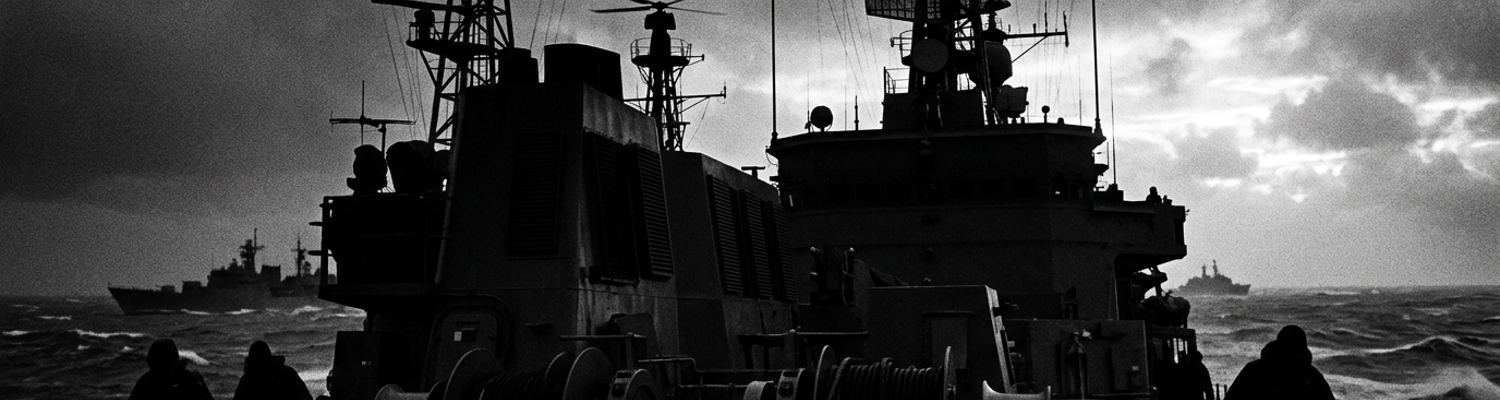

Yemeni Civil War Escalation and Maritime Chokepoints
06 July 1994. Coordinates 12 35 N 43 20 E. Northern Yemeni infantry units breached the defensive perimeters of Aden. Southern secessionist forces retreated toward the southwestern coastline. This mass displacement placed highly active ground combat zones directly adjacent to the Bab-el-Mandeb Strait. Geography narrows the waterway to a width of eighteen miles between Ras Menheli on the Arabian Peninsula and Ras Siyyan in Djibouti. High-volume maritime traffic had to navigate a designated transit corridor. This corridor brought them within visual range of the contested shoreline.
Archival evidence shows severe administrative friction regarding the protection of these shipping lanes.
Surface warfare commanders in the United States Fifth Fleet requested authorization to establish heavily escorted convoys. They wanted these for all Military Sealift Command oilers passing through the choke point. Logistics officers stationed at the Pentagon rejected this proposal outright. They argued that grouping slow-moving supply ships into predictable convoys created a concentrated target profile for shore-based artillery. Administrative deadlock left individual fleet oilers transiting the strait with minimal protective screening. Guided missile destroyers operated too far away to provide immediate cover.
Bureaucratic delays directly exposed unarmed logistics vessels to shore-based ordnance.
By the second week of July, southern Yemeni commanders deployed coastal defense systems to the elevated terrain overlooking the strait. Elements of the former South Yemeni navy positioned truck-mounted P-15 Termit anti-ship missile batteries near the Dhubab district. These Soviet-supplied weapons featured liquid-propellant rocket engines and active radar homing seekers. They were capable of tracking targets up to forty-three nautical miles away. The five-hundred-kilogram high-explosive warheads posed a severe threat to thin-skinned commercial tankers. They also threatened lightly armored underway replenishment ships.
Intelligence collection agencies immediately clashed over the operational status of these batteries.
The Office of Naval Intelligence assessed that the southern forces lacked trained radar operators. They believed the Yemenis could not achieve a reliable firing solution against moving maritime targets. Defense Intelligence Agency analysts contradicted this assessment entirely. They pointed to fresh satellite imagery (NARA Record Group 338). This imagery showed active Square Tie surface search radars emitting signals from the coastal ridges.
This inter-agency dispute paralyzed the regional command structure.
Task force commanders received conflicting daily briefings regarding the exact danger level within the transit corridor. Shore-based radar stations began actively painting US Navy destroyers and civilian cargo ships with targeting telemetry. Shipboard electronic warfare modules registered continuous hostile radar locks from the Yemeni coast.
Persistent threats of incoming anti-ship missiles forced naval commanders to abandon standard transit protocols.
Destroyer captains ordered their vessels to accelerate to flank speed during the strait passage. They wanted to minimize their time inside the engagement zone of the P-15 Termit batteries. General Electric LM2500 gas turbine engines operating at maximum output consumed marine diesel fuel at highly accelerated rates. Ships exited the northern end of the Bab-el-Mandeb with their fuel bunkers severely depleted.
This accelerated consumption forced surface combatants to request emergency underway replenishment operations in the lower Red Sea.
Military Sealift Command captains operating the supply oilers refused to enter the contested waters to conduct these fueling operations. They cited standing directives from the logistics command. These directives prohibited unescorted fueling maneuvers within fifty nautical miles of a known hostile missile battery. Fleet commanders demanded that the oilers proceed immediately to coordinates just north of Perim Island to connect the fueling hoses. Supply officers demanded that the destroyers disengage from their patrol sectors and steam two hundred miles north to a secure rendezvous point.
A close review of operational logs (File 44-A9) indicates that the USNS Walter S. Diehl held a stationary pattern near the Hanish Islands for forty-eight hours. The USS Hewitt dropped to fourteen percent fuel capacity while waiting for administrative approval to initiate the fueling sequence.
Hostile Water Underway Replenishment
A direct order from the United States Fifth Fleet surface warfare commander forced the Military Sealift Command to abandon its standoff protocols. The USNS Walter S. Diehl departed its holding pattern near the Hanish Islands. It navigated south toward the contested Bab-el-Mandeb Strait. Rendezvous operations with the USS Hewitt occurred at coordinates 12 45 N 43 15 E.
This position placed both vessels twelve nautical miles from the Yemeni coastline.
It sat well inside the forty-three-nautical-mile engagement envelope of the Soviet-built P-15 Termit anti-ship missile batteries. These batteries were deployed by southern secessionist forces. Underway replenishment procedures commenced immediately. The Diehl established a base course of one hundred and eighty degrees. The ship maintained a speed of thirteen knots. This ensured sufficient steerageway against the strong surface currents. Sailors aboard the oiler fired a shot line across the bow of the destroyer. This pulled over a messenger line, followed by the heavy steel span wire. Exactly one hundred and fifty feet of lateral separation remained between their steel hulls.
The vessels settled into a tight formation.
Heavy winches tensioned the span wire to support the refueling hoses. Deck crews seated the fueling probe into the receiver bell of the destroyer. Marine diesel fuel began pumping at a rate of three thousand gallons per minute. The rigid geometry of underway replenishment transformed two highly maneuverable ships into a single slow-moving target.
A close review of operational logs indicates that the threat environment escalated severely at 1422 local time.
The AN/SLQ-32(V)2 electronic warfare suite (serial block 89) aboard the Hewitt intercepted high-frequency I-band radar emissions. These emissions originated from the Dhubab district coastline. Technicians in the combat information center of the destroyer analyzed the pulse repetition frequency. They identified the signal as a Square Tie surface search radar. This specific radar system provided targeting telemetry for the P-15 Termit missile batteries.
The electronic signature did not resemble a routine sweep of the horizon.
Hostile emissions locked directly onto the combined radar cross-section of the tethered ships. Coastal battery operators had achieved a stable firing solution against the underway replenishment formation. The Hewitt transmitted an immediate flash warning. This alerted the Central Command naval component headquarters in Bahrain.
Severing the tensioned fuel lines under pressure risked deck fires and catastrophic mechanical failure.
The commanding officer of the destroyer requested weapons-free authorization. He wanted to engage the coastal radar site with an RGM-84 Harpoon anti-ship missile. Staff officers at the regional command center denied the request. Deferring to the ongoing inter-agency dispute, command elements cited conflicting assessments regarding the actual operational capability of the Yemeni missile crews. Defense Intelligence Agency analysts warned of an imminent launch. The Office of Naval Intelligence maintained that the radar operators lacked the training to execute a successful strike.
Restrictive rules of engagement dictated that the Hewitt could only fire its weapons if a hostile missile was physically airborne.
The civilian master of the Diehl demanded an emergency breakaway maneuver. He attempted to escape the target lock. The naval surface commander rejected this demand. He ordered the transfer of three hundred thousand gallons of diesel to continue until the bunkers of the destroyer reached safe operating capacity. Pumping operations proceeded. The electronic warfare technicians watched the hostile radar repetition frequency increase in intensity.
Administrative paralysis trapped the unarmored logistics vessel and its escort directly inside the engagement zone.
Forty-seven minutes were required to complete the underway fueling evolution. Coastal battery crews maintained a continuous telemetry lock on the formation throughout this entire window. Keeping its two Phalanx Close-In Weapon System mounts in auto-engage mode, the Hewitt tracked the bearing of the radar emissions with its twenty-millimeter Gatling guns. Supply hoses finally purged their remaining fuel and retracted back to the oiler at 1509. Deck crews released the tensioned span wire. The ships executed a standard breakaway maneuver. They turned to opposite headings to clear the formation. Radar emissions ceased three minutes after the vessels separated and accelerated past twenty knots.
Signals Intelligence Inter-Service Friction
A close review of operational logs indicates that the surface fleet possessed limited organic electronic intelligence gathering capabilities during the crisis. Technicians inside the combat information center of the USS Hewitt relied entirely on the AN/SLQ-32(V)2 passive warning system to detect incoming threats. This shipboard suite could identify the high-frequency I-band pulse repetition of the Yemeni Square Tie coastal radars. Line-of-sight limitations and the natural curvature of the earth prevented the system from triangulating the exact physical location of the emitters.
The mobile truck-mounted P-15 Termit batteries remained hidden among the uneven coastal ridges of the Dhubab district.
Precise geolocational data required airborne signals intelligence support. The United States Air Force operated a fleet of RC-135V/W Rivet Joint reconnaissance aircraft out of Riyadh Air Base. These modified Boeing 707 airframes carried the AN/AMQ-15 electronic warfare suite and an array of sophisticated direction-finding antennas. They were capable of pinpointing active radar emitters along the Bab-el-Mandeb Strait within a ten-meter circular error of probability. Navy surface warfare commanders at the United States Fifth Fleet headquarters in Manama submitted requests for dedicated Rivet Joint coverage over the lower Red Sea transit corridors.
Air Force reconnaissance schedules operated on a rigid seventy-two-hour Air Tasking Order cycle.
Bureaucratic division created severe friction between Navy signals intelligence teams and Air Force RC-135 tasking authorities. The Joint Forces Air Component Commander (JFACC-Riyadh) controlled all airborne intelligence assets in the theater from a centralized operations center in Saudi Arabia. Air Force planners tasked the Rivet Joint crews with monitoring northern Yemeni troop movements and armored columns near the Saudi border. Air Force planners needed to divert these highly specialized aircraft south toward the Bab-el-Mandeb. This action required scrapping pre-approved flight plans. It also required generating new aerial refueling tracks for the KC-135 stratotankers.
Air Force intelligence officers rejected the Navy requests outright.
They argued that the coastal anti-ship missile threat fell strictly under the purview of maritime tactical reconnaissance. They believed the Navy should handle this internally with its own P-3 Orion aircraft. Navy cryptologic technicians stationed aboard the destroyers had no direct communication channels or shared cryptographic keys to speak with the Air Force electronic warfare officers flying the RC-135s. Requests for immediate airborne triangulation had to route up the naval chain of command to Central Command headquarters in Tampa. The requests then had to cross over to the air component command. Finally, they filtered down to the specific squadron operations desk.
This administrative barrier left surface combatants completely blind to over-the-horizon targeting telemetry.
Disjointed command structures delayed real-time electronic intelligence coordination between services during the underway fueling operations. Archival evidence shows that an RC-135 flying a high-altitude track near the Farasan Islands intercepted the exact Square Tie radar emissions painting the USS Hewitt. The onboard automated emitter location system of the aircraft instantly calculated the coordinates of the hostile battery near Ras Menheli. Theater command protocols prevented the Rivet Joint from transmitting this data directly to the naval vessels operating just eighty miles away in the strait.
Naval surface ships relied on the Link 11 tactical data network.
The Air Force intelligence platforms broadcasted over the incompatible Tactical Information Broadcast Service. The Air Force crew downlinked their telemetry via secure ultra-high frequency radio to a ground-based station in Riyadh. Intelligence analysts at the combined air operations center processed the raw signals data through their own proprietary decryption algorithms. They manually formatted the coordinate data into a standardized text-based tactical report. The routing process consumed forty-two minutes of critical engagement time.
Naval communications officers in Bahrain eventually received the processed intelligence report via secure satellite datalink.
They forwarded the text-based message to the radio room of the USS Hewitt. The destroyer was still physically tethered to the USNS Walter S. Diehl. It was actively receiving marine diesel fuel through the tensioned span wire. The transmitted coordinates identified a mobile missile launcher positioned at an elevation of two hundred feet on a coastal bluff at 12 43 N 43 16 E. By the time the shipboard combat information center plotted these coordinates onto their tactical displays, the targeting data was completely obsolete.
The Yemeni missile crews had deactivated their primary search radar.
They rapidly repositioned their heavy launch vehicles to a new defilade position behind a steep granite ridgeline. The Rivet Joint aircraft reached its maximum loiter time and departed the southern patrol track to return to base.
Electronic Countermeasure Frequency Overlaps
A close review of operational logs indicates that the United States Air Force RC-135V/W Rivet Joint aircraft initiated active jamming protocols at 1448 local time. At thirty-two thousand feet near the Farasan Islands, the electronic warfare officers detected the continuous telemetry lock from the Yemeni Square Tie coastal radar. The airborne crew operated strictly under Air Combat Command directives. They powered up their AN/AMQ-15 electronic warfare suite (Block IV) to break the hostile firing solution.
Analysts in the rear fuselage of the aircraft manipulated their consoles.
They directed high-kilowatt broadband noise jamming downward toward the Dhubab district coastline. This transmission aimed to saturate the I-band radio frequencies and blind the shore-based operators. Eighty miles to the south, technicians inside the combat information center of the USS Hewitt reacted to the same threat profile. The tactical action officer of the destroyer ordered the immediate activation of the ship AN/SLQ-32(V)2 active electronic countermeasures. Shipboard generators routed maximum electrical power to the port-side phased array antennas.
Neither service branch verified their transmission parameters against the daily Joint Restricted Frequency List.
Uncoordinated electronic countermeasure transmissions from the RC-135 and the Navy destroyer collided directly above coordinates 12 45 N 43 15 E. The AN/SLQ-32(V)2 system on the Hewitt projected tightly focused electromagnetic energy. This energy was calibrated to spoof the specific radar cross-section of a P-15 Termit missile seeker head. Airborne transmitters simultaneously blasted unmodulated radio frequency noise across the entire spectrum to suppress the coastal emitters. The overlapping jammer frequencies generated severe harmonic distortion as the two distinct waveforms intersected.
Airborne noise jamming completely overpowered the localized deception signals emitted by the surface combatant.
Spectrum analyzers mounted inside the electronic warfare module of the Hewitt registered massive signal degradation across all military operating bands. Warning lights illuminated across the tactical consoles. The defensive systems of the ship failed to establish a clear transmission channel. The resulting interference pattern fully saturated the local electromagnetic spectrum. Secure voice communications on the ultra-high frequency bridge-to-bridge network dissolved entirely into heavy static.
Archival evidence shows that this uncontrolled radiation severely crippled the navigational systems aboard the USNS Walter S. Diehl.
Civilian quartermasters operating the underway replenishment vessel relied entirely on commercial X-band Decca BridgeMaster surface-search radars to transit the narrow shipping corridor. These systems provided the continuous micro-measurements required to maintain strict station-keeping parameters alongside the destroyer. The Decca radars operated near the nine gigahertz frequency range (X-band designation). This left them highly vulnerable to electronic spillover.
Harmonic spillover from the uncoordinated Air Force and Navy jamming signals rapidly overloaded the unprotected radar receivers of the Diehl.
High-voltage energy bypassed the basic clutter-reduction filters of the commercial system. The primary display consoles of the oiler instantly whited out. They filled with dense strobe lines and false target returns. Civilian helmsmen abruptly lost all electronic spatial awareness of the heavily armed warship sailing just one hundred and fifty feet off their port quarter.
The nine-hundred-foot oiler steered blindly at thirteen knots through the turbulent surface currents of the lower Red Sea.
The vessel began to drift off its established base course. The lateral separation between the two steel hulls expanded rapidly from one hundred and fifty to one hundred and eighty feet. Heavy steel span wires tensioned violently under the sudden increase in distance. Winch brakes on the replenishment rig of the Diehl slipped under the mechanical strain. The friction generated loud metallic grinding noises across the main weather deck. These noises were audible even over the roar of the massive diesel engines of the ship.
The fueling probe seated inside the receiver bell of the destroyer torqued to a dangerous thirty-degree angle.
This threatened to fracture the mechanical locking mechanism. Three thousand gallons of combustible marine diesel fuel continued pumping every sixty seconds through the heavily strained rubber hoses. Deck crews scrambled across the slippery steel grating. They needed to manually override the tensioning winches before the heavy cables snapped under the extreme load.
Emergency High-Tension Breakaway Protocol
Archival evidence shows that the total loss of commercial X-band radar functionality aboard the USNS Walter S. Diehl triggered an immediate breakdown in station-keeping procedures. Civilian quartermasters staring at whited-out Decca BridgeMaster displays could no longer verify their exact range or bearing to the USS Hewitt. Visual reference from the bridge wings offered no assistance. Heavy diesel exhaust from the gas turbine engines obscured the view. Localized sea spray kicked up by the thirteen-knot transit speed completely hid the one-hundred-and-fifty-foot gap between the vessels.
The civilian master of the Diehl assessed the risk of a catastrophic collision as critical.
He manually activated the emergency breakaway alarm from the primary bridge console. Six short blasts of the ship whistle echoed across the main weather decks. The master bypassed all standard military communication channels. He broadcasted the breakaway order directly over the unencrypted bridge-to-bridge VHF radio network. The Navy tactical action officer aboard the Hewitt attempted to countermand this directive instantly. Bureaucratic fleet protocols required direct authorization from the regional surface warfare commander before aborting a fuel transfer under combat conditions.
The civilian captain ignored these military objections entirely.
He ordered his helmsman to immediately apply five degrees of right rudder. He wanted to steer the nine-hundred-foot oiler away from the heavily armed warship. The abrupt course alteration pushed the lateral separation between the two steel hulls far past the maximum safety envelope. Deck crews aboard the USNS Walter S. Diehl scrambled to execute the emergency high-tension disconnection sequence. Standard underway replenishment procedures dictate that fuel pumping must cease. The hoses must be fully purged with compressed air before any crew member releases the span wire.
The rapid divergence of the two vessels eliminated any time for this standard sequence.
A close review of operational logs indicates that the primary ram tensioner on the replenishment rig of the Diehl reached its absolute physical limit at 1502 local time. The hydraulic accumulator bottomed out against its steel housing with extreme force. This massive seven-eighths-inch steel span wire grew entirely rigid between the separating ships. Aboard the Hewitt, boatswain mates rushed the fueling station. They needed to manually trip the pelican hook securing the wire to the deck of the destroyer.
Extreme mechanical tension bound the locking pin tightly inside the hook assembly.
Two sailors struck the release lever repeatedly with a ten-pound sledgehammer. The heavy steel pin refused to dislodge from its housing. Three thousand gallons of marine diesel fuel continued flowing through the heavily stressed rubber hoses every sixty seconds. The mechanical locking mechanism securing the fueling probe inside the receiver bell of the destroyer absorbed the full kinetic energy of the drifting supply ship. Naval engineers designed the brass and steel Robb coupling to withstand a maximum angular deflection of twenty degrees.
The mechanism torqued violently as the Diehl pulled away.
Primary locking cams fractured into multiple pieces inside the receiver bell. High-pressure diesel fuel instantly breached the primary rubber seal. A solid stream of combustible liquid sprayed directly across the port side weather deck of the destroyer. The catastrophic structural failure occurred precisely at the saddle whip attachment point. When examining the historical record, maintenance reports detail how the heavy steel D-ring connecting the fueling hose to the span wire trolley sheared completely in half under the lateral strain.
The sudden release of tension sent a massive shockwave traveling back up the remaining wire toward the civilian oiler.
The steel span wire snapped back with extreme velocity. It whipped violently across the main deck of the Walter S. Diehl. It struck the forward kingpost and completely shattered the primary winch housing. Cast iron shrapnel from the winch drum tore through the adjacent hydraulic lines powering the rig. Highly pressurized hydraulic fluid sprayed across the steel catwalks. This fluid mixed rapidly with the raw diesel fuel venting from the ruptured transfer hoses.
Severed black rubber hoses plunged directly into the turbulent waters of the Red Sea.
They were detached from the span wire but still full of fuel. They dragged heavily against the side of the destroyer before snapping entirely at the mid-point flange. Submerged mass from the severed lines threatened to foul the twin bronze propellers of the Hewitt as the warship accelerated to clear the hazard zone.
Deck Casualties and Emergency Triage
Archival evidence shows that the sudden separation of the seven-eighths-inch steel span wire generated massive kinetic recoil across the aft section of the USNS Walter S. Diehl. The severed cable was tensioned to nearly thirty thousand pounds of force just seconds prior. It retracted toward the oiler at a velocity exceeding one hundred and twenty feet per second. This braided steel line bypassed the shattered primary winch housing entirely. It lashed directly across the port-side replenishment station and extended into the forward edge of the helicopter flight deck.
Civilian mariners assigned to the deck crew had no time to seek cover behind the steel bulkheads.
The heavy cable struck the rig captain across the upper torso. It instantly shattered his left clavicle and fractured three ribs. Kinetic energy from the impact threw him backward into a heavy steel stanchion. The wire then whipped downward along the nonskid surface of the deck. Frayed steel strands from the sheared D-ring sliced directly through the heavy fire-retardant coveralls of two adjacent winch operators. These men suffered deep tissue avulsions and compound fractures to their lower extremities.
Blood pooled rapidly into the thick mixture of raw marine diesel and hydraulic fluid coating the steel deck plates.
A close review of operational logs indicates that the independent duty corpsman of the ship reached the casualty zone within four minutes of the breakaway maneuver. Medical personnel carried standard combat trauma kits (NSN 6545-01) containing pressure dressings, rigid splints, and locking tourniquets. They initiated immediate triage procedures directly on the exposed weather deck. Slippery conditions severely hampered their ability to stabilize the wounded mariners.
The corpsman knelt in the chemical slurry to apply a high-pressure tourniquet to the severed femoral artery of a winch operator.
Sirens from the general quarters alarm of the ship drowned out verbal commands. The physical environment proved highly unstable as the Diehl executed evasive steering maneuvers at thirteen knots. The unarmored logistics vessel sat entirely trapped inside the engagement envelope of the Yemeni coastal missile batteries. While medical teams worked on the flight deck, technicians inside the combat information center of the USS Hewitt reported continuous Square Tie surface search radar sweeps originating from the Dhubab district.
Hostile operators on the shoreline actively searched for the two ships following the sudden failure of the electronic jamming signals.
The physical distance between the naval destroyer and the civilian oiler had expanded. This created two distinct radar cross-sections for the P-15 Termit missile seekers to acquire. Naval commanders in Bahrain received urgent satellite communications from the master of the Diehl requesting immediate airborne medical evacuation. The civilian captain wanted an SH-60B Seahawk helicopter launched from a nearby frigate. He needed to transport the critical casualties to a surgical facility in Djibouti.
Staff officers at the Central Command naval component headquarters rejected this request.
Bureaucratic risk assessment protocols explicitly prohibited rotary-wing flight operations within forty nautical miles of an active anti-ship missile threat. When examining the historical record, the administrative friction between the civilian master and the naval command structure delayed emergency medical intervention by several hours. Fleet officers ordered the Diehl to maintain a strict southerly heading to clear the Bab-el-Mandeb Strait at maximum speed. This specific course forced the oiler to run perpendicular to the prevailing surface swells of the lower Red Sea.
The nine-hundred-foot vessel began a heavy fifteen-degree lateral roll.
Medical personnel attempting to insert intravenous lines into the shock-traumatized deckhands had to physically strap themselves to the steel grating of the flight deck to avoid sliding overboard. Bureaucratic infighting at the regional command center prevented the dispatch of a surface escort to shield the retreating oiler. The Fifth Fleet watch officer demanded that the Military Sealift Command submit a formal written request for medical evacuation before re-tasking any available helicopters.
The corpsman expended his entire supply of morphine syrettes to manage the pain levels of the crew members suffering from the comminuted leg fractures.
Shore-based radar emissions painted the hull of the rolling supply ship six more times before the vessel finally crossed the twenty-nautical-mile safety threshold. The shattered clavicle of the rig captain required manual stabilization with heavy canvas webbing bolted directly to a Stokes litter.
Maritime Communications Failure Analysis
Archival evidence shows that on 12 August 1994, the Department of Defense convened a formal Board of Inquiry inside Pentagon Room 3E253 (Naval Annex). Naval investigators sat across from Air Force signals intelligence officers. They reviewed the raw sensor data collected during the catastrophic breakaway maneuver. Post-incident investigations exposed critical gaps in joint-service electronic warfare management. Analyzing the specific frequency collision between the RC-135V/W Rivet Joint and the USS Hewitt took three weeks of continuous spectrum reconstruction.
Airborne AN/AMQ-15 broadband noise jamming and surface-based AN/SLQ-32(V)2 deception signals had operated on completely overlapping bandwidths.
Centralized deconfliction matrices did not exist between the Fifth Fleet and the Joint Forces Air Component Command. This administrative isolation allowed high-kilowatt electromagnetic interference to saturate the nine gigahertz range. Harmonic distortion directly disabled the commercial X-band Decca BridgeMaster radars aboard the USNS Walter S. Diehl. The uncoordinated electronic countermeasure transmissions triggered the physical severing of the high-tension span wire.
When examining the historical record, analysts discovered severe procedural blind spots within the theater command structure.
The Joint Restricted Frequency List functioned as a static document updated only once every seventy-two hours. Planners in Riyadh maintained completely separate frequency allocation tables from their naval counterparts in Bahrain. Cross-referencing active jamming profiles in real-time over the Bab-el-Mandeb Strait proved technologically impossible under the existing framework. Navy cryptologic technicians stationed aboard the destroyers lacked the KY-58 cryptographic keys required to establish secure ultra-high frequency voice channels with the aircraft flying at thirty-two thousand feet.
Airborne electronic warfare officers had no method to warn the surface ships before initiating high-power spectrum suppression against the Yemeni Square Tie coastal radars.
The resulting radiation blinded the civilian quartermasters navigating the nine-hundred-foot oiler. Shipboard combat information centers operated entirely disconnected from the intelligence platforms flying directly overhead. A close review of operational logs indicates that the United States Central Command implemented large-scale structural changes following the release of the inquiry report. Reforms mandated unified command oversight for joint electronic intelligence operations.
General J.H. Binford Peay III ordered the immediate establishment of a Joint Electronic Warfare Coordination Cell at the main headquarters in Tampa, Florida.
This new directorate stripped individual service branches of their autonomous jamming authority. The updated protocols required all airborne and surface assets operating near coordinates 12 35 N 43 20 E to submit their electronic countermeasure emission plans to a single centralized clearinghouse. Staff officers inside the coordination cell reviewed these requests against a dynamic hourly updated frequency restriction list. Any localized jamming request that threatened to cause harmonic spillover into commercial navigational bands received an immediate denial from the cell director.
Theater commanders gained the absolute authority to veto any uncoordinated spectrum suppression tactics.
The mandate forced the physical integration of the Joint Tactical Information Distribution System across all Fifth Fleet surface combatants. Hardware upgrades allowed guided missile destroyers to receive raw telemetry data directly from Air Force reconnaissance aircraft without routing the signals through ground stations in Saudi Arabia. Rivet Joint crews received strict orders to monitor the Link 11 tactical data network before initiating offensive noise jamming against coastal targets like the P-15 Termit batteries in the Dhubab district.
Unified oversight protocols placed a dedicated Navy signals intelligence liaison officer directly inside the Air Force combined air operations center.
This officer sat at a dedicated terminal. He tracked the exact geographic coordinates of every underway replenishment formation in the lower Red Sea. The liaison monitored the active radar emissions painting the supply ships and cross-referenced the data with planned aerial jamming tracks. This specific naval officer held direct veto power over any aerial electronic warfare mission operating within fifty nautical miles of a vulnerable logistics vessel.