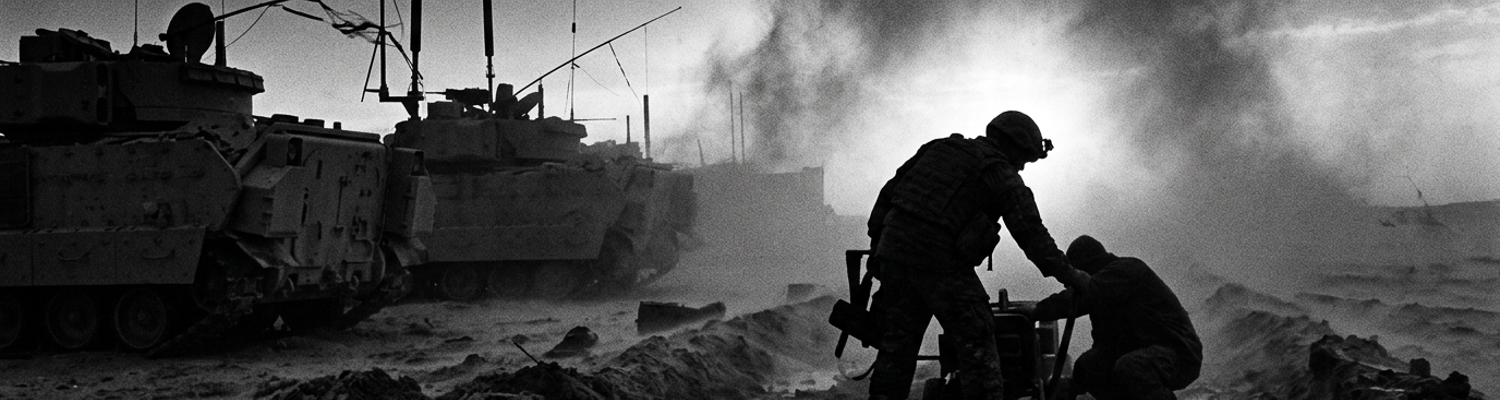

Digital Command Myths of Operation Desert Storm
231800Z FEB 91. LOG BASE ECHO, SAUDI ARABIA, COORDINATES 28 19 44 N, 045 21 18 E.
Archival evidence shows that civilian television networks broadcast images of an all-seeing push-button conflict. Frontline staff officers actually sat inside blacked-out canvas command tents struggling with corrupted drive sectors. Defense contractors spent the immediate aftermath of the ground war circulating promotional films. These films credited automated tactical mainframes and microcomputers with choreographing the Coalition advance across the Euphrates basin. According to those industry accounts, digitized networks had fused radar tracks, supply manifests, and armored columns into an instantly refreshed electronic board at Central Command headquarters in Riyadh. The international press embraced this sanitized depiction. They presented the campaign as an era of clean, bloodless electronic command executed entirely from air-conditioned operations centers.
The televised war was an advertising illusion.
When examining the historical record of VII Corps, operational plans demonstrate that Lieutenant General Frederick Franks Jr. expected automated tactical systems to maintain continuous synchronization across five heavy divisions. These divisions deployed along the Saudi-Iraqi border. AirLand Battle doctrine required rapid decision-making across broad geographic depths. Communications planners integrated the Maneuver Control System alongside tactical logistics terminals. These terminals ran AT&T Unix System V and Santa Cruz Operation Xenix. They oversaw the mechanized movement of forty-eight thousand combat and support vehicles through northern Saudi Arabia. Military planners assumed this computing architecture would automatically process field reports. They expected it to synchronize heavy artillery barrages with the 2nd Armored Cavalry Regiment and calculate forward fuel consumption rates without manual clerical intervention.
Procurement documents from the United States Army Training and Doctrine Command promised that these ruggedized workstations would eliminate delays. The plan called for feeding live operational data directly to tactical operations centers. Operational units arranged their entire logistics timetable under the assumption that this automated digital network would operate continuously.
Silicon failed when exposed to diesel exhaust and powdered quartz.
A close review of operational logs indicates that the physical machinery deployed to Log Base Echo deteriorated almost immediately upon entering the desert environment. Commercial-grade Unix kernels loaded onto Altos 386 computers and Miltope transportable terminals lacked write-caching protections. These protections were necessary to handle the erratic voltage supplied by standard military field generators. Every time a MEP-002A diesel generator fluctuated under the draw of cooling compressors in the sandstorms along the Tapline Road, operating system memory corrupted. This severed database connections across the forward supply depot. Cooling fans pulled fine silicate silt directly through chassis air filters. The grit ground into Winchester hard drive spindles and stripped magnetic tape heads within forty-eight hours of setup.
Ambient heat inside uninsulated S-280 shelter boxes routinely exceeded fifty degrees Celsius. This triggered thermal shutdowns in the core logic boards of the Standard Army Ammunition System.
Tactical logisticians assigned to the VII Corps 2nd Support Command spent the seventy-two hours prior to the ground offensive hand-copying ammunition allocations. They wrote diesel tallies onto plastic acetate map sheets with grease pencils. Staff personnel routinely dispatched messengers in utility trucks to drive five-inch floppy disks across fifty miles of unpaved tracks. The local network architecture failed to establish socket connections across mismatched system revisions.
By midnight on February 23, three out of four tactical computing nodes at Log Base Echo sat completely dead.
Revetment Excavation Failures at Log Base Echo
When examining the historical record of the 7th Engineer Brigade, earthmoving logs show combat engineers scraping forty separate subterranean pits across Log Base Echo during the third week of January 1991. Corps staff officers feared Iraqi tactical ballistic missiles and fragmentation munitions. They ordered heavy equipment operators to sink the entire 2nd Support Command operations complex beneath the desert surface. Caterpillar D7G bulldozers and heavy scoop loaders carved fifteen-foot-deep cuts into the barren plateau. They displaced tens of thousands of cubic yards of silty caliche hardpan to shelter S-280 electronics shelters. Speed took operational precedence over structural reinforcement.
Standard theater revetment kits stayed behind in supply depots at Al Jubail. Interlocking steel corrugated sheets and heavy dimensional timber were left on the docks to preserve flatbed transport capacity for tank ammunition. Equipment operators simply piled raw uncompressed spoil along the rim of each pit. This formed twenty-foot loose berms directly above the excavated workspaces without retaining walls or geotextile stabilization fabric.
Engineers assumed the baked desert floor would stay solid indefinitely.
Archival weather telemetry confirms that an anomalous polar trough stalled over the Tapline Road corridor between February 1 and February 5. This system dropped record rainfall onto northern Saudi Arabia. Local soil across that sector contained high concentrations of limestone dust and water-soluble gypsum with no organic binding material. Unprotected spoil berms absorbed hundreds of tons of cold surface runoff within hours. The packed marl converted into dense fluid silt. Shearing failures split the perimeter walls as saturated weight pushed past the natural angle of repose. Chunks of unreinforced earth broke free from the rim crests. The mud tumbled down into the sunken command spaces.
Vehicle egress cuts had been graded at steep fifteen-degree declines without lateral drainage swales or interceptor ditches. These cuts acted as direct flumes. They channeled sheet runoff from three square miles of desert pan straight down into the revetment pits.
Every excavated command shelter turned into a catchment basin.
A close review of operational logs indicates that freezing runoff and thick mud reached a depth of four feet inside the subterranean operations revetments before sunrise on February 4. Slurry poured through the unsealed door gaskets of sunken S-280 shelter boxes. The water flooded subfloor raceways and submerged unprotected 110-volt and 208-volt distribution looms. External MEP-002A generator sets seated in adjacent drainage depressions were swamped. Their alternators burned out. This cut AC power to tactical computers across the depot. Altos 386 central processing units and Miltope terminals mounted on floor-level shock frames filled with silt. The lower power units drowned and backplane circuits corroded.
Communications specialists worked in waist-deep four-degree Celsius water attempting to haul magnetic tape drives up slippery access cuts to surface level. They also dragged unshielded modems and paper requisition files out of the mud. Mud coated the terminal keyboards and fouled the cooling fan vents of every active workstation. This froze logic boards and killed data synchronization between the corps logistics staff and forward division elements.
Standing water submerged the primary network bus under three feet of sediment.
Subterranean Signal Inundation and Wire Failures
Trench water drowned the physical links of the corps network before the first tank fired an engine.
When examining the historical record of the 93rd Signal Brigade, construction logs reveal that wire teams dug narrow two-foot ditches between command revetments at Log Base Echo. This was done to shield multi-conductor trunk lines from shrapnel and heavy wheeled transports. Signal personnel laid heavy CX-11230 twin coaxial cables and twenty-six-pair CX-4566 audio trunks along the bottom of these cuts. The wires connected the main operations center to subordinate command shelters scattered across a three-kilometer radius. Soil conditions rendered standard backfilling counterproductive. Excavation crews dumped loose pulverized marl over the cables without compacting the fill or installing gravel sub-drains.
When sheet flooding struck the base on February 4, the unlined ditches turned into subsurface conduits. They gathered standing surface water from the surrounding plateau. Cold runoff rapidly filled every ditch from end to end. The water carried thousands of gallons of suspended gypsum silt directly into the trenches. Pressurized water accumulated to depths exceeding twenty-four inches. The heavy cable bundles were pinned against the trench floors beneath layers of dense sediment. Diversion berms were nonexistent. Within six hours of the initial downpour, every primary communications ditch connecting the 2nd Support Command to its forward logistics nodes was completely submerged.
Water found the splices.
Archival evidence shows that field technicians failed to waterproof the primary connection nodes dispersed between the subterranean shelters. Signal specialists relied on standard J-1077/U junction boxes and terminal distributor assemblies to cross-connect twenty-six-pair trunk lines. These lines ran between the main corps operations center, the ammunition control shelter, and forward fuel distribution points. Rapid relocation drills had prioritized speed above technical protocol. Maintenance crews had bypassed vulcanized rubber sealing gaskets. They left access plates fastened with only two of four corner wing nuts.
Sandstorms had previously stripped the threads on dozens of terminal housing bodies. Runoff laden with fine abrasive silt seeped past the loose rubber grommets and flooded the interior terminal strips. Dissolved minerals formed a thick conductive gray sludge across the binding posts. This bridged positive and negative terminals inside the boxes. Technicians sent into the flooded revetment pits pulled junction boxes from the mud only to find the internal terminal boards caked in semi-liquid clay. Individual wire pairs were corroded at the clamp screws.
Corrosion destroyed the digital pulse.
A close review of operational logs indicates that the physical deterioration of the copper command lines rapidly severed serial data transfer across Log Base Echo. Digital transmissions between Altos 386 Unix hosts and peripheral Miltope terminals depended on low-voltage RS-232 and MIL-STD-188 data pulses. These pulses were transmitted over unshielded copper wiring pairs. Saturated caliche mud and water intrusion altered the electrical characteristics of the buried lines. Resistance measurements across WD-1/TT field wire runs spiked from fifty ohms to hundreds of thousands of ohms. Electrical current leaked into the surrounding waterlogged earth.
Signal attenuation collapsed the 9600-baud asynchronous transmission rate down to zero. This caused continuous parity errors, buffer overruns, and frozen terminal sessions across the Standard Army Ammunition System. Copper lines shorted mechanically under the physical weight of wet earth pressing degraded cable jackets against sharp subterranean flint. By the evening of February 5, line continuity tests conducted by the 142nd Signal Battalion revealed total ground faults across eighty percent of the buried local area network links. This blocked automated logistical requisition transmissions across northern Saudi Arabia.
Technicians abandoned the buried copper lines and strung raw telephone wire across the wet sand by hand.
CHS-1 Militarized Workstation Hardware Vulnerabilities
When examining the historical record of the Project Manager for Common Hardware/Software, procurement documentation shows the United States Army committed its forward automated battle management to the militarized Common Hardware/Software CHS-1 program. Awarded to prime contractor Hewlett-Packard along with Hughes Aircraft in August 1988, the contract specified militarized Unix workstations. These machines were based on the Motorola 68020 and 68030 microprocessor architecture. They were designed to drive the Maneuver Control System and the Standard Army Ammunition System across tactical command echelons. VII Corps staff deployed these militarized CHS-1 configurations directly into the subterranean S-280 shelter complex at Log Base Echo during the second week of February 1991.
Packaged inside cast-aluminum chassis with heavy mechanical shock mounts, each ninety-pound terminal ran a modified secure implementation of Unix System V Release 3. This software was designed to handle tactical communications, automated targeting tracks, and mechanized divisional logistics over local area Ethernet buses. Engineering specifications required the CHS-1 workstations to survive continuous operation in ambient temperatures exceeding fifty degrees Celsius. They were also expected to sustain extreme field shock and physical vibration from nearby tracked vehicle movements. Training and Doctrine Command procurement officers intended these militarized machines to replace paper status maps and dry-erase command boards across every brigade and corps-level tactical operations center.
Cold air was a design requirement that northern Saudi Arabia could not fulfill.
Archival evidence shows that airborne micro-fine silicon dust began entering the militarized CHS-1 enclosures within twenty-four hours of installation inside the Log Base Echo revetments. The surrounding desert near the Tapline Road consisted of powdery pulverized quartz marl measuring under ten microns in diameter. The military specification callout required the chassis to resist coarse environmental sand. The CHS-1 air intake assemblies relied on standard open-cell polyurethane foam and wire-mesh impingement pre-filters. These proved completely permeable to aerosolized silica particles.
Twin 28-volt direct-current muffin cooling fans pulled hundreds of cubic feet of dusty air per minute through the internal equipment card cages. Abrasive quartz powder slipped past the intake baffles. It bypassed the housing perimeter seals to settle across the heat sinks and chassis floorboards. Silt coated the fan spindle sleeves within two days of continuous operation. The grit ground away factory-packed silicone grease and degraded the ball-bearing races. Friction loads spiked the electrical current draw across the cooling circuits.
By February 15, seventy-two hours before VII Corps initiated final rehearsal exercises, fan rotation speeds across fifty-eight separate workstations dropped below four hundred revolutions per minute. The sleeve shafts then seized entirely.
Blowers stopped spinning while the command shelters filled with exhaust heat.
A close review of operational logs indicates that the mechanical fan failures triggered persistent thermal shutdowns and component-level chip burnouts across the tactical operations centers of both the 2nd Support Command and the 11th Aviation Brigade. Silicon dust accumulated on horizontal logic boards. It formed an insulating gray blanket up to three millimeters thick over the surface of the Motorola 68030 central processing units and math coprocessors. Heat sinks were choked with mineral debris. With air circulation killed by seized cooling fans, internal chassis temperatures mounted beyond seventy degrees Celsius.
Bimetallic thermal trip sensors tripped repeatedly. This cut power to the processing units mid-transaction and crashed the Unix file system without unmounting active disk volumes. Memory caches burned out. Surface-mount capacitors and ceramic leadless chip carriers suffered thermal stress fractures. This caused direct shorts across the multi-layer circuit boards. Field service technicians assigned to the 142nd Signal Battalion had no replacement motherboards. They stripped cannibalized memory chips and custom bus interface cards from downed units inside a maintenance tent pitched directly in the sand.
By February 20, technicians were cutting open the top access hatches of dead CHS-1 chassis with handheld tin snips. They directed household floor fans into the exposed electronic circuitry.
Mobile Subscriber Equipment Packet Network Failures
When examining the historical record of the 93rd Signal Brigade, communications logs reveal that the Mobile Subscriber Equipment Tactical Packet Network began collapsing three days prior to G-Day. Signal operators at Log Base Echo had established multi-node packet-switching rings using AN/TYC-39 switches and node center vans to route logistical telemetry across the VII Corps operational area. Sustained forty-knot shamal winds drove dense clouds of powdered quartz silt directly into the antenna arrays on February 19.
Mineral build-up coated the parabolic reflectors of OE-361/GRC antenna masts. Abrasive grit entered unsealed coaxial radio frequency fittings on AN/GRC-226 radio terminals. Airborne dust particles carried heavy electrostatic friction charges. This induced continuous electromagnetic interference along exposed wire runs and antenna feeds. High-voltage static discharge overwhelmed front-end receivers. Bit error rates escalated exponentially across the sixteen-kilobit-per-second packet links. This produced packet-loss rates exceeding forty percent. Automated X.25 protocols responded to dropped frames by flooding the circuits with retransmission requests. This choked available network capacity until internal switch buffers suffered memory overflows.
Physical grit severed the airborne signal links.
Archival evidence shows that atmospheric anomalies compounded physical equipment contamination by severing line-of-sight radio transmissions between digital relay nodes. Network planning diagrams placed AN/GRC-226 radio groups on thirty-meter quick-erect masts to bridge the forty-kilometer hops between Log Base Echo, Node Center 12 at Hafar al-Batin, and forward divisional staging sites. Severe temperature inversions formed over the stony desert basin each afternoon as ground heat dissipated rapidly into clear night air. These thermal boundary layers altered the atmospheric refractive index directly along the transmission pathways.
Tropospheric ducting and multi-path fading deflected microwave beams downward into the caliche ground or angled them high into the upper atmosphere. Digital radios operating in Frequency Band III lost carrier lock as signal-to-noise ratios plunged below acceptable operating thresholds. Time-division multiplexers inside the transmission shelters uncoupled their framing sequences during the signal fade-outs. This caused complete line outages that lasted from twenty minutes to several hours across primary trunk routes.
Microwave carrier beams drifted into empty space.
A close review of operational logs indicates that erratic throughput across surviving links triggered destructive synchronization dropouts between distributed staff cells. Tactical Unix host servers running the Maneuver Control System and the Standard Army Ammunition System at the VII Corps Main Command Post attempted to execute automated database replications with logistics cells inside the 2nd Support Command. Transmission speeds fluctuated unpredictably between zero and twelve kilobits per second. Network socket timeouts repeatedly aborted remote copy procedures halfway through transaction batches. This left shared database tables locked in indeterminate write states.
Unix processes hung while waiting for transmission acknowledgments that never arrived from disconnected remote nodes. Data divergence escalated rapidly across northern Saudi Arabia. Operations staff in the forward tactical operations center tracked reserve fuel bladders as empty. The supply cell at Log Base Echo showed hundreds of thousands of gallons awaiting distribution.
Automated divisional inventory counts ceased to agree.
Communications officers with the 142nd Signal Battalion disabled packet routing protocols on February 22 after concluding that automated resynchronization attempts were crashing the remaining switches. Staff officers at Log Base Echo disconnected their Unix network cables. They loaded raw ammunition tallies onto three-and-a-half-inch diskettes and handed the magnetic media to drivers assigned to the 2nd Support Command. Utility trucks departed the compound every two hours to carry physical disks north over seventy miles of rutted gravel to division command posts.
Generator Spikes and Operating System Kernel Panics
When examining the historical record of the 2nd Support Command, maintenance logs reveal that the primary electrical grid at Log Base Echo relied on unshielded MEP-003A ten-kilowatt tactical diesel generators running in parallel to power the shelter revetments. Mechanical governors inside these generator sets degraded rapidly as fine silica dust clogged their fuel injection pumps and air intake filters. Engine speeds hunted erratically between 1,600 and 2,100 revolutions per minute. Every time heavy compressor units on environmental cooling trailers cycled on, the inductive surge dragged the line frequency down to fifty-two hertz before snapping back past sixty-eight hertz.
Transient voltage on the secondary distribution buses swung between 92 and 148 volts alternating current. Power conditioners and battery-backed uninterruptible power supplies had been left behind at King Khalid Military City. Logistics officers prioritized heavy vehicle fluids and 120-millimeter tank rounds during the initial staging push. Raw current flowed straight into the power supply units of the Altos 386 computers and militarized CHS-1 processing units inside the S-280 shelters. Switching diodes ruptured. Filter capacitors inside the chassis dried out under the surge loads. They leaked electrical noise directly across the backplanes.
Voltage rails drifted far beyond digital tolerance levels.
Archival evidence shows that local radio-electronic interference combined with this unstable power feed to provoke continuous operating system kernel panics across the depot. The 142nd Signal Battalion had erected high-output AN/TRC-170 troposcatter terminals and AN/VRC-46 VHF radio transceivers less than forty meters from the logistics computing complex to ensure link reach back to Riyadh. Grounding rods for these transmitters penetrated dry calcified limestone and gypsum marl. This produced electrical ground resistance exceeding two hundred ohms.
Unshielded tactical power cables running across the surface sand acted as long-wire reception antennas. They absorbed high-frequency radio frequency energy and carried stray radio emissions straight into the processing revetments. Digital logic buses inside the Unix terminals registered this continuous interference as erratic memory state changes. AT&T Unix System V and SCO Xenix operating systems suffered uninterrupted general protection faults and unexpected processor traps. The kernel console screens filled with panic traces indicating memory parity failures, illegal address bounds, and invalid opcodes.
Technicians watched terminal sessions freeze during live artillery supply allocations. This left the workstations completely unresponsive to console input until operators physically flipped the main power breakers.
Silicon logic collapsed under stray radio waves.
A close review of operational logs indicates that these hard crashes produced severe root file system corruption across the internal Winchester hard drives of the corps logistics nodes. Unix System V relied on a delayed-write caching architecture. It kept critical disk superblocks, directory inodes, and modified allocation tables inside volatile RAM for up to thirty seconds before writing changes back to physical disk sectors. Sudden power drops and kernel freezes hit while drives were executing high-density writes for the Standard Army Ammunition System. Disk heads were caught mid-cylinder.
Inodes severed from their parent directories. Free-block counts desynchronized from file allocation maps. File superblocks corrupted on both primary and backup partitions. Rebooting the Altos machines required system administrators to interrupt standard initialization scripts and force the operating system into single-user maintenance mode. Operators ran the fsck file system consistency check manually from a single terminal prompt.
Automation was disabled. Technicians answered interactive confirmation prompts by hand for every corrupted sector, orphaned inode, and unreferenced block cluster across eighty-megabyte ESDI hard drives. A single fsck recovery pass demanded forty-five minutes of manual keyboard entries per system. During active divisional staging maneuvers on the night of February 22, three consecutive manual recovery passes failed to rebuild the core ammunition database. This dumped critical transport records into orphaned lost-and-found directories.
Logistics specialists tracked five forward artillery battalions using pencil entries written on masking tape.
Operational Reversion to Acetate Maps and Runners
When examining the historical record of the VII Corps tactical operations center, shift logs confirm that command staff executed a complete emergency abandonment of automated battle tracking terminals twenty-four hours prior to the ground assault. On the morning of February 23, staff officers inside the main command shelter at Log Base Echo accepted that the Maneuver Control System and the Standard Army Ammunition System could not maintain stable runtimes. Persistent operating system traps, ruined hard drive sectors, and corrupted local area network packets threatened to feed false unit positions to tactical commanders.
Technicians physically severed serial connections and unseated monochrome display cables. Operators shut off secondary breaker panels. They allowed the militarized CHS-1 Unix workstations and Altos 386 computers to power down completely. Keyboards were gathered and stacked on steel shelving. Ninety-pound processing chassis were shoved against the S-280 shelter walls to create standing room for staff personnel. Tactical command officers ceased inputting digital keystrokes entirely. They locked the operating system consoles into silent maintenance prompts.
The automated digital command post was abandoned from within.
Archival evidence shows that operations sergeants immediately initiated the reinstallation of traditional analog map boards inside every sunken revetment. Combat engineers hauled half-inch exterior plywood sheets out of cargo trailers. They braced the timber panels onto folding metal sawhorses set along the perimeter walls. Staff personnel pinned 1:250,000 scale Joint Operations Graphic charts and 1:50,000 tactical topographic sheets across the wood faces using olive-drab duct tape and metal thumb tacks. Clear sheets of five-mil plastic acetate were pulled tightly across the paper maps. These were secured at the corners with electrical tape to form waterproof cleanable plotting surfaces.
Battle captains picked up grease pencils and Staedtler Lumocolor markers. They drew divisional boundaries, phase lines, and assembly areas across the plastic by hand. Blue chinagraph markers plotted the forward staging lanes of the 1st Armored Division, 3rd Armored Division, 1st Infantry Division (Mechanized), and the 2nd Armored Cavalry Regiment. Red wax identified suspected defensive lines held by the Iraqi VII Corps and Republican Guard reserves. When supply updates or combat reports arrived, staff sergeants wiped old grease marks away using isopropyl alcohol pads and dry rags. They wrote the new numbers in thick wax letters.
Plywood and clear plastic replaced sixty-megabyte relational databases.
A close review of operational logs indicates that internal communication across Log Base Echo and forward command echelons reverted entirely to human runners and tactical dispatch vehicles. The collapse of the Mobile Subscriber Equipment packet switching nodes and buried copper wire lines left staff sections unable to transmit operational movements electronically between scattered revetment pits. Enlisted personnel on foot manually transferred the operational messages. Runners moved through blowing marl between the ammunition shelter, the fuel management cell, and the corps operations center. They carried handwritten carbon-copy message pads containing fuel status figures and fire missions.
For longer distribution routes across the three-kilometer depot, dispatchers assigned drivers from the 2nd Support Command in M998 High Mobility Multipurpose Wheeled Vehicles and M1009 Commercial Utility Cargo Vehicles. Drivers operated under strict blackout rules. They ran without headlights across deep sand ruts guided solely by cat-eye blackout markers and hand-held magnetic compasses. Courier teams loaded physical route manifests, artillery allocation tables, and three-and-a-half-inch floppy disks into waterproof vinyl dispatch cases.
Enlisted couriers drove forty miles through open desert to hand-deliver typed fuel balance sheets to division rear echelons.
By dusk on February 23, the entire operational movement schedule for forty-eight thousand combat vehicles hung from thumb tacks pressed into unpainted wood.