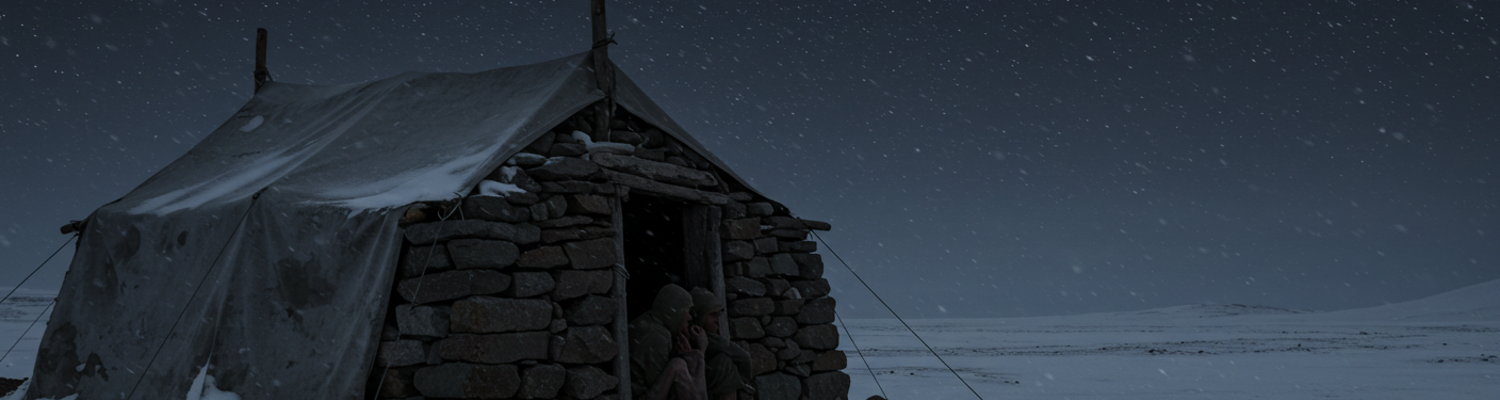

The Gilded Age pushed American ambition into every corner of the globe. While industry remade the nation's cities, the U.S. Army Signal Corps looked to the desolate, frozen expanse of the high Arctic. This was not a mission of conquest but of science and national prestige. The Lady Franklin Bay Expedition of 1881, commanded by First Lieutenant Adolphus W. Greely, represented a new type of military operation. It was a venture where the primary adversaries were ice, isolation, and the brutal arithmetic of logistics. The expedition's story is one of meticulous scientific planning colliding with catastrophic supply failures, a chronicle of the Signal Corps' technical skill tested by the raw, unforgiving physics of starvation.
A Mandate of Science and Sovereignty
The expedition was America's primary contribution to the First International Polar Year, a coordinated scientific effort by eleven nations to study the planet's polar regions. The United States committed to establishing two observation posts. One was at Point Barrow, Alaska, and the other, far more ambitious, was at Lady Franklin Bay on Ellesmere Island, deep inside the Arctic Circle. The Army Signal Corps, then the nation's official weather service and a hub of technical expertise, received the assignment. The mission's objectives were twofold. First, to execute a demanding, year-long program of scientific measurements. Second, to push farther north than any previous expedition, specifically to beat the British record set by Captain George Nares in 1876. Greely, a Civil War veteran and experienced Signal Corps officer, was selected to lead a party of twenty-one soldiers, a contract surgeon, and two Inuit hunters and dog drivers, Jens Edward and Thorlip Frederik Christiansen. His orders were precise. He was to establish his station, conduct his observations, and await a resupply ship in the summer of 1882. If that ship failed to arrive, a second would be sent in 1883. If the second ship also failed, Greely was ordered to abandon his post and retreat south to a designated rendezvous point.
The expedition was outfitted with the most advanced scientific instruments of the day. They carried a Fauth and Company magnetometer for geomagnetic research, a C.F. Casella and Company dip circle to measure the Earth's magnetic field inclination, and an array of thermometers, barometers, anemometers, and psychrometers for constant meteorological readings. They also brought a pendulum to conduct gravity experiments. The scientific team, including the civilian astronomer Edward Israel, was tasked with a grueling schedule of hourly, and sometimes more frequent, observations, day and night, through the blinding light of the arctic summer and the profound darkness of the polar winter.
Initial Success at Fort Conger
In July 1881, the expedition's chartered steam sealer, the Proteus, departed St. John's, Newfoundland. After navigating the treacherous ice-choked waters of Baffin Bay and the Nares Strait, the ship successfully reached its destination in Discovery Harbor, Lady Franklin Bay, on August 11. The location was one of the northernmost points ever reached by a vessel. The men immediately began constructing their prefabricated wooden headquarters, which they named Fort Conger. They unloaded three years' worth of provisions, coal, and equipment.
The initial phase of the mission proceeded as planned. The scientific program began without delay, with soldiers trained as observers meticulously recording data around the clock. During the first year, exploration parties on sledges fanned out from the fort. Greely himself led a party that crossed Ellesmere Island, discovering a large interior body of water he named Lake Hazen. The expedition's most celebrated success came in the spring of 1882. A sledging party led by Lieutenant James B. Lockwood, accompanied by Sergeant David L. Brainard and the Inuit hunter Frederik Christiansen, pushed across the frozen sea ice north of Greenland. On May 13, 1882, they reached a latitude of 83°24'N, breaking the British