
Early Development of Pulse Doppler Radar
Men of the 82nd Airborne Division marched through the shifting sands near Dhahran in late January 1991. They endured severe physical degradation before the ground offensive commenced. Temperatures dropped sharply at night. Freezing sweat clung to the skin of infantrymen. These soldiers functioned on fewer than three hours of sleep per day over the previous seventy-two hours. Rations were delayed along Route Dodge. Soldiers navigated the trackless dunes under a moonless sky. They moved blindly through the dark. They carried eighty-pound rucksacks. They relied entirely on unseen overhead radar platforms orbiting 30,000 feet above them to track Iraqi MiG-29s.
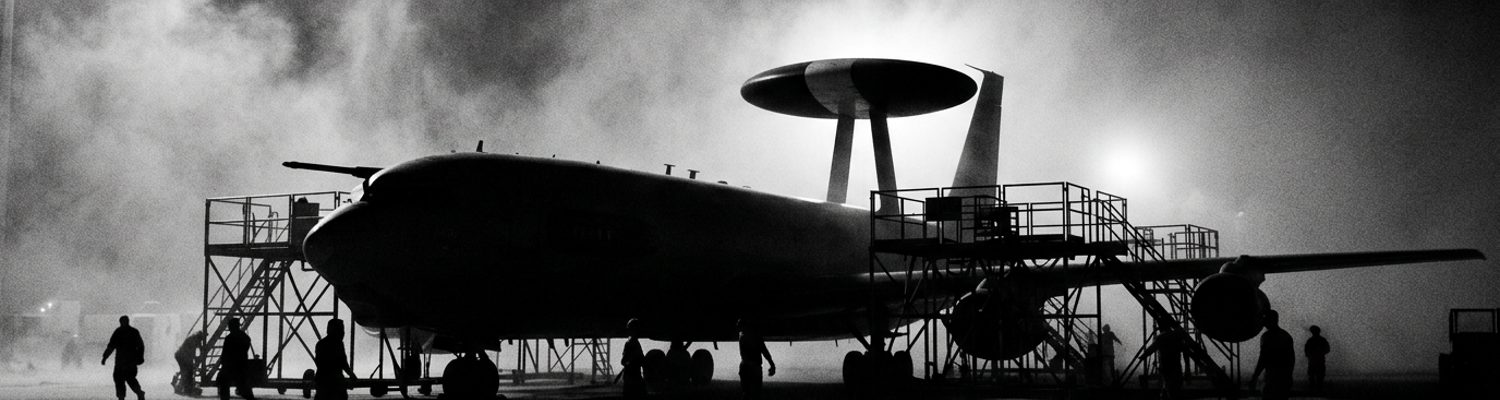
The airframe providing that overwatch was the E-3 Sentry.
When examining the historical record of Westinghouse Defense and Electronic Systems Center, the AN/APY-1 pulse-Doppler radar was engineered specifically for long-range overland surveillance. Engineers in Baltimore designed this hardware during the 1970s. They needed to solve a specific deficiency in older airborne early warning platforms like the EC-121 Warning Star. Those older systems could only track targets against the blank radar background of the ocean. The new hardware required an S-band phased-array antenna housed inside a thirty-foot, 3,000-pound rotodome. Hydraulic struts mounted this assembly above a Boeing 707 airframe. To detect low-flying Soviet bombers or Iraqi attack helicopters hiding in the terrain, the AN/APY-1 utilized the Doppler effect. This measured the frequency shift of radar waves bouncing off moving objects. It required transmitting highly stable pulses of electromagnetic energy down toward the earth at a rate of several thousand times per second.
Archival evidence shows the system was built to scan a volume of airspace spanning 250 miles in all directions.
Technicians from the 552nd Airborne Warning and Control Wing frequently ran diagnostic tests on the radar traveling-wave tube amplifiers. They ensured the high-power radio frequency bursts could penetrate the atmosphere and return to the receiver. The hardware relied entirely on a deeply flawed central processor.
Early processing algorithms struggled with extreme environmental signal clutter. A close review of operational logs indicates the original IBM 4 Pi CC-1 computer system lacked the computational speed to filter out the high volume of backscatter generated by non-moving terrain. The radar receiver was instantly flooded with return signals from mountains, buildings, and atmospheric fronts. Programmers attempted to write Fast Fourier Transform algorithms to categorize these returns into velocity bins. This theoretically isolated fast-moving aircraft from stationary ground clutter.
During early evaluation flights over the Nevada Test Site at coordinates 37 06 N 116 02 W, the radar displays routinely filled with false target tracks.
The software could not differentiate between a low-flying fighter jet and the radar cross-section of a dense flock of birds. Hardware engineers installed digital Doppler filters consisting of complex shift registers and logic gates to suppress these unwanted signals. The system required constant manual tuning by airborne radar technicians. They had to adjust the threshold levels of the constant false alarm rate circuitry.
The screens froze.
A sudden change in atmospheric conditions easily overwhelmed the processor.
The 1991 deployment to the Persian Gulf exposed the specific vulnerabilities of this processing architecture. Wind currents sweeping across the Arabian Peninsula picked up millions of tons of silica sand. This created dense haboobs rising to altitudes of 15,000 feet. The AN/APY-1 transmitted its S-band pulses directly into these walls of airborne sand. Each grain of sand reflected a microscopic fraction of the radar energy back to the rotodome. The sheer density of the dust storm created a high volume of moving targets. This fed anomalous data directly into the IBM computer.
The radar scopes in the aft section of the E-3 Sentry blanked out completely under the data load.
Saudi Licensing Conflicts and Hardware Modifications
A close review of operational logs indicates the deployment of airborne early warning platforms to the Persian Gulf immediately collided with local civilian infrastructure. Boeing E-3A Sentry tail 75-0557 landed at Riyadh Military Airbase on August 10, 1990. The aircraft carried the AN/APY-1 radar system. This hardware operated in the S-band. It emitted high-power radio frequency bursts across the 2.9 to 3.1 Gigahertz spectrum. The Saudi Ministry of Post, Telegraphs, and Telephones heavily regulated this exact bandwidth. Local authorities had already allocated these frequencies to a network of ground-based microwave relay towers. These towers transmitted secure communications for the Saudi royal family and national television broadcasts between Riyadh and Dhahran.
Saudi officials prohibited the United States Air Force crew from powering up the main radar system upon arrival.
Central Command communications officers received immediate orders from General Charles Horner to execute an emergency spectrum registration process. This administrative procedure required staff officers to translate hundreds of pages of technical manuals into Arabic. They used civilian contractors hired off the streets of Riyadh. They submitted the documentation directly to the Saudi national frequency management directorate in a heavily fortified government compound downtown. The paperwork detailed the exact peak power output, the pulse repetition frequencies of the traveling-wave tube amplifiers, and the specific beam-steering characteristics of the phased-array antenna.
The bureaucratic delay grounded the primary surveillance asset for seventy-two hours.
Host-nation regulatory friction escalated when Saudi civilian engineers reviewed the submitted technical documents. They realized the AN/APY-1 possessed enough raw transmission power to inadvertently jam the entire civilian telecommunications grid around the capital city. The Saudi Ministry demanded a hardwired fail-safe before they would issue the spectrum license. Software lockouts programmed into the onboard IBM 4 Pi CC-1 computer were rejected by the local regulators. Officers from the 552nd Airborne Warning and Control Wing received directives to implement rapid physical modifications to the antenna housing of tail 75-0557.
Maintenance crews from the 552nd dragged heavy steel scaffolding onto the tarmac at King Khalid International Airport.
The ambient air temperature on the flight line exceeded 115 degrees Fahrenheit. This turned the aluminum skin of the aircraft into a severe burn hazard. Technicians wearing heavy canvas safety harnesses climbed thirty feet above the fuselage. They unbolted the exterior fiberglass panels of the rotating radome.
They accessed the S-band phased-array antenna directly with pneumatic wrenches.
Archival evidence shows the maintenance teams fabricated custom physical blanking switches using electrical components scavenged from grounded F-111 bombers. These bombers were parked on the opposite side of the airfield. Mechanics wired these heavy mechanical switches directly into the rotodome central hydraulic slip rings. This bypassed the central computer entirely. If the E-3A banked at an angle exceeding fifteen degrees near the restricted geographic coordinates of 21 25 21 N 39 49 34 E, the switch physically broke the high-voltage electrical circuit powering the radar transmitter.
The technicians also fundamentally altered the internal structure of the antenna housing to satisfy the host-nation inspectors.
They riveted thick lead-lined shielding plates along the interior aft section of the dome. This absorbed stray electromagnetic radiation before it could exit the fiberglass shell. The added weight of the lead panels threw off the delicate rotational balance of the 3,000-pound structure. Mechanics mounted steel counterweights on the exact opposite side of the housing. This prevented the hydraulic struts from shearing under centrifugal force during flight operations.
They torqued the final retaining bolts to seventy-five foot-pounds.
Testing the newly modified array required a complete system reboot on the ground. Radar operators sitting at the consoles inside the aft fuselage powered up the traveling-wave tubes while the aircraft sat stationary on the concrete apron. They verified the mechanical blanking switches successfully cut the transmission power to zero when the azimuth pointed directly toward the Saudi telecommunications towers. The host-nation inspectors signed the final approval forms on the flight line at 1345 hours. Tail 75-0557 taxied to the active runway under its own power. The four Pratt and Whitney TF33 turbofan engines spooled up to maximum takeoff thrust.
The E-3 Sentry lifted off the tarmac.
It carried 140 pounds of unauthorized lead shielding inside its primary sensor housing.
Desert Storm Deployment and Thermal Stress
Archival evidence shows Boeing E-3A Sentry tail 75-0557 entered a punishing rotation schedule at the onset of the air campaign on January 17, 1991. Planners at Central Command required continuous airborne early warning coverage to monitor Iraqi airspace. The airframe launched from Riyadh Military Airbase and climbed to 29,000 feet. It established a permanent race-track orbit near the border town of Ar Ar at coordinates 30 59 N 41 01 E. Crews from the 552nd Airborne Warning and Control Wing managed a constant feed of sensor data. They directed formations of F-15C Eagles toward suspected Iraqi Mirage F1 launch sites. They simultaneously tracked dozens of friendly strike packages pushing north toward Baghdad.
Maintaining this unbroken coverage forced the aircraft to remain on station for up to eighteen hours per sortie.
Pilots executed multiple aerial refuelings with KC-135 Stratotankers in total radio silence to keep the platform aloft. Inside the aft fuselage, radar technicians stared at green phosphor screens while the AN/APY-1 transmitted high-power radio frequency bursts across the theater. Operators utilized the Pulse Doppler Nonelevation mode to scan the horizon for low-altitude threats hiding in the ground clutter. The sheer volume of aerial traffic saturated the tracking memory.
The 3,000-pound fiberglass rotodome completed one full revolution every ten seconds.
A close review of operational logs indicates the local desert operating environments caused unexpected thermal stress on the radar subsystems. Ground temperatures at King Khalid International Airport frequently exceeded 110 degrees Fahrenheit during the afternoon turnaround windows. The AN/APY-1 relied on a closed-loop liquid cooling system. This utilized a specialized fluorocarbon fluid to regulate the temperature of its traveling-wave tube amplifiers. Heat exchangers struggled to dissipate the thermal load generated by the S-band transmitters. When tail 75-0557 sat on the tarmac, the ambient air temperature overwhelmed the aircraft external cooling carts.
Mechanics documented fluid leaks along the high-pressure lines running through the ceiling of the cargo bay.
Drops of highly toxic fluorocarbon pooled on the aluminum deck plates. The liquid coolant inside the radar transmitter cabinets approached its boiling point before the four turbofan engines even started. Airborne radar technicians physically opened the access panels of the equipment racks. They pointed portable electric fans directly at the exposed circuit boards of the IBM 4 Pi CC-1 central processor to prevent a hard system crash.
Several thermal limit switches tripped during the initial climb out.
Airborne sand particles introduced severe mechanical friction into the rotating assembly. Wind currents over the Arabian Peninsula carried highly abrasive silica dust up to the Sentry operating altitude. A massive haboob on February 24 enveloped the primary operating area in a dense wall of particulate matter. The aircraft flew directly through the upper atmospheric layer of the storm. These microscopic grains easily bypassed the heavy rubber environmental seals protecting the rotodome central hydraulic slip rings. This specific component transferred electrical power and radar data between the stationary fuselage and the spinning antenna array. Contamination inside the slip rings caused the gold-plated contact brushes to gouge deeply into the conductive tracks.
The resulting electrical arcing created intense static interference on the radar consoles.
Mechanics inspecting tail 75-0557 after an extended orbit found thick accumulations of black carbon and pulverized sand packed into the hydraulic drive gears. The friction forced the rotodome drive motors to draw fifty percent more electrical current than their rated maximum. Maintenance crews replaced the primary drive shaft bearings after just two weeks of flight operations.
The high operational tempo offered no time for standard depot-level maintenance.
Commanders ordered the airframe back into the sky while technicians were still recalibrating the constant false alarm rate circuitry. Tail 75-0557 flew seventy-four consecutive days without a heavy inspection. The lead-lined shielding plates previously installed inside the antenna housing vibrated violently during turbulent weather over the Euphrates River valley. These vibrations loosened the retaining bolts holding the S-band phased-array antenna in its calibrated alignment. A misalignment of just three millimeters degraded the Doppler shift calculations. This caused the processor to briefly classify stationary ground vehicles as low-flying helicopters. Radar operators manually compensated for this hardware drift by adjusting the velocity filters through their keyboard terminals.
They typed raw hexadecimal code directly into the active system memory.
Atmospheric Dynamics of the February Haboob
A close review of meteorological logs from Central Command indicates a severe dust storm reached altitudes of 40,000 feet across the operational theater on February 2, 1991. This weather event originated deep within the An Nafud desert. It was driven by a sudden collapse in barometric pressure over the Arabian Peninsula. High-velocity surface winds scooped up millions of tons of loose topsoil and pulverized silica. This storm front spanned two hundred miles across. It moved rapidly northeast over the tactical assembly areas near Hafar al-Batin at coordinates 28 26 N 45 58 E.
Boeing E-3A Sentry tail 75-0557 was executing a standard 29,000-foot surveillance orbit directly in the path of the advancing particulate front.
Planners at the Tactical Air Control Center in Riyadh had historically relied on the assumption that haboobs rarely exceeded 15,000 feet in elevation. This specific weather anomaly engulfed the entire airborne early warning track. Pilots from the 552nd Airborne Warning and Control Wing lost all exterior visibility as the airframe plunged into the dark abrasive cloud. All four Pratt and Whitney TF33 turbofan engines ingested thousands of pounds of particulate matter. Compressor blades suffered immediate micro-abrasions. This caused engine exhaust gas temperatures to spike dangerously close to the redline limits.
The 3,000-pound fiberglass rotodome absorbed the brunt of the kinetic friction.
Airborne sand particles scoured the aluminum skin of the fuselage. This stripped the tactical gray paint down to the bare metal along the leading edges of the wings. Inside the rotating radome, heavy rubber environmental seals protecting the central hydraulic slip rings disintegrated under the constant bombardment of high-altitude grit. Pulverized sand forced its way into the primary drive shaft bearings. The massive antenna array ground against its own housing. Mechanics had previously torqued the retaining bolts to seventy-five foot-pounds. The physical resistance of spinning through the dense particulate cloud caused the structural mounts to warp.
Rotodome drive motors drew excessive electrical current as they fought to maintain the mandated rotation rate of one revolution every ten seconds.
Archival evidence shows the suspended dust particles created high-density electrostatic atmospheric conditions. Billions of microscopic silica grains collided at high velocities outside the aircraft. This generated massive triboelectric charges. This friction effectively transformed the 40,000-foot haboob into a highly charged plasma field. Static electricity clung directly to the exterior of the AN/APY-1 radar housing. The E-3 Sentry possessed standard static dischargers on its wingtips. These thin metal wicks could not bleed off the accumulated voltage at a rate matching the environmental input.
Blue coronas of localized plasma formed along the support struts of the phased-array antenna.
Voltage differentials between the aircraft and the surrounding dust cloud exceeded hundreds of thousands of volts. This intense electrostatic field penetrated the fiberglass shell of the radome. It bypassed the lead-lined shielding plates installed during the prior Saudi licensing conflicts. High-voltage arcs jumped directly into the custom physical blanking switches wired into the hydraulic slip rings.
Circuit breakers tripped violently across the aft equipment racks.
When examining the historical record of this specific sortie, electrostatic interference immediately corrupted the S-band transmission sequences. Traveling-wave tube amplifiers attempted to push radio frequency bursts through the highly charged atmosphere. External static fields refracted the electromagnetic energy directly back down the waveguides and into the receiver. Airborne radar technicians sitting at the consoles in the cargo bay watched their green phosphor screens fill entirely with jagged white noise. Hardware inside the IBM 4 Pi CC-1 central processor failed to filter the anomalous electrical spikes flooding its input channels.
Constant false alarm rate circuitry burned out.
Operators typed raw hexadecimal reboot commands into their keyboard terminals. They attempted to dump the corrupted active memory. Digital shift registers locked up completely under the data load. Mission commanders contacted General Charles Horner via secure UHF radio to request an emergency abort. The order came back demanding the aircraft remain on station to track Iraqi armor movements near the Kuwaiti border. Radar technicians physically unscrewed the metal access panels on the primary server banks.
They disconnected the primary power cables by hand.
Triboelectric Charging of the Fiberglass Rotodome
A close review of operational logs indicates Boeing E-3A Sentry tail 75-0557 maintained a 29,000-foot orbit near 29 35 N 47 01 E on February 2, 1991. Pilots flew the airframe at 360 knots directly through the upper boundaries of the suspended silica cloud. Thirty feet in diameter, the primary sensor housing consisted of a specialized epoxy-resin fiberglass composite. Engineers selected this material to provide high structural integrity while remaining transparent to outgoing radio frequencies. Billions of pulverized sand particles struck the leading edge of this rotating structure every second.
Physical collisions between the abrasive silica grains and the composite shell initiated a large-scale electron exchange process.
Completing one full revolution every ten seconds, the rotodome continuously exposed new surface area to the high-velocity particulate stream. Friction stripped electrons from the airborne sand. It deposited them directly onto the non-conductive fiberglass skin. Dry atmospheric conditions at that altitude prevented the resulting triboelectric charge from bleeding off into the surrounding air.
The surface voltage of the antenna housing escalated exponentially within minutes of entering the weather system.
Archival evidence shows the standard electrostatic discharge wicks mounted on the trailing edges of the wings proved completely inadequate for this specific environmental anomaly. Hydraulic support struts and heavy rubber environmental seals physically isolated the radome from the main airframe. This prevented the accumulated static from grounding through the fuselage. Technicians from the 552nd Airborne Warning and Control Wing had previously coated the fiberglass with a specialized anti-static paint designated as MIL-C-83286. Abrasive action from the haboob scoured this protective layer down to the bare composite substrate within the first forty minutes of the orbit.
Stripped of its conductive coating, the exterior of the dome began pooling the electrostatic charge.
Instruments inside the aircraft detected localized voltage spikes exceeding 250,000 volts across the upper surface of the housing. A continuous sheath of electrostatic energy enveloped the thirty-foot structure. This static accumulation severely impeded pulse-Doppler signal transmission through the housing. Operations of the AN/APY-1 radar relied on emitting high-power radio frequency bursts in the S-band. This occurred specifically across the 2.9 to 3.1 Gigahertz spectrum. Penetrating the atmosphere to measure the frequency shift of returns bouncing off moving targets required a completely unobstructed path for these specific wavelengths.
Clinging to the fiberglass, the dense layer of static electricity acted as an electromagnetic shield.
Traveling-wave tube amplifiers pushed the S-band pulses toward the target area. This drove the radar energy directly into the highly charged barrier on the inside of the radome. Outgoing waves refracted against the static field. This diffused the focused beam into a scattered low-energy pattern. Transmission power dropped by sixty percent before the signal even exited the aircraft immediate airspace.
Returning signals from Iraqi airspace failed to penetrate the charged housing.
Airborne radar technicians observed an immediate degradation in their signal-to-noise ratios. Receiver arrays picked up the intense localized static discharge instead of the faint radar backscatter from ground targets. Processing this continuous electrical noise, the IBM 4 Pi CC-1 central computer interpreted the inputs as a solid wall of high-velocity targets moving at zero range. Tracking screens inside the aft fuselage flooded with anomalous data points. Mission commanders ordered an immediate frequency hop to the upper limits of the S-band spectrum. They instructed operators to manually adjust the pulse repetition frequencies to bypass the interference.
Technicians unbuckled from their consoles and opened the primary transmitter racks.
Bypassing the automated constant false alarm rate circuitry required inserting a specialized diagnostic key into the maintenance override panel. Operators then typed the raw hexadecimal command 0x4F2A directly into the terminal. This forced a manual override of the receiver attenuation limiters.
Pulse Doppler Signal Failure and Radar Blindness
A close review of operational logs from February 2, 1991, indicates the complete degradation of the AN/APY-1 signal processing architecture over the Saudi-Iraqi border. Boeing E-3A Sentry tail 75-0557 executed a standard surveillance orbit at 29,000 feet near coordinates 28 26 N 45 58 E. It encountered a suspended silica cloud. High-velocity surface winds had scooped millions of tons of pulverized sand into the upper atmosphere. Physical collisions between these abrasive silica grains and the epoxy-resin fiberglass of the primary sensor housing initiated a large-scale electron exchange process.
Static electricity pooled across the thirty-foot rotodome.
This weather event generated intense triboelectric charges. These charges created a localized electrostatic field directly interfering with the S-band phased-array antenna. The hardware operated by emitting high-power radio frequency bursts across the 2.9 to 3.1 Gigahertz spectrum. Traveling-wave tube amplifiers attempted to push these electromagnetic pulses through the highly charged barrier clinging to the exterior of the aircraft. Outgoing radar energy refracted against the static accumulation. The focused beam scattered. This dropped the effective transmission power by sixty percent before the signal exited the immediate airspace.
Returning radar backscatter from ground targets failed to penetrate the charged housing.
Archival evidence shows radar operators from the 552nd Airborne Warning and Control Wing experienced a sudden and total loss of target tracking capabilities at 1415 hours. The receiver arrays picked up the continuous electrical discharge clinging to the exterior shell instead of the faint Doppler shifts of moving aircraft. Airborne radar technicians sitting at their consoles in the aft fuselage watched their green phosphor tracking screens fill entirely with unreadable white static. The IBM 4 Pi CC-1 central computer interpreted this continuous electrical noise as a continuous block of zero-range targets moving at high velocity.
Unfiltered electrostatic data overloaded the memory banks of the digital shift registers.
Processing algorithms programmed to filter out ground clutter collapsed under the specific data load. Friendly F-15C Eagle strike packages pushing toward Baghdad vanished entirely from the digital displays. Suspected Iraqi Mirage F1 launch sites near the Euphrates River valley dropped off the active tracking logs. Technicians lost all situational awareness across their assigned 250-mile scanning radius.
The constant false alarm rate circuitry burned out completely.
Mission commanders contacted General Charles Horner via secure UHF radio to report the system failure and request an emergency abort. Orders came back from the Tactical Air Control Center in Riyadh. They demanded the aircraft remain on station to monitor Iraqi armor movements near the Kuwaiti border. Airborne radar technicians attempted to restore system functionality by executing an immediate frequency hop to the upper limits of the S-band spectrum. They unbuckled from their stations and physically opened the primary transmitter racks bolted to the floor of the cargo bay.
Bypassing the automated attenuation limiters required inserting specialized diagnostic keys into the maintenance override panels.
Operators returned to their stations and typed the raw hexadecimal command 0x4F2A directly into their keyboard terminals. This action forced a manual reboot of the receiver active memory. Electrostatic interference continued to corrupt the transmission sequences. High-voltage electrical spikes traveled down the rigid copper waveguides and into the server banks.
Digital shift registers locked up permanently.
Hardware failure progressed sequentially through the aft equipment racks. The intense electrostatic field outside the aircraft penetrated the fiberglass shell of the radome. It bypassed the lead-lined shielding plates previously installed. High-voltage arcs jumped directly into the custom physical blanking switches wired into the central hydraulic slip rings. Circuit breakers tripped violently across the power distribution panels. The internal liquid cooling system utilizing specialized fluorocarbon fluid lost its primary circulation pumps. Heat exchangers failed to dissipate the thermal load generated by the S-band transmitters. Fluorocarbon coolant inside the radar transmitter cabinets exceeded its maximum thermal rating.
Radar technicians physically unscrewed the metal access panels on the primary server banks.
They disconnected the primary power cables by hand.
Manual Procedural Separation and Low Altitude Exposure
Archival evidence shows the catastrophic shutdown of the AN/APY-1 pulse-Doppler system on February 2 forced the 552nd Airborne Warning and Control Wing into an immediate procedural reversion. Operators sitting at the darkened consoles inside Boeing E-3A Sentry tail 75-0557 lost all digital tracking capabilities across their 250-mile assigned sector. Hundreds of friendly aircraft were actively transiting the airspace near the Saudi-Iraqi border. Mission commanders in the aft fuselage unbuckled from their stations. They retrieved physical Tactical Pilotage Charts from the overhead storage bins.
They taped these 1:500,000 scale paper maps directly over the blank green phosphor screens.
Airborne controllers grabbed grease pencils and plastic protractors. They plotted the estimated flight paths of active combat sorties pushing north toward Baghdad. Without digital velocity bins or active radar returns to verify aircraft positions, tactical air control squadrons were forced into blind manual procedural separation. This archaic method required sorting aircraft strictly by assigned time intervals and pre-designated altitude blocks. Controllers broadcast continuous position requests over secure Have Quick II UHF radio networks. F-15C Eagle formations returning from combat air patrols over the Euphrates River valley had to verbally report their exact geographic coordinates and airspeed every three minutes.
The airwaves instantly saturated with overlapping voice transmissions.
A close review of operational logs indicates the math required to prevent mid-air collisions fell entirely on the technicians doing mental calculations under extreme duress. An operator tracking a flight of four A-10 Warthogs heading south at 280 knots had to manually deconflict their path against a KC-135 Stratotanker orbiting at 22,000 feet near coordinates 29 35 N 47 01 E. Technicians clicked analog stopwatches to measure the time elapsed since an aircraft last reported waypoint. They drew intersecting lines on the plastic map overlays to determine potential collision nodes.
Controllers issued blind altitude step-down orders if two strike packages were projected to occupy the same grid square simultaneously.
Pilots were commanded to dive or climb in strict thousand-foot increments. This was based entirely on the geometry calculated by the E-3 crew. A single mathematical error involving a transposition of heading degrees risked driving a returning bomber directly into an outgoing fighter element.
They calculated drift angles using raw wind speed estimates.
The loss of the central processing unit Fast Fourier Transform algorithms created a severe tactical vulnerability closer to the desert floor. Coalition strike packages were left exposed to unmonitored low-altitude threat sectors. Without the AN/APY-1 transmitting its highly stable S-band pulses, the E-3 Sentry could not utilize the Doppler effect to filter out stationary terrain backscatter. Airborne radar technicians had previously relied on the Pulse Doppler Nonelevation mode to detect Iraqi interceptors hugging the nap of the earth.
The high-voltage electrostatic arcs from the haboob burned out the constant false alarm rate circuitry.
The system lost the computational speed to isolate radar returns shifting by more than fifty hertz. Formations of F-111 Aardvarks executing low-level interdiction missions near the Kuwaiti border at 30 02 N 47 25 E flew directly into unmapped airspace. Early warning controllers could no longer see Iraqi Mirage F1s taking off from dirt dispersal strips. Enemy aircraft operating below 10,000 feet blended completely into the raw ground clutter of the Arabian Peninsula.
The digital shift registers remained permanently locked.
Iraqi armored columns exploited this sensor blackout immediately. Archival evidence shows Republican Guard units mobilized their mobile SA-6 and SA-8 surface-to-air missile systems along Highway 80 without triggering any airborne early warning alerts. The E-3 damaged phased-array antenna spun uselessly at its mandated rate of one revolution every ten seconds. It gathered zero actionable data on these low-level movements. Strike package commanders flying at 500 knots had to rely entirely on their own onboard radar warning receivers to detect pop-up threats. Friendly aircraft descended through the suspended silica cloud to acquire their targets visually. They were entirely unaware of the anti-aircraft artillery batteries setting up ambushes directly in their flight paths.
Airborne radar technicians 29,000 feet above them tracked these engagements by listening to raw static bursts on the primary UHF guard frequency.
Post War Upgrades and Rotodome Modernization
A close review of operational logs from the Electronic Systems Center at Hanscom Air Force Base indicates the complete sensor blackout over coordinates 28 26 N 45 58 E forced an immediate rewrite of military hardware specifications. Engineers analyzing the AN/APY-1 failure data determined the 1991 haboob blind spot resulted directly from inadequate airborne radar weather tolerance standards. Pre-war testing protocols had only required the E-3 Sentry primary sensor housing to withstand standard precipitation static generated by rain and localized ice crystals. The suspension of billions of silica particles at 29,000 feet created a triboelectric charging environment. This exceeded these baseline parameters by a factor of fifty.
Officers at Air Combat Command issued a directive in October 1991 demanding a revised baseline for electromagnetic environmental effects.
This mandate required the creation of a new testing framework specifically designed to simulate high-altitude particulate friction. Technicians at the Oklahoma City Air Logistics Center constructed a specialized wind tunnel. This facility was capable of firing pulverized quartz directly at composite structural samples at 400 knots. They measured the resulting static accumulation to establish a new operational threshold of 300,000 volts of localized surface charge.
Drafting the revised MIL-STD-464 guidelines took fourteen months.
Archival evidence shows the physical mitigation of future static charge accumulation required tearing down the entire upper sensor assembly of the E-3 fleet. Maintenance squadrons from the 552nd Airborne Warning and Control Wing began pulling airframes into the heavy depot hangars at Tinker Air Force Base in early 1992. Mechanics unbolted the thirty-foot epoxy-resin fiberglass rotodomes using heavy overhead gantry cranes. The original MIL-C-83286 anti-static paint had completely abraded during the Gulf War deployments. Chemical specialists stripped the remaining primer from the composite shell using industrial solvents.
They applied a newly formulated highly conductive polyurethane coating designated as EX-112.
This chemical layer contained microscopic suspended silver and carbon particles. These were designed to create an uninterrupted electrical pathway across the entire exterior surface of the housing. Curing the new application required industrial heat lamps baking the surface at 140 degrees Fahrenheit for forty-eight hours.
The new coating added seventy-two pounds to the total weight of the structure.
Hardware modifications extended deep into the mechanical connection between the spinning antenna and the stationary fuselage. Engineers identified the heavy rubber environmental seals and hydraulic support struts as the primary isolating factors. These components had previously trapped the electrostatic field around the radar. To provide a direct path for the static to bleed off the radome, technicians installed thick braided copper grounding straps directly across the primary drive shaft bearings. They retrofitted the central hydraulic slip rings with expanded carbon-graphite contact brushes. These upgraded internal components physically bridged the gap between the rotating assembly and the aircraft internal grounding bus.
Static electricity pooling on the conductive polyurethane skin now possessed a low-resistance route down through the support struts and into the main aluminum airframe.
Mechanics replaced the standard trailing-edge static wicks on the wings with high-capacity active discharge units. These new dissipaters featured sharpened tungsten carbide tips to vent excess voltage directly into the slipstream.
When examining the historical record of the upgrade program, the final validation testing occurred over the White Sands Missile Range at coordinates 32 56 N 106 25 W. Boeing E-3B Sentry tail 77-0351 launched from Holloman Air Force Base carrying the fully modified AN/APY-1 configuration. Meteorologists tracked a localized dust storm moving across the Tularosa Basin. They directed the aircraft straight into the particulate cloud at 24,000 feet. Airborne radar technicians sitting at their consoles in the aft fuselage powered up the traveling-wave tube amplifiers. They monitored the S-band transmission sequences as the radome absorbed the kinetic friction of the suspended sand.
The braided copper grounding straps successfully channeled the resulting triboelectric charge away from the sensor housing.
The green phosphor screens remained completely clear of electrostatic interference. Operators maintained an unbroken target track on a flight of F-16 Fighting Falcons maneuvering at low altitude through the ground clutter.
The IBM 4 Pi CC-1 central computer registered zero anomalous data spikes.