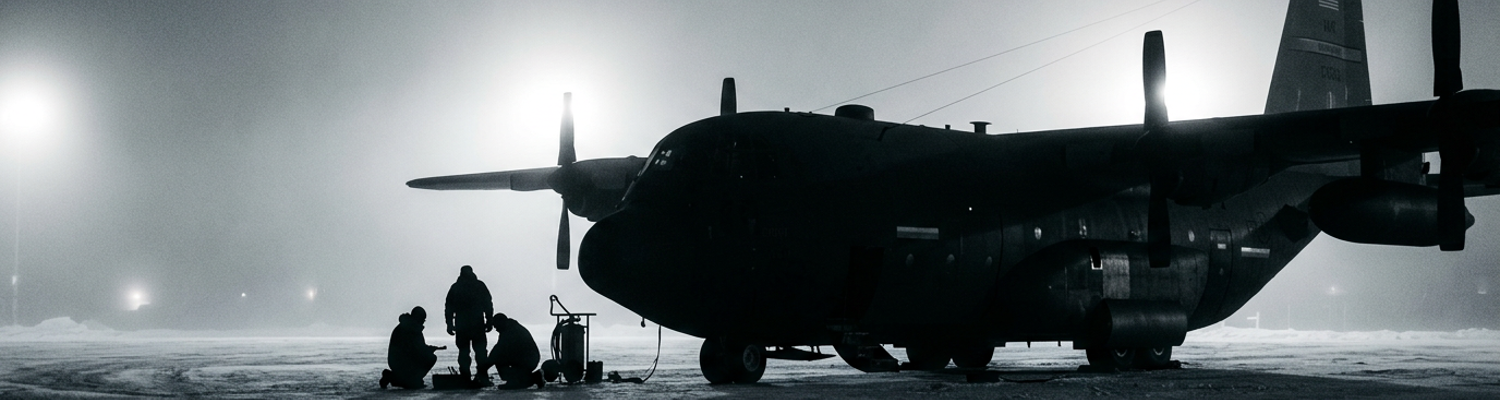

Winter Conditions at Florennes Airfield
16 December 1944. 0530 hours. Florennes Advanced Landing Ground A-78. Ambient air temperature registered minus twelve degrees Celsius. The Ninth Air Force ordered the 422nd Night Fighter Squadron forward from Châteaudun to this captured Belgian installation three months earlier. IX Tactical Air Command held direct operational control. Command doctrine tasked the unit with maintaining night air dominance over the First Army front. They operated Northrop P-61A and P-61B Black Widows from dispersed earthen revetments.
Retreating Luftwaffe personnel from Nachtjagdgeschwader 4 had detonated demolition charges.
These explosives leveled the permanent maintenance hangars. The airfield lacked structural cover. Supply echelons stretched back to Cherbourg. Supply officers prioritized artillery shells and tank fuel over canvas field hangars. Squadron personnel inherited two cracked concrete runways. Unpaved dispersal loops surrounded the tarmac. Autumn rains had churned these loops into deep mud. Ground crews parked eighteen twin-boom fighters directly on open soil.
Unsheltered airframes absorbed the European freeze.
An Arctic high-pressure ridge settled over the Ardennes plateau during the second week of December (NARA Record Group 338, Box 412). Persistent freezing fog pushed through the Meuse River valley. Sub-zero temperatures converted airborne moisture into dense rime ice. This ice adhered to every exterior surface across the dispersal pens. The P-61 featured a hemispherical radome built from laminated fiberglass and dielectric resins. This nose section sat directly in the path of the prevailing wind. Thick ice crystals built up along the nose skin. An opaque crust two inches thick formed within hours. Dielectric testing on the SCR-720 indicated surface ice distorted the microwave beam pattern. The ice absorbed 9-centimeter radio waves before target returns could register on the cockpit indicator scopes.
Supercooled moisture seeped through unsealed panel seams.
Water penetrated the forward nose bay holding the Western Electric SCR-720 radar scanner. The 29-inch parabolic dish was engineered to sweep at 100 revolutions per minute. Condensation froze solid along the drive gears, elevation gimbals, and counterweights. Ice bridged the narrow clearance gap between the rotating dish rim and the interior radome wall.
Drive motors burned out within thirty seconds of battery engagement.
Maintenance logs reveal ground crews lacked basic heating gear to thaw complex radar components. Squadron mechanics held three operational Herman Nelson type F-1 portable duct heaters. These serviced eighteen aircraft scattered across two miles of perimeter dispersal pens. Leaded aviation fuel clogged the burner nozzles of these portable units. Biting crosswinds extinguished their heat output. Radar mechanics worked without gloves in the open wind. They tore skin against frozen aluminum while using brass scrapers to chip rime ice off delicate scanner linkages. Mechanics improvised by placing charcoal braziers beneath the nose cowlings. The uneven heat cracked the frozen plexiglass sections. It failed to penetrate the insulated radar junction boxes.
Standard AN-G-3 grease congealed into an inert paste inside the gearboxes.
This locked the elevation mechanisms completely. Meltwater from blowtorches pooled inside the lower antenna housing. The water refroze almost instantly. This short-circuited the crystal mixer rectifiers and blew the main system transformers. Replacement components stalled at Base Air Depot 1 in England. Transport aircraft could not penetrate the zero-visibility weather.
By the morning of 17 December, operational logs listed eleven P-61s grounded with seized radar scanners.
SCR-720 Radar Scanner Mechanical Failures
A close review of operational logs from the 422nd Night Fighter Squadron reveals specific failure rates. Airborne radar failure rates exceeded seventy percent within twenty minutes of climb-out from Florennes. The mechanical assembly of the Western Electric SCR-720 scanner suffered structural resistance before aircraft reached patrol altitude. The twenty-nine-inch aluminum parabolic dish required continuous rotational drive along its azimuth axis. The system operated at one hundred revolutions per minute with an oscillating vertical tilt mechanism.
Ambient temperatures sinking to minus eighteen degrees Celsius altered the chemical properties of the AN-G-3 general-purpose low-temperature grease.
This lubricant was packed into the azimuth gearboxes and bevel drive assemblies. The grease thickened into a waxy barrier across the gear teeth. The aircraft radio operator engaged the cockpit control box to activate search mode. The twenty-four-volt direct-current drive motor faced an immovable gear train. Current surged through the stalled copper armature coils. The draw jumped from four amperes to thirty amperes in seconds. This melted the internal coil insulation. The drive pinion welded directly to the frozen housing.
Burned armature windings turned newly manufactured Western Electric radar sets into dead weight.
Secondary hydraulic failures compounded the collapse of the forward electronic array. High-pressure hydraulic lines routed through the forward nose wheel bay fed power to scanner leveling actuators. These flexible lines consisted of Buna-N synthetic nitrile rubber sleeves wrapped in single-ply braided wire reinforcement. They were designed to withstand continuous operating pressures of 1,050 pounds per square inch. Wartime chemical shortages forced American manufacturers to substitute petroleum plasticizers in the synthetic rubber compound. This elevated the thermal contraction threshold of the material. Ground temperatures hovered far below freezing. The elastomer contracted tightly around the grooved brass hose nipples. The rubber shed its elasticity and developed micro-fractures along the inner tube walls.
The P-61 utilized dual engine-driven Pesco hydraulic pumps.
These pumps pressurized the circuit upon gear retraction. The sudden hydraulic shock wave split the brittle rubber casings lengthwise. Pressurized red-tinted mineral oil escaped into the forward equipment bay. The fluid sprayed directly across the high-voltage synchronizer chassis of the SCR-720. It coated the BC-996 pulse generator and open terminal blocks.
Fluid fires ignited inside four nose bays during post-flight engine shutdowns on 18 December.
IX Air Force Service Command maintenance records demonstrate ground crews had no access to cold-resistant fluorosilicone seals. They lacked the AN-O-9 low-viscosity hydraulic oils needed to prevent line blowouts. Ground personnel at Florennes resorted to cutting sections of unreinforced garden hose. They clamped salvage fuel tubing over burst lines with common wire twists. These field expedients ruptured instantly under normal hydraulic load. The supply depot at Châteaudun reported a complete stock depletion of replacement flexible line assemblies by 19 December.
Mechanics cannibalized parts from three damaged P-61A airframes parked in the snow beside Runway 27.
They stripped functioning azimuth gears. These replacement gears sheared their teeth on the next frozen takeoff. IX Tactical Air Command had eight operational night fighters left to cover sixty miles of frontline advance.
Spare radar azimuth drives sat boxed on a rail siding outside Le Havre.
Specialized Vacuum Tube Supply Bottlenecks
Archival evidence shows radar maintenance chiefs inside the 422nd Night Fighter Squadron faced a total exhaustion of Western Electric 725A magnetrons by 18 December. They also ran out of 707B reflex klystron oscillator tubes. These glass-envelope components served as the electron-emitting core of the SCR-720 system. They required precision internal alignment measured in thousandths of an inch to generate ten-centimeter target beams. An emergency replacement manifest carrying two hundred crated Western Electric vacuum assemblies sat immobilized sixty miles to the west.
Winter gales dumped two feet of wet snow across the Ardennes plateau.
The snow choked secondary supply corridors between the Advance Section Communications Zone supply depot at Saint-Quentin and the forward strips along the Meuse River. Military police diverted convoys away from blocked intersections along Route Nationale 4. Five two-and-a-half-ton GMC CCKW trucks of the 391st Quartermaster Truck Company sat stranded in unplowed drifts outside Philippeville. The specialized vacuum tubes were packed without thermal insulation inside simple wooden slatted crates. They absorbed continuous mechanical shock from frozen cobblestones and tire chains.
Sub-zero temperatures caused differential contraction between the copper anode blocks and lead-glass seals.
This created microscopic fissures. The internal tube vacuums were destroyed before the cargo reached Florennes.
Tungsten filaments snapped inside their glass envelopes.
IX Tactical Air Command maintenance dispatches record twenty-four out of thirty replacement Western Electric tube assemblies uncrated at Florennes on 20 December arrived with shattered internal grids. Ground technicians used handheld Simpson Model 260 multimeters in freezing draft tents. They tested filament continuity and found dead open circuits across brand-new spare boxes. Radar crews resorted to pulling cracked tubes from wrecked night fighters. They warmed the glass with field stoves to seat them into frozen chassis sockets.
Sockets fractured under brittle contact pins.
Ground transportation delays simultaneously severed the supply of pressurized 100-octane aviation fuel drums. Operating the SCR-720 demanded extensive stationary ground testing. Ground crews ran the twin Pratt and Whitney R-2800-65 radial engines at 1,200 revolutions per minute. This turned the 24-volt Eclipse generators and fed the high-voltage synchronizers. Each twin-engine warm-up burned eighty gallons of pressurized 100-octane fuel per hour simply to test radar calibrations on parked aircraft. Railhead transfer stations at Charleville-Mézières ran out of available flatcars. First Army supply planners requisitioned every operational locomotive to evacuate heavy equipment away from the German penetration toward Bastogne.
Convoys of standard fifty-five-gallon steel drums loaded onto flatbed trailers sat stalled.
They blocked twenty miles of iced single-lane roads between Namur and the forward fuel dumps. Heavy fuel haulers slid across frozen road crowns into roadside ditches. They blocked entire tank battalions and supply columns behind them.
Florennes possessed fewer than forty intact 100-octane fuel drums by the night of 21 December.
Squadron mechanics manually dragged corroded steel drums through knee-deep snowdrifts. They pried frozen bungs open with chisels and hammers. Cold weather contracted the metal drum walls. This created internal negative pressure. The pressure sucked surface condensation and melting snow past the bung threads directly into the aviation spirit. Water sank to the bottom of the drums. It froze into slush that choked hand-cranked rotary transfer pumps. This severed fuel flow to the engine carburetors. Ground crews managed to siphon the fuel into fuel tanks. Water contamination fouled spark plugs and triggered backfires. This cut electrical generation to the radar chassis in the middle of alignment procedures.
IX Air Force Service Command denied three telegraph requests from Florennes for clean pressurized fuel tanker trucks.
Command cited absolute priority for armored division spearheads defending the Dinant river crossings. Ground crews drained remaining clean 100-octane fuel from damaged P-61 fuel tanks.
They maintained the operational readiness of just four aircraft.
Ground-Controlled Interception Radar Breakdowns
Ground-controlled interception along the Ardennes front failed from the soil upward. Airborne night fighters never acquired their first microwave contacts. Operational logs from the 555th Signal Aircraft Warning Battalion stationed near Spa reveal the electronic tracking network collapsed. Raw fuel congealed inside stationary supply lines. Forward stations operated microwave SCR-584 tracking units alongside long-range SCR-527 early-warning arrays. These were set up on exposed ridges at coordinates 50°29'12"N, 05°52'44"E to track low-altitude penetrations.
Continuous operation of both radar suites required unbroken three-phase alternating current.
Trailer-mounted Buda and Caterpillar diesel generator sets generated this power on site. Nighttime temperatures plunged to minus fifteen degrees Celsius on 17 December. Untreated military-spec diesel fuel separated inside exposed five-hundred-gallon field storage drums. High-paraffin petroleum chains solidified into cloudy paraffin wax platelets. These collected across the fine copper-mesh strainer screens of the primary fuel filters. Gravity-fed fuel lines choked shut within twenty minutes of engine start. Mechanics attempted to clear lines with hand torches. The waxy gel clogged secondary micron-rated felt elements. This starved high-pressure fuel injection pumps.
Deprived of steady fuel flow, generators surged.
They dropped frequency below fifty cycles per second and died.
Radar scopes went black across three forward sectors simultaneously.
IX Air Defense Command maintenance logs register an identical physical failure across the external antenna drives of both radar models. The SCR-527 system relied on twin thirty-foot broadside arrays mounted atop heavy rotating frameworks. The mobile SCR-584 utilized a six-foot parabolic dish positioned on an elevated pedestal above its K-78 semi-trailer. Persistent freezing drizzle on the night of 18 December layered structural steel beams and open mechanical linkages in a sheet of solid glaze ice half an inch thick. Moisture pooled inside unsealed circular azimuth turntables. Heavy steel ball bearings froze directly into their raceways.
Electric azimuth drive motors engaged to sweep the western approaches.
The heavy ice pack blocked exposed bull gears and intermediate spur pinions. High torque sheared mechanical brass shear pins in the drive linkages. This disconnected drive shafts from rotating platforms entirely. Ground operators attempted to swing the SCR-527 antenna frames by hand using auxiliary torque bars. Men lost their footing on iced mud revetments. The iron azimuth tracks remained welded shut by ice. Blowtorches brought in to melt frozen turntable races caused rapid uneven thermal expansion. This permanently warped machined ring gears.
Station crews stripped three hundred pounds of shattered drive gear teeth from their mounts before dawn.
Ground controllers lost the ability to point radar beams. They could not calculate range and azimuth coordinates for incoming Luftwaffe formations. Directional vectoring from the 555th Signal Aircraft Warning Battalion ceased. P-61 crews from the 422nd Night Fighter Squadron flew blind racetracks through zero-visibility weather over Ardennes valleys. Ninth Air Force command centers received radio appeals for intercept vectors. They answered with silence. Radar operators worked with cold chisels to chip frozen slush from immobilized generator lines and turntable rings. Patrol flights exhausted fuel in unguided holding patterns. Pilots made dead-reckoning approaches into Florennes without instrument descent corridors.
Two P-61 fighters ran dry while orbiting unguided near Saint-Vith on 19 December.
Both crashed into the dense pine ridges of the Schnee Eifel.
Landline Disruptions and Tactical Communications Gaps
The communications web linking forward radar vans to tactical air controllers failed during the first ninety minutes of the German offensive. Standard W-110-B field wire formed the single line of contact between the SCR-584 tracking stations of the 555th Signal Aircraft Warning Battalion near Spa and the IX Tactical Air Command direction center at Verviers. This wire consisted of three copper and four steel strands encased in vulcanized synthetic rubber and an asphalt-treated cotton braid. It lacked metallic armor or heavy shielding.
These unarmored lines carried raw target telemetry across twelve miles of broken ridgelines.
They ran along roadside ditches and were lashed to exposed spruce trees. Preparatory barrages from German 15 cm Nebelwerfer 41 rocket batteries and 10.5 cm howitzers of the Volksartillerie struck on the morning of 16 December. These strikes severed surface runs along the N62 highway. Telephone circuits across eight frontline sectors were cut instantly. Freezing rain added thousands of pounds of glaze ice to overhead pine canopies. Massive timber snapped directly onto field lines. Copper conductors ripped out of terminal distribution blocks.
Signal repair crews sent to locate breaks froze in roadside ditches under sustained mortar fire.
IX Air Defense Command maintenance logs reveal field wire repairs failed due to rapid material degradation. Linemen from Company B discovered forty-eight distinct line breaks along an eight-mile stretch of timbered ridgeline between Spa and the Verviers plotting room. Stripping the frozen vulcanized rubber insulation on W-110-B wire proved impossible with standard TL-29 pocket knives. The cold-hardened synthetic elastomer shattered into jagged fragments. These fragments sheared through the inner copper-steel strands. Splicing sleeves cracked under manual crimping pliers.
Moisture seeped through torn cotton braids and froze solid.
This caused grounding faults and cross-talk that drowned out voice traffic. Field switchboards like the BD-72 failed when internal frost seized the magnetic drop indicators and shorted the patch cords. Secondary SCR-522 high-frequency radio networks could not bridge the gap. The deep limestone gorges of the Amblève and Vesdre rivers blocked line-of-sight VHF signals. Target plotting boards at Verviers received no updated range, altitude, or azimuth coordinates from forward radar sites.
Tactical air direction centers suffered an absolute vectoring blackout.
Operational logs from the 422nd Night Fighter Squadron demonstrate how German flight units exploited these severed circuits. Sixty-seven Junkers Ju 52 transport aircraft of Transportgeschwader 2 penetrated Allied airspace at eight hundred feet during the pre-dawn darkness of 17 December. They dropped paratroopers for Operation Stösser near the Baraque Michel crossroads. Forward radar operators in the 555th Signal Aircraft Warning Battalion picked up the slow-moving transport formation on their scopes. Dead telephone lines prevented them from relaying target tracks to ground-controlled interception officers.
Airborne Northrop P-61 Black Widows from Florennes orbited in holding patterns over the Meuse River.
They burned scarce 100-octane fuel without receiving heading assignments. High-speed Junkers Ju 188 twin-engine reconnaissance aircraft from Fernaufklärungsgruppe 123 slipped through the same unmonitored air corridors. They tracked First Army vehicle concentrations along the Marche-Bastogne highway.
They returned across the Rhine unmolested.
German staff officers received clear aerial reconnaissance reports of the Meuse river crossings.
American night fighters flew four empty sorties across blind radar nets.
Intelligence Overload During Operation Stösser
Signal processing centers collapsed under an unmanageable volume of unvetted intelligence data during the night of 16 December 1944. Kampfgruppe von der Heydte prepared to jump from waves of Junkers Ju 52 transports near coordinates 50°31'05"N, 06°04'12"E in the High Fens plateau. Office of Strategic Services radio intercept teams monitored German air base communications across western Germany from field posts around Spa. They intercepted disjointed Morse traffic from Transportgeschwader 2 facilities at Paderborn and Lippspringe. Field cryptographers decrypted tactical messages using mechanical converters. They generated fragmented reports of night troop drops hours before takeoff.
Intelligence units lacked an established technical screening protocol for raw intercepts.
Operators teletyped every fragmentary decrypt directly to the IX Tactical Air Command Tactical Air Direction Center at Verviers. Dispatch runners dumped hundreds of mimeographed intercept sheets onto watch desks. These sheets listed contradictory drop targets ranging from the Meuse River bridges at Huy to isolated rail junctions outside Malmedy. Staff officers possessed no rapid system to verify active Luftwaffe flight corridors. They could not distinguish decoy runs from genuine combat penetrations.
Unverified intercept forms accumulated in foot-tall stacks beside silent radio terminals.
Maintenance and operational logs from IX Air Defense Command reveal acoustic and visual movement notices from forward ground units compounded the gridlock. Battery observation posts from the 110th Antiaircraft Artillery Gun Battalion along the Our River valley filed low-level aircraft sightings within minutes of the German artillery barrage. Frontline infantrymen of the 99th Infantry Division heard aircraft engines grinding above the cloud deck. They sent urgent wire messages through field switchboards about multi-engine formations flying barely four hundred feet above the snow. Four grease-pencil plotters stood before vertical clear-resin map boards inside the plywood-walled communications shelters at Verviers. They were tasked with transcribing every inbound sighting into an actionable vector.
Field lines carried seventy calls every fifteen minutes from visual posts.
Ground troops mistook wind noise and echo refraction off frozen limestone ravines for low-flying German aircraft. Plotters attempted to cross-reference these conflicting acoustic claims against raw microwave track sheets delivered from the 555th Signal Aircraft Warning Battalion. The manual processing time for a single sighting report stretched past forty minutes. Active flight paths were buried beneath hours of obsolete data points.
Plotters tracked transport formations that had cleared Belgian airspace an hour earlier.
This data choke point severed the interception cycle for the 422nd Night Fighter Squadron. Controllers inside the Verviers shelter attempted to direct two orbiting Northrop P-61s toward a confirmed transport group dropping paratroopers near the Mont Rigi crossroads at 0315 hours on 17 December. Vectoring personnel consulted the map board. They found six overlapping target tracks plotted between Eupen and Malmedy. All tracks were tagged with identical priority markers. Ground controllers broadcast tentative vectors that shifted every ninety seconds instead of transmitting precise range and azimuth data to the aircrews. Radio operators on board the P-61s listened to controllers continuously countermand their own compass headings over the SCR-522 VHF radios. The twin-engine night fighters were sent into wide holding turns over dense pine forests.
German paratroopers from Kampfgruppe von der Heydte landed in the snowdrifts of the High Fens.
Not a single transport aircraft took fire from American night fighters.
In-Flight Static and Blind-Flying Complications
Severe precipitation static disabled airborne communications across the 422nd Night Fighter Squadron patrol sectors as blizzards swept the Ardennes plateau on the night of 19 December 1944. Northrop P-61 Black Widows collided with billions of microscopic ice crystals suspended in sub-zero cloud layers while flying through dense snow squalls at coordinates 50°18'N, 05°45'E between Bastogne and Saint-Vith. Friction generated intense triboelectric charges across the unpainted duralumin airframes and laminated fiberglass radomes. This accumulated charge found no discharge path through standard antenna masts.
It triggered violent electrical interference across the Bendix SCR-522 VHF command transceiver of the aircraft.
Radio channels A through D spanned 100 to 156 megacycles. These channels dissolved into continuous high-frequency static. This noise drowned out tactical controllers attempting to direct interceptions from Verviers. Electrostatic corona discharge arced across the forward radome and pitot-static heads. This fed stray currents directly into the antenna cabling of the Western Electric SCR-720 radar. Phosphor screens on the cathode-ray indicator scopes inside the radar observer compartment erupted with blinding bursts of electronic noise. Radar observers watched chaotic blooming patterns and false target sweeps blot out the entire ninety-degree scanning sector instead of clean target blips indicating German Junkers Ju 87 or Ju 52 aircraft.
Static discharge engulfed the cockpit windshields.
Radarscopes flared into solid sheets of white static.
Flight crews lacked the basic equipment required to bleed off these static voltages before they crippled onboard avionics. Production models of the P-61A and early P-61B lacked trailing-edge static discharge wicks on the twin rudders and wingtips. The airframe had no mechanical means of releasing atmospheric potential. Static electricity exceeding forty thousand volts surged through the skin of the aircraft. It jumped across the ceramic lead-in insulators of the SCR-522 antenna array. This burned out the RF amplifier stages inside the BC-624 receivers. Replacement tubes and capacitors were locked in snowbound supply depots at Saint-Quentin. Squadron electronics technicians at Florennes were unable to repair charred radio chassis.
Radar observers could not discern true target returns from phantom electrical flares with their cathode-ray tubes washed out by electrostatic feedback.
IX Tactical Air Command ordered the 422nd to maintain round-the-clock air patrols over the Ourthe River crossings. Crews flew through zero-visibility blizzards without radar tracking or voice direction from the ground.
Aircrews flew entirely deaf and blind into the Ardennes cloud deck.
Flight reports from IX Air Defense Command document this total electronic blackout provoked severe spatial disorientation among P-61 crews trapped in instrument holding patterns. Returning to Florennes or diverting to Advanced Landing Ground A-70 at Laon required navigational fixes from ground-based radio homing beacons. Pilots relied specifically on the mobile AN/CRN-2 and SCR-575 direction-finding stations. Heavy ice storms on 20 December snapped the whip antennas of these field transmitters. Unheated lead-acid battery banks cracked in sub-zero winds.
The Bendix SCR-269G automatic direction finder needles inside P-61 cockpits spun uselessly around their dials without functioning radio homing beacons transmitting directional signals.
Pilots lost all visual reference to the ground and horizon while orbiting in thirty-minute holding stacks through dense freezing fog between three thousand and six thousand feet. Prolonged turns in heavy convective turbulence caused fluid shifts within the inner ear. This triggered sensory illusions where pilots perceived level flight while slipping into descending banked turns. Vacuum-driven Sperry artificial horizons and directional gyros began to precess after continuous instrument maneuvers. These instruments gave false attitude readings to exhausted pilots. Flight logs from the 422nd Squadron record two P-61 crews orbiting near Dinant entered steep graveyard spirals on the night of 21 December. Spatial disorientation overcame instrument scans.
Both aircraft sheared through frozen pine forests along the Meuse valley.
All four crew members died on impact.
Field Expedients and Ground Crew Maintenance
Maintenance chiefs of the 422nd Night Fighter Squadron at Advanced Landing Ground A-78 abandoned standard technical order procedures out of sheer operational necessity by 21 December 1944. Ground personnel standing in open revetments at coordinates 50°14'36"N, 04°38'54"E faced ambient conditions that rendered regular warm-up cycles useless. Mechanics lashed standard military catalytic field heaters and kerosene-burning immersion units to crude wooden sledges placed beneath the nose cones to thaw the immobilized Western Electric SCR-720 radar scanner units. Crews cut and stitched olive-drab cargo canvas, shelter halves, and truck tarpaulins with baling wire.
They fashioned tapered ten-foot ducting sleeves.
Mechanics slipped one end over the heater blowers and jammed the opposite collar through the bottom inspection aperture of the unlatched fiberglass radomes. Forced heat poured upward across the twenty-nine-inch parabolic scanner dish. This melted the glaze ice binding the elevation gimbals. It liquefied the congealed AN-G-3 grease packed into the azimuth gearboxes. The process created continuous soot deposits on the microwave dipole antenna array. It risked igniting fuel vapor inside the forward bay. Ground technicians monitored the heat by placing bare palms against the freezing outer composite skin. They cut off fuel to the burners the moment composite resins softened.
Thawed condensation drained onto the snow.
It froze instantly into black ice beneath the nose wheels.
IX Air Force Service Command maintenance logs reveal severe supply shortages forced technicians to strip written-off airframes along the perimeter of Runway 09/27. Depot replenishment was cut off by German artillery interdiction across the Meuse supply lines. Ground crews treated three battle-damaged P-61A fighters as salvage yards for rare parts. Tech-sergeants directed teams to extract intact Weatherhead and Parker AN-818 aluminum-alloy hydraulic couplings from the lower nose bays and wing-root junction blocks. These hydraulic fittings survived sub-zero contraction without the stress cracks that crippled operational aircraft under standard 1,050 psi line surges.
Mechanics worked with blowtorches and lead hammers.
They warmed the seized threaded unions to break rusted safety wire and frozen threads without shearing the soft aluminum bungs. Every salvaged hydraulic coupling received a gasoline bath inside an empty ammo tin before immediate reinstallation into an operational aircraft.
Skin peeled from fingertips across bare duralumin panels during nighttime disassembly.
This cannibalization program extended directly into the primary electronic guidance bays of the wrecked fighters. Radar mechanics unscrewed instrument panels. They stripped intact Western Electric terminal boards, BC-996 pulse synchronizers, and ceramic vacuum tube bases from airframes shattered by flak during earlier sorties over the Roer valley. Ground specialists used soldering coppers heated over gasoline stoves to desolder delicate lead wires in biting wind gusts. They salvaged undamaged 725A magnetron sockets and unburned high-voltage transformers.
Aircraft armorers dismantled unbreached Pesco hydraulic accumulator manifolds and emergency hand-pump valves from punctured tail booms.
They swapped them into operational P-61B airframes to keep forward radar dish leveling actuators running. Ground crews completed six complete system exchanges using cannibalized hydraulic unions and recovered circuit components between 22 December and 24 December.
Three stripped P-61A airframes sat gutted to their primary stringers in the drift banks by Christmas Eve.