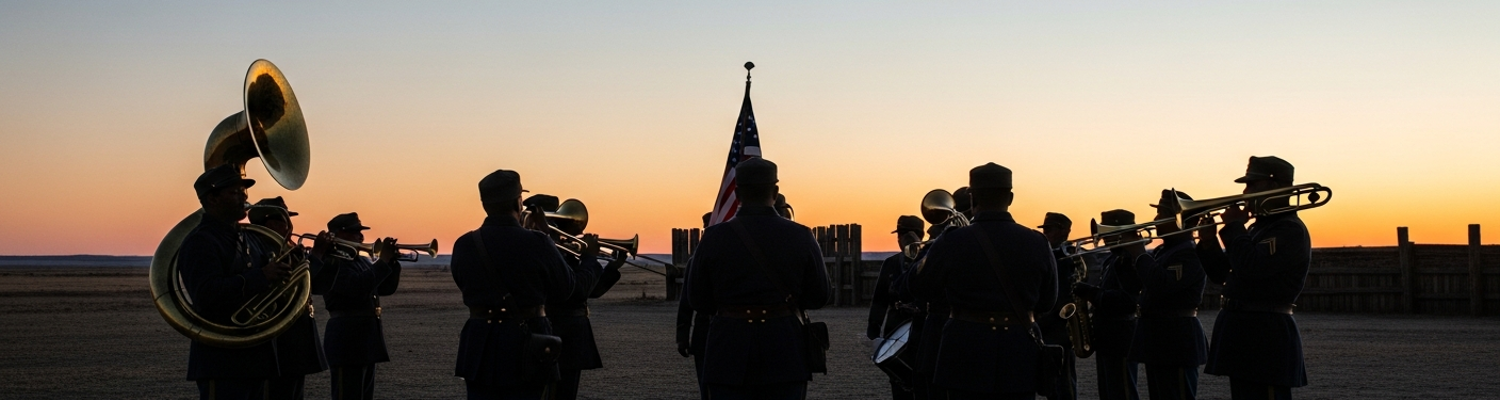

A lone bugle call cut through the pre-dawn chill over Fort Davis, Texas. The notes, clear and sharp, were not just a signal to wake. They were an assertion of order in a vast, hostile landscape. For the African American soldiers of the 9th and 10th Cavalry and the 24th and 25th Infantry, this was the sound of their world. These men, the Buffalo Soldiers, confronted an unforgiving frontier and the deep-seated racism of the nation they served. In this environment of extreme isolation and pressure, the regimental band functioned as an operational necessity. It was a weapon system for the soul, a mechanism that built discipline, forged identity, and sustained morale against overwhelming odds. The music was not a luxury. It was a core component of military readiness.
Discipline and Identity in Brass and Percussion
Life at a remote western post was a grind of monotony, physical labor, and constant tension. The regimental band provided the structural counterpoint to this existence. The daily sequence of bugle calls, from Reveille to Taps, dictated the rhythm of life, transforming a sprawling collection of individuals into a synchronized military machine. Formal events, such as guard mount, parades, and Sunday reviews, became powerful displays of unit pride when accompanied by a full brass band. The sight of musicians in their dress uniforms, instruments polished to a mirror shine, performing intricate marching maneuvers, turned a routine formation into a statement of collective competence and professionalism. The music was a constant, audible projection of order and purpose.
Commanders understood this dynamic. Colonel Benjamin Grierson, the first commander of the 10th Cavalry, was a former music teacher who grasped the practical power of music. Stationed at the sun-baked outpost of Fort Concho in West Texas, Grierson personally invested in his regiment’s band. He often used his own funds to purchase sheet music, from military marches to popular waltzes, and better instruments. Evening concerts on the parade ground became a fixture of post life. These events offered a vital psychological release for the troopers and a rare point of contact with the small civilian populations near the forts. For African American soldiers, whose abilities were constantly questioned, the band’s technical skill offered a potent, undeniable rebuttal to racist assumptions. Excellence in performance was a form of combat. The 25th Infantry’s band earned national acclaim playing at the World’s Industrial and Cotton Centennial Exposition in New Orleans in 1885 and later received praise for their performance at a Memorial Day parade in St. Paul, Minnesota, in 1888. These were not just concerts, they were demonstrations of capability that chipped away at the wall of prejudice.
Black Bandmasters in Command
The leadership of these bands marked a critical space for African American advancement within the segregated military. Initially, many of these bands were led by white, sometimes European, bandmasters. A concerted push by Black leaders, both military and civilian, sought to change this. The appointment of African American Chief Musicians, or bandmasters, was a significant step. Wade H. Hammond became one of the most prominent examples of this new leadership. Born in Alabama around 1879, Hammond was a graduate of Alabama A&M, where he had directed the college band. In 1909, through the advocacy of influential figures like Bishop William T. Vernon, Hammond secured an appointment as Chief Musician of the 9th Cavalry. This made him one of the first African Americans to hold the position in the regular army.
Hammond’s thirty-three year career was a model of sustained excellence. He led the 9th Cavalry band at posts like Fort D.A. Russell in Wyoming, where the band became an integral part of life in nearby Cheyenne. They performed at state fairs, civic ceremonies, and church functions, building goodwill for the regiment. In early 1915, while the 9th was stationed on border patrol duty, the mayor of Douglas, Arizona, presented Hammond with a diamond-set gold medal recognizing the band’s superior quality. Hammond’s influence spread as he transferred to the 10th Cavalry at Fort Huachuca in 1922 and later took command of the 25th Infantry’s band in 1934. His career demonstrated institutional competence and provided a pathway for others.
Another key figure was Frank 'Pats' Johnson, the longtime bandleader of the 24th Infantry. Johnson led his band to distinction during the Spanish-American War, serving in Cuba and later in the Philippines. The 24th's band, stationed for a time at Fort Douglas near Salt Lake City, Utah, became exceptionally popular. Upon their arrival in 1896, the regiment faced racial hostility, but Johnson's band systematically dismantled it through public performance. They held regular concerts for the civilian population, showcasing a repertoire that included classical overtures, popular songs, and military marches, earning widespread praise in local newspapers. These men, along with others like the musically gifted officer Charles Young, a West Point graduate who composed and directed music, navigated a deeply prejudiced system. They used their talent not just to make music, but to lead soldiers and advance their race.
From Concert Stage to Combat Support
The band's function extended far beyond the parade ground. On campaign, musicians reverted to their fundamental role as soldiers, assuming critical non-combat and support duties. This practice had been formalized during the Civil War, where bandsmen frequently served as medical assistants. On the frontier, this dual role was a tactical necessity. Before an engagement, the musicians would establish a field dressing station, prepare litters, and gather supplies for the surgeons. During and after a battle, they became stretcher-bearers, moving into the fire-swept field to carry the wounded to safety. They provided immediate first aid and assisted the surgeons in the grim work that followed.
This reality was starkly evident during the Victorio Campaign of 1879-1880. As elements of the 9th and 10th Cavalry relentlessly pursued the Apache leader Victorio across the harsh terrain of New Mexico, Arizona, and West Texas, the regimental bands were integral to the operations. While troopers engaged in skirmishes and grueling pursuits, the musicians provided essential rear-echelon support. They guarded supply trains, managed logistics at temporary camps, and, most importantly, served as the primary medical evacuation teams. Carrying a wounded man on a litter across rocky, broken ground, all while remaining vigilant for attack, was hazardous work vital for operational success. Though not officially designated as combatants in these moments, their duties were performed under the same lethal risks.
Musicians also proved their adaptability in other ways. During the 25th Infantry’s experimental bicycle expedition from Fort Missoula, Montana, to St. Louis, Missouri, in 1897, Musician John Findley served as the trip’s official correspondent, documenting the unit's progress. As trained soldiers, every musician was qualified with a rifle and was expected to man the stockade walls and participate in the defense of the post if it came under direct attack. They were specialists who never lost the fundamental identity of the soldier.
Enduring Notes for the Modern Force
The history of the Buffalo Soldier regimental bands provides direct, actionable insights for today's military forces. Their story confirms that unit cohesion and high morale are not built by combat training alone. Shared cultural activities, especially those performed at a high level of excellence, forge powerful bonds and create a distinct, positive unit identity. This is particularly true in high-stress, isolated, or forward-deployed environments. The bands acted as a force multiplier for morale, their very presence a tangible investment by the command in the well-being of its soldiers.
The band’s extensive community engagement serves as a textbook model for what are now called Civil Affairs and public relations operations. For the 24th Infantry in Salt Lake City, every concert was an act of strategic communication, directly countering racial animosity and building local support for the Army's presence. A disciplined, professional musical performance is a non-threatening projection of military excellence. This is a lesson modern forces deployed globally can use to build trust and understanding with local populations.
Finally, the dual-role of the musicians as artists, medics, and logisticians underscores the enduring need for adaptability. They were not narrow specialists. They were soldiers first, capable of performing multiple essential tasks when the situation demanded. The Buffalo Soldier bands proved that a unit's spirit, identity, and operational effectiveness can be carried on the notes of a song. That is a lesson as relevant on the complex, asymmetric battlefields of the 21st century as it was on the sparse American frontier.