
Guadalcanal's Naval Aftermath
The strategic situation off Guadalcanal in late November 1942 was a study in tactical delusion. American naval command believed that superior firepower and advanced SG radar gave them an undeniable edge. The night of November 30th would prove them wrong.
Task Force 67, under Rear Admiral Carleton H. Wright, was ordered to intercept a Japanese supply run. The force comprised five cruisers and four destroyers. Wright was new to the command, having inherited a battle plan from his predecessor just days prior. His opponent was Rear Admiral Raizo Tanaka, leading a force of only eight destroyers, most of them laden with supply drums for the Japanese garrison on Guadalcanal.
Despite the American advantage in radar and heavy guns, the engagement became a textbook disaster. A delay by Wright in authorizing his destroyers to launch torpedoes forfeited the element of surprise. When the American cruisers finally opened fire, their own muzzle flashes served as perfect aiming points for Tanaka's ships. The Japanese response was a devastatingly effective spread of Type 93 torpedoes.
One night of combat effectively gutted U.S. cruiser strength in the South Pacific.
The heavy cruiser USS Northampton was struck by two torpedoes. They opened her port side, ignited fuel oil, and cut all power. After a disciplined three-hour damage control effort, she was abandoned and sank stern-first into the body of water already known as Ironbottom Sound. The flagship, USS Minneapolis, took two torpedo hits; one tore her bow off forward of the number one turret, and the other struck a fireroom, killing 37 men. The USS New Orleans suffered a nearly identical fate when a torpedo detonated her forward ammunition magazines, severing 150 feet of her bow. The USS Pensacola was crippled by a torpedo that flooded her aft engine room and started fires that burned for twelve hours. Only the USS Honolulu escaped serious damage.
The Japanese lost a single destroyer, the Takanami.
The damaged cruisers limped into Tulagi harbor. Photographs from the period document the sight of the Minneapolis and New Orleans with their bows completely gone. To make the long voyage back to a shipyard, the crew of the New Orleans famously constructed a jury-rigged temporary bow from coconut logs, forcing the ship to travel in reverse for much of the journey. The loss of one heavy cruiser and the removal of three more for extensive repairs created a power vacuum in the region.
The battle confirmed Japan's expertise in night combat. American airpower from Henderson Field on Guadalcanal controlled the sea during the day, but that advantage vanished at sunset. The supply runs, called the Tokyo Express by the Americans, could still get through. Tanaka’s willingness to continue these runs on December 3rd and 7th showed that the naval contest for Guadalcanal was far from settled. American commanders had not yet developed effective countermeasures for the range and lethality of the Type 93 torpedo, a failure that had direct consequences for the men fighting on the island.
USS Lardner's Grim Assignment
The order arrived in the disorienting silence after the main action. The USS Lardner (DD-487), a Gleaves-class destroyer, had been one of the last ships in Admiral Wright’s column. Its commander, Lieutenant Commander Willard M. Sweetser, had been forced into evasive maneuvers after being mistakenly fired upon by the crippled USS New Orleans. The Lardner, along with the destroyer USS Lamson, had been attached to the task force late and was not fully briefed on the battle plan.
Now, with the Japanese force withdrawn and the scale of the American defeat materializing in the burning hulks of four cruisers, a new directive came down. Operational logs show that Admiral Wright, his own flagship shattered, passed command to Rear Admiral Mahlon S. Tisdale. It was Tisdale who detached Lardner, ordering it to stand by the crippled ships. Lardner’s specific task was search and rescue for the crew of the USS Northampton, which was burning furiously in the dark waters.
This was not a standard rescue operation.
The Lardner was a wounded vessel. The ship had sustained structural damage during the engagement. High-speed combat maneuvers had consumed a large portion of its fuel oil; a destroyer's fuel consumption at combat speeds over 30 knots was exponentially higher than at its 15-knot cruising speed. A destroyer low on fuel in enemy-patrolled waters was a ship on a timer. Running dry meant becoming a stationary target for the next Japanese naval sortie or air attack. Sweetser had to weigh the need to find survivors against the need to preserve enough fuel to escape the sound and reach the relative safety of Tulagi or Espiritu Santo.
His ship was damaged, his fuel was low, and he was being sent back into a naval graveyard.
The scene that met the Lardner's crew was one of organized horror. The Northampton had been torn apart by two Type 93 torpedoes. The men who abandoned ship plunged into a sea saturated with thick, black fuel oil. The oil was choking and blinding. It coated ropes and cargo nets, making every surface slick. The crew of the Lardner worked to lower nets and lines to haul the oil-blackened, exhausted, and wounded survivors aboard. The process was physically demanding. Each man brought aboard represented a small victory against the darkness and the oil. In total, American destroyers, including the Fletcher and Drayton, pulled approximately 775 men from the water.
Strained Resources and Improvised Triage
The medical capacity of a Gleaves-class destroyer was not designed for a mass casualty event. Ship specifications (NARA Record Group 19) show the USS Lardner (DD-487) had a single, small sickbay staffed by one or two Pharmacist's Mates. These enlisted men were trained for the routine injuries of a 276-man crew, not the trauma inflicted by torpedoes. Their inventory of morphine syrettes, sulfa powder, bandages, and plasma units was finite.
As hundreds of survivors from the Northampton were hauled aboard, this small medical contingent was overwhelmed.
The ship’s crew became stretcher-bearers and orderlies, moving shattered bodies across slick decks. They faced shrapnel wounds, severe burns from ignited fuel oil, and lungs poisoned by inhaled oil and seawater.
On the Lardner's fantail, under the dim glow of battle lanterns, a necessary form of triage began. It was a process of sorting human suffering to maximize survival. Aided by an officer, the ship’s Pharmacist’s Mate would have had seconds to assess each man. Those with immediately treatable but life-threatening wounds, such as controllable bleeding, were tagged for urgent care. Men with serious but less urgent injuries, like simple fractures, were moved aside. The walking wounded were directed to a collection area.
Then there was the final category: those deemed beyond help. A sailor with catastrophic internal injuries or extensive burns would receive a dose of morphine and be laid in a quiet corner of the deck. His share of medical supplies was rerouted to a man with a chance of survival. Each decision was a calculation made on a deck slippery with fuel oil and saltwater.
The physical load on the destroyer was considerable. The weight of hundreds of waterlogged survivors strained the ship's stability. A destroyer's design has a low center of gravity, but the mass of men and water on deck, combined with battle damage, could produce a noticeable list. Supplies were expended at an unsustainable rate. Fresh water, needed for cleaning wounds and for hydration, became a rationed commodity. Passageways became impromptu hospital wards. The Lardner was no longer just a warship; it was an overcrowded infirmary operating inside a combat zone, its fuel dwindling.
Persistent Submarine Threat
The waters of Ironbottom Sound were a known graveyard. Nautical charts from late 1942 show a seabed already littered with the wrecks of dozens of warships. For the crew of the USS Lardner, the order to search for the Northampton’s men was an order to become a stationary target in the most dangerous section of ocean in the theater. The psychological weight was heavy. These men had just seen four heavy cruisers torn apart by weapons they could not counter.
The fear was specific. The Type 93 torpedo. Intelligence reports, not yet fully appreciated by high command, described a weapon with a range and warhead that far exceeded anything in the Allied arsenal. To the sailors on deck, it was a threat that arrived out of the darkness without warning.
The rescue operation, with its required lights and noise, was an invitation for another attack.
This sense of danger was amplified by tactical reality: the Imperial Japanese Navy still controlled the sea at night. American airpower from Henderson Field provided a clear advantage during daylight, but this was useless after sunset. The Tokyo Express, the supply runs conducted by Rear Admiral Tanaka's destroyers, continued. Tanaka's forces were masters of night engagements. Beyond the immediate threat of Tanaka's destroyers returning, there was the silent menace of submarines. Japanese I-class submarines operated throughout the Solomon Islands, tasked with interdicting Allied shipping.
An I-boat commander on patrol would view a destroyer dead in the water, lights on, crew distracted, as a perfect target.
Every minute spent pulling men from the water increased the odds of attack. A destroyer's primary defenses were its speed and maneuverability. Both were negated during the rescue. The ship was a fixed point on a Japanese tactical map. The noise of the rescue, shouting men and the operation of winches, could also mask the subtle sounds of an approaching submarine from the ship's sonar operators. The crew's attention was focused on the human catastrophe alongside, not on the horizon or the sonar display. The Japanese had already proven their willingness to press attacks against damaged foes. The Lardner was operating on borrowed time.
December 1st Evasive Maneuver
The first light of dawn on December 1st, 1942, brought no relief. The growing light changed the mission from a race against darkness to a race against discovery. The Lardner was low on fuel, its decks a triage center, its crew exhausted. It was a damaged ship, sitting almost stationary in Ironbottom Sound. The five-minute window after first light was the most dangerous period of the ordeal. The cover of night was gone, but the full protection of American air cover from Henderson Field had not yet arrived. The ship was exposed, silhouetted against the brightening eastern sky.
A sudden, sharp sonar contact cut through the quiet.
Aboard a Gleaves-class destroyer, the active QC sonar system sent out a directed ping and the operator listened for the echo. A return from a submarine was a distinct, solid, metallic echo. The report would have shot from the sonar hut to the bridge in seconds. The contact was clear, close, and converging. Japanese naval records (JACAR B020324300) confirm multiple I-class submarines were active in the Solomons. An I-boat commander, drawn by the previous night's battle, would have seen the Lardner as an ideal target.
The piercing ring of the general quarters alarm sent men scrambling for battle stations for the second time in less than twelve hours.
There was no time for deliberation. A submarine in attack position meant torpedoes could already be in the water. Lieutenant Commander Sweetser's command was instantaneous: hard to port, all engines ahead full. The Lardner, burdened with the extra weight of survivors, heeled over sharply. Her decks tilted at an angle that sent unsecured gear and wounded men sliding. This was an emergency maneuver designed to present the narrowest possible target to incoming torpedoes.
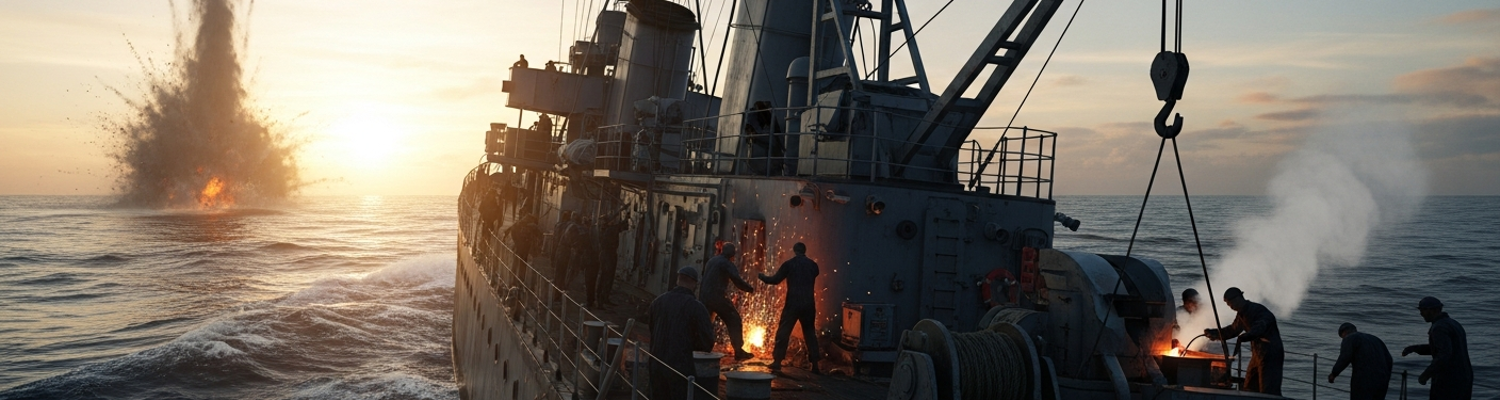
As the destroyer surged forward, its fantail swung around toward the sonar contact's bearing. The order to attack followed. A standard depth charge attack involved dropping charges from stern racks and firing them from K-gun projectors. The K-guns, black powder mortars, fired with a sharp crack, hurling 600-pound Mark 6 depth charges out to bracket the submarine's suspected position. Seconds later, more charges rolled off the stern racks. The resulting explosions erupted in massive geysers of white water. On board, the ship shuddered as the underwater shockwaves from its own weapons struck the hull.
Pushing the engines to flank speed consumed a massive amount of the Lardner's remaining fuel, jeopardizing its ability to return to Tulagi. The high-speed turn put incredible stress on the ship's damaged structure. After the initial barrage, the Lardner continued its high-speed evasive action, zigzagging away from the contact point. Its sonar operators listened for any sign of the submarine breaking up or for the sound of incoming torpedoes.
Medic's Impossible Choice
A ship’s Pharmacist’s Mate was not a surgeon. The USS Lardner had one or two such men responsible for the health of its crew. They were trained in first aid and basic nursing, not the trauma of naval warfare. On the decks of the Lardner, this small medical detachment faced an overwhelming disaster.
Kneeling in the mixture of fuel oil and seawater was Pharmacist’s Mate Second Class John D. L. V. Schrum. His attention was on one patient: a young seaman whose left leg was a ruin of shattered bone and shredded muscle from shrapnel. The tibia was a jagged white spike protruding from the wound, a compound fracture that was a probable death sentence.
Through the rubber soles of his boots, Schrum could feel the ceaseless thrum of the destroyer. It was not the steady vibration of a healthy warship but an uneven shudder that spoke of a vessel pushed beyond its limits. The vibration was a physical manifestation of the Lardner’s own wounds. It traveled up through the medic’s legs, a constant reminder of their precarious position. Every tremor in the steel plates made the delicate work of cleaning the wound with precious fresh water and applying sulfa powder an exercise in frustration.
Then the general quarters alarm blared. A submarine contact. Sweetser’s order: “Hard to port, all engines ahead full!”
The destroyer heeled over violently. Wounded men, gear, and medical supplies slid across the slick steel. Schrum threw his body over his patient, bracing against the ship’s superstructure as the hull groaned in protest. The maneuver turned the triage deck into a tumbling nightmare. The ship, already strained, was now subjected to the full force of a high-speed combat turn.
For Schrum, the maneuver compressed an impossible choice into a single moment. He had been trying to stabilize the shattered leg. With no proper splints, he and another sailor were improvising with wooden battens from a damaged crate and strips of torn canvas. The goal was immobilization to prevent further blood loss. Now, as the deck pitched, the task became a frantic struggle. The sailor’s leg flopped with each movement of the ship. The man screamed. Schrum knew a dose of morphine was the only humane option, but the syrettes were a finite resource. To use one here, on a man whose leg would require amputation to prevent fatal infection, felt like a waste. In that five-minute window of evasive action, wrestling with a shattered limb on a shuddering warship, the medic weighed one man’s agony against the potential survival of dozens more. He administered the morphine, sacrificing a piece of his limited arsenal for a moment of mercy, and then returned to the task of binding the splintered wood to the ruined leg.
Guadalcanal's Enduring Naval Burden
The illusion of control shattered completely after midnight on November 30, 1942. An American task force, built around the supposed advantage of its heavy cruisers and SG radar, was dismembered. For the crew of the USS Lardner (DD-487), the situation was uniquely difficult. Having maneuvered to avoid friendly fire, they were ordered back into the disaster they had just escaped. The waters of Ironbottom Sound were a seascape of burning ships and desperate men.
This was not a victorious fleet action. It was a rout.
The threat of annihilation was constant during the rescue of the Northampton’s crew. A destroyer's primary defense is its speed, rated at over 37 knots for a Gleaves-class vessel. By stopping to pull men from the water, the Lardner sacrificed its greatest asset. It did so in an area where Japanese naval forces had just demonstrated their mastery of night combat. The danger was not just from another surface attack. Japanese I-class submarines were active, hunting for targets of opportunity. To an enemy submarine commander, a destroyer dead in the water, illuminated by its own work lights, presented a perfect firing solution.
The crew of the Lardner, having endured a naval battle, were immediately thrown into a physically and emotionally draining rescue. They worked on decks made treacherous by seawater and fuel oil. They hauled aboard hundreds of exhausted, wounded, and dying men, turning their 348-foot warship into a makeshift hospital. The ship's complement of roughly 276 was never designed to handle such an event. The sheer weight of the survivors strained the ship's stability. Medical supplies were expended at a high rate. Every available space became a triage station. The crew performed this work while contending with their own ship's damage, dwindling fuel, and the knowledge that an attack could come at any second. Their ability to save hundreds of their comrades was a function of discipline under extreme duress. Following the depth charge attack and evasive maneuvers, the Lardner, its fuel tanks now critically low, broke off the search and began the slow, vulnerable retreat to Tulagi harbor.