
The Alchemist's Promise Forging the Norden
In the years between the great wars, the United States Army Air Corps searched for a purpose. Its leaders, evangelists of air power like Billy Mitchell, saw a future where battles were won not in muddy trenches but from the skies. They needed a tool, a technological talisman, that could turn this vision into a concrete military doctrine. They found their answer in a complex mechanical device, a 2,000-part analog computer of gears, gyroscopes, and lenses that promised to revolutionize warfare. It was the Norden bombsight, and it carried the promise of surgical precision from four miles high.
The device was the brainchild of Carl L. Norden, a Dutch-Swiss engineer who began work for the U.S. Navy in 1920. Norden was a meticulous, if volatile, genius obsessed with perfection. Partnering with the more business-savvy Theodore Barth, Norden’s company began hand-crafting the bombsights. The heart of the Norden Mark XV was a gyroscopic stabilizer that held the optical line of sight steady, coupled with a mechanical calculator that continuously computed the bomb’s release point. The bombardier would input the aircraft’s altitude and airspeed, then track the target through a telescope. The sight would calculate the effects of wind and motion. In the final moments of the run, an autopilot linkage, the Stabilized Bombing Approach Equipment, would actually fly the airplane, removing the pilot from the equation to eliminate last-second errors. The bomb release was automatic.
Its development was shrouded in secrecy, an effort on a scale comparable to the later Manhattan Project, ultimately costing over a billion dollars. Production was a massive undertaking, with companies like Victor Adding Machine and Sperry Gyroscope manufacturing components without full knowledge of the final device. Bombardiers were sworn to an oath, promising to defend the sight with their lives. The device was transported under armed guard, often handcuffed to an officer, and installed in the aircraft just before a mission. Onboard, it was fitted with a thermite charge to be ignited in the event of a crash, melting the intricate mechanism into a useless block of metal. Crews were even instructed to use their .45 service pistols to destroy the optics if the charge failed. This intense security cultivated a myth around the Norden. Propaganda claimed it could "drop a bomb into a pickle barrel from 20,000 feet," a claim that originated in marketing and was amplified by a hungry press and a hopeful public. The source of this belief stemmed from near-perfect test conditions in the clear, calm desert skies of the American Southwest, where the sight demonstrated a circular error probable (CEP), the radius in which 50% of bombs would land, of as little as 75 feet. This apparent accuracy was the foundation upon which a new, uniquely American doctrine of air power would be built.
A Doctrine Cast in Steel
The motto of the Air Corps Tactical School (ACTS) at Maxwell Field, Alabama, was "Proficimus More Irretenti," or "We Make Progress Unhindered by Custom." It was here, in the 1930s, that a group of influential officers, later dubbed the "Bomber Mafia," codified the doctrine that the Norden’s performance seemed to enable. Figures like Haywood S. Hansell, Kenneth N. Walker, Harold George, and Laurence Kuter theorized that modern industrial nations were complex, interconnected systems, or "industrial webs." They argued that by surgically destroying key nodes in this web, an enemy’s entire war economy could be paralyzed. This was not a vague concept, it was a detailed plan. The Air War Plans Division Plan 1 (AWPD/1), drafted in 1941, identified Germany's critical vulnerabilities: its electrical power grid, its transportation network, its petroleum production, and the Luftwaffe's own industrial base.
This theory of high-altitude, daylight precision bombing was a radical departure from prevailing military thought. It explicitly rejected the Royal Air Force’s emerging strategy of night area bombing, which targeted entire cities to destroy infrastructure and civilian morale. The American leadership saw their approach as both more effective and morally superior, a way to win wars by crippling an enemy’s ability to fight without resorting to the mass slaughter of noncombatants. The Norden bombsight was the linchpin of this entire philosophy. Its promised accuracy was the proof that such selective targeting was possible.
This new doctrine directly drove aircraft procurement and design. The Boeing B-17 Flying Fortress and the Consolidated B-24 Liberator were not merely bombers; they were platforms engineered around the Norden. They were designed to fly high and stable, creating the ideal environment for the bombardier to work his magic. The doctrine held that tight formations of these heavily armed bombers, bristling with .50-caliber machine guns, could defend themselves against enemy fighters without the need for long-range escort. This belief, born of necessity and optimism, would later be tested with calamitous consequences. The entire edifice of American strategic air power, from the training of its aircrews to the design of its most advanced aircraft, rested on the almost mythical capability of Carl Norden’s secret device.
Collision with Reality
The doctrine of precision daylight bombing, so elegantly conceived in the classrooms of Alabama, faced its brutal test in the perpetually overcast and hostile skies over occupied Europe. The gap between the Norden’s theoretical accuracy and its actual combat performance was vast and immediate. The pickle barrels were safe. Post-war analysis revealed that during the main bomber offensive, only about 31.8 percent of bombs dropped by the Eighth Air Force landed within 1,000 feet of their aiming point. The average CEP in combat was a staggering 1,200 feet or more, a far cry from the 75 feet achieved in testing. Numerous factors contributed to this disparity.
The most significant and persistent obstacle was weather. European weather, particularly over industrial Germany, was notoriously poor. A bombardier could not hit what he could not see. Missions were frequently scrubbed or rendered ineffective by thick cloud cover. Even on clear days, the then-unknown jet stream, a high-altitude river of wind, could push bombers far off course, rendering the sight's windage calculations useless.
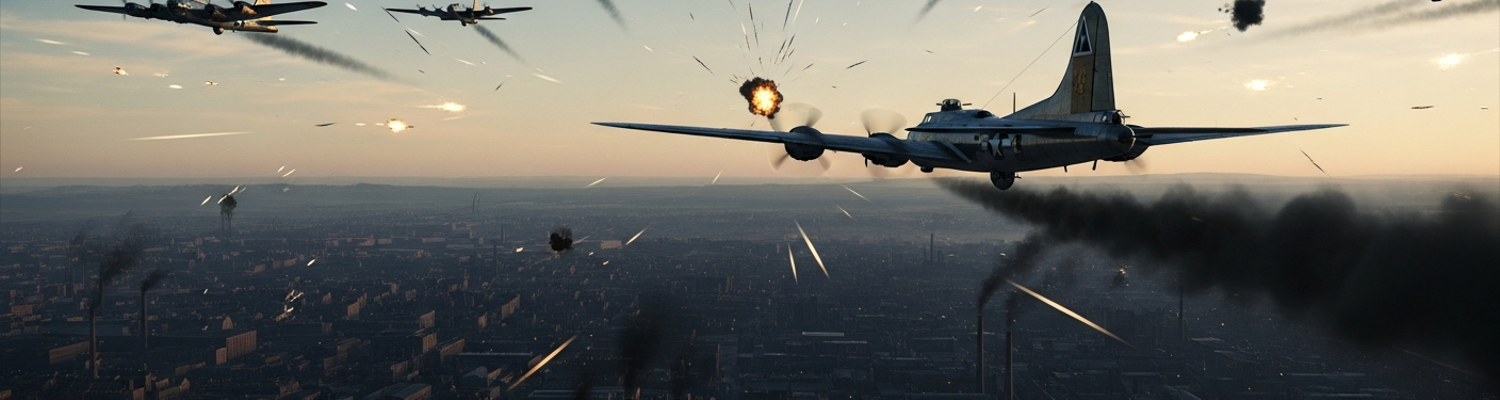
When the skies were clear, the enemy was waiting. Heavy anti-aircraft fire, or flak, filled the air around the target. The black explosions would buffet the bombers, disrupting the delicate, straight-and-level 30-to-60-second bomb run required by the Norden. The psychological pressure on the bombardier, trying to keep a steady hand while the aircraft was shaken by nearby detonations and shrapnel rattled against the fuselage, was immense.
Aggressive fighter opposition from the Luftwaffe presented the deadliest problem. Attacks by Messerschmitts and Focke-Wulfs forced bombers to break formation and take evasive action, making the stable bomb run an impossibility. The pre-war assumption that bomber formations could defend themselves proved tragically wrong. The nadir came during "Black Week" in October 1943, when a series of raids against German ball-bearing plants culminated in the second raid on Schweinfurt. Sixty B-17s, and their 600 crewmen, were shot down out of a force of 291. Such catastrophic losses forced a temporary halt to deep penetration raids until a proper solution could be found.
Finally, human error and the harsh physical environment took their toll. At 25,000 feet, temperatures in the bomber’s nose could plummet far below freezing. A bombardier, encumbered by a bulky flight suit, oxygen mask, and thick gloves, had to manipulate the Norden’s sensitive dials and knobs with precision. Under extreme stress, with optics fogging over and fingers going numb, even the best-trained men struggled to replicate the perfect results of peacetime tests.
Forging New Tactics in Combat
Faced with the stark reality that individual precision was a myth, USAAF leadership did not abandon the doctrine but adapted it. The first major evolution was the widespread adoption of formation bombing. An entire squadron or group would drop its bombs on the signal of a single, highly skilled lead bombardier in a designated lead aircraft. This tactic acknowledged the impossibility of every bombardier executing a perfect run on every mission. It concentrated the bomb pattern, increasing the probability that at least some bombs would hit the target area.
To overcome the persistent problem of weather, a technological pivot was made. Specialized pathfinder aircraft were equipped with a new ground-scanning radar system called H2X, nicknamed "Mickey." A US development of the British H2S radar, the H2X could paint a rough picture of the ground through solid clouds, allowing a radar operator to identify coastlines, rivers, and the outlines of cities. On overcast days, these Mickey-equipped pathfinders would lead the formation, and the entire group would drop their bombs on the pathfinder’s mark. While far less accurate than visual bombing with the Norden, H2X allowed the bombing campaign to continue relentlessly, regardless of the weather, which had previously grounded the bomber force for days or weeks at a time. It also pushed the application of bombing further from precision and closer to area attack.
The most important adaptation, however, was not a bombing tactic but a different aircraft entirely. The arrival of the North American P-51 Mustang in late 1943, equipped with drop tanks that allowed it to escort bombers all the way to Berlin and back, changed the air war. The Mustang provided the solution to the fighter problem that the bomber's own guns could not. With effective fighter escort, bomber losses plummeted, and crews could focus more on accuracy without constant harassment. The P-51 enabled the daylight bombing doctrine to function.
The promise of a clean, technological solution to warfare, embodied by the Norden bombsight, dissolved in the chaos of the air war over Germany. The device never lived up to its own myth. Yet, the doctrine it inspired, however flawed, created the mightiest air armada the world had ever seen. The B-17s and B-24s, built to carry the Norden, ultimately helped achieve air superiority and cripple the German war machine, not through singular pickle-barrel accuracy, but through overwhelming industrial might and the grim, attritional application of air power. The victory was achieved, but in a manner far more brutal and less precise than its architects had ever forecast. This lesson was reinforced in the Pacific, where high-altitude winds made the Norden ineffective against Japan, leading commanders like Curtis LeMay to abandon it entirely in favor of low-level incendiary raids, a final, pragmatic departure from the original doctrine of precision.