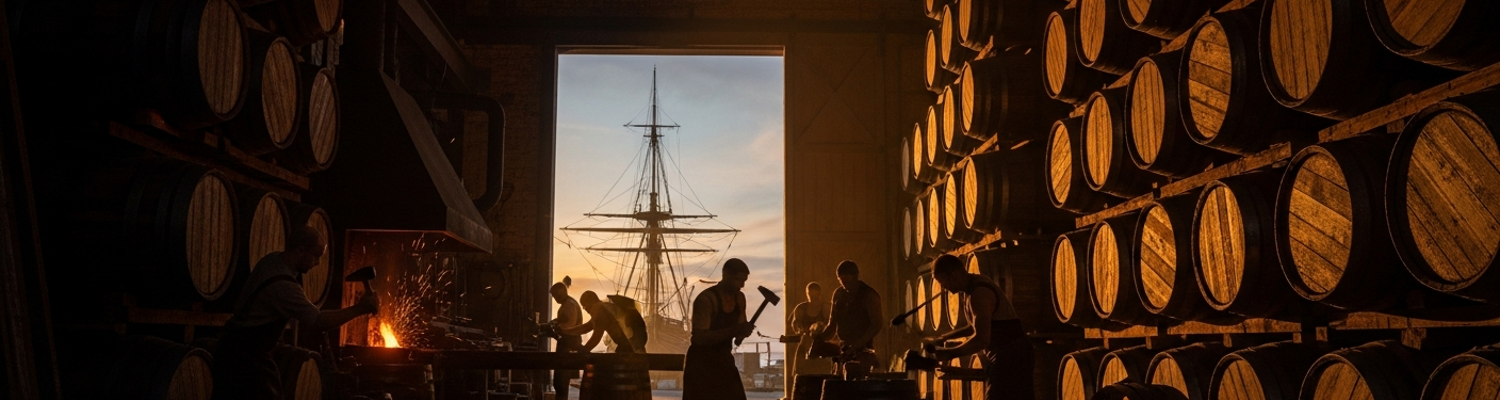

The Unseen Engine of Sea Power
The roar of cannon and the snap of canvas dominate the popular image of the early United States Navy. We picture frigates like USS Constitution dueling British warships, their hulls repelling enemy shot. This vision of combat effectiveness, however, depended entirely on a silent, less celebrated craft. The ability of the young republic’s navy to project force, sustain blockades, and keep its sailors alive on long voyages rested not on its guns alone, but on the integrity of its barrels. The men who made these barrels, the coopers, were the unheralded masters of naval logistics. Their work in the sprawling naval yards and in the cramped, damp holds of ships at sea was the true foundation of American sea power. Without their skill, water would turn foul, food would rot, and gunpowder would become useless paste. A ship’s operational range was not measured in knots or cannon throw-weight, but in the soundness of its cooperage.
An Arsenal in the Hold
A warship of the early national period was a floating village and a mobile fortress. Its entire economy ran on the contents of its barrels. A single frigate preparing for a six-month cruise carried a shocking quantity of provisions, nearly all of them stored in casks of varying sizes, from the massive 126-gallon butt to the more common hogshead and tierce. The USS Constitution, for example, could be provisioned with over 76,000 pounds of ship's biscuit, 50,000 pounds of beef, and nearly 40,000 pounds of pork, all packed tightly in salt-filled barrels. The most vital stores were potable water and gunpowder. For a typical cruise, Constitution might carry over 48,000 gallons of fresh water in a complex system of casks stored deep in the hold. This supply was the crew’s lifeline. Its depletion or contamination meant a premature end to a patrol and invited the ravages of dehydration, scurvy, and dysentery. The daily water ration was dispensed from a specific cask on deck, the scuttlebutt, which was literally a cask that had been 'scuttled' or opened. It became the natural gathering place for sailors, and its name entered the language as a term for gossip.
The cooper's craft was therefore a matter of life, death, and combat readiness. Onboard a vessel, a ship’s cooper was a rated tradesman, often a warrant officer, responsible for the constant maintenance of hundreds of casks. He and his mates were perpetually at work in the hold. The relentless motion of the ship, changes in temperature and humidity, and the daily consumption of supplies meant that barrels constantly needed inspection and repair. A loose hoop or a drying stave could lead to a catastrophic leak, wasting precious water or food. The cooper and his team would be in the dark, using their specialized tools, the adze and driver, to tighten hoops and plug leaks, ensuring the ship’s vital fluids remained contained. Gunpowder presented a unique and deadly challenge. It had to be kept absolutely dry. Powder barrels, or cartridges, were constructed with immense care, often using copper or wooden hoops instead of iron to eliminate the risk of a spark that could destroy the entire ship. A damp powder magazine rendered a warship toothless. The cooper’s daily, often mundane, work directly translated into the ship’s ability to fight and endure.
The Strategic Value of White Oak
The effectiveness of the barrels depended almost entirely on the quality of the wood. The US Navy, learning from the hard-won experience of the British Royal Navy, quickly identified American white oak, Quercus alba, as the supreme material for cooperage. Its cellular structure contains tyloses, balloon-like growths that clog the wood's pores and make it naturally waterproof. This property was non-negotiable for water and spirit casks. White oak was also dense and resistant to rot, making it ideal for the brutal conditions at sea. While shipwrights like Joshua Humphreys used it for the famously durable hulls of vessels like the Constitution, coopers prized it for its unique combination of strength and workability, allowing it to be shaped into the staves that formed a barrel’s body.
The Navy’s demand for high-quality white oak was enormous and created a new strategic calculus for the young nation. The Naval Act of 1794, which authorized the construction of the original six frigates, triggered a massive resource acquisition effort. The federal government under secretaries like Benjamin Stoddert understood that to build and maintain a navy, it first had to control the forests. This led to acts like the Federal Timber Purchasers Act of 1799, which set aside lands such as Grover's Island in Georgia specifically for naval timber reserves. The Navy needed straight, clear-grained oak for planking and masts, but it also needed vast quantities for its cooperages in the shipyards of Boston, Philadelphia, and Norfolk. This put the Navy Department in direct competition for a finite resource.
This competition was not just with foreign powers seeking timber for their own navies. It created a sharp inter-service dynamic within the United States itself. The US Army, responsible for provisioning its frontier forts and conducting land campaigns, also required barrels for storing flour, salted meat, and powder. While the Army’s logistical needs were substantial, they differed in nature. An army column could often forage or rely on shorter, land-based supply lines. The Navy’s requirement was absolute. A ship sailing for the Mediterranean to confront the Barbary pirates was a self-contained world for months on end. The quality of its barrels was paramount. This often led the Navy to assert priority, arguing that its unique need for long-term preservation at sea justified its claim to the best white oak stands and the most skilled labor. A naval quartermaster in Philadelphia might find himself bidding against an Army supply officer for the same shipment of seasoned staves, with the Navy arguing that its mission to protect American commerce from corsairs depended on securing that specific resource. This created an undercurrent of rivalry over budgets and resources, with the Navy viewing its logistical prowess, built on the cooper's skill, as a point of distinct service pride.
The Industrial Logic of Production
Producing the thousands of barrels needed to support the fleet was a major logistical undertaking. The process began deep in the American forests, where teams of loggers, sometimes employed directly by naval contractors, selected and felled the giant white oaks. The timber was then transported, often via a nascent network of rivers and roads, to the great naval yards. There, the raw timber had to be seasoned, a process of air-drying that could take months or even years, to ensure the finished staves would not warp or shrink. This inventory of wood was itself a strategic asset.
Inside the cavernous, noisy cooperages of the naval yards, a production line of skilled artisans and their apprentices went to work. This was not a simple task. A seven-year apprenticeship was often required to master the trade, making a master cooper one of the highest-paid craftsmen in the yard. The cooper’s toolset was highly specialized and extensive. He used a froe to split the oak logs into rough staves, a broad axe and adze to give them their initial shape, and a drawknife on a shaving horse to refine the curves. A long, heavy jointer plane, often requiring two men to operate, was used to create the precise bevel on the edges of each stave that would ensure a watertight fit when pressed together. No glue or caulking was used, only the pressure of wood against wood.
To form the barrel, the staves were stood on end inside a metal truss hoop. The half-formed barrel was then placed over a small fire in a metal basket called a cresset. The heat and steam made the wood pliable, allowing the cooper to use a windlass or rope to pull the staves together at the other end. This 'firing' also toasted the inside of the barrel, a critical step for casks meant for spirits. After shaping, one of the most critical steps was cutting the croze, a groove near the top and bottom of the staves to accept the barrel head, using a specialized tool of the same name. The final iron hoops were then forged by blacksmiths, another key part of the industrial ecosystem. These hoops were heated red-hot, which expanded them, and then hammered down over the barrel. As the iron cooled, it shrank, clamping the staves into an incredibly strong, tight vessel capable of withstanding immense internal and external pressures. The Navy had to establish this entire industrial system from the ground up, training its own workforce through rigorous apprenticeships to guarantee a supply of men who understood the Navy’s exacting standards. A cooper who learned his trade in a naval yard knew that the operational survival of a frigate could depend on the angle of his jointer plane and the force of his hammer.