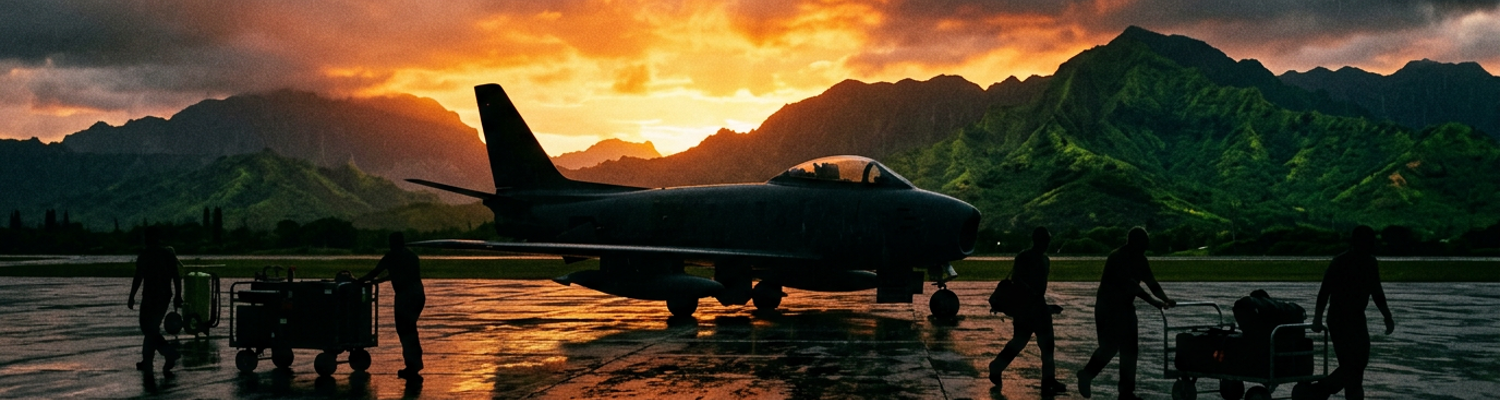

Runway Engineering Failures at Taoyuan Air Base
Douglas C-124 Globemaster cargo transports touched down on the rain-swept airfield at Taoyuan Air Base in northern Taiwan. Operation Jonah Able deployed Lockheed F-104A Starfighters of the USAF 83rd Fighter Interceptor Squadron to counter mainland Chinese air power in September 1958. Aviation engineers and ground crews struggled against severe runway subgrade subsidence caused by torrential monsoon downpours. Classified teletype cables reached my desk in the Pentagon every morning, detailing how our newest supersonic interceptors sat immobilized on broken concrete while the crisis escalated. Water saturated the clay subsoil beneath the heavy pavement, washing away foundation gravel and leaving wide voids under the primary runway. Runway slabs cracked along their joints under the weight of mobile maintenance cranes, tilting several inches out of alignment.
Concrete slabs required immediate leveling using hydraulic jacks while repair teams shoveled dry crushed stone into the sunken cavities. Cable traffic arriving in Washington warned that gravel packing could not withstand the mechanical forces produced by Mach 2 interceptor operations. Lockheed designed the F-104A with short, thin wings that produced minimal lift at low speeds, forcing pilots to land at approach speeds of roughly one hundred and fifty knots. High landing speeds combined with small tires inflated to over two hundred and fifty pounds per square inch exerted immense downward pressure onto the pavement upon every touchdown. Severe wheel impacts chipped the edges of the unseated slabs, scattering stone chips across the airstrip and puncturing main landing gear tires during initial test flights.
Tire punctures forced maintenance personnel to conduct round-the-clock emergency concrete patching to support the high landing speeds and high-pressure tires of Mach 2 interceptors during alert scrambles. Ground crews mixed rapid-setting cement in mechanical drums beside the runway, shoveling mortar into shattered joints between heavy downpours. Kerosene heaters and portable forced-air blowers dried the freshly poured concrete so the patches could harden before the next scramble order sounded. Logistics staff in my Pentagon office tracked these repair efforts through urgent supply requisitions, noting that the base quickly exhausted regional military stockpiles of quick-curing binder agents across the Pacific. Taiwanese labor details worked alongside American airmen through the night, digging runoff ditches and clearing standing water from the runway shoulders to keep the subgrade from washing away completely.
Pumps drained pooled water from the runway shoulders, but alert horns repeatedly interrupted the repair work whenever radar posts detected Chinese aircraft over the Taiwan Strait. Pilots of the 83rd Fighter Interceptor Squadron sprinted to their alert Starfighters, firing up turbojet engines while mechanics disconnected ground power carts and pulled wheel chocks from the wet tarmac. Accelerating Starfighters rolled directly across the newly patched slabs, blowing water and loose grit against the perimeter wire as they reached takeoff speed. Returning interceptors slammed down onto the damp concrete, deploying drag parachutes and applying heavy brake pressure to stop before reaching the unpaved overrun. Base commanders ordered engineering squads to sweep every patched joint with hand brooms and flashlights immediately after each recovery, clearing loose gravel before the next pair of fighters launched.
Air Staff Intelligence Assessments and Radar Tracking
Flashlight beams swept across the wet runway concrete as engineering squads cleared paths for urgent scrambles driven by an expanding enemy buildup. Air Force Directorate of Intelligence assessments cataloged under decimal files 9670 and 9800 tracked massive People's Liberation Army Air Force staging along the Taiwan Strait. Analysts on my staff plotted incoming sightings hour by hour, marking red grease-pencil circles across coastal airfields directly opposite Nationalist territory. Raw electronic intercepts and photographic prints showed that Chinese commanders were funneling frontline air regiments south from regional bases. These movements filled our secure file cabinets with urgent cables describing continuous shifts in tactical aircraft balances. Every morning briefing in Washington confirmed that Beijing was establishing the logistical support needed for a sustained air campaign.
Film rolls arriving from reconnaissance flights confirmed that mainland forces massed hundreds of MiG-15 and MiG-17 fighters at forward operating bases including Liancheng and Shantou to challenge Allied air superiority. Imagery analysts spread high-magnification contact prints across light tables, counting swept-wing jets parked in dense rows along newly expanded dispersal revetments. Support equipment surrounded these dispersal areas, with fuel bowsers and oxygen trucks servicing rows of fighters for rapid turnaround operations. Intercepted radio traffic revealed that Beijing had transferred combat-proven fighter divisions from northern provinces down to the coastal front. Tactical maps on our plotting boards showed that these staging hubs brought Communist jets within minutes of the Nationalist garrison islands. Pilots waiting on alert at Taoyuan understood that any launch over the strait placed them within striking range of an overwhelming opposing force guided by coastal radar stations.
Steel antenna masts stood atop those coastal hills, where declassified intelligence logs documented the integration of Soviet-supplied P-8 and P-10 early-warning radar arrays tied directly into mainland coastal ground-controlled intercept sectors. These curved wire-mesh reflectors rotated continuously atop coastal promontories, detecting high-altitude American patrols the moment they lifted off from northern Taiwan. Ground controllers in hardened bunkers tracked the flight paths of our aircraft and directed Communist fighters toward intercept positions before Allied pilots crossed the water. Radar operators fed target bearings through dedicated telephone lines to forward MiG squadrons, eliminating the need for Chinese pilots to search for targets on their own cockpit radar scopes. Our intelligence staff monitored these tracking transmissions, noting how the mainland air defense system functioned as a unified surveillance network that left no radar blind spots over the strait. The precision of this coastal network meant that every American training orbit or alert patrol generated immediate counter-scrambles from mainland bases.
Sirens blared across Taoyuan whenever those mainland radar sectors launched fighters toward the median line. American pilots strapped into their cockpits multiple times each day, only to idle their engines on the patched tarmac while controllers evaluated whether mainland flights were probing defenses or committing to a full strike. Ground mechanics sprinted through the rain to hook up external starter carts and replace depleted battery packs after false alerts drained aircraft electrical systems. The continuous cycle of sudden launches and aborted missions wore down flight crews who could never predict when a routine patrol would erupt into combat. Staff officers in my department filed the incoming operational summaries each evening, knowing that human endurance and fragile machinery were stretching toward mechanical breakdown under the pressure of continuous mainland radar tracking. Air commanders in Taipei maintained round-the-clock telephone contact with our desk, debating tactical rules of engagement while interceptors on both sides shadowed each other across the water.
Pressure Suit Hazards and High Altitude Physiology
Starfighters and Republic of China F-86 Sabres climbed past forty-five thousand feet to track hostile MiGs cruising in the freezing upper atmosphere. Republic of China and USAF intercept pilots operated above forty-five thousand feet wearing primitive MC-3 partial-pressure suits and high-altitude capstan bladders. Rubber pneumatic capstans ran down the sleeves and pant legs of these stiff canvas suits, designed to inflate automatically from aircraft air compressors if cabin pressure failed. Flight surgeons at Taoyuan laced these tight garments over each pilot by hand, pulling dozens of adjustment cords along the torso, thighs, and calves to ensure skin-tight contact. Technicians attached oxygen hoses directly into the pressurized facepieces of MA-2 helmets, locking down heavy neck rings while pilots sat sweating in the humid tropical heat on alert ramps. Marginal cockpit pressurization systems in the lightweight interceptors forced pilots to depend entirely on these mechanical garments to survive the near-vacuum of extreme altitudes.
Cockpit pressure systems failed as rubber seals around canopies leaked whenever airframes twisted under high gravity turns above fifty thousand feet, venting breathable air into the thin atmosphere. Pilots experienced acute cockpit hypoxia, severe decompression sickness, and painful physical bruising from ill-fitting pressure equipment during sustained high-altitude sorties. Oxygen regulators frequently malfunctioned under cold temperatures, failing to feed pressurized breathing gas at steady rates and causing pilots to fight sudden dizziness, tunnel vision, and cognitive impairment. Nitrogen gas escaped from flyers bloodstreams as cabin barometric pressure dropped, producing agonizing decompression sickness that settled into knee joints, shoulders, and elbows. Automatic capstan bladders inflated violently along the arms and legs to squeeze pilot limbs, forcing blood back toward the heart but driving heavy brass eyelets and rigid canvas seams deep into pilot flesh. Returning flyers peeled off their flight suits in Taoyuan locker rooms to reveal dark purple bruises, blistered skin, and deep tissue contusions where the pressure laces had pinched their bodies.
Surgeons at the base dispensary documented severe physical degradation and combat fatigue caused by these tight garments during prolonged flight durations in unpressurized environments. Sorties stretched past two hours as Allied interceptors circled in high-altitude holding patterns to counter mainland radar traps and feints across the strait. Pilots strained continuously against the mechanical counter-pressure of their inflated garments, using extreme physical effort just to bend their elbows and grip the flight controls. Breathing pure oxygen delivered under positive pressure forced gas into flyer lungs, requiring pilots to push out actively on every exhalation until their chest muscles cramped with exhaustion. Trapped inside sealed rubber suits and MA-2 helmets, aviators could not drink water or wipe away sweat that stung their eyes during critical maneuvers. Severe dehydration and physical punishment accumulated over consecutive daily flights, eroding pilot reaction times and leaving frontline squadrons close to physical collapse.
Paper teletype cables arriving at our Pentagon desks revealed that this physical collapse had cut frontline mission availability by nearly one third. Flight surgeons in Taipei grounded veteran fighter pilots after repeated high-altitude flights produced lingering joint pain and severe tremors that standard rest cycles failed to cure. Base commanders scrambled junior aviators with fewer high-altitude flight hours into the alert pool to fill empty cockpits, raising fears among our staff that inexperienced flyers would succumb to hypoxia during high-speed intercepts. Maintenance crews struggled to resize and re-lace the limited stockpile of MC-3 pressure suits for these replacement pilots on the rain-soaked flight lines. Logistics officers in Washington received urgent requisitions for improved partial-pressure suits, larger oxygen regulators, and relief flight crews from American bases in Japan and the Philippines. Pentagon planners responded by authorizing emergency airlift flights of custom-fitted flight gear from Clark Air Base while commanders reduced combat air patrol durations over the strait.
Radar Intercept Tactics and Mainland Scramble Fatigue
Commanders reduced combat air patrol durations over the strait, prompting mainland radar installations to take advantage of the reduced Allied presence by conducting deliberate radar illumination and mock incursions to bait Allied air defense sectors into constant scramble reactions. Communist ground operators locked continuous electronic tracking beams onto Nationalist patrol routes, flooding early-warning scopes with powerful search signals and dispatching fast MiG-17 divisions on high-speed runs directly toward the median line. Coastal PLA Air Force radar stations accurately monitored Allied reaction times, mapping coverage gaps across the Nationalist early-warning net every time defensive sirens sounded in Taiwan. Chinese operators noted the exact minutes and seconds required for radar outposts on Kinmen, Matsu, and northern Taiwan to recognize false tracks, relay vectors through tactical command centers, and launch scramble fighters off base runways. Plotting boards in mainland air control bunkers mapped the electronic dead zones created by western Taiwan mountain terrain, recording specific blind spots where low-flying Communist jets could maneuver beneath Allied radar surveillance beams. Air Staff intelligence summaries arriving at our Pentagon desks demonstrated that Beijing was using these electronic probes to assemble a comprehensive tactical roadmap of Allied defensive blind spots.
Sirens across Taoyuan Air Base howled without pause as those mainland feints forced our frontline interceptor units into constant emergency mobilizations. Pilots and ground crews of the 83rd Fighter Interceptor Squadron endured psychological exhaustion under continuous round-the-clock five-minute alert rotations. Flight crews lived in sweat-soaked flight gear inside corrugated zinc alert shacks beside the flight line, jolting awake to warning horns multiple times each night only to sprint across wet tarmac and strap into F-104A cockpits. Ground mechanics labored through pouring rain and suffocating heat, dragging heavy external gas turbine starter carts across fractured concrete, swapping depleted batteries, and clearing landing gear linkages under frantic countdown clocks. Interceptor pilots suffered from persistent nausea, split-second lapses in attention, and severe disorientation after enduring six or seven aborted high-speed taxi runs and full-afterburner launches within a single twenty-four-hour shift. Mechanics dropped onto oily hangar floors from sheer physical collapse, leaving fatigued crew chiefs to hand-inspect high-pressure tires and delicate jet intake cones under handheld flashlights before the next alert bell rang.
Flashlight inspections failed to prevent all mechanical breakdowns as flight surgeons at Taoyuan reported that severe sleep loss and constant nervous tension rapidly degraded pilot motor skills, cutting frontline combat effectiveness across the squadron. Ground support equipment broke down under the frantic launch pace as mechanical starter turbines burned out their bearings and high-pressure hydraulic pumps failed from continuous cycling. Defensive controllers in the Taipei air defense operations center second-guessed their own radar scopes, hesitating for vital seconds as they attempted to separate harmless mainland radar feints from genuine massed bomber attacks. Tactical intelligence analysts on our Air Staff realized that the mainland command had deliberately turned early-warning electronics into a weapon of attrition, exhausting Allied personnel without risking their own frontline air regiments. Air Force commanders in Washington responded by authorizing the transfer of fresh maintenance teams from Kadena Air Base on Okinawa to relieve the overwhelmed ground echelons at Taoyuan. Theater commanders also implemented tiered alert readiness rules that kept the F-104A Starfighters on fifteen-minute standby status, forcing Republic of China F-86 Sabres to absorb the initial scramble strain against mainland electronic harassment.
Pentagon Rules of Engagement and Strategic Paralysis
Sabre pilots absorbing those relentless scrambles flew under tactical restrictions drafted eight thousand miles away in Washington. Air Staff officers in the Pentagon operated under rigid, ambiguous rules of engagement that prohibited pursuit of hostile aircraft into mainland airspace. General Thomas D White and our staff planners drafted operational cables that barred Allied interceptors from firing weapons unless hostile aircraft committed an overt hostile act over international waters or Nationalist territory. Communist MiG-17 formations exploited these limitations by executing high-speed mock attacks against Taiwanese patrols and then fleeing across the shoreline into mainland sanctuary. Allied pilots watched enemy jets retreat unharmed through their gunsights, forbidden by Washington from firing Sidewinder missiles or pursuing targets past the coastline. American rules forced our interceptors to wait until enemy cannons opened fire before controllers could clear them to retaliate, turning every patrol into a dangerous waiting game that surrendered total tactical initiative to the mainland air regiments.
Planners on our staff reviewed those urgent field warnings, but Joint Chiefs of Staff indecision and delayed ROE directives left forward interceptors vulnerable to radar-directed ambush tactics near mainland littoral waters. Coastal ground-controlled intercept sectors at Liancheng and Shantou recognized the paralysis gripping American command channels and organized aggressive trap maneuvers along the Fujian coast. Chinese radar controllers vectored pairs of MiG-17s at low altitudes beneath Allied radar horizons, holding them in position until Taiwanese fighters descended to investigate sudden surface-skimming contacts. Communist interceptors then engaged their afterburners, pulled into vertical climbs behind the descending Sabres, and opened fire with thirty-seven-millimeter cannons before diving back into mainland cloud cover. Damaged Sabres limped back to base with punctured fuel bladders and torn elevators, while mainland ground controllers logged the success of each ambush route. American theater commanders requested immediate emergency authorization to engage hostile fighters the moment coastal radar tracked them maneuvering toward Allied formations, but each request stalled in inter-service committees inside the Pentagon.
Analysts on our intelligence desk shielded those deadlocked committees from the human crisis developing across the Pacific. Operational intelligence reports intentionally obscured severe frontline psychological strain to present an impression of complete tactical readiness to command leadership. Daily intelligence summaries stripped out flight dispensary records detailing pilot tremors, chronic insomnia, acute disorientation, and cockpit vomiting, replacing human degradation with sterile tables of completed sorties. Staff officers filed sanitized readiness percentages that showed frontline interceptor squadrons operating at peak capability, concealing the fact that ground crews were collapsing beside taxiways and veteran flyers were breaking down under relentless scramble sirens. Duty officers routinely replaced reports of severe nervous exhaustion with brief notes attributing pilot absences to minor physical fatigue or routine administrative leave. Pentagon leaders read these polished accounts and concluded that the containment perimeter was holding firm without requiring any updates to the rules of engagement.
Generals reviewing those polished accounts accepted the artificial numbers at face value, leaving the restrictive combat directives completely unchanged. Dispatches sent back to Taoyuan and Taipei instructed forward units to maintain their passive posture and avoid any provocative maneuvers near mainland airspace. Base commanders had to keep rotating sleep-deprived aviators back into cockpits because Washington refused to acknowledge the human attrition taking place on the flight line. Ground crews on the alert ramps continued fueling fighters for blind scrambles against coastal radar bait, while flight surgeons quietly administered sedatives to exhausted pilots in darkened squadron barracks. Mechanics at Taoyuan pushed another pair of shrapnel-damaged Sabres into the maintenance hangars, riveting fresh aluminum patches over bullet holes while the next alert flight taxied onto the damp runway.
Deterrence Tactics and Operational Lessons of Jonah Able
Runway operations continued as turbine exhaust blasted across the tarmac from newly launched Nationalist F-86F Sabres carrying infrared-guided AIM-9B Sidewinder missiles directly toward patrol corridors over the strait. The forward deployment of Mach 2 F-104A Starfighters and AIM-9B Sidewinder-equipped Nationalist F-86F Sabres effectively checked mainland offensive air plans by late 1958. Nationalist pilots scored direct hits against surprised MiG-17 formations, proving that short-range guided missiles could destroy enemy fighters before Communist cannons could get into firing range. Mainland commanders observed Starfighters climbing above fifty thousand feet at twice the speed of sound and recognized that their Soviet-built fighters could not overcome this combined technological barrier. Chinese air divisions cancelled planned offensive bombing runs against the offshore islands and pulled their fighter regiments back into defensive holding patterns behind the coastal radar screen. Classified intelligence cables reaching our desks in Washington confirmed that the immediate threat of an invasion had receded, but those same reports revealed that the relentless pace of scrambles had pushed the forward airfield at Taoyuan to the edge of structural collapse.
Concrete runway slabs cracked apart under the repeated high-speed landings, as the operation highlighted severe limitations in expeditionary runway durability, subgrade preparation, and forward maintenance logistics for advanced supersonic jets. Saturated clay washed out from beneath the tarmac foundation during the continuous autumn rains, creating subgrade voids that tilted heavy concrete blocks and sheared off landing gear components. Maintenance personnel lacked the climate-controlled hangars, precision test sets, and clean work spaces required to keep the complex electronic systems of Mach 2 interceptors working in humid tropical conditions. Supply flights from Japan could not deliver replacement avionics, tires, and hydraulic pumps quickly enough to match the wear caused by constant alert launches off damaged pavement. Mechanics had to ground operational Starfighters to scavenge spare parts for the remaining alert aircraft, while ground crews worked around the clock on bare ramps to keep engines running. Field commanders sent urgent messages to Washington warning that our most advanced supersonic interceptors could not remain combat ready without massive overhauls to expeditionary supply chains and airfield construction standards.
Surgeons and engineers forwarded those field reports to the Pentagon, where deficiencies identified during the 1958 standoff accelerated USAF overhauls of high-altitude flight gear and tactical air control infrastructure in the Pacific. Air Staff planners approved emergency funding to replace the rigid MC-3 capstan suits with full-pressure suits and reliable cockpit regulators, eliminating the severe bruising and oxygen failures that had grounded frontline fighter pilots. Tactical commands across the western Pacific dismantled their vulnerable manual air defense rooms and replaced them with mobile radar vans, secure voice links, and hardened communications bunkers capable of coordinating interceptors in real time. Aviation engineers updated Pacific base development plans to require deep subgrade gravel compaction and thick reinforced concrete runways designed specifically to survive heavy supersonic jet traffic during severe weather. Logistics directors established forward supply depots on Okinawa and the Philippines to store pre-packaged maintenance packs and spare jet components for future emergency deployments. Engineering battalions poured new heavy-duty concrete aprons across Pacific air bases, while supply depots shipped improved high-altitude pressure gear directly to operational squadrons.