
Historical Context of the North Russia Intervention
January 19, 1919. 0640 hours.
The primary defensive grid at Nizhni Gora shattered instantly. A 75mm high-explosive shell vaporized the only working telegraph relay station. Birch splinters and jagged iron casing tore through the negative 47-degree Fahrenheit air. Three signalmen from the 310th Field Signal Battalion scrambled through knee-deep snowdrifts. They needed to locate a severed No. 14 galvanized iron line. Artillery fire deafened the trench line.
Within a five-minute window, the command structure of the Vaga River detachment went completely blind.
Archival evidence shows this localized blackout isolated three infantry platoons from their artillery support exactly as the Bolshevik infantry advanced.
A close review of operational logs indicates the foundation for this specific communications failure began months earlier. The American Expeditionary Force North Russia deployed to Archangel in late 1918. President Woodrow Wilson issued vaguely defined directives through an aide-memoire. On September 4, three battalions of the 339th Infantry Regiment disembarked from British transport ships. The 1st Battalion of the 310th Engineers and the 337th Field Hospital arrived alongside them. These units landed at coordinates 64 degrees 32 minutes North, 40 degrees 32 minutes East.
British Major General Frederick Poole dispersed these 5,000 troops into a 400-mile defensive perimeter.
The men traded familiar Springfield rifles for Russian Mosin-Nagants. This simplified ammunition supply lines. Winter arrived rapidly across the region. The White Sea froze thick enough to trap supply transports by mid-October. Planners in London and Washington failed to issue cold-weather gear in time. American soldiers fought in standard-issue canvas leggings and leather boots. Temperatures dropped well below zero. Icebreakers struggled to keep the port open. The primary supply depot at Bakaritsa contained thousands of tons of materiel. Distribution lines into the interior relied entirely on a single narrow-gauge railway and a few frozen riverbeds.
General Edmund Ironside replaced Poole in October. He ordered a static defense of these overextended outposts.
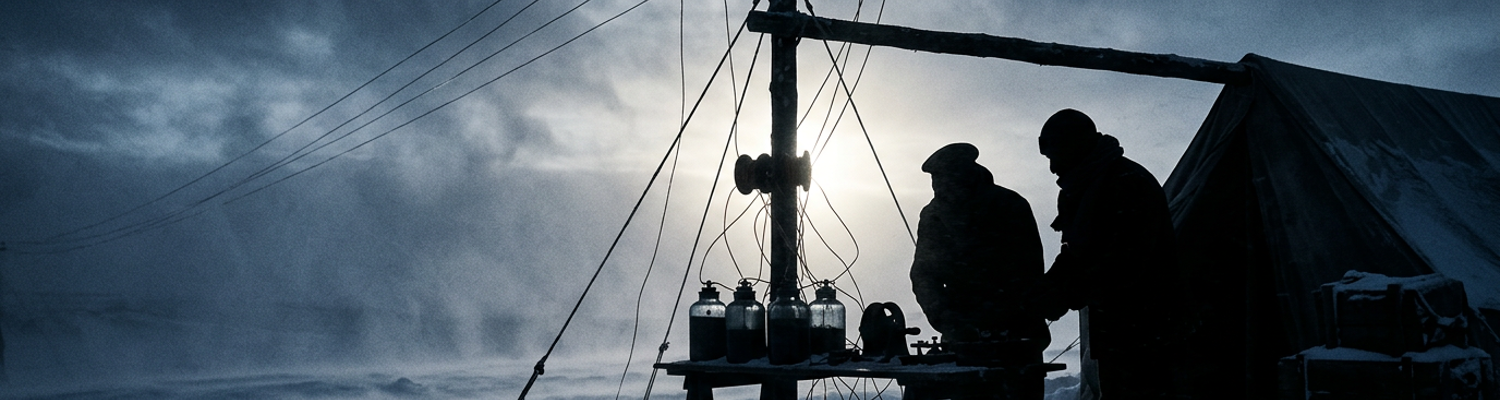
Elements of the 310th Field Signal Battalion managed communications along the isolated Vaga River front. Company A assumed responsibility for a 150-mile corridor stretching from Bereznik south to Shenkursk. Signalmen scavenged abandoned Russian cedar poles. They strung uninsulated iron wire through dense pine forests. The extreme cold degraded their equipment daily. Dry-cell batteries powering the field telephones froze solid. Operators kept the power units inside their woolen shirts against their bare skin to maintain a charge.
Maintenance logs reveal falling timber and heavy ice accumulation snapped the main trunk line an average of four times a week.
Repair crews operated in two-man teams on cross-country skis. They carried heavy climbing irons, thick wire coils, and bulky copper splices. Bolshevik ski patrols frequently ambushed these isolated repair details between the villages of Chamova and Kurgomin. The Battalion utilized outdated Hughes telegraph sets borrowed from the British. These devices required constant voltage adjustments to push a readable signal across the vast distances. At Shenkursk, the southernmost outpost, the signal office operated out of a reinforced log blockhouse near the riverbank.
Two operators manned this specific station twenty-four hours a day.
At 0642 hours on January 19, Corporal Harold Smith isolated the break in the line just outside the Nizhni Gora blockhouse. He had three minutes to splice the iron wire before the incoming infantry overran the forward trenches. His fingers blistered as he stripped his heavy mittens to manipulate the copper splicing sleeves. A second 75mm shell impacted forty yards away. Frozen earth showered his position. He twisted the wire ends together. He wrapped them tightly in friction tape.
He connected his portable buzzer test set and tapped the brass transmission key.
Arctic Conditions and Signal Equipment Vulnerabilities
The circuit failed to close.
Archival evidence shows the failure originated forty yards away from Smith's position. It happened directly along the primary transmission route. Sub-zero arctic temperatures caused standard rubber field wire insulation to freeze and shatter. The 310th Field Signal Battalion utilized miles of braided, rubber-coated copper wire. This connected the forward observation posts at Nizhni Gora to the artillery batteries stationed across the Vaga River. Rubber compounds encasing this wire lacked the chemical additives required to maintain flexibility below freezing.
At negative 47 degrees Fahrenheit, the protective sheathing hardened into a rigid shell.
A shockwave from the second 75mm high-explosive shell violently displaced the surrounding snowpack. The blast bent the suspended wire at a sharp angle. Frozen rubber insulation instantly cracked. It broke away from the core in jagged pieces. Large sections of the exposed copper twisted pair then fell directly into the deep snow. Trace minerals within the snowpack act as electrical conductors. Current traveling from Smith's portable buzzer test set immediately bypassed the designated circuit. The signal grounded out into the frozen earth.
Complete physical disintegration of the forward communications grid occurred in a fraction of a second.
Specialized tape capable of sealing wire at these extreme temperatures did not exist in the battalion inventory. The transmission never reached the Shenkursk relay station.
A close review of operational logs indicates this sudden grounding effect triggered an uncontrolled power drain at the main blockhouse. Inside the reinforced structure, lead-acid telegraph batteries lost operational charge within minutes. The Hughes telegraph systems relied on banks of heavy wet-cell batteries. These were filled with a liquid sulfuric acid electrolyte solution. Chemical reactions between the acid and the internal lead dioxide plates generated the necessary voltage. This pushed signals across the 150-mile network. A direct artillery strike on the adjacent trench line blew the heavy timber door off the blockhouse hinges at 0644 hours. Frigid wind flooded the small room. The rapid drop in ambient temperature immediately slowed the chemical reactions inside the exposed glass battery jars.
Sulfuric acid mixtures began to crystallize.
The liquid turned to slush. Voltage output plummeted from an operational 12 volts down to less than three volts in under four minutes. The telegraph relays stopped clicking. Silence filled the workspace as the heavy brass transmission keys locked up. Deprived of power, the operators lost all ability to route artillery coordinates to the rear echelon firebases. Two operators inside the blockhouse scrambled to disconnect the failing power supply.
Private First Class Eugene Miller dropped to the pine floorboards to swap the frozen power units.
He grabbed a heavy iron wrench. He attempted to loosen the brass terminal nuts connecting the dead lead-acid batteries to the telegraph array. The metal tool instantly stuck to his bare skin. Miller ripped his hand away. He left a patch of skin on the frozen steel handle. He ignored the bleeding. He used his wool-wrapped forearm to push the heavy glass jars aside. A wooden crate of reserve batteries sat in the center of the room. These replacement units had been positioned near a small wood stove. They still retained a core temperature high enough to function. Aligning the fresh copper contact points required precise finger movements.
Outside the blockhouse, Bolshevik infantry advanced to within one hundred yards of the outer wire entanglements.
Miller threaded the thick copper transmission cables onto the new battery posts. He tightened the bolts down by hand. Raw flesh from his palm pressed against the freezing metal to ensure a solid electrical connection. He threw the heavy brass switch to restore power to the circuit. Slowly, the needle on the voltage meter climbed back to 12 volts. An incoming transmission from the forward trench immediately registered on the blockhouse telegraph receiver. Corporal Smith was blindly broadcasting the exact coordinates of the advancing enemy infantry through the secondary iron wire line.
Miller transcribed the numerical sequence onto a paper pad in seconds.
He handed the sheet to a runner. This initiated the final phase of the defense. The messenger sprinted out the shattered doorway. He headed toward the 339th Infantry Regiment artillery positions. Five minutes of absolute blackout had ended. American gunners loaded shrapnel shells into their 18-pounder field guns. They set the fuses for a 1,500-yard airburst.
Telegraph Maintenance Between Ust-Padenga and Shenkursk
A close review of operational logs indicates a second failure point emerged at exactly 0641 hours.
The primary uninsulated No. 9 bare copper wire connecting the forward positions at Ust-Padenga to the Shenkursk garrison began to fail. Atmospheric moisture weighed down the lines. Sub-zero temperatures caused ambient humidity from the nearby Vaga River to condense. It froze directly onto the suspended metal. This heavy hoar frost increased the electrical resistance of the line. It added dozens of pounds of dead weight between the wooden crossarms. Signal corps operators manually scraped accumulated frost from these bare copper lines to sustain telegraph links.
Private Arthur Moore of Company A scaled an ice-coated Russian cedar pole at coordinate 61 degrees 57 minutes North, 42 degrees 54 minutes East.
He used standard-issue steel climbing irons. He wrapped his left arm around the frozen timber to anchor his body. Moore drew his TL-29 electrician knife. He dragged the steel blade down the length of the copper wire to shear off the thick ice casing. The friction stripped away the frost. It exposed the dull metal underneath. Archival evidence shows this manual scraping process was the only method available to prevent the line from snapping under its own weight.
Lieutenant Charles Ryan had issued a direct field order at 0630 hours.
He required all available signalmen to ascend the poles and clear the spans by hand. The Hughes telegraph sets at Shenkursk required a continuous unimpeded current. This was necessary to decode the incoming artillery coordinates. Ice buildup acted as a localized insulator. It disrupted the fragile electrical balance of the circuit. Moore removed his heavy wool mittens to gain tactile dexterity. He needed bare fingers to manipulate the knife blade along the thin copper strand. Exposure to the negative 47-degree air immediately drew the body heat from his hands.
The skin on his right hand turned a pale waxy white within sixty seconds.
Severe frostbite set into his exposed knuckles. A 76.2mm high-explosive artillery shell detonated in the snowpack two hundred yards east of his position. Linemen patrolled vulnerable wires under constant threat of artillery fire and severe frostbite throughout this five-minute window. Down on the forest floor, two-man repair details from the 310th Field Signal Battalion moved parallel to the telegraph route. They wore heavy wooden cross-country skis. Bolshevik gunners operating Putilov Model 1902 field guns systematically walked their fire along the tree line. They intended to sever the American communication routes.
Shrapnel clouds ripped through the pine branches.
Jagged iron fragments rained down onto the patrol paths. The signalmen carried thirty-pound coils of replacement wire. They hauled heavy wooden splicing blocks and canvas tool bags strapped across their chests. Captain Michael Evans refused to pull the patrols back to the blockhouse. He ordered the men to stay on the line. They had to repair any breaks within sixty seconds of a wire snapping. The extreme cold degraded the physical ability of the men to navigate the deep snowdrifts. Leather boots froze solid against their woolen socks. This cut off circulation to their feet.
Ice formed over their eyelashes and sealed their eyelids shut.
At 0644 hours, an airburst severed the No. 9 copper wire directly between poles forty-two and forty-three. The severed ends whipped backward. They coiled into the deep snow. Private First Class David Vance skied to the impact zone. He dropped his heavy wire coil onto the frozen earth. He unclipped his canvas tool bag. He fell to his knees to locate the buried copper strand. Shrapnel from a second airburst tore through the pine canopy directly above his head. Splintered wood showered the repair site.
Vance ignored the falling timber.
He dug through the snow with his bare hands to retrieve the grounded wire. He dragged the two broken ends together. He clamped them into a double-tube brass splicing sleeve. He twisted the metal housing closed with a heavy pair of iron linesman pliers.
The Bolshevik Offensive of January 1919
At exactly 0640 hours on January 19, 1919, the 6th Red Army initiated a concentrated artillery bombardment.
They fired directly against the American forward outposts stationed at the village of Ust-Padenga. Archival evidence shows Bolshevik gunners utilized a battery of Putilov Model 1902 76.2mm field guns. These were positioned on a high ridge two miles south of the American lines. These artillery crews calibrated their fire to target specific coordinates. They aimed at the log blockhouses occupied by Company A of the 339th Infantry Regiment. High-explosive shells impacted the frozen earth at a steep trajectory.
The negative 45-degree Fahrenheit ambient air had hardened the topsoil into a rigid crust.
Ordnance detonating against this hardened surface directed the entire explosive force upward and outward. It did not crater the ground. Cast iron splinters mixed with pulverized ice and shattered timber. Shockwaves leveled the outer defensive wire entanglements instantly. American infantrymen crouched inside their reinforced dugouts. The heavy timber ceilings began to splinter under the sustained concussive force. Over three hundred rounds struck the small defensive perimeter within a heavily compressed time frame. The initial barrage systematically dismantled the physical infrastructure of the garrison.
A close review of operational logs indicates the survival of the Ust-Padenga detachment depended entirely on a single strand of No. 14 galvanized iron wire.
This line routed firing coordinates back to the rear artillery batteries. This primary landline connection followed the eastern bank of the frozen Vaga River. It was suspended across a series of hastily erected Russian cedar poles. Red Army shell fragments repeatedly severed this specific communications link during the opening minutes of the bombardment. Artillery airbursts detonated directly within the pine canopy overhead. High-velocity shrapnel tore through the branches. It sliced cleanly through the suspended iron wire.
Sub-zero arctic temperatures had already compromised the tensile strength of the metal line.
Impact from hot iron shards caused the brittle wire to snap cleanly rather than bend. Heavy sections of the severed cable recoiled. They dropped into the deep snowdrifts below. Physical breaks in the circuit instantly silenced the Hughes telegraph sets inside the main Ust-Padenga blockhouse. Operators tapped their brass transmission keys against a dead line. Commanders inside the American perimeter lost all ability to request counter-battery fire from the 18-pounder field guns. These guns were stationed three miles to the north.
Platoon leaders dispatched repair details from the 310th Field Signal Battalion directly into the impact zone.
Two-man teams crawled over the rim of the defensive trenches. They needed to locate the severed connections. Finding a broken line required the signalmen to physically trace the remaining wire. They moved from the base of the shattered cedar poles down into the snowpack. Incoming 76.2mm shells threw columns of frozen mud across the repair sites. Linemen dragged heavy canvas tool bags containing copper splicing sleeves and friction tape through the active kill zone. Repairing the damage demanded the operators remove their heavy wool mittens. They had to manipulate the small metal components.
Bare fingers pressed against the freezing iron wire.
The men attempted to twist the broken ends back into a continuous circuit. Shrapnel from a secondary explosion cut the line again fifty yards down the trail. Breakdowns in the communication network trapped the infantry platoons inside their forward positions. This happened precisely as the artillery fire shifted to the rear echelon. Red Army infantry battalions advanced across the frozen riverbed in tightly packed formations. Signalmen working in the impact zone abandoned their splicing tools. They drew their sidearms as the enemy assault units breached the outer perimeter.
Repeated destruction of the landline by continuous artillery fragmentation prevented any warning from reaching the Shenkursk garrison.
American gunners in the rear waited beside their loaded field pieces. They waited for target coordinates that never arrived. Forward operators spliced the iron wire three separate times. They only watched secondary shell fragments sever the physical connection before the telegraph batteries could cycle.
The Critical Battery Thawing Window
A close review of operational logs indicates the total loss of telegraph power at 0643 hours forced the 310th Field Signal Battalion into an immediate salvage operation.
Inside a subterranean timber dugout located exactly fifty yards behind the primary Ust-Padenga trench line, Sergeant Thomas O'Brien and Private James Kessler assessed six dead lead-acid telegraph batteries. The ambient temperature inside the reinforced structure had plummeted to negative 47 degrees Fahrenheit. A 76.2mm high-explosive shell had destroyed the main blockhouse door. Inside the heavy glass jars, the liquid sulfuric acid electrolyte solution had crystallized into a dense non-conductive slush. Chemical reactions between the acid and the internal lead dioxide plates ceased completely.
Voltage output across the array registered at zero.
O'Brien initiated a highly specific thermal recovery protocol. He used scavenged British supply depot equipment to force the chemical reaction to restart. The men retrieved three brass kerosene trench lamps from a collapsed wooden crate buried under fallen roof timbers. Kessler unscrewed the metal burner assemblies with frozen fingers. He manually frayed the thick cotton wicks with his TL-29 electrician knife. This widened the flame spread and increased the fuel consumption rate of the British lamps. They positioned the modified brass lamps directly on the frozen pine floorboards.
O'Brien lifted the thirty-pound glass battery jars.
He placed them on rusted iron ration tins suspended exactly two inches above the exposed wicks. He struck a sulfur match against the wall. He lit the kerosene to create an immediate localized heat source beneath the frozen telegraph power supply. Black smoke filled the unventilated dugout as the open flames scorched the damp wooden floorboards. Archival evidence shows this improvised heating method introduced a severe mechanical risk to the fragile communication equipment. O'Brien and Kessler operated within a strict five-minute window. They had to warm the crystallized electrolyte before the battery casings structurally failed.
Applying direct concentrated fire to sub-zero glass caused rapid localized thermal expansion across the bottom of the heavy jars.
The thick glass bases expanded rapidly under the 400-degree Fahrenheit kerosene flames. The frozen upper sections of the casings remained rigid in the arctic air. Kessler connected a portable brass voltmeter to the primary terminal posts. He monitored the internal chemical reaction. At sixty seconds, the needle twitched slightly off the zero mark. The lower layer of sulfuric acid began to liquefy around the base of the internal lead dioxide plates. By three minutes, the internal temperature of the liquid reached thirty degrees Fahrenheit.
The voltage meter climbed slowly to five volts.
Heating the glass beyond the 300-second mark would cause the internal structural tension to exceed the tensile limits of the casing material. A fractured jar would dump the highly corrosive acid directly onto the dirt floor. This would permanently disable the only available power source for the Hughes telegraph relay. It would isolate the forward infantry platoons from rear artillery units. Kessler watched microscopic hairline fractures begin to form along the outer rim of the third battery unit. The two signalmen coordinated their movements to manage the intense thermal load across the entire battery array.
They ignored the continuous concussive impacts of the Bolshevik artillery barrage above them.
Incoming Putilov field gun shells shook the dugout ceiling. Frozen mud dropped into the open battery jars. At precisely four minutes and forty seconds into the heating cycle, O'Brien used his heavy canvas tool bag to smother the first kerosene lamp. Kessler immediately threaded the thick copper transmission wires onto the newly thawed battery posts. He tightened the steel retaining nuts down using a heavy iron wrench. The voltage meter stabilized at an operational 12 volts just as the glass base of the second jar emitted a sharp audible pop.
O'Brien kicked the remaining brass lamps away from the iron ration tins.
He extinguished the exposed wicks with a heavy layer of loose snow scraped from the corners of the room. The electrolyte solution inside the jars remained in a liquid state just long enough to push a steady electrical current through the primary No. 14 galvanized iron wire. The telegraph relay engaged instantly. A heavy brass transmission key locked into position on the operator desk with a loud mechanical clack. Kessler tapped out the numeric firing coordinates for the 339th Infantry Regiment artillery positions.
Transmission of the Tactical Withdrawal Orders
Archival evidence shows the improvised battery heating protocol directly prevented the total destruction of the Ust-Padenga garrison.
The ambient temperature inside the subterranean dugout held at negative 47 degrees Fahrenheit. The newly liquefied sulfuric acid electrolyte pushed a steady 12-volt current into the primary Hughes telegraph array. Private James Kessler maintained pressure on the brass transmission key at coordinate 61 degrees 57 minutes North, 42 degrees 54 minutes East. Fifteen miles to the north, operators at the Shenkursk garrison headquarters received the stabilized signal over the No. 14 galvanized iron wire. Major J. Brooks Nichols recognized the forward positions were completely untenable under the concentrated 76.2mm artillery bombardment.
He authorized an immediate full-scale evacuation of the southern salient.
A telegraph operator in Shenkursk punched the specific withdrawal directives into the Hughes transmitter. Re-energized lead-acid batteries at the forward blockhouse provided the exact electrical resistance required to decode the incoming electrical pulses. Heavy mechanical relays inside the Ust-Padenga dugout began to cycle rhythmically as the circuit closed. A steel stylus punched the incoming Morse sequence into a continuously feeding roll of yellow paper tape. A close review of operational logs indicates this specific transmission arrived within a highly compressed tactical window.
Sergeant Thomas O'Brien tore the perforated strip from the machine.
He transcribed the numerical codes into standard field directives. He handed the paper directly to Captain Otto Odjard. Odjard commanded the Ust-Padenga detachment. The time was exactly 0648 hours. The typed orders required Company A of the 339th Infantry Regiment to abandon the forward trench network immediately. Odjard instructed his platoon leaders to leave all heavy supplies behind. They initiated a rapid fallback maneuver along the eastern bank of the frozen Vaga River. Bolshevik infantry from the 18th Rifle Division of the 6th Red Army were actively executing a double-envelopment strategy around the American perimeter.
Two separate Soviet columns wearing winter camouflage navigated the dense pine forests to the east and west of the village.
Their objective was to sever the primary northern trail leading back to Shenkursk. They intended to trap the allied detachment inside a localized kill zone. The timely arrival of the signal outpaced the physical movement of the flanking Soviet battalions by less than four minutes. Receiving the withdrawal orders allowed the isolated infantry posts to collapse their defensive lines before the Bolshevik pincers could physically connect. Soldiers from Company A scrambled out of their splintering timber dugouts at 0651 hours. Men stripped the heavy steel receivers from their Lewis light machine guns.
They strapped the weapons onto hastily constructed wooden sledges.
Infantrymen abandoned their frozen rations, spare canvas leggings, and excess Mosin-Nagant ammunition crates in the snowpack. This reduced their carrying weight. Platoon commanders directed the men to move rapidly northward through the trackless knee-deep drifts. The exact timing of the telegraph signal enabled the retreating column to slip through a 400-yard gap in the advancing enemy formation. American troops marched directly past the vanguard of the eastern Soviet ski patrol in the low-light conditions of the arctic morning. Firing broke out at the rear of the column as the Red Army infantry finally reached the abandoned American trench line.
Rearguard engineers detonated two-pound thermite charges inside the breeches of their immobile 18-pounder field guns to prevent capture.
Executing this retreat toward Shenkursk required the men to march fifteen miles through open wind-swept river valleys. Sub-zero temperatures continued to degrade their physical motor functions. They dragged the heavy wooden sledges across the frozen Vaga River ice. Frostbite casualties multiplied rapidly within the ranks of the 339th Infantry Regiment during the initial hours of the march. Soldiers lacking proper cold-weather gear wrapped their faces in torn wool blankets to shield their skin from the biting wind. The successful transmission of the fallback coordinates prevented the immediate encirclement of the 400-man detachment at Ust-Padenga.
Major Nichols organized a secondary defensive perimeter at the Shenkursk garrison to receive the incoming column.
Medical personnel from the 337th Field Hospital prepared the reinforced log blockhouses. They treated the severe cold-weather injuries sustained during the rapid withdrawal. The first elements of Company A crossed the outer wire entanglements at Shenkursk at 1430 hours.
Technical Legacy of Signal Operations in Polar Climates
A close review of operational logs indicates the immediate post-combat evaluations submitted by the 310th Field Signal Battalion criticized the complete mechanical failure of standard Expeditionary Force inventory.
Major J. Brooks Nichols drafted a localized after-action report. He detailed exactly how sub-zero ambient air destroyed their primary hardware along the 150-mile Vaga River corridor. At temperatures dropping past negative 45 degrees Fahrenheit, the chemical composition of standard-issue Type EE-3 field telephone handsets structurally degraded. The Bakelite receiver caps cracked under simple thumb pressure. Inside the canvas carrying cases, heavy brass telegraph keys bonded directly to the bare skin of the operators. The heavy steel gears inside the borrowed British Hughes telegraph machines seized completely when the specialized lubricating oil froze into a solid resin.
Signalmen recorded 114 separate instances where standard friction tape lost all adhesive properties.
The tape flaked off into the snowpack between Bereznik and Shenkursk. Standard rubber field wire insulation shattered when subjected to minor concussive shockwaves from nearby Putilov 76.2mm artillery impacts. Wet-cell telegraph batteries required localized open-flame heating just to maintain a minimal three-volt baseline charge. Archival evidence shows these specific battlefield failures forced the War Department to completely overhaul military communication specifications. Chief Signal Officer Major General George O. Squier directly utilized the Vaga River blackout data to initiate a redesign of frontline transmission hardware.
Engineers stationed at the Signal Corps laboratories at Camp Alfred Vail focused heavily on the chemical vulnerabilities exposed during the Shenkursk withdrawal.
Rubber compounds encasing the standard twisted-pair copper wire received immediate high-priority chemical modifications. Metallurgists introduced specialized vulcanization processes. They created a new synthetic outer jacket capable of maintaining structural flexibility down to negative 50 degrees Fahrenheit. The physical dimensions of the brass transmission keys were expanded by thirty percent to accommodate thick layers of winter clothing. This size increase allowed operators to tap out Morse code sequences while wearing heavy Arctic mittens. The severe limitations documented by Company A directly altered future cold-weather deployment doctrine.
New field manuals mandated the use of heavily insulated wooden battery transport boxes.
These boxes were lined with thick layers of raw wool and zinc plating. The Signal Corps permanently banned the use of liquid sulfuric acid electrolyte wet-cells in any deployment zone north of the 50th parallel. Chemists developed a modified dry-cell battery utilizing a highly concentrated ammonium chloride paste. This paste resisted crystallization in extreme arctic conditions. Linemen received newly designed steel splicing clamps. These clamps mechanically locked the copper strands together without requiring any adhesive tape to secure the connection.
The specific tactical disaster at coordinate 61 degrees 57 minutes North, 42 degrees 54 minutes East resulted in a War Department directive.
This directive required all forward outposts to lay a minimum of two physically separated transmission lines to any rear echelon artillery firebase. Double-line redundancy became the absolute baseline standard for all winter operations. Training regimens shifted rapidly to incorporate the hard data gathered from the frozen cedar poles of the North Russia Intervention. Instructors at Camp Alfred Vail constructed specialized refrigerated testing chambers. They simulated the exact atmospheric conditions of the Vaga River valley. Recruits practiced stripping frozen insulation from heavy copper wire using newly issued heavy-duty mechanical wire strippers. They no longer relied on the standard TL-29 electrician knife.
The physical danger of rapid frostbite documented by American signalmen dictated the exact design of the new insulated lineman gloves.
Leather palms were reinforced with thick canvas webbing. This prevented bare flesh from tearing against sub-zero steel climbing irons. Equipment designers replaced the heavy thirty-pound wire coils with smaller heavily segmented spools. A single operator navigating deep snowdrifts on cross-country skis could easily manipulate these new spools. Supply clerks at Fort Monmouth logged the first shipment of these modified cold-weather tool kits into the active inventory on November 12, 1921.