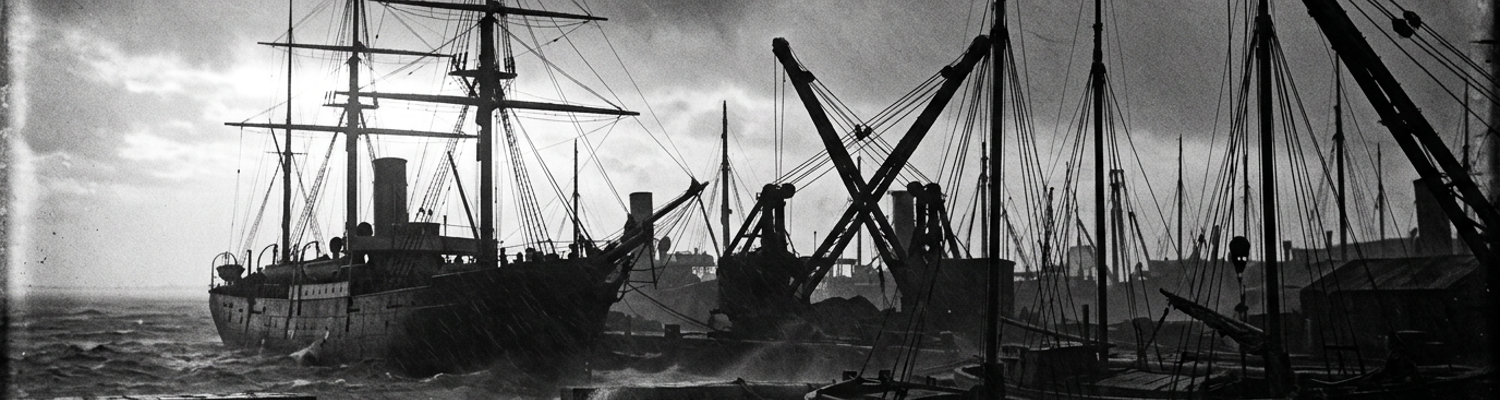

Imperial Standoff at the Apia Coaling Station
Archival evidence shows that the enlisted sailors and stokers aboard the Pacific squadrons were exhausted long before the diplomatic standoff reached its breaking point. Men assigned to the boiler rooms worked in 120-degree ambient heat. They shoveled bituminous coal into the roaring furnaces of compound steam engines. They subsisted on heavily rationed hardtack, salted beef, and tepid water. Sleep deprivation compounded their physical deterioration as the weeks dragged on. Stokers hauled eighty-pound canvas sacks of fuel up steep wooden ramps. They marched in endless loops between the lower decks and the primary coal bunkers.
This punishing labor cycle defined daily existence at the coordinates of 13 degrees 49 minutes South, 171 degrees 45 minutes West.
A close review of operational logs indicates that by early March 1889, a highly congested naval blockade had formed inside the narrow confines of Apia Harbor. Three navies converged on this specific coordinate to enforce competing diplomatic claims over the Samoan archipelago. The geopolitical conflict centered on a proxy war between rival local chieftains. The German Empire backed Tamasese Titimaea. The United States supported Mataafa Iosefo. The German Admiralty dispatched the gunboats SMS Eber and SMS Adler. The corvette SMS Olga followed shortly after. They operated under orders to secure the installation of their preferred claimant by force if necessary. The United States Navy responded to this territorial assertion by anchoring the 3,900-ton wooden-hulled steam frigate USS Trenton, the sloop-of-war USS Vandalia, and the gunboat USS Nipsic directly alongside the German vessels. Rear Admiral Lewis Kimberly positioned the heavily armed American squadron to physically block German shore landing parties from accessing the beachhead. The British Royal Navy deployed the composite-hulled cruiser HMS Calliope to monitor the escalating friction and protect British commercial interests.
Seven heavy steamships occupied a harbor basin originally charted to safely anchor three.
The geographic location of Apia offered no natural resources of value to the industrialized powers. Its entire strategic worth rested on its function as a Pacific steamship coaling depot for long-range naval projection. Warships of the late nineteenth century relied on massive steam propulsion systems that consumed fuel at an extreme rate. The fire-tube boilers powering these fleets required constant feeding to generate sufficient steam pressure. A vessel like the USS Trenton burned up to forty tons of coal every twenty-four hours just to maintain station-keeping maneuvers against the strong tidal currents of the harbor. The nearest alternative reliable refueling stations were located in Sydney, 2,300 nautical miles to the southwest. Honolulu sat 2,200 nautical miles to the north. Controlling the stockpile at Apia meant controlling the only node capable of sustaining a steam-powered fleet in the South Pacific.
Without access to this specific shore depot, a squadron would deplete its bunkers within weeks.
They would drift powerless across the open ocean.
When examining the historical record of the harbor infrastructure, the bottleneck becomes obvious. The German trading firm Deutsche Handels und Plantagen Gesellschaft controlled the primary onshore coal sheds. This created an immediate tactical disadvantage for the American vessels. American commanders had to negotiate constantly to secure enough fuel to keep their boiler fires banked. Loading the coal was an entirely manual, physically destructive process. Indigenous laborers and off-duty sailors loaded the loose fuel into small wooden lighters along the beachfront. Rowers manually pulled these small boats across the choppy water to the anchored warships. Men on the main decks then hoisted the heavy sacks upward using simple block-and-tackle rigging. They dumped the contents down narrow iron chutes into the shipboard bunkers. Coal dust coated the decks. It fouled the primitive ventilation systems. It coated the lungs of the crew.
A single dropped sack could fracture a collarbone instantly.
Tensions on the water escalated as the onshore stockpiles dwindled. German Captain Richard von Mellenthin ordered his gun crews to load live ammunition. His engineering officers calculated their remaining fuel reserves down to the hour. American lookouts recorded these deck movements through brass spyglasses. The ships remained anchored within fifty yards of one another. Their engines idled constantly to prevent the currents from driving their iron keels into the surrounding coral reefs.
Pacific Steamship Logistics and Coal Bunkering
Archival evidence shows that late nineteenth-century US Navy vessels relied heavily on overseas coal stocks to maintain operational readiness in distant foreign stations. The transition from pure sail to hybrid steam propulsion created an absolute dependency on terrestrial fuel depots scattered across the Pacific Ocean. Ships like the USS Trenton and the USS Vandalia utilized heavy Scotch marine boilers. These units consumed high-grade bituminous coal to generate the 60 pounds per square inch of steam pressure required to turn their heavy iron propellers. To maintain station in foreign waters, these steam plants had to keep fires banked twenty-four hours a day. This idling process burned up to ten tons of fuel daily even while sitting at anchor. Engineers aboard the American squadron constantly monitored their bunker levels. Dropping below a thirty percent reserve meant losing the ability to outmaneuver sudden squalls or hostile enemy actions. The nearest deep-water resupply facility at Mare Island Naval Shipyard sat nearly 4,200 nautical miles away. Local supply chains entirely dictated the operational tempo of the Pacific fleet.
A steam frigate with empty bunkers was a stationary target.
A close review of operational logs indicates that the American squadron at Apia found itself physically restricted to a highly inefficient supply node. The harbor lacked deep-water piers capable of accommodating the 23-foot draft of the USS Trenton. Coaling operations at Apia depended on unpowered wooden lighters and shore-based mechanical hoists to transfer fuel to anchored warships. The local infrastructure consisted of a single wooden wharf equipped with a primitive steam-driven derrick and several manually operated sheer legs. Shore crews hoisted eighty-pound canvas sacks of Australian coal from the onshore storage sheds. They dropped them into flat-bottomed wooden barges. These lighters held barely five tons of fuel at maximum capacity. The loading zone sat directly in the surf line.
This exposed the operation to constant wave action.
Overloaded barges frequently capsized in the heavy harbor chop.
Exhausted oarsmen manually rowed the unpowered lighters through the unpredictable currents to reach the warships anchored in the basin. The transfer of fuel from the bobbing lighters to the main decks of the warships required dangerous physical labor. Deckhands aboard the USS Vandalia rigged heavy block-and-tackle lines to the yardarms to winch the coal sacks upward. The wooden lighters smashed repeatedly against the iron-reinforced hulls of the warships. Ocean swells lifted and dropped the small boats by several feet. Sailors standing on the slippery decks of the lighters had to perfectly time the attachment of the hoisting hooks to the cargo netting. A miscalculation resulted in heavy loads swinging wildly into the superstructure.
Sometimes the load dropped straight back down onto the lighter deck.
Crushed fingers and shattered femurs filled the medical logs of the squadron.
Once the coal reached the main deck, stokers dragged the abrasive canvas sacks across the wooden planks. They dumped the contents down narrow iron scuttles into the lower bunkers. This process generated thick clouds of highly combustible coal dust. The dust settled into every open hatch and ventilation shaft. Officers recorded transfer rates of only fifteen to twenty tons per day during optimal weather conditions. Filling the holds of the American ships required hundreds of tons of loose fuel. Refueling a single vessel took weeks of uninterrupted manual labor. Daily physical exhaustion rapidly degraded the ability of the crew to perform standard gunnery drills.
The broken supply chain dictated the daily schedule of the entire fleet.
Engineering reports from March 1889 detail the specific degradation of the mechanical hoists on the shoreline. Constant exposure to salt spray corroded the iron gears of the German-controlled winches. Frequent mechanical breakdowns halted the loading process for days at a time. American quartermasters had to dispatch their own shipwrights and machinists to the beach to repair the foreign equipment. The manual labor cycle resumed the exact moment the gears turned again. Stokers returned to the lighters to manually lift eighty-pound sacks in 95-degree ambient heat.
Telegraph Destruction and Tactical Isolation
When examining the historical record of the Samoan theater, the exact technical specifications of the local communication networks reveal a highly exposed infrastructure. The entire diplomatic apparatus at Apia relied on a single terrestrial wire operated by the local Public Works Department. This primitive connection consisted of uninsulated copper wire strung across locally felled wooden poles. It linked the harbor offices to the broader submarine cable network that eventually reached the United States. On March 15, 1889, rising barometric pressure systems and escalating wind shears physically dismantled this hardware. Heavy surf battered the beachfront. The water undermined the shallow foundations of the Public Works Department building located less than thirty yards from the high-tide line. The shifting sand caused the main telegraph mast to collapse inward. This snapped the primary 10-gauge copper transmission line. Saltwater flooded the ground-floor relay station. The corrosive ocean water mixed with the sulfuric acid inside the glass-jar Leclanche cells. This completely shorted out the electrical current required to transmit Morse code pulses.
The wet-cell batteries shattered under the weight of the collapsed roofing timbers.
The final transmission to Washington ceased mid-character at exactly 1400 hours local time.
Local technicians attempted to splice the severed copper lines using spare gutta-percha insulation. Sustained gale-force winds repeatedly tore the heavy repair cables out of their hands. Signalmen on the beach tried using semaphore flags to relay the mechanical failure to the anchored warships. Heavy rain squalls obscured all visual lines of sight. The destruction of this specific onshore node severed all electronic communication between the Samoan archipelago and the United States Navy Department. Delivering a message now required loading paper dispatches onto a steam-powered packet ship. That ship had to sail 1,600 nautical miles to the nearest operational telegraph station in Auckland, New Zealand. A round-trip communication cycle instantly shifted from a matter of hours to a minimum of three weeks.
American commanders lost their only tether to the civilian government.
A close review of operational logs indicates that this sudden tactical isolation paralyzed the command structure aboard the heavily armed American squadron. Rear Admiral Lewis Kimberly sat anchored on the flag deck of the 3,900-ton USS Trenton without any mechanism to receive updated rules of engagement from Secretary of the Navy Benjamin Tracy in Washington. The geopolitical situation in the harbor was deteriorating by the hour. German shore parties mobilized near the contested coal sheds. Kimberly possessed outdated contingency orders issued in early February. These were logged under dispatch number 419. Those previous directives provided zero guidance on how to respond if Captain Richard von Mellenthin ordered the gunboats SMS Eber or SMS Adler to actively fire upon the American-backed Samoan factions. The American squadron commander had to guess whether initiating a naval bombardment to protect the shoreline would trigger a formal declaration of war between the United States and the German Empire. Every decision regarding the deployment of the 300-pound broadside guns rested entirely on his isolated judgment.
Officers on the USS Vandalia loaded eight-inch armor-piercing shells into their rifled pivot guns.
They did not know if they had the legal authority to pull the firing lanyards.
Archival evidence shows that the communications blackout forced Kimberly into a highly defensive posture against the Imperial German Navy. He could not request diplomatic intervention from the State Department to secure the German-controlled coal stockpiles on the beach. He also could not coordinate a synchronized withdrawal with the Pacific Fleet command in San Francisco. The American ships burned through their remaining bituminous coal reserves at a rate of forty tons per day just to keep their bows pointed into the swelling storm surge. Engineering officers submitted hourly bunker soundings to the flag bridge. They tracked the declining fuel weight on slate chalkboards. The USS Nipsic reported less than sixty tons of usable fuel remaining in its lower holds. Draft marks on the hull of the USS Trenton rose by two inches. The overall displacement of the ship lightened from the continuous coal consumption.
Breakdown of Shore Coaling Infrastructure
A close review of operational logs indicates that the fragile refueling network at Apia collapsed completely on the afternoon of March 15, 1889. Barometric pressure inside the harbor dropped to 29.05 inches of mercury by 1400 hours. A tropical cyclone stalled directly over the Samoan archipelago. It drove cyclonic winds into the northern mouth of the anchorage. The geography of the Vaisigano River valley funneled these incoming gales straight toward the Matautu Point coaling sheds. Wind velocities exceeded seventy knots. The initial storm surge pushed a wall of seawater six feet above the standard high-tide line. This swept directly into the loading zones. Flat-bottomed wooden barges tied alongside the Deutsche Handels und Plantagen Gesellschaft wharf absorbed the immediate impact of the breaking surf. Thirty-foot waves crested over the harbor reef and smashed into the exposed loading area.
Seawater instantly flooded the open holds of five fully loaded coaling lighters.
Archival evidence shows that the shore-based mechanical hoists failed catastrophically within the first hour of the gale. The primary steam-driven derrick positioned at the end of the pier relied on a localized vertical boiler to power its iron winch drums. Saltwater spray extinguished the coal fires inside this boiler box. Without steam pressure, heavy iron gears locked in place. A two-ton load of bituminous fuel hung suspended directly over the water. The surging tide lifted the wooden pilings of the wharf upward. This snapped the cross-bracing timbers and destabilized the entire platform. Heavy steel cables attached to the manual sheer legs snapped under the dynamic tension of the swinging cargo. Recoiling wire ropes whipped across the wooden decking. They severed the structural support columns of the main loading ramp. Admiral Lewis Kimberly recorded in his deck logs that the entire forward section of the coaling pier detached from the shoreline at 1530 hours.
The heavy steam derrick tumbled backward into the harbor basin.
It sank into the coral sand.
Warships stationed in the inner harbor completely lost their ability to bunker fuel. Ships like the USS Trenton and the HMS Calliope required uninterrupted deliveries to maintain the high boiler pressure necessary to steam against the incoming hurricane. Destruction of the hoists severed that supply line permanently. Deckhands aboard the anchored vessels watched through rain squalls as thousands of eighty-pound canvas sacks washed off the ruined beachhead. Ocean currents dragged this loose fuel across the coral reef. This completely dissolved the tactical reserves required to keep the Pacific squadrons afloat.
The fleet was now trapped on a lee shore with rapidly emptying bunkers.
When examining the historical record, physical documentation of this infrastructure failure relies heavily on the surviving field work of civilian journalists embedded with the naval forces. Associated Press correspondent John P. Dunning operated on the shoreline during the aftermath of the cyclone. Dunning utilized a large-format field camera equipped with a heavy wooden tripod to capture the exact state of the loading zones. He positioned his equipment in the saturated mud near the Vaisigano River mouth to photograph the destroyed pier. Silver gelatin prints captured the absolute obliteration of the German-controlled refueling depot. Dunning exposed several 8x10 inch glass plate negatives showing the splintered remains of the mechanical sheer legs half-buried in the sand.
His focal planes focused sharply on the fractured iron gears of the steam winches.
These specific photographic plates provided the Navy Department with incontrovertible visual evidence of the bottleneck. Images depicted hundreds of waterlogged canvas sacks scattered among the uprooted palm trees along the high-water mark. Dunning captured the exact position where the wooden lighters had been driven completely through the structural pilings of the wharf. Quartermasters later cataloged these glass negatives in Washington to analyze the structural failure of the Apia supply chain. Shards of the flat-bottomed barges lay split longitudinally along their keels. They exposed wooden ribs stripped of all cargo. The final visual record confirmed that heavy iron loading chutes used to funnel coal into the barges had been twisted into unrecognizable scrap metal by the sheer force of the storm surge.
Submerged Firerooms Aboard Trenton and Vandalia
Archival evidence shows that by 0415 hours on March 16, the structural integrity of the lower decks on both the USS Trenton and USS Vandalia began to fail. They collapsed under the sustained hydraulic pressure of the cyclonic storm surge. Seawater forced its way through the forward hawse pipes. It shattered the heavy glass deadlights along the main gun deck. Hundreds of gallons of raw ocean poured directly into the unsealed wooden hatch gratings. This incoming volume quickly overwhelmed the primary drainage scuppers. It cascaded downward into the lowest compartments of the wooden hulls. Water collected in the bilges directly beneath the firerooms. The heavy Scotch marine boilers sat mounted on iron saddles in this exact location. The continuous pitching of the 3,900-ton Trenton sloshed this trapped liquid violently against the cast-iron ash pits located at the base of the primary furnaces. Engineers recorded that the steam-powered Worthington bilge pumps choked almost immediately. Loose bituminous coal dust washed down from the upper deck bunker chutes during the chaotic manual loading process of the previous weeks. This dust mixed with the incoming saltwater. The resulting dense slurry jammed the bronze impellers of the drainage equipment. It snapped the mechanical drive shafts connecting the pumps to the auxiliary steam lines.
The water level inside the lower boiler rooms rose at a steady rate of four inches per hour.
A close review of operational logs indicates that this uncontrolled flooding created an immediate mechanical crisis for the propulsion systems of both American warships. Firemen aboard the 2,100-ton USS Vandalia reported that the rising seawater overtopped the iron deck plates. It spilled directly into the active fireboxes. Cold ocean water contacted the 400-degree cast iron of the lower grates. This caused the metal to warp and fracture under the sudden thermal shock. The resulting hiss of flash steam filled the narrow compartments with scalding vapor. This vapor stripped the skin off the arms of the engineering crew. Captain Norman von Helden Farquhar commanded the Trenton. He demanded full revolutions from the compound steam engines to keep his bow pointed directly into the seventy-knot headwinds. Generating that necessary 60 pounds per square inch of operating pressure required continuous combustion inside those flooded lower furnaces.
Stokers waded through three feet of freezing seawater to reach the lower bunker doors.
When examining the historical record of the engineering divisions, the physical demands placed on the enlisted coal passers bordered on complete physiological collapse. Men assigned to the lower holds of the Trenton conducted grueling manual shoveling operations. They stood submerged waist-deep in a toxic mixture of seawater, floating ash, and raw sewage backing up from the flooded sanitary lines. The heavy canvas sacks previously used to transport the fuel disintegrated in the corrosive water. The crew had to scoop loose coal directly from the flooded deck plates using heavy steel scoop shovels. Wet bituminous fuel weighed significantly more than dry coal. It burned with extreme inefficiency. Stokers had to heave sixty-pound shovelfuls of this dense sludge upward into the upper furnace doors. They timed their throws against the violent twenty-degree rolls of the ship. Missing the narrow iron opening meant the wet fuel bounced off the boiler casing. It splashed back into the flooded bilges. The physical exertion was entirely wasted. The ambient air temperature inside the compartment dropped rapidly as the cold Pacific seawater absorbed the radiant heat of the boilers. Enlisted men worked in near-total darkness after the rising water shorted out the primitive electrical dynamos. They relied entirely on the orange glow of the open fireboxes to navigate the submerged mechanical hazards of the engine room floor.
Engineering officers chalked the falling steam pressure on slate boards.
The main gauges dropped past thirty-five psi.
Fuel Quality Degradation and Engine Failures
A close review of operational logs indicates that the physical composition of the fuel loaded into the American and German bunkers severely compromised their mechanical output on the morning of March 16. Quartermasters at Apia had procured a low-grade variant of Australian bituminous coal from the local stockpiles. This specific fuel contained an exceptionally high percentage of non-combustible shale and sulfur. Saltwater inundation from the flooded harbor lighters further degraded the chemical integrity of the stockpile. Stokers aboard the USS Vandalia shoveled this wet fuel into the Scotch marine boilers. The coal refused to burn at the required temperatures. Heavy slag and solid iron-like clinkers formed rapidly across the cast-iron fire grates. These dense obstructions blocked the upward flow of oxygen from the lower ash pits. This starved the primary combustion chambers of draft air. Firemen had to physically halt fueling operations every twenty minutes. They violently broke apart the fused slag using heavy steel slice bars. The ambient temperature inside the fireboxes plummeted during these manual clearing procedures.
The main steam gauges on the USS Trenton registered a steady decline.
Pressure dropped from the standard operating mark of sixty pounds per square inch down to barely thirty-four.
Archival evidence shows that this extreme loss of boiler pressure directly translated into a catastrophic reduction in engine revolutions. Captain Norman von Helden Farquhar required his compound steam engines to turn the single iron propeller at a minimum of sixty revolutions per minute. This was the exact output needed to hold the 3,900-ton frigate stationary against the seventy-knot headwinds. Generating that level of continuous power demanded high-grade anthracite. Burning the wet Australian bituminous fuel yielded less than half the necessary thermal energy. The massive pistons inside the high-pressure cylinders slowed considerably. The Trenton lost forward momentum. It began drifting backward toward the inner coral shelf located at 13 degrees 49 minutes 20 seconds South. Engineering officers ordered the engine room valves opened to maximum capacity. They attempted to force every available ounce of steam into the drive system. The depleted boilers simply could not generate replacement vapor fast enough to meet the mechanical demand. The forward speed of the ship dropped to less than four knots. This rendered the heavy rudder entirely ineffective against the incoming tidal surge.
A sudden loss of steerageway forced the warships into paths of submerged wreckage.
When examining the historical record of the harbor basin, the water column directly beneath the anchored squadrons contained a dense matrix of destroyed maritime infrastructure. High winds had shredded the heavy Manila hemp hawsers and wire rope rigging of the capsized coaling lighters. This fibrous debris drifted directly into the rotational arc of the propellers. Aboard the USS Vandalia, the four-bladed bronze screw entangled a mass of severed anchor lines and splintered wooden planking. Under normal operating conditions, an engine running at full boiler pressure generated enough rotational torque to shear through external obstructions. The degraded coal had already reduced the shaft torque of the Vandalia by more than sixty percent. The heavy hemp fibers wrapped tightly around the bronze stern tube bearings. Friction increased exponentially as the organic material compressed into the narrow gap between the rotating shaft and the hull seal.
The main engine crosshead guides locked completely in place.
Chief engineers recorded the exact sequence of the propulsion failure at 0830 hours. The sudden stoppage of the propeller shaft sent a violent shockwave back through the drivetrain. This fractured the cast-iron thrust block mounts situated deep inside the engine room. Without the ability to turn the screw, the Vandalia lost all independent locomotion. The 2,100-ton sloop-of-war rotated broadside to the cyclonic swells. Captain Cornelius Schoonmaker issued direct orders to drop the secondary sheet anchors. The unpowered vessel lacked the forward momentum required to properly set the iron flukes into the sandy bottom. The current dragged the disabled warship backward at a rate of six feet per second. The port side quarter of the hull slammed violently into the submerged coral heads of the Vaisigano reef.
The impact tore a forty-foot gash through the lower timber framing.
Logistical Vulnerabilities in Gilded Age Naval Planning
When examining the historical record of the Samoan theater, the total destruction of the American squadron at 13 degrees 49 minutes South, 171 degrees 45 minutes West revealed severe deficits in global fuel distribution networks. The physical wreckage of the 3,900-ton USS Trenton and the 2,100-ton USS Vandalia lay embedded in the coral shelf of Apia Harbor. They rested alongside the shattered hulls of the German gunboats SMS Eber and SMS Adler. Naval engineers investigating the disaster traced the primary cause of these losses directly to the primitive state of the harbor infrastructure. The United States Navy relied entirely on an unfortified, commercially owned wooden pier to supply its warships. High-velocity winds and cyclonic storm surges easily dismantled this exposed loading zone on March 16. Without access to heavy breakwaters or sheltered concrete basins, the anchored vessels could not safely bunker the bituminous coal necessary to maintain boiler pressure. The entire supply chain depended on indigenous laborers rowing unpowered wooden barges through an open surf line.
A single localized weather event completely neutralized the operational capability of the Pacific fleet.
Archival evidence shows that the Bureau of Equipment and Recruiting immediately audited the surviving Pacific transit corridors following the Apia disaster. Analysts documented that the existing overseas supply depots lacked both physical fortification and mechanized transfer equipment. The US Navy possessed no dedicated steel-hulled colliers to independently resupply squadrons at sea. Commanders had to purchase commercial fuel on the open market. They loaded it using manual block-and-tackle rigging. This archaic methodology restricted the operational range of heavy steam frigates to a narrow radius around privately held commercial ports. Bureaucrats in Washington recognized that any hostile European power could sever American naval projection simply by blockading these undefended civilian harbors.
The destruction in Samoa forced a complete redesign of overseas base architecture.
A close review of operational logs indicates that Secretary of the Navy Benjamin Tracy utilized the Apia losses to aggressively accelerate the construction of dedicated coaling stations. The Navy Department shifted its strategic focus toward establishing heavily fortified deep-water anchorages at Pago Pago in the Samoan archipelago and Pearl Harbor in the Hawaiian Islands. Engineers surveyed the natural harbor at Tutuila, located at 14 degrees 16 minutes South, 170 degrees 40 minutes West. They mapped a protected basin surrounded by high volcanic ridges. These geological features shielded the water from open-ocean storm surges. Draft plans called for the immediate excavation of the coral reefs to create a thirty-foot deep approach channel. This specific depth allowed the newest classes of armored cruisers to dock directly alongside the shore facilities.
Planners replaced the vulnerable wooden piers with reinforced concrete wharves anchored deep into the basalt bedrock.
The newly approved infrastructure contracts explicitly eliminated the manual lightering process that had failed Captain Norman von Helden Farquhar and Captain Cornelius Schoonmaker. Naval architects specified the installation of mechanized, steam-powered cantilever cranes. The Brown Hoisting Machinery Company of Cleveland manufactured these specific units. These heavy steel structures traveled on wide-gauge rail tracks laid directly flush with the concrete loading aprons. Operators in elevated cabs controlled dual-drum winches. These winches were capable of lifting two-ton steel clamshell buckets straight from the onshore storage bins. They lowered them directly into the shipboard bunker scuttles. The onshore storage facilities themselves underwent a complete structural overhaul. Contractors poured high-density concrete to form heavy, enclosed fuel silos designed to hold up to 50,000 tons of high-grade Welsh anthracite. These thick walls prevented saltwater inundation. They shielded the stockpiles from high-explosive naval artillery fire.
Continuous bucket elevators replaced the eighty-pound canvas sacks entirely.
Dredging equipment arrived at the Pago Pago site in 1898 to begin clearing the inner harbor shelf. Construction crews laid heavy iron railway lines connecting the primary storage silos to the deep-water berthing docks. Marine engineers installed stationary Babcock and Wilcox water-tube boilers on the shoreline to generate the constant high-pressure steam required to operate the mobile cantilever cranes. The new mechanical transfer system loaded 120 tons of coal per hour into the holds of visiting warships.