
Aleutian Strategic Importance 1943
A review of operational logs from early 1943 shows a persistent anxiety within American command concerning the Aleutian Islands. The Japanese occupation of Attu and Kiska the previous June, while possibly a diversion from Midway, established a direct threat along the northern approach to North America. Planners in Tokyo and Washington understood the island chain formed a natural great-circle route, a series of stepping stones for aircraft and naval forces between continents. For Japan, the occupied islands were a defensive buffer to prevent the United States from using the Aleutians as a staging ground for an invasion of the home islands. For the Americans, the Japanese presence was an unacceptable strategic liability. It was the first time since the War of 1812 that enemy forces had occupied North American soil. The possibility of Japanese long-range bombers using forward airfields on Kiska or Attu to strike targets in Alaska, Canada, or the Pacific Northwest was a constant pressure on military leaders.
The U.S. Navy’s defensive posture in the region reflected the higher priority of the war in the South Pacific. Resources were scarce. Command of naval forces afloat fell to Rear Admiral Charles “Soc” McMorris, a seasoned officer given a collection of mostly older warships. His primary surface force, Task Group 16.6, was built around the heavy cruiser USS Salt Lake City and the light cruiser USS Richmond, his flagship. These were supported by a handful of destroyers, including the Coghlan, Bailey, Dale, and Monaghan. The core task for this group was containment. They were ordered to establish and maintain a naval blockade west of Attu, interdicting any Japanese attempt to reinforce or resupply their isolated garrisons. It was a strategy of attrition, meant to slowly strangle the occupying forces while the bulk of American naval power was concentrated thousands of miles to the south.
Operating in the Aleutians meant fighting the environment itself. The weather was not an occasional inconvenience; it was a constant, hostile opponent that inflicted casualties and damaged equipment with relentless efficiency. Archival evidence shows American forces suffered a higher ratio of operational losses to combat losses here than in any other theater of the war. One hundred fifty aircraft were lost to weather incidents alone. Ships and men were assaulted by sudden, dense fogs that could reduce visibility to mere feet, blinding lookouts and rendering early radar systems unreliable. Even more feared were the Williwaws, violent katabatic winds that plummet down coastal mountains at hurricane force, capable of capsizing smaller vessels. Freezing spray and snow would encase superstructures in tons of ice, creating a severe risk of capsizing and requiring exhausted crews to constantly chip it away with mallets and axes. This environment caused widespread mechanical failures, from frozen gun mechanisms to cracked engine components, wearing down the material readiness of a naval force already stretched thin.
Clandestine Minefield Deployment
The strategic calculus in the Aleutians shifted after the naval battle off the Komandorski Islands in March 1943. Following that engagement, Japanese attempts to resupply their garrisons on Attu and Kiska by surface convoy ceased. They became dependent on the far more limited capacity of submarines. To sever this lifeline and isolate the Japanese forces on Kiska ahead of a planned invasion, American commanders authorized a series of clandestine mining operations. The mission was given to a specialized group of destroyers, ships not originally built for the task but adapted for it. This reflected the theater’s perpetual shortage of dedicated naval assets. These were not purpose-built minelayers but standard fleet destroyers, a fact that introduced immediate mechanical and operational complications.
A review of operational logs shows that the Fletcher-class destroyer USS Pringle and several of her sister ships were central to these missions. The Pringle was one of a small number of Fletchers built with an experimental aircraft catapult, a feature removed in 1943 to accommodate mine tracks. These tracks, little more than steel rails fitted to the deck, allowed the ships to carry and deploy the U.S. Navy’s standard Mark 6 naval mine. The Mark 6 was a spherical contact mine, 34 inches in diameter and filled with 300 pounds of TNT or Toxyl, a TNT alternative used due to shortages. Its “K-pistol” firing mechanism used a long copper antenna that, when touched by a steel hull, would complete an electrical circuit with a copper plate on the mine body, using seawater as an electrolyte to detonate the charge. This design allowed a single mine to cover a wider area, a key factor given the limited number that could be carried on a destroyer’s deck. The task for these destroyers was to sow fields of these mines in the approaches to Kiska Harbor, creating an unseen barrier intended to sink any Japanese submarine attempting to enter or leave port.
The entire operation was conducted under a strict cloak of invisibility. Sorties were timed to coincide with the worst possible weather, using the region’s infamous dense fog and low cloud cover to shield the ships from Japanese reconnaissance planes based on Kiska. Archival evidence shows that radio silence was paramount. Ships navigated by primitive radar and dead reckoning through treacherous, poorly charted waters. The threat of a Williwaw or a moment of a sudden, blinding fog bank made formation steaming a nerve-wracking ordeal. A collision, like the one that occurred between the minelayers Preble and Montgomery during a similar operation in the Solomons, would be a disaster. Crews operated in near-total darkness, manhandling the heavy mines onto the rails as the ships pitched in heavy seas. The deployment itself was a moment of high tension. A premature detonation or a mine snagging on the tracks could cripple or sink the vessel. The goal was to lay the fields without alerting the Kiska garrison, an objective that was largely successful. The minefields were sown, silent and waiting in the frigid water, a fact unknown even to much of the American fleet itself. This lack of broad awareness would have catastrophic consequences.
Navigational Error and Deviation
The clandestine mining operation was predicated on precision. A review of operational logs from the destroyer minelayers reveals a focus on accurate navigation, as even a minor deviation could render the fields ineffective or create an unknown hazard. Yet the very conditions that provided concealment, the impenetrable Aleutian fog and violent seas, were the same conditions that systematically degraded the tools of navigation available in 1943. The primary method was dead reckoning, a mariner’s art of calculating a ship’s current position by using a previously determined position and advancing it based upon estimated speed, direction, and time. This was supplemented by celestial fixes when the weather cleared and by the newly installed SG surface-search radar. This device, while revolutionary, was prone to errors in the unique environment of the Aleutians. Atmospheric conditions and false returns from distant islands or large waves plagued operators. The minelaying destroyers, steaming at speed through poorly charted waters, relied on a frantic cross-checking of these systems. A gyrocompass failure, a miscalculated current, or a moment of disorientation in the fog could throw a vessel miles off its intended track. The pressure on the navigators was immense, working for hours in cramped, blacked-out chart rooms while their ships were battered by the elements.
Archival evidence shows a significant discrepancy between the planned coordinates for the minefields off Kiska and their actual, as-laid positions. The mission plan called for several distinct fields to be laid in the approaches to Kiska Harbor, creating a layered defense. However, one of these fields was laid significantly out of position. The cumulative effect of gyrocompass drift, misinterpretation of radar returns bouncing off the mountainous Kiska coastline, and the sheer impossibility of getting an accurate fix in the persistent fog caused one of the minelaying groups to deviate from its approved track. The result was a line of Mark 6 mines sown several nautical miles away from where Navy planners in Adak believed it to be. The error went undetected. Under mandatory radio silence and the chaos of the weather, the ships’ crews believed they had executed the mission as planned. They recorded the drop coordinates in their logs based on their faulty navigational data.
The deviation placed hundreds of pounds of high explosives directly into a transit lane used for patrol and transport. While not a civilian shipping lane in the commercial sense, this area was a recognized corridor for Allied naval vessels moving around Kiska. The extreme secrecy surrounding the minefields now became a liability. Because the existence of the fields was so highly classified, their precise, and in this case incorrect, locations were not disseminated widely even within the U.S. Navy. Task force commanders preparing for “Operation Cottage,” the invasion of Kiska, had charts showing the intended minefield locations, not the actual ones. The misplaced field created an invisible, uncharted deathtrap. On August 18, 1943, three days after U.S. and Canadian forces landed on Kiska to find it deserted, the destroyer USS Abner Read was conducting an anti-submarine patrol. At approximately 1:50 AM, its stern drifted into this unknown, American-laid minefield. The resulting explosion tore the aft 75 feet of the ship completely off, killing or mortally wounding 71 sailors.
Kiska King's Unacknowledged Loss
While the damage to the USS Abner Read on August 18, 1943, became a recorded incident of the Aleutian Campaign, it was not the only loss attributable to the misplaced American minefield. A review of naval auxiliary records and casualty lists reveals a more obscure tragedy. The loss of the Aleut motor vessel Kiska King, a small, non-combatant craft pressed into service, represents a forgotten footnote to the operational blunders around Kiska. The vessel was a typical small motorboat, likely a purse seiner or similar fishing vessel requisitioned for local transport and patrol duties under Navy direction. Such auxiliary vessels were the logistical lifeblood in the island chain, performing unglamorous but necessary tasks that larger warships could not. Lacking armor, advanced navigational systems, or the speed of a warship, these boats operated at the extreme edge of risk, crewed by men who were often as much a part of the islands as the terrain itself.
The crew of the Kiska King vanished with their vessel. These men were local Aleut sailors, indigenous to the islands and possessing generations of experience navigating the treacherous Aleutian waters. The American military frequently relied on the knowledge of the Unangax̂ people, whose skills were indispensable. Unlike the formal casualty reporting for the 71 sailors killed or missing from the Abner Read, the loss of the Kiska King's crew appears as a void in the historical record. There were no heroic narratives written, no medals awarded, and no extensive search and rescue operation mounted. They were presumed lost, a common fate for small boat operators in a region where the sea regularly claimed lives. The official silence underscores the rigid hierarchy of wartime loss. The destruction of a commissioned warship demanded an investigation, while the disappearance of an auxiliary boat with a native crew was treated as an expected cost of operating in a hazardous theater.
The vessel’s final moments can only be reconstructed through its fatal connection to the rogue minefield. The Kiska King was operating in the waters off the island in the days surrounding the main Kiska landing on August 15, 1943. Its mission placed it directly within the transit lanes that naval planners believed were safe but which, due to the navigational errors, were not. The detonation that destroyed the vessel was almost certainly caused by a Mark 6 naval mine. For a small motor vessel like the Kiska King, the effect of a 300-pound TNT charge would have been instantaneous and absolute. Unlike the Abner Read, which was large enough to survive having its stern blown off, the smaller hull of the Kiska King would have been obliterated. No wreckage was ever reported found. No distress call was ever received.
Indigenous Distrust and Covert Inquiry
An examination of Unangax̂ (Aleut) oral histories and post-war testimonies reveals that the loss of the Kiska King was not interpreted as a random accident. It was seen as the predictable outcome of a profound and justified distrust toward the American military. This suspicion was born in June 1942, when U.S. authorities forcibly evacuated 881 Unangax̂ from nine villages across the island chain. Herded onto transport ships with only a single suitcase each, they were taken to Southeast Alaska and interned in squalid, rotting fish canneries and abandoned mining camps. These sites lacked adequate sanitation, clean water, or medical care, leading to rampant disease. At Funter Bay, one such camp, health officials documented the overwhelming odor of human excreta and found children naked and covered with filth in the damp, dark bunkhouses. Nearly ten percent of the interned population died in these conditions, not from enemy action, but from the direct negligence of the U.S. government. Upon their return years later, many found their homes and villages looted and vandalized, not by the Japanese, but by the American troops who had occupied their lands. This experience created a chasm of distrust. The military was not seen as a protector, but as a careless, often destructive force.
The extreme secrecy surrounding the Kiska minefields meant that clear, detailed warnings were an operational impossibility. Naval command could not risk Japanese intelligence learning of the operation, so information was kept on a strict need-to-know basis. This circle did not extend to the local indigenous population, even those employed in auxiliary roles. A review of naval procedures from the period shows no standardized protocol for communicating such specific dangers to non-military personnel. Unangax̂ sailors, valued for their intimate knowledge of the local waters, were given vague orders to avoid broad areas, but without the context of why. To a people who had navigated these passages for millennia, a blanket prohibition on entering a specific strait without a clear reason would have seemed arbitrary and illogical. The warnings were simply another opaque rule from an outside authority that had already proven itself untrustworthy.
This combination of official silence and deep-seated suspicion prompted the formation of a covert, informal inquiry by Unangax̂ community leaders. The disappearance of the Kiska King was not an isolated data point for them. It was part of a developing, frightening pattern. Oral histories collected after the war speak of a network of communication between hunters and fishermen who began quietly pooling their knowledge. This was not an investigation with formal reports, but a whispered consensus built in the holds of fishing boats. Experienced mariners began to map, in their minds and on scraps of paper, the locations of unexplained phenomena. They noted where other small vessels had vanished and the specific waters where men had heard unexplained explosions carried on the wind. Using their generational understanding of the powerful Aleutian currents and tides, they could extrapolate where a floating object, or a naval mine, might drift. It was a grassroots intelligence effort, born of necessity, to protect their own people from the hidden lethality their supposed protectors had sown in their ancestral waters.
Emergency Minesweeping Failures
The detonation that tore the stern from the USS Abner Read created an immediate crisis for the Kiska invasion force. It was not a Japanese torpedo that had crippled the destroyer; analysis confirmed the source was an American-laid minefield, sown in secrecy and now dangerously misplaced. The realization sent a shockwave through the command structure. An urgent directive was issued to locate and clear these hidden fields before another vessel was lost. The burden of this task fell to the small flotilla of minesweepers assigned to the Aleutian theater, primarily composed of Auk-class and Admirable-class vessels. These were small, specialized warships tasked with one of the most hazardous duties in naval warfare.
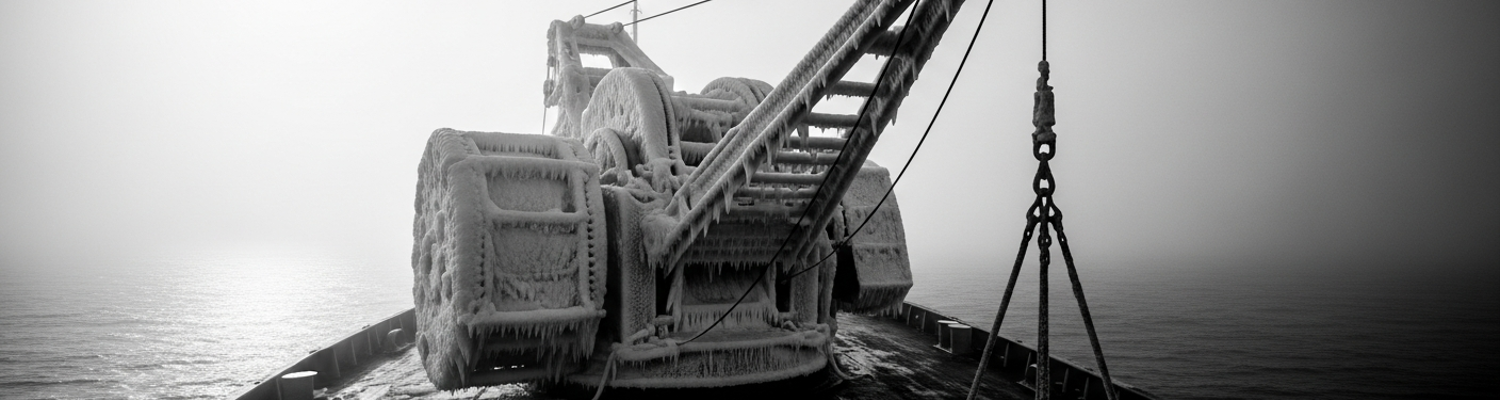
A review of maintenance records from the period reveals a cascading series of equipment failures, driven by the Aleutian environment. The standard minesweeping procedure involved deploying Oropesa-type sweep gear. This consisted of heavy steel cables fitted with cutters, towed behind the ship and kept at a specific depth and width by hydrodynamic paravanes, or “otters.” In the sub-arctic conditions off Kiska, this process became a mechanical nightmare. Freezing sea spray instantly coated the complex machinery on the fantail with thick layers of ice. This ice accumulation threatened the stability of the small minesweepers, but its more immediate effect was the complete seizure of moving parts. Hydraulic systems for the heavy winches became sluggish as their fluid thickened in the cold. Metal components, from winch frames to sweep cables, became brittle, increasing the risk of stress fractures under high tension.
The most persistent problem was the combination of corrosion and mechanical seizure. The heavy winches were particularly vulnerable. The constant salt spray and fog created a perfect environment for rapid rusting. Maintenance was a constant, losing battle. The massive steel drums of the winches, designed to spool hundreds of meters of thick cable, would freeze solid, their braking and clutch mechanisms locked by ice and rust. Deck crews resorted to using sledgehammers and steam hoses in desperate attempts to break the winches free. The sweep gear itself was just as susceptible. The intricate release clips on the paravanes would jam. The serrated steel cutters, designed to sever the mooring cables of mines, became rusted and dull. The sweep cables, constantly being dragged through saltwater and then spooled back onto the winch, suffered from accelerated corrosion, creating weak points that would snap under strain. This would send the entire sweep assembly plummeting to the seafloor, leaving the minefield dangerously intact.
Strategic Exposure and Japanese Reconnaissance
The mechanical failures that paralyzed the American minesweeping flotilla off Kiska created a new, unintended vulnerability. A mission that depended on speed devolved into a static, protracted, and highly visible operation. Archival evidence shows the Auk-class and Admirable-class minesweepers were effectively trapped, lingering for days in the waters they were supposed to be clearing. Instead of swift, methodical passes, the crews were engaged in a desperate fight with their own equipment. The effort to de-ice and repair frozen Oropesa sweep gear and seized deck winches turned the task force into a stationary cluster of vessels. Warships, particularly smaller vessels in a hostile zone, relied on constant movement to survive. By remaining fixed in a predictable location, the American ships presented an irresistible target for observation.
This inactivity offered a perfect, low-risk opportunity for Japanese aerial reconnaissance. A review of operational records indicates that Japanese forces on the island maintained regular air patrols, weather permitting. These patrols were often flown by slow, rugged floatplanes like the Nakajima E8N or the more modern Mitsubishi F1M “Pete.” Launched by catapult from cruisers or operating from sheltered coves, these were the eyes of the garrison. Through a break in the Aleutian fog, a Japanese pilot on a routine patrol would have spotted the American naval group. The sight was deeply suspicious. The ships were not in a standard combat or transit formation; they were clustered, some appearing dead in the water for long periods. The presence of multiple minesweepers, vessels with a unique and unmistakable silhouette, was a definitive piece of tactical intelligence. The pilot would have noted the number of ships, their specific classes, and their precise coordinates before slipping back into the cloud cover.
The individual reconnaissance sightings were rapidly consolidated into a coherent intelligence picture by the Japanese command. A single report of minesweepers was an anomaly; multiple reports over several days confirmed a clear American intent. Japanese intelligence officers, analyzing the flow of information from air patrols, connected the unusual naval activity directly to the recent loss of submarine contact with the Kiska garrison. The puzzle was complete. The Americans had secretly mined the approaches to the island, and now they were clearing those same mines. Such an action only preceded one event: a full-scale amphibious invasion. This intelligence, born from the simple observation of stalled American minesweepers, allowed the Japanese Imperial General Headquarters to make a calculated decision. Recognizing that the isolated garrison on Kiska could not withstand the coming assault, they initiated a daring and secret evacuation, codenamed Operation KE. While American forces were still struggling with frozen equipment and misplaced explosives, the Japanese were already planning to render the impending invasion of Kiska entirely pointless.