
Strategic Command Friction and Oahu Defense Debates
Yeoman Second Class Frank Pritchard tightened the thumbscrews on a battered teletype unit in the basement communications center of the Submarine Base at Pearl Harbor as emergency message traffic rattled the machine. Ink smudged across his fingers while he tore off yellow dispatch strips carrying alarmist intelligence assessments from the Army Hawaiian Department. Lieutenant General Delos Emmons, serving as the military governor of Hawaii, sent urgent cables demanding that the Pacific Fleet keep its surviving aircraft carriers tethered directly to Oahu for territorial defense against anticipated Japanese invasions. Emmons maintained that Hawaiian airfields and harbor facilities remained dangerously vulnerable to follow up airstrikes and amphibious landings without carrier fighters flying constant protective patrols overhead. Soldiers under his command were already digging trenches along Waikiki Beach, and Emmons viewed any naval operation that sent carriers beyond local fighter range as an unacceptable risk to island security.
Island security concerns reached Admiral Harold Stark, the Chief of Naval Operations in Washington, who initially favored a cautious doctrine prioritizing the Hawaiian perimeter and the American West Coast. Stark and his staff argued that the few operational American carriers were too valuable to risk in unsupported operations across enemy waters. This conservative stance immediately sparked fierce bureaucratic clashes with Admiral Ernest J. King and his newly formed office of the Commander in Chief, United States Fleet. King rejected the passive deployment doctrine of Stark, insisting that static defense would surrender the central Pacific to Japan without a fight. King demanded aggressive hit and run strikes to interrupt enemy supply lines and regain strategic initiative, creating deep institutional friction between the two highest naval authorities in the capital.
Dispatch riders delivered reports of this capital friction to Admiral Chester W. Nimitz as he evaluated operational plans at his Pearl Harbor headquarters. Nimitz firmly sided with the aggressive philosophy of King, recognizing that keeping carriers idling in Hawaiian waters offered no real protection and left the initiative entirely to the enemy. Army Hawaiian Department leadership voiced sharp objections during joint staff conferences, warning that stripping Oahu of naval aviation exposed air bases like Hickam Field to another devastating strike. Nimitz overruled the Army generals, deciding that the Pacific Fleet had to strike the outer edges of the expanding Japanese perimeter to force enemy commanders into a defensive posture. He approved bold strike missions against Japanese bases in the Marshall and Gilbert Islands, calculating that surprising the enemy outposts would draw Japanese focus away from Hawaii itself.
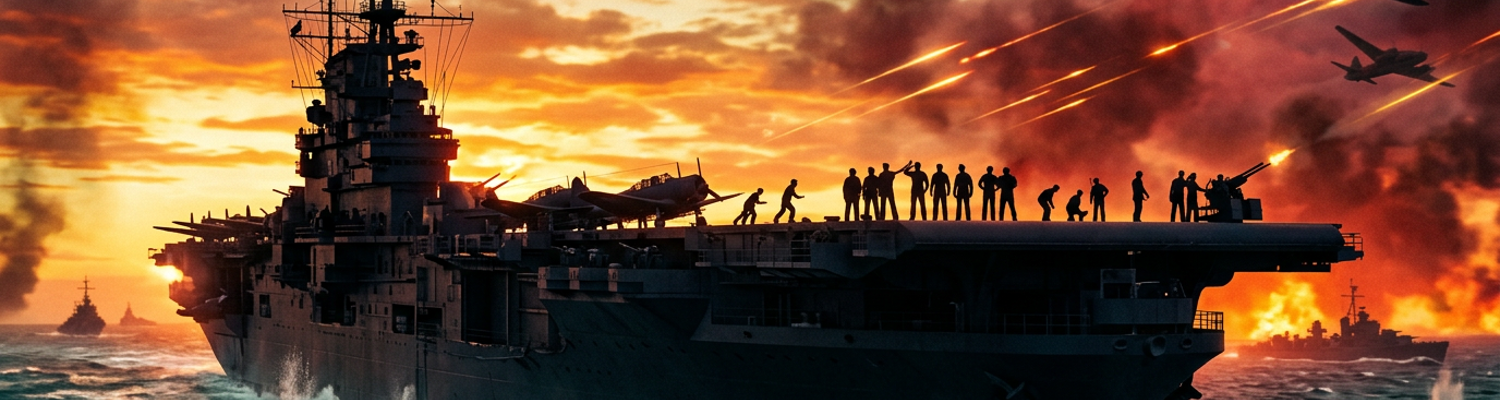
Hawaii faded into the wake of Task Force Eight as it assembled its carrier and escort cruisers at Pearl Harbor after Nimitz issued formal operational orders for the raid against the outer islands. Vice Admiral William F. Halsey Jr. eagerly took command of the ships, brushing aside the defensive anxieties of the Army as counterproductive hesitation. Deck crews at the naval shipyard worked through the night to load aviation fuel, 500 pound bombs, and ammunition crates aboard the carrier Enterprise and its screening cruisers. Line handlers cast off heavy mooring ropes from the concrete quays as the warships slipped down the main channel past the submerged wreckage of the battle fleet. Lookouts on Enterprise turned their binoculars toward the open Pacific as the task force cleared the harbor entrance and increased speed to sixteen knots.
Task Force Eight Sortie and Tactical Preparations
Boilers pushing sixteen knots of speed drove Enterprise through the deep sea swells under the direct operational command of Vice Admiral William F. Halsey Jr., who organized Task Force 8 into an expansive cruising formation. Heavy cruisers USS Northampton, USS Chester, and USS Salt Lake City formed a protective screening perimeter around the flagship, while nine destroyers of Destroyer Squadron Six spread out miles ahead to sweep the water with active sonar. Tactical coordination across this sprawling armada required absolute reliance on visual methods because Halsey enforced rigid radio silence to prevent Japanese shore direction finders from tracking their transit. Signalmen perched high on the carrier superstructure flashed tactical course changes across the wave crests using shuttered blinker lamps by night and colored signal flags hoisted along the yardarms by day. Lookouts and helmsmen across the formation strained their eyes through rough weather and darkened conditions to hold exact station distances, knowing that a single unshielded light or an errant radio transmission would reveal their position to prowling enemy submarines.
Destroyer engines executing evasion tactics against these submarines burned fuel at an alarming rate, forcing sailors aboard the fleet oiler USS Platte to rig heavy rubber fuel hoses across churning troughs of seawater to replenish the escort vessels. Destroyer captains brought their narrow hulls alongside the lumbering oiler, matching speeds within fifty feet of Platte while deck crews wrestled slippery messenger lines and heavy fueling rigs across the gap. Halsey monitored these delicate underway replenishments from the carrier catwalks, keeping his cruiser screening elements in a wide protective circle to shield the vulnerable oiler without transmitting a single radio message. Inter service friction back in Oahu complicated these tactical maneuvers, as Army air commanders refused naval requests to dispatch long range B 17 bombers to scout the sea lanes ahead of the fueling group. Army leadership insisted on keeping every operational bomber parked on Hawaiian runways for island defense, denying Task Force 8 any advance reconnaissance and forcing Halsey to push into hostile waters without knowing if Japanese surface patrols waited over the horizon.
Binoculars scanning the horizon offered the only early warning because paper navigational charts spread across the plotting tables inside the flag plot of Enterprise confirmed the acute reconnaissance limitations facing the carrier air groups and surface gunners. Naval intelligence officers possessed no modern aerial photographs of the Japanese installations across the Marshall Islands, leaving tactical planners with target surveys that were decades out of date. Staff navigators relied on brittle German hydrographic maps produced before the First World War alongside sketchy drawings produced by commercial merchant captains who had visited the atolls before Japan closed the mandate to foreign shipping. Hidden coral pinnacles, uncharted sandbars, and shallow reef passages around Kwajalein, Wotje, and Maloelap were marked with dangerous uncertainty, creating severe navigation hazards for American cruisers assigned to bombard shore installations at close range. Halsey traced the vague atoll contours with grease pencils, instructing his air group commanders to locate enemy airfields, hangars, and warship anchorages entirely by eye during their initial attack dives over the target islands.
Carrier Air Strikes Across Kwajalein and Roi-Namur
Target islands loomed in the minds of flight deck officers on Enterprise as they signaled the launch crews forward into the darkness before dawn on February 1, 1942, initiating coordinated multi squadron strikes featuring Enterprise Air Group squadrons VS 6, VB 6, and VT 6. Pilots climbed into the cockpits of Douglas SBD Dauntless dive bombers and Douglas TBD Devastators without the benefit of fresh Army aerial reconnaissance because joint service cooperation had broken down in Honolulu. Army commanders in Hawaii had refused to risk their heavy bombers on maritime scouting missions, forcing naval aviators to navigate across open ocean using dead reckoning and outdated hydrographic charts. Blue exhaust flames flickered along the carrier flight deck as thirty-seven dive bombers and nine torpedo planes rolled down the wooden planks, formed into tactical divisions, and climbed through low cloud layers toward the Japanese northern anchorages.
Anchorages in the north came into view when aviators from Scouting Six and Bombing Six reached the atolls at sunrise and initiated steep dive bombing and low level strafing attacks targeting Japanese hangars, shore infrastructure, and aircraft at Roi Namur and Taroa. Pilots pushed their SBD Dauntless dive bombers into seventy degree dives from twelve thousand feet, aiming directly at twin engine Mitsubishi bombers lined up along the coral airfields. Heavy anti aircraft fire burst around the diving planes as five hundred pound high explosive bombs detonated across concrete operations buildings, fuel storage depots, and maintenance hangars. Navy pilots pulled out of their dives just above the palm trees and used cowl mounted .50 caliber machine guns to sweep the runways, destroying enemy fighters before Japanese crews could get them airborne. Flight leaders noticed that the primary warship fleet was absent from the northern anchorages and redirected the remaining strike waves south toward the deeper waters of Kwajalein lagoon.
Kwajalein lagoon became the primary target as Lieutenant Commander Eugene Lindsey led nine Douglas TBD Devastators of VT 6 south across the outer reefs to execute low altitude torpedo attacks targeting Japanese naval auxiliaries and transport shipping. Torpedo crews leveled out fifty feet above the choppy lagoon water, facing concentrated fire from shore batteries and moored combatants as they lined up on their maritime targets. Pilots released their heavy Mark 13 torpedoes into the shipping channels, watching the weapons splash into the seawater and run toward converted merchantmen, supply tenders, and the cruiser Katori. Defective warheads failed to detonate against the hulls of the auxiliary transport ships, leaving the Japanese vessels undamaged while rear gunners in the Devastators manned their single .30 caliber flexible machine guns during the withdrawal back across the coral reef barrier.
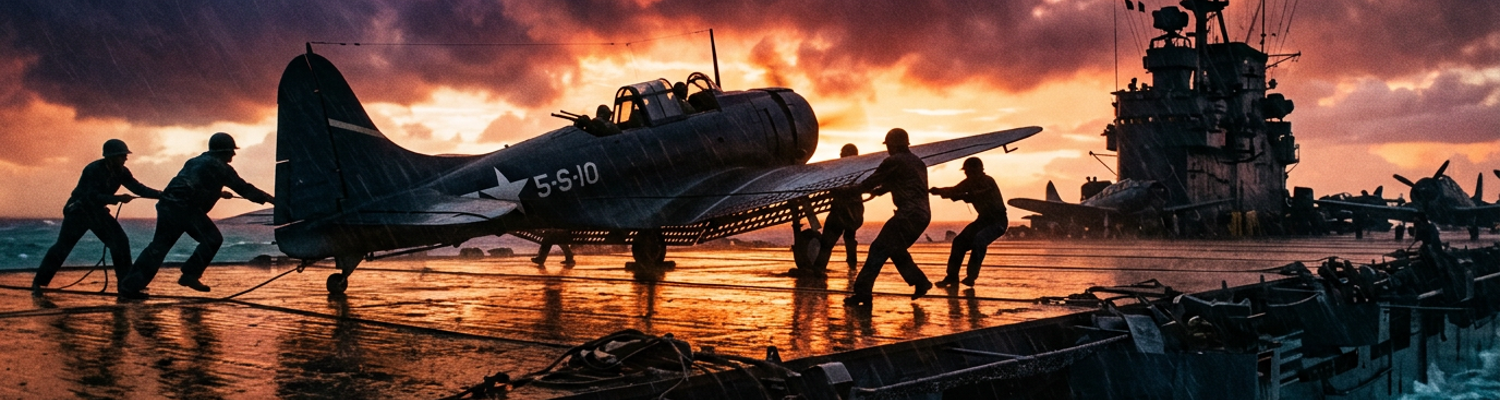
Pilots clearing the coral reef barrier returned to open ocean flying as Enterprise flight crews maintained a rapid turnaround cycle on the flight deck, watching returning dive bombers and torpedo planes slam onto the arresting wires. Armorers rolled carts of replacement bombs across the oil streaked wooden deck, hoisting fresh ordnance onto hot wing shackles while mechanics patched bullet holes in aluminum fuselage skins with fabric and dope. Halsey ordered a second wave of dive bombers launched against Kwajalein shore batteries and harbor infrastructure, ignoring warning dispatches from army and naval bureaucrats on Oahu who urged an immediate retreat to protect the carrier fleet. Deck catapults hurled the rearmed SBDs into the air as the task force altered course into the wind to sustain continuous flight operations.
Systemic Aerial Bomb and Mark 13 Torpedo Malfunctions
Deck crews sustaining continuous flight operations launched a second wave of Dauntless dive bomber pilots who pushed over into steep seventy degree dives above Kwajalein to drop their fresh payloads against reinforced hangars, fuel depots, and concrete command bunkers. Navy fliers placed their weapons directly onto fortified installations, but the strike suffered from a widespread incidence of unexploded 500 pound aerial bombs dropped against hardened shore targets. Steel nose fuzes sheared off upon striking thick concrete roofs, while delicate arming vanes failed to spin properly during the rapid descent from high altitudes. Aviators looked back through their cockpit canopies and saw heavy bomb casings bouncing off coral revetments or burying themselves into dirt berms without detonating. Bureau of Ordnance officials in Washington had repeatedly dismissed frontline warnings about brittle fuzes, stubbornly defending their prewar stockpile specifications and blaming combat pilots for improper release angles. These intact dud bombs left critical enemy coastal batteries undamaged, enabling Japanese shore gunners to maintain heavy defensive barrages against the departing American strike waves.
Aviators in the departing American strike waves included the torpedo crews of VT 6, who flew straight into those defensive barrages over Kwajalein lagoon only to encounter catastrophic weapon malfunctions of their own. Pilots dropped their heavy weapons from fifty feet above the water, but chronic failures of aerial Mark 13 torpedoes, which suffered from erratic depth running and defective exploder mechanisms upon impact, stripped the squadron of decisive results. Rudder controls inside the torpedo tails malfunctioned as soon as the weapons plunged into the seawater, sending the heavy torpedoes diving into the sea floor or veering off course across the coral shallows. Warheads that actually reached their targets struck the steel hull plates of Japanese transports and cruisers with loud metallic thuds, yet the defective exploder mechanisms crushed without detonating the main explosive charge. Naval weapons designers had guarded the secret blueprints of these complex exploders for years, refusing to let combat aviators conduct live fire drop tests or modify the fragile firing pins. Crews watched helplessly as target ships remained upright and operational, allowing Japanese airfield commanders on nearby atolls time to organize an immediate aerial response against Task Force 8.
Task Force 8 faced this aerial response when Japanese Mitsubishi G3M Nell bombers executed retaliatory counterstrikes against USS Enterprise after staging from nearby island airfields that dud American ordnance had failed to destroy. Lookouts aboard the carrier spotted five twin engine bombers breaking out of low storm clouds at midday, approaching in a tight V formation from the starboard quarter. Helmsmen spun the carrier steering wheel hard over as Enterprise heeled sharply into high speed evasive turns, while every anti aircraft battery along the catwalks erupted into continuous fire. Heavy aerial bombs plummeted around the turning warship, narrowly missing the flight deck and throwing towering columns of seawater across the wooden planks. Splinter fragments from the near misses peppered the carrier hull plates and severed minor electrical wiring, but the ship maintained full boiler pressure and thirty knots of speed through the swells. Anti aircraft gunners concentrated their tracer fire on the retreating Japanese formation, damaging the trailing bomber and forcing its pilot to break formation.
Smoke poured from the crippled Mitsubishi G3M Nell as its pilot broke formation and banked sharply back toward the carrier to attempt a suicide dive directly into the parked aircraft on the flight deck. Aviation Machinist Mate Bruno Gaido leaped into the rear cockpit of an SBD Dauntless secured on the flight deck and swung its twin .30 caliber machine guns toward the diving enemy plane. Tracer rounds poured from the machine guns of Gaido into the cockpit and wing roots of the bomber as the Japanese plane swept low over the carrier stern. The diving bomber sheared off the tail section of the parked Dauntless before spinning over the port catwalk and crashing into the sea alongside the ship. Vice Admiral Halsey immediately brought Gaido up to the navigation bridge and promoted him on the spot to Aviation Machinist Mate First Class for defending the carrier. Deck crews pushed the shattered wreckage of the Dauntless over the carrier catwalk and prepared the flight deck to recover the final returning strike planes.
White House Battle Reporting and Fleet Doctrinal Shifts
Aircraft returning from the target slammed onto the deck as steel arresting cables trapped the tailhooks of the Douglas dive bombers, allowing Enterprise to recover its air group and shape a high speed course back toward Pearl Harbor. Line handlers guided the fuel starved aircraft down to the hangar deck while flight surgeons treated wounded aircrew members in the sick bay. Maintenance mechanics patched bullet holes and cataloged remaining munitions while communications clerks in the carrier radio shack encoded preliminary after action dispatches. Chief radiomen transmitted these raw tactical summaries across secure naval frequencies to the Navy Department in Washington, where staff planners working under Admiral Ernest J. King gathered the incoming dispatches to evaluate how carrier combat doctrines functioned under genuine combat conditions. King compiled a comprehensive COMINCH battle analysis on February 6, 1942, delivering the assessment directly to the confidential file of President Franklin D. Roosevelt. White House couriers carried the classified folder into the Oval Office, where Roosevelt examined the detailed operational performance of the first offensive American naval strike of the Pacific War.
President Roosevelt studied these Pacific War operations as he reviewed official documentation inside the report detailing the destruction of several Japanese auxiliary vessels caught at Kwajalein lagoon, including converted patrol craft, cargo hulls, and armed merchant tenders. Fleet analysts balanced these confirmed maritime sinkings against severe technical critiques regarding the reliability of frontline Navy ordnance. Tactical records revealed that Mark 13 aerial torpedoes had repeatedly malfunctioned, either plunging directly into the lagoon mud due to faulty depth rudders or failing to detonate when their firing mechanisms crushed against steel armor plates. Dive bomber pilots reported that their 500 pound general purpose bombs had cracked upon impact or bounced harmlessly off Japanese concrete bunkers because of brittle nose fuzes and defective arming vanes. Ordnance bureaucrats in Washington faced direct challenges from fleet officers as these verified mechanical failures explained why key Japanese combatant warships and fortified shore batteries had survived the American bombardment largely undamaged. Naval evaluators stressed that frontline pilots had executed their missions with skill, only to have their tactical success undermined by substandard torpedoes and dud bombs.
Torpedo failures and dud bombs could not overshadow the broader operational success, as King utilized this combat evidence from Task Force Eight to settle the strategic dispute that had paralyzed joint military planning across Hawaii. Combat data provided definitive strategic validation for independent carrier task force operations, proving that fast mobile warships could strike deep into fortified island perimeters and withdraw before land based enemy bombers could organize a destructive response. These tactical achievements decisively discredited the static harbor defense doctrines championed by land based Army commanders, who had demanded that Pacific Fleet carriers remain tethered to the beaches of Oahu. Lieutenant General Delos Emmons had repeatedly insisted that valuable carriers must serve as anchored anti aircraft shields to protect territorial bases from anticipated Japanese invasion forces, but the raid demonstrated that carrier mobility offered far greater protection than stationary fortifications. Bureaucratic pressure from the War Department faded as the White House recognized that aggressive carrier raids disrupted Japanese offensive timetables and forced enemy commanders onto the defensive. Admiral Chester Nimitz leveraged the presidential endorsement of the COMINCH report to reject further Army interference, directing his task force commanders to plan fresh offensive strikes against Japanese garrisons across the central Pacific.