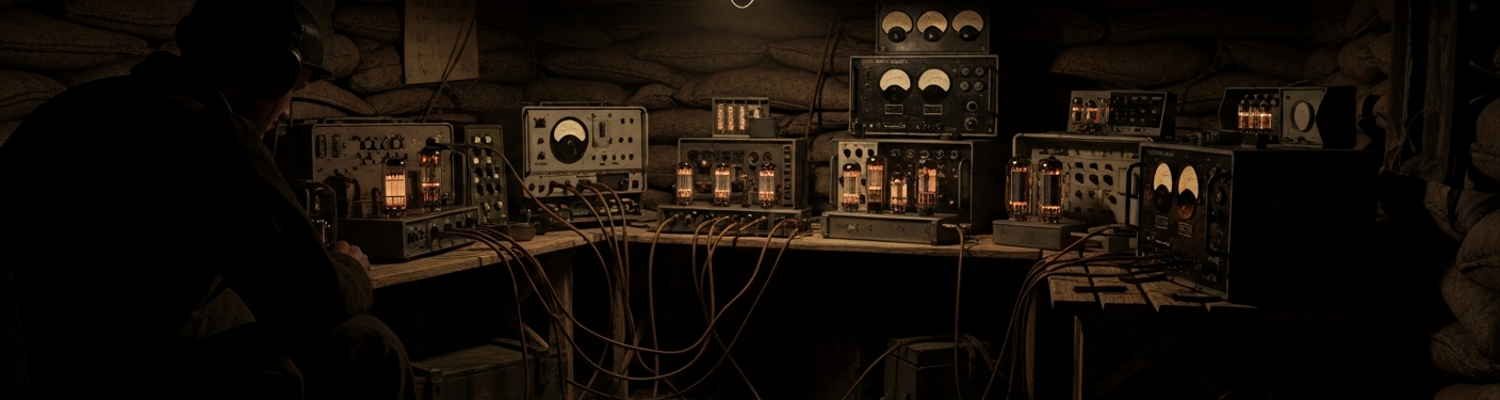

The static hiss from the radio net gave way to a broken transmission. German armor, heavy and entirely unexpected, was moving on the perimeter. That single, panicked report signaled the unraveling of a carefully planned offensive and the start of a protracted agony.
Operation Shingle began on January 22, 1944. It was a major Allied amphibious assault intended to resolve the grinding stalemate in Italy. An initial force of 36,000 men and thousands of vehicles, primarily from the U.S. VI Corps under Major General John P. Lucas, landed on the coast. The force included the U.S. 3rd Infantry Division, elements of the U.S. Rangers, and the British 1st Infantry Division. The landings at the coastal towns of Anzio and Nettuno, roughly 33 miles south of Rome, achieved complete tactical surprise.
German coastal defenses were almost nonexistent. A few engineer companies were caught completely off guard, many of their personnel captured while they slept. The initial assault on Peter Beach by the British and other zones by the Americans was virtually unopposed. This created a surreal atmosphere of calm. The operational plan required Lucas to secure the beachhead and then advance inland. The absence of immediate German resistance, however, became a source of command indecision, not an opportunity for rapid exploitation. Lieutenant-General Mark Clark, the Fifth Army commander, had previously cautioned Lucas against overextending his forces. This advice reinforced Lucas’s own cautious nature.
The silence was a trap.
The purpose of Operation Shingle was to outflank the formidable Gustav Line, a heavily fortified German defensive belt stretching 100 miles across the Italian peninsula. Anchored on mountainous terrain, particularly the strategic heights of Monte Cassino which dominated the Liri Valley, the Gustav Line had halted the Allied advance during the winter of 1943-1944. The fighting there had devolved into a war of attrition with high casualties for minimal gains. Shingle was conceived as an end-run around this static front. By landing forces behind the German Tenth Army, planners intended for VI Corps to thrust toward the Alban Hills. This maneuver would sever the Germans' main supply arteries, Highways 6 and 7, compelling them to abandon the Gustav Line or risk encirclement.
Success depended entirely on the quality of Allied intelligence and the speed of their subsequent actions. Pre-invasion intelligence, particularly from ULTRA decrypts, had been exceptionally accurate in identifying the weakness of German coastal garrisons at Anzio. This success fostered a dangerous underestimation of the German capacity to react. While the Allies knew what forces were present at the point of attack, they failed to predict the speed and decisiveness of the German response. The German commander in Italy, Field Marshal Albert Kesselring, reacted with remarkable swiftness. Within hours of the landing, he initiated Case Richard, a pre-planned countermeasure. He ordered elements of the 4th Parachute and Hermann Göring Panzer Divisions to seal the roads leading from Anzio. Drawing reserves from northern Italy, France, and even from the Gustav Line itself, Kesselring assembled elements of eight German divisions to encircle the beachhead within a week. By January 25, the German 14th Army under General Eberhard von Mackensen had established a solid defensive ring, turning a planned offensive into a desperate, static defense.
A review of operational logs from Allied listening posts shows a dramatic shift in the volume of German radio traffic within hours of the landings. The initial surprise gave way to a high-volume cascade of signals as Kesselring initiated Case Richard. Allied signals intelligence, particularly high-grade ULTRA decrypts of Enigma-coded messages, provided an almost immediate and terrifyingly clear picture of the German reaction. Intercepts detailed Kesselring’s orders at 0500 on January 22, just three hours after the first landings, directing the 4th Parachute Division and elements of the Hermann Göring Panzer Division to block all roads leading inland from Anzio toward the Alban Hills. This was not a panicked response; it was the activation of a well-rehearsed contingency plan. The Allied VI Corps command staff began receiving intelligence reports detailing the orders given to Generaloberst Eberhard von Mackensen to take command of the newly designated Fourteenth Army and orchestrate the encirclement.
Archival evidence shows that Allied intelligence furnished VI Corps headquarters with a remarkably precise and rapidly updating order of battle for the assembling Fourteenth Army. The intercepts detailed the plan for a massive counter-offensive, codenamed Operation Fischfang (Operation Fish Trap). The German objective was unambiguous: to drive a wedge down the Albano-Anzio road, split the Allied beachhead, and annihilate it. The decrypted orders laid out a two-echelon assault. The first wave, intended to rupture the Allied front lines, would consist of the 3rd Panzergrenadier Division, the 715th Infantry Division, and the 114th Jäger Division, spearheaded by the elite Infantry Lehr Regiment. This initial attack was planned for a narrow four-mile front to maximize its force. Allied commanders were reading these intentions, knowing the exact units tasked with their destruction and the intended axis of their attack along the Via Anziate.
The intelligence became even more specific. It detailed the deployment of formidable armored reserves intended to exploit the breach created by the infantry. Decrypts followed the movement of the 26th Panzer Division under General Smilo von Lüttwitz and the veteran 29th Panzergrenadier Division as they were positioned for the second phase of Fischfang. Even more alarmingly, SIGINT tracked the commitment of independent heavy tank battalions. The arrival of the 508th Heavy Panzer Battalion, equipped with 45 Tiger I tanks, was noted with particular concern. The journey of this unit was a drama revealed by intelligence. Rail transport was abandoned far from the front due to Allied air superiority, forcing the heavy tanks to undertake a 200-kilometer road march that resulted in 60% of them suffering mechanical breakdowns before reaching the assembly areas near Aprilia. Despite these issues, the presence of even a handful of operational Tiger I tanks, alongside Panther tanks also identified in the build-up, posed a direct threat to the Allied M4 Shermans. The intercepts were so detailed that by February 12, the Germans themselves acknowledged that the Allies were well-informed of their movements, forcing them to attempt to disguise the final assembly of their armored reserves behind the Cisterna front just before the attack commenced at 0630 on February 16.
Operational logs from Allied signals intelligence units at Anzio reveal a system strained to its breaking point. The ULTRA program, which had provided clear intelligence on the initial German reaction, began to falter under the pressure of high-tempo operations. The core problem was the unavoidable time lag between the interception of a raw German Enigma-coded message and the delivery of its deciphered content to VI Corps headquarters. This was not a failure of the codebreakers at Bletchley Park, but an institutional friction inherent to the process. A German signal first had to be intercepted by a forward listening post, such as those operated by elements of the 128th Signal Radio Intelligence Company, then transmitted back to the United Kingdom for decryption. Once broken, the intelligence was analyzed, sanitized to protect the source, and then transmitted back to the Special Liaison Unit attached to VI Corps. Under optimal conditions, this cycle could take hours. During the Anzio crisis, it often stretched to days. A message sent on a Monday detailing German armored assembly points for the Fischfang counteroffensive might not arrive in General Lucas’s hands until Wednesday, by which time those units had already moved to new positions.
Compounding these delays were intermittent failures of the specialized listening equipment on the beachhead. The damp, saline environment of the coastal plain damaged the delicate electronics of the Allies' radio intercept and direction-finding gear. Field reports from signal companies frequently mention malfunctions in receiver sets and power generators, problems made worse by a shortage of specialist technicians and spare parts within the besieged perimeter. German artillery, particularly the infamous Anzio Annie railway gun, deliberately targeted antenna arrays and command posts. This physical damage severed the collection of raw intelligence at its source. For hours and sometimes entire days, key German radio nets would go silent to Allied ears, not because of German radio discipline, but because the equipment to listen to them was broken, awaiting repair under shellfire. These technical blackouts created gaps in the intelligence picture, especially in the 48 hours leading up to the main German assault on February 16, leaving analysts to guess at the enemy’s final dispositions.
Even when intelligence was timely and the equipment functioned, it was subject to misinterpretation. The G-2 intelligence section of VI Corps received a flood of data, not just from ULTRA, but from tactical reconnaissance, prisoner interrogations, and frontline reports. The sheer volume of information, some of it contradictory, created a confusing picture. While ULTRA had correctly identified the participating German divisions for Fischfang and their general objective, it was less clear about the precise timing and weight of the main blow. German communications security improved after the initial landings, with greater use of landlines that were immune to interception and tactical codes that could not be broken in time to be actionable. The Germans also engaged in radio deception, creating false signals to suggest attacks in one sector while massing forces in another. Faced with this ambiguity and operating under institutional caution, the VI Corps staff failed to appreciate the full scale of the armored force concentrating against the 45th Infantry Division’s front along the Albano-Anzio road. The intelligence pointed to a major attack, but the belief that it would be a piecemeal assault persisted, a misinterpretation that left frontline units inadequately prepared for the concentrated weight of the German panzers.
The intelligence vacuum in the days following the initial landing contributed directly to the creation of a bloody stalemate. A review of VI Corps' operational posture shows that Major General John P. Lucas prioritized consolidating the beachhead over a rapid inland thrust. This cautious approach was amplified by the lack of clear, real-time intelligence on enemy dispositions beyond the immediate coastal area. The landing force had achieved surprise, but the window of opportunity was brief. Lucas’s decision to dig in, expecting a German counterattack rather than exploiting the enemy’s momentary disarray, gave Field Marshal Albert Kesselring the exact advantage he needed. By January 25, Kesselring had already moved elements of the Hermann Göring Panzer Division and 3rd Panzergrenadier Division into a picket line. The new German Fourteenth Army under General von Mackensen was forming to create an iron ring around the beachhead. An intelligence picture that was either days old, technically compromised, or not trusted by the command staff meant that the opportunity for a swift advance on the Alban Hills was traded for the perceived security of a fortified perimeter. This decision transformed a potential turning movement into a static siege.
The beachhead became a killing box.
This siege rapidly devolved into one of the most brutal killing grounds of the Italian campaign. The low-lying, reclaimed marshland of the Pontine Marshes offered virtually no natural cover for the Allied soldiers trapped within the perimeter. From the Alban Hills and surrounding high ground, German artillery observers could see every square inch of the Allied position, from the frontline trenches to the supply dumps and field hospitals by the port. This allowed for devastatingly accurate and sustained bombardment from over 370 German artillery pieces, including the notorious 280mm K5 railway gun the Allies nicknamed Anzio Annie. Life in the beachhead, which was never more than fifteen miles wide and seven miles deep, meant living under constant, observed fire. The fighting took on the character of World War I trench warfare, with units bleeding for days over possession of shattered objectives like The Factory near Aprilia. The result was a horrific rate of attrition that, over the four months of the stalemate, would produce over 40,000 Allied casualties.
The cost for Anzio was a direct consequence of this prolonged, static fighting. The total figure included nearly 7,000 killed and thousands more wounded or missing. American forces suffered approximately 24,000 combat casualties and the British nearly 10,000. An additional 37,000 non-combat casualties, a significant number from trench foot, exposure, and diseases like malaria in the flooded marshlands, further drained Allied strength. This cost was exemplified by specific, disastrous actions born from a failure to appreciate the strength of the now-solid German ring. The attempt by the U.S. 1st and 3rd Ranger Battalions to infiltrate and seize Cisterna on January 30 was based on poor intelligence that suggested the town was lightly held. Instead, the 767 Rangers walked into a staging area for a German counter-offensive and were annihilated. Only six men returned to Allied lines. The two battalions were effectively destroyed, a loss symptomatic of the wider battle where units were fed into a meat grinder for negligible gains. The high casualty figures were not the result of a single climactic battle, but the accumulated cost of four months trapped in a geographic cage, a direct outcome of the initial failure to break out.
Post-operational analyses, exemplified by the candid internal review known as the 'Guy Jones Report', reveal a catastrophic series of intelligence failures. This after-action report, compiled for VI Corps command, did not focus on the tactical decisions of frontline commanders but on the systemic rot within the intelligence apparatus itself. It detailed a process crippled by institutional friction and an inability to combine disparate streams of information into a coherent, actionable picture. The report methodically detailed how the G-2 intelligence section of VI Corps was overwhelmed by a deluge of raw data. High-grade ULTRA decrypts from Bletchley Park, which confirmed the activation of German contingency plans, were arriving hours, and sometimes days, too late to be of tactical use. Simultaneously, the G-2 staff contended with a flood of frontline patrol reports, air reconnaissance photos, and prisoner-of-war interrogations that were often contradictory. The 'Guy Jones Report' concluded that there was no effective mechanism for intelligence fusion, the process of weighing, corroborating, and integrating these different sources. The result was paralysis. The command staff saw a picture of a major German build-up, but because the information was fragmented, they failed to grasp the sheer concentration of force being arrayed against a specific, narrow front.
This systemic breakdown was worsened by the technological fragility of early electronic warfare equipment. The damp, saline-heavy air of the Pontine Marshes proved corrosive to the internal mechanics of Allied radio receivers. Field logs from VI Corps' signal companies are replete with entries detailing persistent malfunctions in receiver vacuum tubes, short-circuits in power generators, and moisture damage to sensitive antenna components. Compounding the environmental degradation was a severe shortage of specialist technicians and replacement parts, a consequence of the tenuous supply line into the besieged port. Enemy action deliberately targeted this fragile infrastructure. German artillery was systematically directed against Allied command posts and their associated antenna arrays. These bombardments frequently severed the physical link for intelligence collection, creating intermittent but critical blackouts in Allied monitoring of German radio nets. For hours at a time, especially in the 48-hour window before the main Fischfang counteroffensive on February 16, key German command frequencies went silent to Allied listeners, not because of German radio discipline, but because the Allied equipment designed to intercept them was a wreck of twisted metal and shattered vacuum tubes.
Even when intelligence was timely, it fell victim to a sophisticated German deception campaign. While ULTRA had correctly identified the German divisions being assembled for Operation Fischfang, it provided less clarity on the precise timing and axis of the main assault. Following the initial shock of the landings, German units improved their communications security, relying more on secure landlines immune to interception. More critically, the German Fourteenth Army initiated a deliberate radio deception plan. This involved creating false radio traffic to suggest the massing of armored reserves in sectors away from the true point of attack. The VI Corps G-2 section, faced with ambiguous data and institutionally predisposed to caution, failed to definitively identify the primary threat axis. They saw multiple threats across the perimeter and failed to recognize that the bulk of German armor, including the 26th Panzer and 29th Panzergrenadier Divisions, was concentrating for a single, overwhelming blow along the Albano-Anzio road. The intelligence screamed of a coming attack, but the belief that it would be diffuse and piecemeal persisted, a final, fatal misreading that left the U.S. 45th Infantry Division directly in the path of a panzer onslaught it was not adequately reinforced to meet.
After-action reports and personal accounts of signals intelligence personnel reveal a unique and corrosive form of psychological distress. The men of the 128th Signal Radio Intelligence Company and other SIGINT detachments on the beachhead were not merely soldiers; they were unwilling observers, listening in real time to the operational tempo of the enemy. They became intimately familiar with the German Fourteenth Army, not as a faceless entity, but through the voices of its officers and men. Intercept operators would track a German artillery battery’s call for fire missions, hear the confirmation, and moments later, feel the ground shake as those same shells impacted Allied lines. This created a profound sense of helplessness. They possessed a god-like perspective on the enemy’s intentions but were utterly powerless to intervene directly. For the men at Anzio, this was a daily, hourly reality. They listened as German units confirmed receipt of supplies, requested medical aid, or conducted mundane radio checks, creating a humanized portrait of the very men whose destruction they were tasked to facilitate.
This sense of detached omniscience fed a crushing burden of perceived responsibility. An operator hunched over his receiver in a dank, sandbagged dugout near Nettuno would intercept a German transmission detailing the assembly point for a panzer counter-thrust. He would meticulously log it, pass it up the chain, and then wait. Hours or sometimes days later, reports would filter through Allied channels of a friendly position being overrun, with high casualties, by the exact unit he had identified. The time lag between intercepting a German plan and the dissemination of actionable intelligence meant that SIGINT personnel often knew of a threat long before the men on the frontline could be warned. They were the first to know about the massing of forces for Operation Fischfang, hearing the buildup in traffic as the 3rd Panzergrenadier and 715th Infantry Divisions prepared their assault. When these attacks fell with full fury on the US 45th Division, the intelligence personnel who had tracked them felt an acute sense of culpability, a feeling that they had failed to prevent the slaughter despite their foreknowledge.
The psychological pressure was compounded by the extreme combat stress of the beachhead itself. SIGINT personnel were not located in safe rear areas. Their posts were scattered within the besieged perimeter, making them as vulnerable as any other support unit to the constant German artillery fire. The soggy, marsh-like terrain was a constant enemy, causing trench foot and malaria while also degrading the sensitive electronic equipment essential for their mission. More terrifying was the random, high-velocity death delivered by the K5 Anzio Annie railway gun. The distinctive sound of the gun firing, followed by the agonizing wait for its 280mm shell to impact, was a form of psychological warfare that frayed the nerves of every soldier. A direct hit could, and did, destroy antenna arrays, command posts, and the men inside them, creating intelligence blackouts at the most critical moments. Living and working under these conditions, where death could arrive at any second, while simultaneously listening to the enemy plan your destruction, pushed these specialists to the absolute breaking point.