
Pre-Invasion Signal Planning and Prewar Army Doctrine
When examining the historical record of Operation Shingle, the timeline dictated by Allied High Command stands out as a severe constraint. Major General John P. Lucas received the formal directive to execute an amphibious landing at Anzio on December 18, 1943. Target D-Day was set for January 22, 1944. VI Corps staff had exactly thirty-five days to draft the entire signal annex for a multi-division assault force. Planners at the Caserta headquarters worked through the night calculating equipment loads, frequency allocations, and cryptographic distributions for British and American units. This compressed schedule forced staff officers to default to prewar training manuals. They copied standard tables of organization and equipment directly from Field Manual 24-5.
Archival evidence shows they planned for a textbook war.
The 63rd Signal Battalion deployed in January 1944 relying on doctrine assuming stable wire networks. Under the command of Lieutenant Colonel Charles E. Harrison, the battalion loaded transport ships at the port of Naples with thousands of miles of Field Wire W-110-B. This twisted-pair copper and steel cable weighed exactly 130 pounds per mile. Prewar doctrine dictated that wire would form the primary communication link for division and corps headquarters. Signalmen were trained to unspool this cable from RL-31 reel stands and DR-4 drums mounted on the back of moving jeeps (Standard Ordnance Catalog G-503). Technical guidelines instructed them to lay the lines in shallow trenches behind advancing infantry. The VI Corps signal plan projected that wire teams would establish a permanent trunk line from the landing beaches at X-Ray and Peter directly inland to the town of Cisterna within forty-eight hours. Planners allocated large amounts of cargo space for BD-71 six-line switchboards, BD-72 twelve-line switchboards, and hundreds of EE-8 field telephones. Command decisions prioritized these heavy wire spools over lightweight, battery-operated equipment. Troops of the 63rd boarded the landing craft with their standard complement of wire-laying vehicles.
Pre-invasion radio planning assumed uninhibited high-frequency communications across the beachhead.
A close review of operational logs indicates that VI Corps staff evaluated the topography of the Pontine Marshes around the port of Nettuno, located at 41 degrees 27 minutes North, 12 degrees 39 minutes East. Theoretical calculations based on these two-dimensional maps suggested that Amplitude Modulation signals would propagate cleanly from the shoreline to the Alban Hills. Signal officers assigned the SCR-284 and the vehicle-mounted SCR-299 radio sets as the primary wireless links for forward artillery observers and infantry command posts. These high-frequency systems operated between 3.8 and 5.8 megacycles. Prewar training documents stated these frequencies would cover a 20-mile radius over flat ground. Staff officers drafted the frequency allocation charts assuming zero terrain interference. They ignored the high water table and the damp, highly conductive peat soil of the reclaimed marshland. Operators of the SCR-284 relied on a GN-45 hand generator and a heavy BC-654 transmitter.
Ground wave attenuation was entirely omitted from the pre-invasion briefings.
General Lucas expected to maintain direct voice contact with his forward regimental commanders using the SCR-299s housed in standard shelter cabins on 1.5-ton trucks. These trucks were scheduled to roll off the landing craft and establish a continuous transmission net. Staff officers built the entire signal annex on the mathematical certainty of clean radio waves traveling directly over the flat Italian soil. Planners assigned overlapping frequencies to the 3rd Infantry Division and the British 1st Infantry Division based entirely on peacetime testing data gathered in the dry deserts of the American Southwest.
Artillery Bombardment and Surface Wire Destruction
A close review of operational logs from February 1944 reveals exactly how quickly the prewar manuals failed under high-explosive ordnance. General Eberhard von Mackensen positioned the heavy artillery batteries of the German 14th Army along the elevated ridges of the Alban Hills. This high ground provided German spotters with an unobstructed, panoramic view of the entire Allied beachhead spreading across the flat Pontine Marshes. Artillery crews manning 170mm Kanone 18 field guns and 210mm Mrs 18 howitzers dialed in their firing coordinates using highly accurate pre-war Italian topographical maps. They targeted the main supply routes. American signalmen from the 63rd Signal Battalion had unspooled their Field Wire W-110-B directly into these shallow transit trenches. The twisted-pair cables sat entirely exposed on the surface of the frozen mud along the primary transit corridors. German heavy artillery shelling systematically severed surface communication lines across the beachhead. When a 170mm high-explosive shell detonated near a surface trunk line, the expanding fragmentation ring ripped the copper and steel strands into hundreds of disconnected pieces. Splinters of hot metal sliced through the heavy rubber insulation. This grounded the conductive wires directly into the wet, highly conductive peat soil.
The physical destruction of the network occurred at a rate far outpacing any repair capacity.
Signal linemen dispatched to locate the breaks carried TL-29 electrician knives, friction tape, and heavy splicing pliers. They drove RL-31 reel-equipped jeeps directly into active impact zones along the Albano road. German spotters tracked these slow-moving vehicles from their elevated perches and directed 88mm Flak 36 airbursts to detonate directly over the repair teams. Shrapnel rained down through the canopy of the Padiglione woods. The jagged steel instantly snapped the overhead cables that American troops had strung through the pine branches just hours earlier. A single artillery barrage could sever a regimental wire grid in a dozen different grid squares simultaneously. The primary trunk line connecting VI Corps headquarters at Nettuno to the 3rd Infantry Division switchboards near Cisterna sustained over fifty separate breaks during a single three-hour bombardment on February 16. Switchboard operators stared at BD-71 and BD-72 units as the mechanical drop indicators froze.
This signaled a complete loss of line continuity across the entire northern sector.
Archival evidence shows the immediate tactical consequences of this severed infrastructure along the muddy banks of the Mussolini Canal. Forward posts of VI Corps were left isolated in pitch-black coastal fog without wire links. Elements of the 45th Infantry Division held defensive positions dug directly into the canal banks at 41 degrees 24 minutes North, 12 degrees 44 minutes East. Nighttime temperatures dropped rapidly. Dense, freezing fog pulled off the Tyrrhenian Sea and became trapped against the coastal plain. Visibility dropped to less than ten feet. Platoon leaders huddled in these forward outposts relied entirely on EE-8 field telephones to request defensive artillery support. When the German infantry advanced under the cover of the zero-visibility weather, American officers cranked the hand generators on their phones and heard only dead air. The physical wires connecting their handsets to the BD-72 switchboards in the rear had been completely severed by the afternoon shelling.
They were entirely cut off in the dark.
The moisture in the thick fog combined with the freezing temperatures to coat the broken wire ends in ice. This prevented any residual signal transmission through the wet ground. Without physical wire links, infantry battalions lost all contact with the rear artillery batteries. Commanders sitting inside reinforced switchboard dugouts cranked their generator handles repeatedly. They were desperately trying to ring the forward observation posts. The EE-8 receivers in the frontline dugouts emitted nothing. Signal repair teams attempting to navigate the pitch-black fog faced an impossible geometry problem, searching for millimeter-thin wire breaks in an expanse of freezing mud. Runners sent to carry handwritten messages between the isolated command posts routinely became disoriented in the thick coastal inversion layer. Many wandered directly into German patrols. Others stepped on Schu-mine 42 anti-personnel devices hidden in the wet peat soil. A standard infantry regiment required roughly forty miles of wire to maintain a basic operational grid.
The German bombardment erased that grid before midnight.
The 36th Field Artillery Regiment received zero transmission traffic for the next nine hours.
Luftwaffe Electronic Jamming and Beachhead Isolation
A close review of operational logs from the German 14th Army reveals a highly organized electronic countermeasure campaign coordinated directly from the peak of Monte Cavo. Luftwaffe signal intelligence detachments, specifically elements of the 3rd Radio Intercept Company, hauled heavy monitoring equipment up the steep elevation to coordinates 41 degrees 45 minutes North, 12 degrees 42 minutes East. Technicians working inside reinforced concrete bunkers activated high-powered jamming transmitters powered by dedicated diesel generators. These specialized electronic warfare units systematically scanned the Amplitude Modulation spectrum looking for American transmission signatures. German operators quickly identified the specific high-frequency channels allocated to the US VI Corps forward tactical units. They focused their 100-watt directional antennas straight down into the Anzio basin. This exploited the clear line of sight over the flat Pontine Marshes. Deliberate electronic interference was generated using mechanical tone wheels connected directly to the transmitter modulation circuits. This heavy machinery broadcast a continuous, sweeping audio frequency that overlaid the primary Allied communication bands.
Luftwaffe radio jamming targeted key high-frequency channels between 3.8 and 5.8 megacycles.
That specific bandwidth housed the primary tactical nets for every American infantry regiment operating on the beachhead. When the German counterattack launched at 0630 hours on February 16, the Luftwaffe operators synchronized their jamming sweeps with the initial artillery barrages. American operators manning the vehicle-mounted SCR-299 shelter cabins near Nettuno suddenly lost all incoming voice traffic. The 39-foot whip antennas on these trucks pulled in the dominant German signal instead of the weaker transmissions from frontline outposts.
Deliberate electronic interference severely paralyzed standard ground force radios.
Archival evidence shows the immediate breakdown of infantry coordination within the 45th Infantry Division. Forward observers attached to the 157th Infantry Regiment occupied shallow, waterlogged foxholes along the Albano road. These men relied entirely on the man-pack SCR-284 radio set to direct 105mm howitzer fire from the rear batteries. The equipment consisted of a heavy BC-654 transmitter and receiver unit powered by a GN-45 hand generator. German Panzergrenadiers advanced through the coastal scrub. American signalmen cranked the heavy generator handles at exactly sixty revolutions per minute to power up the internal vacuum tubes. They depressed their microphone buttons. The receivers emitted only the deafening, oscillating whine of the Luftwaffe jamming signal. Operators attempted to force their signals past the interference by holding down their transmission keys for extended periods. This emergency procedure overloaded the internal circuitry. The VT-65 vacuum tubes inside the BC-654 transmitters overheated. They shattered inside their protective metal casings. Signalmen unscrewed the back panels of their radios and found the glass components melted directly into the copper wire coils.
Battalion commanders lost all wireless contact with their forward companies.
Signal officers at VI Corps headquarters ordered immediate frequency shifts to bypass the jamming transmissions. To execute this change, staff planners distributed new frequency allocation tables using motorcycle couriers navigating the cratered transit routes. Frontline operators recalibrated their tuning coils and swapped out crystal oscillators to match the new channels. Atop Monte Cavo, the Luftwaffe intercept units monitored these shifts in real-time. Within forty-five seconds, German technicians adjusted their dials and followed the American operators to the new frequencies. Ground force radios remained entirely unusable for requesting artillery support or coordinating troop movements. Pinned down near the Carroceto overpass, infantry platoons abandoned their burned-out SCR-284 sets directly in the freezing mud. Company commanders reverted to firing M19A1 red star cluster flares into the coastal fog to signal their defensive positions to the rear artillery batteries.
By midnight, the 1st Battalion of the 157th Infantry Regiment had fought for six hours without a single functional radio link.
Conflicting Command Directives and Strategic Bureaucracy
A close review of operational logs from February 1944 reveals a disjointed chain of command connecting the Pentagon directly to the Italian coast. Staff officers in Washington issued conflicting communications directives during the battle that halted local command operations. Major General Harry C. Ingles, the Chief Signal Officer, distributed a theater-wide mandate on February 17 demanding strict radio silence across all high-frequency Amplitude Modulation bands. Intelligence analysts reviewing intercepted traffic from Caserta determined that German radio direction-finding units were successfully triangulating American command posts. The War Department directive explicitly ordered operators of the SCR-284 and SCR-299 radio sets to power down their transmitters to prevent further geolocation. Less than twelve hours later, a separate administrative department within the Pentagon issued an overriding requirement for continuous intelligence gathering. Army Ground Forces command dispatched an urgent teleprinter message to the VI Corps headquarters at Nettuno demanding mandatory hourly position updates from all forward infantry battalions. Bureaucrats thousands of miles from the frontline expected these simultaneous, contradictory orders to be executed without friction. Signal officers at the Anzio beachhead were forced to choose between violating the radio silence directive or ignoring the direct demand for hourly positional data.
They possessed no secondary communication networks to resolve the discrepancy.
Commanders attempting to satisfy both directives compromised their own defensive perimeters. Division signal officers ordered frontline operators to power up their heavy BC-654 transmitters exactly at the top of the hour. They were instructed to transmit a heavily compressed burst of positional coordinates and immediately shut down the GN-45 hand generators. German Luftwaffe signal intelligence detachments operating atop Monte Cavo quickly identified this predictable transmission schedule. Enemy technicians synchronized their direction-finding antennas to scan the 3.8 to 5.8 megacycle band precisely when the American operators powered on their equipment.
The hourly compliance reports handed the German artillery exact firing coordinates.
Remote administrative orders failed to align with immediate tactical realities on the shoreline. When Washington realized the radio bursts were being intercepted, bureaucrats drafted War Department Circular 114. This document mandated that all forward units encrypt every outgoing message. The directive required operators to process all tactical traffic through the mechanical M-209 cipher machine. This hand-operated device required a signalman to turn a series of six pin-wheels to encrypt text letter by letter, print the cipher onto a paper tape, and manually transmit the five-letter code groups using a J-38 Morse key. Washington staff officers assumed this process could be executed seamlessly inside a sterile command tent. Couriers delivered the encryption mandate to the 3rd Infantry Division command post located near coordinates 41 degrees 27 minutes North, 12 degrees 39 minutes East. Division signal officers dutifully relayed the order to the forward infantry regiments holding positions along the muddy banks of the Mussolini Canal. Platoon commanders dug into the freezing, waterlogged peat soil of the Padiglione woods received the instruction just as the German 14th Army launched a mechanized assault.
The administrative requirements failed instantly under enemy fire.
Frontline operators attached to the 15th Infantry Regiment attempted to comply with the new encryption directive while actively being assaulted. Signalmen huddled in shallow transit trenches pulled their M-209 cipher machines from canvas carrying cases. The internal gears and metal pin-wheels of the cryptographic devices immediately clogged with the wet, highly conductive mud prevalent across the Pontine Marshes. Encoding a standard twenty-word artillery request required roughly four minutes of continuous mechanical typing under optimal conditions. German Panzer IV tanks advanced at fifteen miles per hour through the coastal scrub. They closed the physical distance to the American foxholes long before a signalman could generate the required encrypted paper tape. When operators finally fed the ciphered Morse code into their transmitters, the receiving artillery batteries in the rear had to reverse the entire mechanical process to decipher the firing coordinates. Delays between a forward observer identifying a German target and the rear batteries firing their 105mm howitzers expanded from forty-five seconds to over twelve minutes.
American infantrymen threw the jammed cipher machines directly into the flooded trenches.
Archival evidence shows that frontline officers entirely abandoned the War Department protocols by the third day of the German counteroffensive. Regimental commanders explicitly ordered their signalmen to broadcast all artillery coordinates in raw plaintext over the open SCR-284 frequencies. They accepted the risk of German interception to ensure their own 155mm Long Tom artillery batteries could receive fire missions without the twelve-minute cryptographic delay. Signal operators locked their SCR-284 tuning dials to 4.2 megacycles and transmitted target coordinates in raw English.
Field-Expedient Antennas and Emergency Signal Restoration
A close review of operational logs from the 3rd Signal Company details the exact mechanical workarounds executed during the night of February 17. The standard 39-foot whip antennas mounted on the SCR-299 shelter cabins captured too much omnidirectional interference from the German jammers operating on Monte Cavo. To transmit a signal past the electronic blockade, American technicians had to abandon the prewar equipment manuals entirely. They constructed highly directional arrays from scratch. First Lieutenant Robert E. Vigus ordered his wiremen to salvage undamaged sections of Field Wire W-110-B from the cratered Albano road. Working in the dense coastal scrub at coordinates 41 degrees 31 minutes North, 12 degrees 39 minutes East, the men stripped the heavy rubber insulation from the twisted copper and steel strands using their TL-29 electrician knives. They discarded the steel fibers to reduce electrical resistance. Operators then spliced the bare copper metal directly into the antenna tuning units of their heavy BC-610 transmitters.
The men calculated the specific lengths required to build half-wave dipole antennas tuned precisely to 4.2 megacycles.
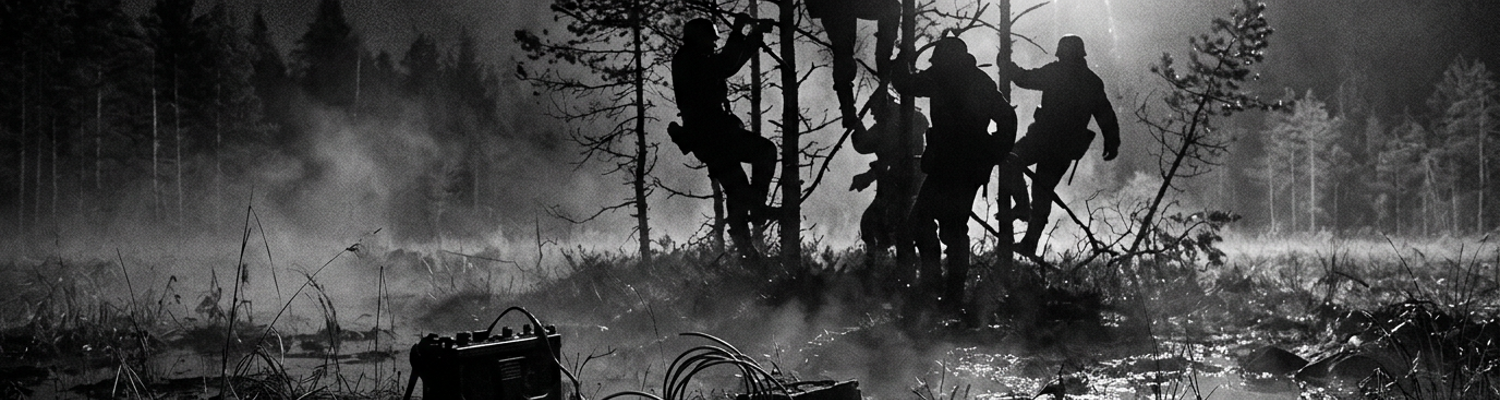
Stringing these improvised rigs exposed the signalmen directly to enemy observation. Luftwaffe aircraft circled the Anzio basin at 3,000 feet, dropping parachute flares to illuminate the American defensive lines. These magnesium canisters ignited with a blinding white intensity of 1.2 million candlepower. The chemical fires burned for three solid minutes as they drifted slowly toward the freezing mud. Signalmen clutching their stripped copper wires climbed twenty feet up the trunks of the umbrella pines in the Padiglione woods while the flares turned the nighttime sky into broad daylight. German forward observers directing 120mm mortar teams immediately spotted the silhouettes of the technicians against the bright white canopy. Mortar rounds detonated in the soft peat soil below the trees, sending jagged steel shrapnel upward into the branches. Technicians ignored the explosions and tied the copper wire ends to the pine boughs. They stretched the array exactly 111 feet across the clearing to match the physical wavelength of the radio frequency. They angled the broadside of the newly constructed dipole directly away from the German jammers on Monte Cavo and aimed it straight toward the 155mm artillery batteries positioned near Nettuno.
The directional orientation physically blocked the sweeping audio interference of the German transmitters.
Archival evidence shows this ad hoc field engineering rapidly expanded to bypass internal hardware failures across the 45th Infantry Division. Frontline operators attached to the 157th Infantry Regiment lacked replacement VT-65 vacuum tubes for their man-pack SCR-284 radio sets. The original glass components had melted during the initial jamming sweeps. Platoon sergeants scrounged the beachhead for destroyed Sherman tanks and knocked-out M8 Greyhound armored cars. They unbolted the shattered SCR-508 radio chassis from the smoking hulls. Technicians extracted intact 12-volt dynamotors and mismatched vacuum tubes from the armored vehicle debris. Operators dragged these heavy components back to their waterlogged foxholes along the Mussolini Canal.
Connecting the salvaged parts required raw physical modification.
Signalmen used friction tape and raw copper wire to force the armored vehicle components to interface with the infantry radio sets. The standard GN-45 hand generators could not produce enough sustained amperage to power the heavier salvaged dynamotors required for the transmission burst. Motor pool mechanics jacked up the rear axles of Willys MB jeeps, removed the rubber tires, and bolted the hand generator shafts directly to the spinning wheel hubs using modified lug nuts. Drivers locked the manual transmissions in second gear and let the four-cylinder engines idle. The mechanical rotation of the jeep axles spun the hand generators at a constant, high-speed velocity. This pushed a steady, high-voltage electrical current into the modified BC-654 transmitters. When the operators keyed their microphones at 0415 hours, the jury-rigged systems pushed a concentrated, amplified radio wave through the improvised dipole antennas suspended in the pine trees.
The 155mm Long Tom batteries at Nettuno received the firing coordinates loud and clear.
Artillery observers immediately fed grid references into the modified headsets. The transmission bypassed the Monte Cavo jammers entirely due to the narrow beam width of the suspended copper wire arrays. Within sixty seconds of the initial broadcast, American artillery crews loaded high-explosive shells into the breeches of their M114 howitzers. The firing lanyards were pulled, sending 95-pound projectiles over the heads of the signalmen still clinging to the pine branches.