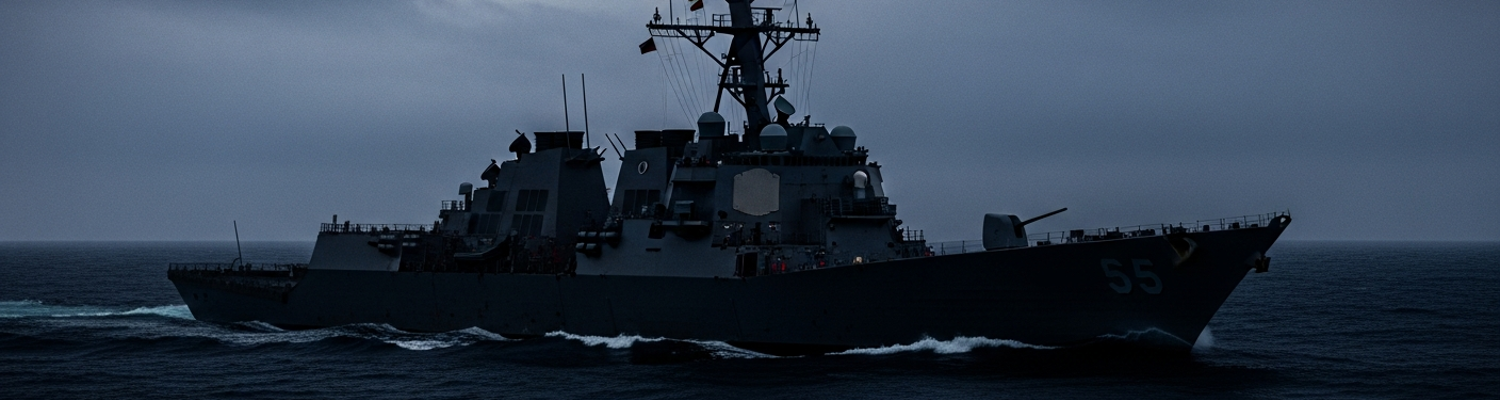

Triumph was not the feeling on the decks of the fleet. The Cold War's end brought a long, grinding decay. The expected peace dividend arrived as a cascade of deep budget cuts that struck the U.S. Navy with punishing force. A close review of operational logs and budget documents from the early 1990s reveals a sharp downturn in fleet readiness that directly correlated with reduced funding. The fleet shrank from a force of over 500 ships to around 290. This placed an extraordinary burden on the remaining vessels.
This new operational reality was codified in policy. The 1993 Bottom-Up Review formally accepted a smaller force structure. It failed, however, to reconcile the reduced budget with the high operational tempo demanded by global commitments. For the crews of Aegis cruisers like the USS Ticonderoga and the expanding fleet of Arleigh Burke-class destroyers, this meant longer deployments, deferred maintenance, and a constant state of making do.
Ships designed for a 35-year service life were suddenly at risk of premature aging. The practice of cannibalizing parts, stripping components from one vessel to keep another combat-ready, became disturbingly common. This was not a strategic choice. It was a necessity born from a supply chain starved of funds and an industrial base that was beginning to shrink. Deferred maintenance became a rolling wave of future problems. Corrosion and wear compounded into more expensive and time-consuming repairs down the line.
For the Aegis Combat System, financial allocations for maintenance and upgrades became a labyrinth of competing priorities. The core of Aegis, the AN/SPY-1 radar, was a marvel of 1980s technology, but it required constant, intensive upkeep. By the mid-1990s, archival evidence shows a spike in casualty reports related to the SPY-1 transmitter groups. Cruisers and destroyers reported over 100 such failures each within a 12-month period. While the Navy initiated cruiser modernization programs in the late 1990s, funding was often constrained. Upgrades were often piecemeal. Funding in the mid-90s allocated small amounts, like $300,000, for SPY-1 radar system analysis, while larger sums were budgeted to begin upgrades for specific baselines. The move to a more open architecture using commercial off-the-shelf (COTS) components was intended to reduce long-term costs, but the transition itself was a complex and expensive undertaking. The Aegis system’s software, once a revolutionary advantage, became a dense collection of layered, underfunded patches instead of integrated rewrites. A contract to modernize the USS Bunker Hill (CG-52) in 2006 for $20.8 million was a key step, but it showed how long it would take to bring the whole fleet to a common, modern standard. All the while, crews operated systems with known deficiencies and lengthening repair backlogs.
Budgets did not deter the threat. While American naval planners grappled with shrinking funds, near-peer adversaries invested heavily in anti-ship missile technology. The goal was simple: to render the Aegis system obsolete. The chief threat which shaped doctrine and panicked engineers was the Russian P-270 Moskit, known to NATO as the SS-N-22 Sunburn. It was not an incremental improvement over older sea-skimmers like the French Exocet. The Sunburn was a ramjet-powered weapon capable of Mach 3 at high altitude and, more critically, Mach 2.2 just meters above the waves. This velocity compressed the detect-to-engage sequence for an Aegis crew to a terrifying 25 to 30 seconds. Its 300-kilogram warhead was designed to cripple a major surface combatant with a single impact.
This threat became alarmingly tangible. Between 1999 and 2006, China purchased four Sovremenny-class destroyers from Russia, warships whose primary armament was the Sunburn missile. The first of these vessels transited the Taiwan Strait in early 2000, placing the weapon system squarely in the Pacific theater. A close review of naval intelligence assessments from this period reveals a growing concern over not just the Sunburn, but also its successors. The P-800 Oniks (SS-N-26 Strobile), which entered service in 2002, presented an even more complex challenge, with a dual-mode guidance system and a flight profile that combined high-altitude cruising with a low-altitude terminal approach. These weapons performed aggressive, high-G terminal maneuvers specifically to defeat an Aegis ship’s defenses. The AN/SPY-1 radar had to be specially configured to focus either on high-altitude threats or low-level sea-skimmers, but not both simultaneously without significant upgrades. This created a dangerous tactical choice for commanders and increased the need for sustained investment in radar processing and software updates, the very things the peace dividend had put on the chopping block.
Evolution was not a choice. It was survival. This new generation of supersonic threats made continuous Aegis Combat System upgrades a matter of life and death. The piecemeal, underfunded patches of the 1990s were insufficient. The response came in the form of Aegis Baselines, integrated hardware and software packages designed to counter specific kinematic threats. The Baseline 5 upgrades in the late 1990s were a direct answer, introducing the AN/SPY-1B/D radar variants with significantly faster processing to handle the reduced reaction times. Even this was a stopgap.
The real shift in capability came with Baselines 6 and 7. These upgrades were built around a new defensive paradigm: layered defense and networked engagement. Baseline 6 began the difficult process of integrating the RIM-162 Evolved Sea Sparrow Missile (ESSM), a weapon designed specifically to intercept high-speed, maneuvering anti-ship missiles. The ESSM could be quad-packed into a single cell of the Mark 41 Vertical Launch System, dramatically increasing a destroyer’s missile loadout.
A more profound change was the introduction of the Cooperative Engagement Capability (CEC). Acknowledging that a single ship’s radar could be overwhelmed or deceived, CEC networked the sensors of an entire battle group, including ships and E-2 Hawkeye aircraft, into a single, integrated fire-control system. This was a monumental engineering task. It required the development of the Cooperative Engagement Processor and a high-bandwidth Data Distribution System to fuse sensor data into a single, real-time track picture available to every ship in the network. The system, which reached initial operational capability in the late 1990s and full capability by 2005, was revolutionary. It allowed a ship to fire on a target using another ship’s or aircraft’s sensor data, a concept known as Engage on Remote.
For the enlisted personnel inside the Combat Information Center (CIC), these upgrades translated into a complete and stressful overhaul of their professional lives. The 30-second engagement window against a Sunburn missile was not a theoretical construct; it was the literal countdown governing every watch. Human reaction time was now a liability, forcing a greater reliance on the system’s automated modes. Training drills, endlessly repeated, focused on building muscle memory and absolute trust in the machine. Operators became monitors of a system making engagement decisions at microsecond speeds. The introduction of CEC created new layers of psychological pressure. A Fire Controlman on the USS Arleigh Burke could now be responsible for an engagement happening over the horizon, based entirely on sensor data from an E-2D aircraft hundreds of miles away. This doctrine demanded a new level of trust, not just in one’s own equipment, but in the seamless functioning of a complex, dispersed network. A software glitch or data-link failure on a different vessel could have catastrophic consequences for your own. The new protocols required operators to maintain situational awareness on a scale previously unimaginable, processing targeting information from across the entire battle group while simultaneously defending their own ship from immediate, high-speed threats. The margin for error was nonexistent.
The AN/SPY-1 radar was unblinking. It demanded the same from its human operators. For the enlisted technicians and operators inside the CIC, this translated into a grinding, 24/7 watchstanding requirement that became the defining feature of their existence. A close review of watch bills from Aegis cruisers and destroyers in the post-Cold War era reveals the prevalence of demanding schedules like the five and dime: five hours on watch, ten hours off. This 15-hour cycle deliberately broke from a natural 24-hour day. Sleep patterns were constantly disrupted. Within the cold, perpetually darkened CIC, an Operations Specialist (OS) would spend their five hours staring into the green or amber glow of a UYK-43 display console, responsible for building a coherent tactical picture from the raw data flooding in. Beside them, a Fire Controlman (FCA) would be focused on the Aegis display itself, their entire world compressed to monitoring the status of the weapon system, ready to act within the 30-second window a supersonic threat allowed. Deeper within the ship, an Aegis Computer Technician (ACT) monitored the literal heart of the system, a bank of computers that required constant oversight. The ten hours off were a fiction. This time was consumed by maintenance, departmental training, cleaning duties, and the endless pursuit of qualifications, all before attempting to find a few hours of sleep before the cycle began again.
Survival depended on automation, but automation depended on flawless human training. The path for an Aegis Fire Controlman was long, beginning at basic electronics training at Great Lakes, Illinois, before moving to the Aegis Training and Readiness Center (ATRC) in Dahlgren, Virginia, for specialized C School. Here, sailors spent months learning the incredibly complex network of systems they would be responsible for. They were trained not just to operate the system, but to diagnose and repair it, memorizing the functions of hundreds of individual circuit cards and learning to navigate the dense software of older Aegis baselines. Training logs from the period indicate a heavy emphasis on the Aegis Combat Training System (ACTS), a powerful simulator that could use the ship’s actual CIC equipment to run hyper-realistic scenarios. The ship’s training teams could script complex, multi-axis attacks involving high-speed, sea-skimming cruise missiles and high-diving ballistic threats, forcing the watch team to respond. These were not academic exercises; they were repetitive drills designed to build the muscle memory required to execute a detect-to-engage sequence in under half a minute, where a single incorrect button press could result in a simulated kill.
The operational tempo was a physical presence. A constant tension. Shattered at any moment by the sudden, piercing electronic tone of the General Quarters alarm over the 1MC ship-wide announcement system. It was the sound of normal life ending. Regardless of the time, whether during a meal, in the middle of complex maintenance, or in the dead of night, the call sent every sailor running. The ship’s passageways would become a controlled chaos of sailors moving to their assigned stations, following designated traffic patterns: forward and up on the starboard side, down and aft on the port side. As they ran, they donned flash hoods and gloves and set material condition Zebra, sealing every designated door and hatch to make the ship watertight. For the CIC team, it meant sprinting back to the very consoles they may have just left hours before. These drills were a constant and unpredictable feature of life at sea, designed to test the crew’s response to everything from inbound missile attacks to fires and flooding. Ship logs show that these were not rare occurrences, but often weekly or even daily events during work-up cycles, destroying any semblance of a predictable schedule and grinding down the crew’s physical and mental endurance long before they reached a combat zone.
The CIC was a windowless world of manufactured twilight, a space existing outside of time and place. For the enlisted operators within, it was an assault on the senses. The dominant sensation was the noise, a constant, pervasive hum from cooling fans and power converters for the racks of equipment that formed the ship’s electronic nervous system. It was a sound punctuated by the high-pitched whine of cathode-ray tube displays and the clicking of relays from deep within the AN/UYK-43 computer cabinets. The air carried the distinct metallic scent of ozone generated by high-voltage electronics, mingling with the smell of stale coffee. Visually, the space was a study in contrasts: deep darkness broken by the sharp, hypnotic glow of radar scopes and tactical displays. An Operations Specialist would spend their watch staring into this amber or green light, their eyes adjusting to a reality composed entirely of symbols and vectors on a screen. Deeper in the ship’s core, in the Aegis equipment rooms, the environment was even more extreme. Here, technicians worked next to the powerful transmitters for the AN/SPY-1 radar, spaces where the ambient temperature could be punishingly high and the electronic hum was a physical vibration felt in the deck plates.
This existence was defined by sustained, high-stakes vigilance. The mental strain on a watchstander was a direct product of the threat. With a supersonic sea-skimming missile allowing only seconds from detection to impact, human reaction time became a system vulnerability. This forced an absolute reliance on the Aegis system’s automated modes, turning the Fire Controlman from a hands-on gunner into a monitor of the machine. The psychological pressure was a state of prolonged, anxious boredom, where hours of uneventful monitoring could be shattered in an instant by the piercing tone of a new threat detection, the Vampire call that signified an inbound anti-ship missile. This tension was compounded by punishing watch schedules. The five and dime rotation was intentionally misaligned with a natural 24-hour day, systematically disrupting circadian rhythms and guaranteeing that no sailor could ever achieve a consistent sleep pattern. A review of studies on crew endurance shows that sailors on these schedules experienced significant degradation in reaction times and a sharp increase in fatigue, even if they managed to get a cumulative seven hours of sleep. The ten hours off were rarely for rest, instead consumed by maintenance, training, and ship’s duties, leaving sailors in a state of rolling sleep deprivation.
The pressure did not end with the watch. It permeated every aspect of life during a prolonged forward deployment. Months spent at sea, often with port calls cancelled or shortened by operational demands, created a powerful sense of isolation. For the nearly 5,000 personnel aboard a carrier strike group, a ship became a crowded, contained world with no escape from the mission. Archival reports and sailor testimonies from long deployments in the post-Cold War era speak to the cumulative effect of this environment. Morale could deteriorate sharply, worsened by shortages of basic supplies, broken laundry facilities, and intermittent access to hot water or adequate meals. This physical and logistical decay fed directly into a decline in mental well-being. The constant, unpredictable drills for General Quarters shattered any remaining sense of normalcy, ensuring that even off-watch periods were tense. The relentless operational tempo, combined with separation from family and the harsh realities of shipboard life, created conditions where mental health challenges became a serious concern, with reports noting a rise in anxiety, depression, and other stress-related conditions among deployed sailors.
The investment in Aegis hardware and software created a parallel, and ultimately more complex, challenge: cultivating and retaining the human expertise required to operate it. A close review of naval personnel data shows a persistent retention problem for highly trained Aegis specialists, particularly Fire Controlman Aegis (FCA) technicians. The very training pipeline that made them effective also made them exceptionally valuable to the civilian defense industry. These sailors possessed a rare combination of electronics theory, computer system administration, and practical troubleshooting skills under extreme pressure. Consequently, experienced Aegis technicians completing their first enlistment were often faced with a significant pay disparity between their military compensation and the lucrative salaries offered by defense contractors seeking the exact same skill set. The Navy attempted to counter this outflow with financial incentives, primarily the Selective Reenlistment Bonus (SRB) program, which used cash bonuses to encourage reenlistment in critical ratings. The constant adjustment of these bonus levels served as a direct financial indicator of the Navy’s struggle to keep its most experienced hands from walking off the ship for good.
The paradox of the automated system is that it increases, rather than decreases, the need for human vigilance. For an Aegis operator, the system’s sheer competence created long stretches of intense boredom punctuated by moments of extreme stress. The human in the loop was the final backstop, the last defense against a system error, a sophisticated electronic warfare spoof, or a threat profile the software had not been programmed to anticipate. This placed an extraordinary load on the operator, who had to remain alert through hours of uneventful watch-standing, ready to intervene in a decision cycle measured in seconds. Trust in the machine was essential, but blind trust was fatal. The role demanded a deep, intuitive understanding of how the system worked and, more importantly, how it could fail. It required the judgment to recognize a ghost track for what it was or, conversely, to identify a subtle indication of a real threat that the system might have dismissed as an anomaly. This critical thinking happened against the backdrop of constant system evolution, forcing operators and technicians to perpetually learn new baselines, software updates, and hardware modifications.
Future demands on Aegis crews are being shaped by the emergence of threats that compress the detect-to-engage sequence to the vanishing point. The development of hypersonic weapons by near-peer adversaries, munitions that travel in excess of Mach 5, threatens to make a 30-second reaction time seem like a luxury. A missile covering a mile per second makes direct human intervention in the firing sequence an impossibility; the OODA loop (Observe, Orient, Decide, Act) must be executed by the machine almost instantaneously. This forces a doctrinal shift from human-in-the-loop to human-on-the-loop. The operator’s role evolves from a direct combatant to a mission commander who must pre-set the system’s rules of engagement, effectively delegating the authority to use lethal force to an algorithm. This is compounded by the threat of saturation attacks, where the system must deal not with one fast missile, but with swarms of cheaper, networked drones and munitions designed to overwhelm its processing capacity and magazine depth. In this environment, the crew’s job becomes one of managing chaos, prioritizing targets for an autonomous system, and defending the network itself from cyber and electronic attacks designed to disable the ship’s digital shield before the first missile is even fired.