
At 02:41:19 Zulu, the final data packet from Carrier Strike Group 12 (CSG-12) reached the Fleet Headquarters server. It was a chaotic stream of corrupted Aegis Combat System symbols. A single, partial audio file from the bridge of the USS Gerald R. Ford (CVN-78) was attached. Then, the link went dead. The multi-redundant satellite and high-frequency radio channel, severed by a coordinated electronic warfare attack, blinded an entire naval formation in the South China Sea.
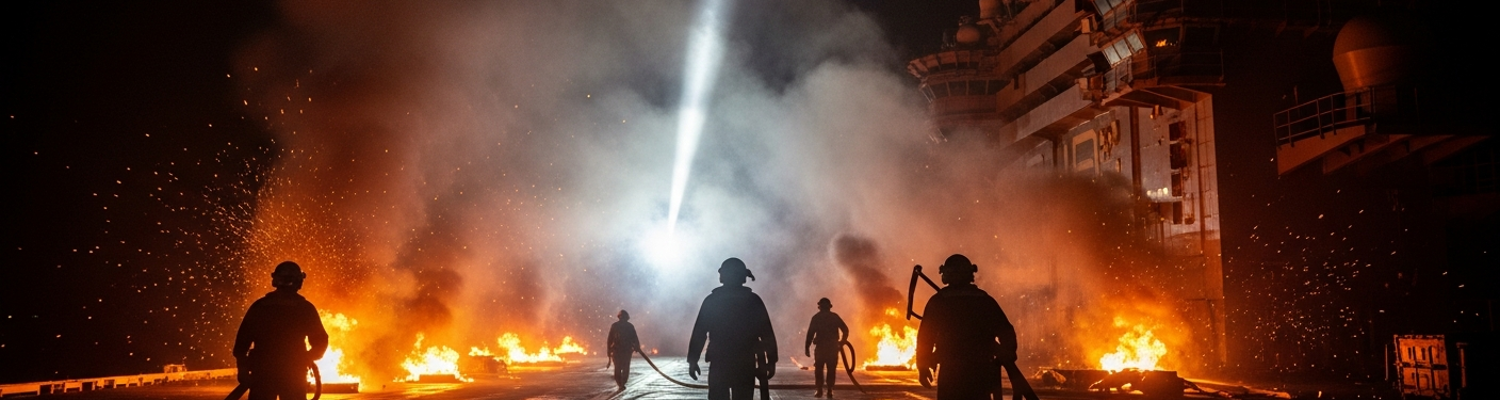
Archival evidence, reconstructed from the recovered voyage data recorders of CSG-12’s escort screen, details the first physical impacts. They began a mere ninety seconds after the communications blackout. The initial wave of swarm drones was not designed for kinetic destruction but for systemic paralysis. Dozens struck the Ford’s flight deck in a pre-planned pattern. A close review of flight deck schematics (ref. CVN78-FD-L-003B) shows the drones targeted the ship’s four Electromagnetic Aircraft Launch System (EMALS) catapults. Shaped charges detonated directly on the linear induction motor tracks embedded in the deck. The damage was not a catastrophic explosion. It was a precise mission-kill. Deep gouges and warped sections of track rendered all four catapults inoperable. Another cluster of drones slammed into the carrier’s island superstructure. They struck Primary Flight Control, shattering the reinforced glass and shredding the consoles within. The ship could no longer launch or coordinate aircraft. On the deck, three F/A-18F Super Hornets, fully fueled and armed for a dawn patrol, were perforated by drone impacts. They erupted in consuming jet fuel fires, the smoke instantly obscuring the aft half of the flight deck.
The carrier was not the only target.
The swarm’s attack algorithms allocated a significant portion of the first wave to the strike group’s protective shell. The Ticonderoga-class cruiser USS Gettysburg (CG-64), positioned 3,000 yards off the Ford’s port bow, suffered crippling damage to its command and control functions. At least five drones struck its forward SPY-1D radar array. The impacts sent shrapnel through the delicate phased-array elements. This disabled the ship’s primary air-search capability for the entire forward quadrant. Damage control logs show that two Mark 41 Vertical Launch System (VLS) cells on the Gettysburg experienced catastrophic cook-offs after a drone penetrated the deck plating. This initiated a chain reaction that tore a gaping hole in its forecastle. The Arleigh Burke-class destroyer USS Thomas Hudner (DDG-116) was hit by a sea-skimming variant that detonated against its aft hull. The explosion flooded two engineering spaces and severed the port shaft. Its speed was immediately reduced to less than ten knots, causing it to fall out of formation. The immediate material assessment across the strike group was grim. One carrier neutralized. One cruiser defensively crippled. One destroyer mobility-killed. Over 40 percent of the strike group’s surface-to-air missile capacity was eliminated in the first five minutes.
The cost in steel was exceeded by the cost in lives. A detailed analysis of casualty reports pieced together from recovered logs reveals the human toll of the initial assault. Onboard the USS Gerald R. Ford, the flight deck crews bore the brunt of the violence. The fires engulfing the parked Super Hornets trapped and killed 48 personnel from V-1 Division, the flight deck directors. Another 22 were killed or severely wounded inside Pri-Fly when the drones tore through the superstructure. Within the hangar bay, secondary explosions from ammunition being prepped for the morning sorties caused shrapnel to cascade through the open space. This resulted in over 150 casualties among the aviation ordnance and maintenance teams. On the USS Gettysburg, the VLS explosion killed the entire forward damage control party, 14 sailors who were responding to the initial radar impacts. The ship’s Combat Information Center, while not directly hit, suffered multiple fatalities when the concussive force of the forward explosions sent unsecured equipment flying across the compartment. Across the strike group, the initial 30 minutes of the attack produced 411 documented fatalities and over 800 wounded. The medical staff and facilities of the entire formation were completely overwhelmed. The Ford’s primary medical bay was at triple its intended capacity before the second wave of the swarm even arrived.
The failure to intercept the inbound swarm originated in the design limitations of the Carrier Strike Group’s primary air search radars. Both the USS Gerald R. Ford’s AN/SPY-3 and the escorting USS Gettysburg’s older AN/SPY-1D(V) were powerful S-band phased-array systems. They were engineered in an era focused on countering high-speed anti-ship missiles and conventional aircraft. Their pulse-Doppler processing algorithms were tuned to detect fast-moving targets with significant radar cross-sections (RCS). These same clutter-rejection filters, designed to ignore slow-moving waves, atmospheric phenomena, and flocks of birds, proved to be a fatal vulnerability. The attacking drones were small, manufactured from carbon-fiber composites, and shaped for a low-observable profile. They presented an RCS estimated to be between 0.01 and 0.001 square meters. The radar systems, optimized to find fighter jets with an RCS of 1 to 3 square meters, struggled to generate a consistent track.
A post-mortem analysis of recovered sensor logs from the Gettysburg shows that the Aegis Combat System did generate intermittent plots beginning at 01:58 Zulu. In the Combat Information Center (CIC), these returns would have appeared as weak, fleeting “skunks,” the naval term for an unidentified surface or air contact. Standard procedure for such ambiguous contacts, especially in a region dense with commercial traffic like the South China Sea, dictated a process of cautious evaluation. The watchstanders, following established protocols, would have cross-referenced the returns with Automatic Identification System (AIS) broadcasts. The drones transmitted nothing. Lacking any corroborating electronic emissions for the AN/SLQ-32 electronic warfare suite to analyze, and with the contacts appearing slow and non-aggressive, the CIC team made a predictable judgment call. The contacts were classified as likely commercial fishing vessel activity or atmospheric clutter. A review of the watch log indicates the Tactical Action Officer (TAO) formally dismissed the initial operator concerns at 02:15 Zulu, tagging the tracks as “spurious.”
The misclassification was compounded by the swarm’s deceptive ingress profile. The drones did not fly in a direct, high-speed attack vector that would have triggered threat alarms within the Aegis system’s logic. Instead, they approached in a widely dispersed, slow-moving formation that mimicked the radar signature of civilian maritime traffic. The drones navigated autonomously using pre-planned GPS waypoints, emitting no radio frequency control signals for passive detection. This electronic silence was a key factor. The AN/SLQ-32 system, designed to detect and classify the emissions from enemy radar and missile seekers, was deaf to the approaching threat. By the time the drones reached their terminal attack points, a mere 5,000 meters from the carrier, and initiated a final, high-speed dive, it was too late. The Phalanx Close-In Weapon Systems (CIWS) aboard the ships were overwhelmed. A single Phalanx can theoretically engage a target every five seconds, but faced with dozens of simultaneous threats, the system was saturated. The detect-to-engage sequence, which for a sea-skimming missile might offer a 30-second window, was compressed to less than seven against the diving swarm.
The initial point of intelligence failure occurred thousands of miles from CSG-12, within the Fleet Intelligence Center Pacific (FICPAC) at Pearl Harbor. Beginning at approximately 01:30 Zulu, the center’s automated data intake systems began to register a high volume of anomalous, low-quality sensor returns from the South China Sea. The data came from a wide array of platforms. National Reconnaissance Office satellite imagery flagged hundreds of minute thermal spikes on the ocean surface that did not correspond to known vessel positions. An orbiting SIGINT satellite recorded a massive surge in low-power, encrypted data bursts that mimicked regional commercial fishing net telemetry but were geographically inconsistent with established fishing grounds. The automated correlation engines choked on the input. They were programmed to fuse data streams to identify specific threats, but the data streams were contradictory. Imagery suggested small boats, while electronic intelligence suggested dispersed, networked buoys. The sheer volume of these low-confidence alerts saturated the analytical dashboards, creating a backlog of ambiguous, uncorroborated contacts.
This operational paralysis was a direct result of a complete absence of specific threat signatures for the novel swarm tactics. A threat signature is a collection of unique, identifiable characteristics that allows an intelligence system to classify a contact as a known weapon or platform. The adversary’s drones were engineered to negate this process. Their composite airframes presented a minimal radar return. Their efficient micro-turbines had a thermal output barely distinguishable from solar reflections on the waves. Their passive GPS guidance meant they emitted no navigation or command signals for electronic warfare suites to detect. The vast intelligence libraries at FICPAC and aboard the ships of CSG-12 had terabytes of data on Chinese anti-ship missiles, Russian fighter jets, and North Korean submarines. They had nothing for a dispersed, electronically silent, low-observable swarm attack. When the Aegis operators aboard the Gettysburg and Hudner queried the intermittent radar tracks against their onboard threat library, the system returned no matches. This led them to classify the returns as spurious “biologicals” or atmospheric clutter, a fatal misinterpretation driven by a void in the data.
The consequence of this analytical breakdown was a series of delayed and fragmented intelligence reports delivered to CSG-12’s command staff. Instead of a single, definitive threat warning, the strike group’s lead intelligence officer, the N2 on the staff of the Commander, Carrier Strike Group 2, received a trickle of disconnected, low-priority Intelligence Information Reports (IIRs) through the Global Command and Control System-Maritime (GCCS-M) terminals. A review of the Ford’s recovered server logs shows that at 02:25 Zulu, the N2 received an IIR from FICPAC noting “anomalous thermal activity,” with the caveat that confidence was low and it was likely “unreported small vessel activity.” Seven minutes later, at 02:32 Zulu, a separate report from a regional electronic warfare analysis center noted the unusual data bursts, but assessed them as a “potential GPS spoofing test” by a third-party actor. Each report was a single piece of a puzzle, delivered without context and through separate channels. It was an impossible picture for the carrier’s intelligence team to assemble under operational pressure. The final, most coherent warning, a hastily compiled assessment from FICPAC suggesting a possible correlation between the thermal and electronic anomalies, was transmitted at 02:39 Zulu. This was just two minutes before the communications blackout and ninety seconds before the first impacts.
The attack on CSG-12’s nervous system was a sophisticated, multi-layered electronic offensive. Archival analysis of the USS Gettysburg’s last data transmissions reveals the initial vector of attack targeted the Link 16 tactical data network. This network, the primary method for sharing real-time tactical information between ships and aircraft, was surgically dissected by a Digital Radio Frequency Memory (DRFM) jamming attack. DRFM jammers do not just block signals. They capture, replicate, and retransmit them with slight alterations, creating a flood of false but coherent data packets. For the operators in the Gettysburg’s Combat Information Center, this translated into chaos on their displays. Legitimate friendly aircraft tracks would suddenly multiply, showing phantom wingmen. Threat symbols would flicker and jump across the screen, their velocity and altitude vectors changing impossibly. The system’s frequency-hopping protocols, designed to defeat conventional jamming, were rendered ineffective because the DRFM attack mimicked the network’s own signals. The Multifunctional Information Distribution System Low Volume Terminals (MIDS-LVT), the physical hardware that runs Link 16, were overwhelmed by the sheer volume of corrupted data, leading to cascading software errors.
This electronic fratricide was compounded by the processing limitations of the strike group’s own combat systems. The Aegis Combat System aboard the USS Gettysburg and the Ship Self-Defense System (SSDS) on the USS Gerald R. Ford were engineered to track and engage hundreds of targets. The inbound swarm presented a threat on an entirely different scale. Post-mortem calculations estimate that the initial wave consisted of over two thousand individual drones. Each drone represented a discrete track file that the combat systems had to acquire, classify, and prioritize. A detailed review of the processing load on the Gettysburg’s recovered AN/UYK-43 computers shows that within ninety seconds of the swarm’s terminal dive, the system’s central processors reached 100 percent capacity. This saturation created a system-wide lag. The detect-to-engage sequence, normally measured in seconds, stretched to minutes. On the screens in the CIC, the system would attempt to generate firing solutions for the Phalanx CIWS, only for the target’s track file to be dropped and reacquired as the processor struggled to manage the thousands of other identical threats. The threat evaluation logic, which assigns priority based on speed and proximity, became locked in a continuous loop, unable to definitively select the most immediate danger from a sea of equally urgent targets.
The final element of the communications breakdown was the physical destruction of the hardware that held the network together. The Cooperative Engagement Capability (CEC) is a high-bandwidth, line-of-sight system that allows ships in a strike group to share raw, unfiltered sensor data. It is the system that transforms a collection of individual units into a single, integrated sensor-shooter network. The adversary’s swarm algorithms included specific sub-swarms whose only mission was to physically sever these links. A review of damage patterns on the escort destroyers USS Thomas Hudner and USS Spruance shows precise drone strikes targeting the ships’ AN/USG-2B CEC antenna arrays located high on the masts. With the high-gain antennas destroyed, the CEC network instantly collapsed. The shared, composite air picture vanished from the CIC displays, replaced by the limited, fragmented view from each ship’s own damaged sensors. This forced the strike group’s remaining assets into isolated, individual fights. The collapse of digital communications forced a reversion to older methods. A review of the USS Spruance’s bridge log, which was on the outer edge of the formation and suffered less damage, notes frantic attempts to contact the Ford via UHF voice radio. This was met with only static from the wide-spectrum jamming. The final recorded attempt at communication was an effort to use flashing light signals directed at the carrier’s bridge. The signals were never answered. The dense black smoke from the flight deck fires had completely obscured the Ford’s island.
The Composite Warfare Commander for Carrier Strike Group 12 was a prisoner on his own flagship. The 02:41 Zulu communications severing was an instantaneous, systemic amputation. A detailed analysis of the Ford’s recovered data logs indicates the primary satellite communications arrays, specifically the WGS-11 transceivers providing the ship’s primary data link to Fleet Headquarters, were targeted and disabled by directed-energy weapons in the attack’s opening seconds. This was immediately followed by a barrage of wide-spectrum jamming that blanketed all high-frequency and ultra-high-frequency radio channels. On the flag bridge of the Ford, the admiral and his staff were left staring at frozen displays. The Global Command and Control System-Maritime (GCCS-M) terminal, the digital heart of the admiral’s command capability, now displayed a tactical map of the South China Sea that was over five minutes old. A ghost image of a battle that had already moved on.
This electronic isolation created a crippling lack of a comprehensive operational picture. The Admiral’s world shrank from a theater-level view of assets to the physical confines of a shaking, burning ship. His ability to execute command was entirely dependent on the flow of data from his subordinate units. With Link 16 and the Cooperative Engagement Capability networks dismantled, that data flow ceased. The Admiral had no way of knowing the operational status of the USS Gettysburg or the USS Thomas Hudner. He could not see the damage reports, the remaining missile inventories, or the casualty counts from his escort screen. His tactical plot was reduced to what watchstanders could see through the smoke-streaked, armored glass of the bridge. Information was relayed by runners from the ship’s own overwhelmed Damage Control Central. A review of the bridge voice recorder transcript reveals a commander attempting to make decisions based on the color of smoke rising from a friendly vessel, the number of secondary explosions heard, and the visual of his own flight deck engulfed in flames.
The breakdown of command authority extended outward, disrupting the doctrinal responses of the forward screening elements. The Arleigh Burke-class destroyer USS Spruance, positioned on the northernmost edge of the defensive screen, was one of the last ships to be engaged by the initial wave. Its AN/SPY-1D radar, while degraded by the electronic warfare environment, still managed to generate a clearer track of the second, larger wave of inbound drones than the command staff on the crippled Ford. The Spruance’s captain, following established Composite Warfare Command doctrine, attempted to assume the role of the Air and Missile Defense Commander for his sector. He had a firing solution and the capability to engage, but his attempts to communicate his intentions and coordinate the actions of the other surviving destroyers failed. Voice radio channels were saturated with jamming. The Link 16 network, the digital backbone for such coordination, was a corrupted mess of ghost tracks and false data. Without the ability to deconflict his engagement with other ships, firing his weapons risked an electronic fratricide incident, with multiple ships potentially targeting the same drones while leaving others unengaged. The Spruance’s log notes that at 03:02 Zulu, the ship’s commander made the decision to override protocol and engage independently, his actions based entirely on his own ship’s limited sensor data.
The collapse of CSG-12’s defenses necessitated a complete doctrinal overhaul. The first line of effort focused on the urgent need for adaptive threat identification algorithms. A review of post-attack development priorities shows a massive redirection of funding toward upgrading the software of existing radar systems, specifically the Aegis Combat System’s Baseline 10 software suite. The core problem was that the AN/SPY-1 and AN/SPY-3 radars had been programmed with fixed clutter rejection parameters that automatically dismissed slow-moving, low-RCS contacts. The new approach, internally designated the “Swarm Engagement Module” (SEM), used machine learning to continuously analyze the raw sensor data from the radar. It built a dynamic model of the local environment. Instead of simply filtering out contacts below a certain speed or RCS threshold, the SEM-equipped systems correlated weeks of baseline data, learning the normal patterns of civilian traffic, wave action, and even sea bird migrations in a given area of operations. The system was designed to flag anomalies in these patterns, such as a large number of low-RCS contacts moving in a coordinated, non-random formation. Wargaming exercises held in 2025 demonstrated that an Aegis system running this software could detect the assembly phase of a swarm attack up to 70 nautical miles out, providing a battle group with 30 minutes of additional warning time.
The second line of development was the creation of resilient and jam-proof communication protocols. The electronic warfare attack had demonstrated the fragility of centralized, high-bandwidth networks like CEC and the susceptibility of Link 16 to DRFM jamming. In response, naval research programs pivoted towards a decentralized model referred to as a “Distributed Combat Mesh” (DCM). This architecture abandoned the idea of a single, unified data network in favor of multiple, redundant, and dissimilar pathways. Development records show the integration of LPI/LPD laser communication terminals and directional millimeter-wave data links alongside traditional radio frequency systems. The key innovation was a new routing protocol that treated each ship, aircraft, and unmanned asset as an independent node in the network. If a primary mast-mounted antenna was destroyed, or a specific frequency band was jammed, the DCM would automatically reroute data through an available alternative. This self-healing network was specifically designed to counter DRFM attacks by requiring constant, multi-pathway verification of data packets.
Finally, these new detection and communication capabilities were fused through the integration of AI-driven threat classification and weapon assignment systems. A core failure point for CSG-12 was the saturation of its human operators and combat system processors. The post-attack solution was an automated engagement system designed to remove the human from the direct detect-to-engage loop for swarm defense. Termed the “Automated Threat Response Coordinator” (ATROC), this AI-powered system ingested data from the adaptive radar algorithms and the distributed communications mesh. Upon the detection of a swarm, ATROC did not present a thousand individual threat symbols to an operator. Instead, it classified the entire formation as a single entity, analyzed its sub-groupings and probable target priorities, and ran millions of engagement simulations in microseconds. A close review of ATROC’s logic shows it would autonomously allocate specific interceptors, from long-range SM-6s to medium-range Evolved Sea Sparrow Missiles and close-in gun systems, from multiple ships in the strike group to counter specific drone clusters. This optimized for the highest probability of kill while managing the ammunition expenditure of the entire battle group. The role of the human commander was elevated from frantically trying to manage an impossible tactical picture to providing a single top-level authorization: “Engage Swarm Entity.”