
Allied psychological warfare doctrine during the 1944 push into Germany was a machine built on paper and sound. Coordinated by the Psychological Warfare Division of SHAEF, the effort depended on two main instruments: aerial leaflet drops and frontline loudspeaker broadcasts. The primary delivery system for paper propaganda was the specialized bomb canister, like the M16A1 or the later Monroe bomb. A single B-17 Flying Fortress could, in theory, saturate a target with hundreds of thousands of leaflets. Operational logs (NARA Record Group 498) tell a different story. A consistent pattern of mechanical failure plagued these missions. Fuzes malfunctioned, causing canisters to impact the ground as inert duds. Others burst at the wrong altitude, scattering their contents for miles on high-altitude winds, far from any intended audience. On the ground, the approach was more direct. Mobile loudspeaker units, typically speaker arrays mounted on M3 half-tracks or jeeps, were tasked with broadcasting surrender appeals. These teams, part of units like the 2nd Mobile Radio Broadcasting Company, were exceptionally exposed to mortar and machine-gun fire. Their electronic equipment was fragile, prone to failure from the concussive shock of nearby artillery and the simple hardship of field conditions.
The effectiveness of these messages hinged entirely on the intelligence behind them. It was often poor.
Allied assumptions about German morale, formulated by the Political Warfare Executive (PWE) and the Office of War Information (OWI), were frequently based on flawed inputs. Planners operated on the belief that the German home front was near collapse, a view shaped by interrogations of dispirited prisoners from isolated sectors and outdated reports from resistance cells. This created a significant credibility gap. Leaflets promised the imminent arrival of Allied forces to towns that were still weeks away from the front. They made appeals to factory workers that demonstrated a fundamental misunderstanding of life under the Nazi regime. A U.S. Army report on Wehrmacht morale noted that a frontal attack on ideological symbols like Hitler was less effective than non-ideological appeals, yet much early propaganda attempted just that. The steadfastness of German resistance, driven in part by fear of retribution, often defied the optimistic projections of Allied planners.
Failure was not just strategic, but linguistic. Archival analysis of early leaflet series reveals a critical oversight: a near-total disregard for the regional dialects of Germany. The texts for many leaflets, such as those in the “G” series, were written in pristine Hochdeutsch (High German). They were often drafted by academics or German émigrés in Britain and the United States who were disconnected from the vernacular of the common soldier. When these leaflets were dropped over Bavaria, Swabia, or the Plattdeutsch-speaking regions of the north, the formal, stilted language was perceived as foreign. To a farmer in the Alps or a factory worker in the Ruhr, the perfectly grammatical prose could be as alienating as if it were written in English. The message was delivered, but its meaning was lost in a cultural gulf.
Operational logs from the U.S. First Army’s push against the Siegfried Line in late 1944 show the terrain itself was a primary antagonist. It actively defeated technologies intended to weaken German resolve. This was particularly evident in the performance of mobile loudspeaker units. The operational concept was straightforward. M3 half-tracks with powerful speaker arrays would approach enemy lines and broadcast surrender appeals. In the dense, rugged Hürtgen Forest, this proved nearly impossible. The forest, a 50-square-mile expanse of tightly packed firs, steep ravines, and muddy logging trails, consumed sound. Acoustic energy that would travel for kilometers across open ground was muffled and distorted by the sheer mass of trees and broken topography, often becoming unintelligible beyond a few hundred yards. This forced loudspeaker teams into a fatal dilemma. To be heard, they had to advance to within point-blank range of the very German positions they were targeting, well inside the lethal radius of mortars and machine-gun nests concealed within the Westwall’s bunker system. The forest canopy also created sound shadows and unpredictable echoes, garbling messages into a confusing racket.
Paper fared no better.
The same geographic and meteorological conditions that grounded Allied air support also defeated aerial leaflet drops. Planners using topographical maps in rear command posts could not account for the microclimates created by the forested hills and deep valleys of the Ardennes-Eifel region. A B-17 might release tens of thousands of leaflets from a Monroe Bomb canister at the designated altitude, but the payload would immediately encounter unpredictable, swirling winds. Instead of blanketing a specific enemy-held village, the paper was scattered for miles. Archival evidence describes entire missions being wasted as gusts carried the propaganda into inaccessible, empty forest, where it would later be found as sodden pulp by advancing patrols. During the Battle of the Bulge, leaflet operations were suspended entirely during the initial German advance. Drops were impossible in the foul weather and considered ineffective against advancing troops. This lack of precision turned a tool of mass communication into a lottery.
Even when the message arrived, it was often not understood. The linguistic failures that plagued the broader campaign were severely amplified along the Siegfried Line. The German forces manning the Westwall fortifications were not elite Panzer troops. Many units were composed of second-rate Landesschützen battalions, older reservists, or young conscripts pulled from the surrounding region. These soldiers spoke local West Central German dialects, primarily Ripuarian and Moselle Franconian. These were substantially different from the pristine Hochdeutsch used in Allied leaflets. A surrender appeal written by an academic émigré in London and voiced by an announcer in a mobile van would be difficult for a soldier from a small village near Trier to comprehend, especially when distorted by forest acoustics and the din of combat. It was a fundamental intelligence failure.
The initial Allied contact with the Westwall in September 1944 did not trigger a mass evacuation of German civilians. Local Nazi Party directives from regional Gauleiters strictly forbade civilians from leaving their homes. The order was intended to project an image of unwavering resolve and to use the civilian presence as a logistical hindrance to an Allied advance. As American divisions, such as the 1st and 9th Infantry, began to probe the defenses around Aachen and into the Hürtgen, civilians found themselves in a trap. When the fighting intensified, this official policy collapsed into a chaotic, panicked flight. Entire villages, which had been ordered to remain, suddenly attempted to flee eastward. These desperate processions of non-combatants, with belongings piled onto handcarts, clogged the same muddy roads needed by the Wehrmacht for troop and supply movements. This chaotic mix of military and civilian traffic on roads already under observation by Allied artillery spotters proved catastrophic.
The prolonged nature of the fighting, from September 1944 into early 1945, subjected trapped non-combatants to months of shelling. In the battle for Aachen alone, thousands of American and German shells fell on the city. Over 80 percent of its buildings were ultimately destroyed. Civilians hiding in cellars were not safe. Standard high-explosive shells from American 105mm and 155mm howitzers could easily penetrate the upper floors of typical German houses, causing them to collapse and bury the occupants. Shrapnel from air-burst shells, a tactic used to suppress infantry, was indiscriminate. It tore through windows and wooden doors, inflicting horrific wounds on anyone caught in the open. Medical attention was virtually non-existent. The local German healthcare system had completely broken down. Advancing American forces were focused on their own mounting casualties. Countless civilians died slow deaths from treatable wounds or infection.
The Westwall’s design reveals a fatal integration of civilian and military structures. The defense-in-depth system was not built in a wilderness; it was woven directly into the fabric of daily life. Bunkers and pillboxes were often constructed in farmyards, on the edge of village streets, or incorporated into the basements of existing houses. Anti-tank obstacles known as dragon’s teeth cut directly through farmers’ fields. When combat began, German soldiers would occupy these positions, turning a family’s home into a frontline strongpoint. A machine gun team might be firing from a window on the first floor while a family huddled in the cellar directly below. For Allied troops, these buildings were legitimate military targets to be neutralized with grenades, flamethrowers, or tank fire. The non-combatants inside were an afterthought. The very structure of the Westwall ensured that for the German civilians living along its length, there was no front line to retreat from.
They were already in it.
A post-combat engineering assessment of Aachen, the first major German city to fall, revealed a comprehensive systems collapse. The relentless Allied bombardment and subsequent street-to-street fighting had dismantled the city’s mechanical and biological support structures. Water mains, shattered by the concussive force of 155mm high-explosive shells, ceased to function. Electrical substations and transformer houses left the city in total darkness. Ruptured gas lines created persistent fire hazards amid the rubble. Roads were impassable, blocked by the debris of collapsed structures and deeply cratered by aerial bombs, which severed the city from the outside world.
This physical destruction was met by an administrative one. A review of initial reports from the U.S. Ninth Army’s G-5 (Civil Affairs) section shows that relief efforts were designed for control, not humanitarian crisis management. The first Civil Affairs detachments, such as Detachment I4G2 which entered the Monschau area in September 1944, were small teams of officers and enlisted men. Their primary mission, as outlined in doctrine like Field Manual 27-5, was to restore basic governance and prevent civilian interference with military operations. They were administrators, equipped with little more than jeeps and typewriters. They suddenly found themselves responsible for the welfare of thousands of starving, displaced civilians emerging from cellars. They possessed no organic stockpiles of food, blankets, or medicine. The logistical train that supplied the Allied armies, exemplified by the Red Ball Express, was dedicated almost exclusively to delivering fuel and ammunition for the push toward the Rhine, not rations for German non-combatants. The demand from the roughly 4,000 surviving civilians in Aachen alone immediately overwhelmed the capacity of the handful of military government officers assigned to the city.
Field reports from Allied medical corps personnel attached to these civil affairs units paint a grim picture. The lack of clean water led to an immediate spike in enteric diseases like dysentery. Food was critically scarce. Official rations, when they could be distributed at all, were often set at levels insufficient to sustain life. For the thousands of civilians who had suffered injuries from shrapnel or collapsing buildings, medical care was almost non-existent. Allied army medical units were stretched to their limits dealing with their own combat casualties. Their finite supplies of plasma, sulfa drugs, and penicillin were strictly prioritized for Allied soldiers. The few remaining German doctors were discovered in the basements of ruined hospitals, attempting to treat horrific injuries with no electricity, no running water, and no sterile equipment. Many civilians who survived the battle itself died in the weeks that followed from infection, exposure, or starvation.
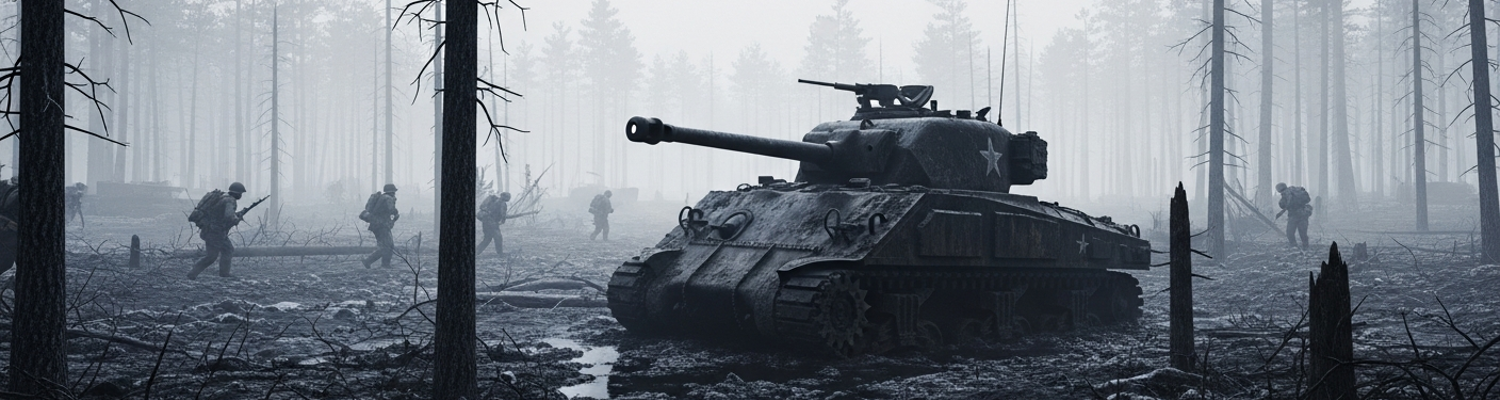
Operational logs from the U.S. First Army in late 1944 show that the primary antagonist in the Hürtgen Forest was not the German soldier. It was the terrain and the weather. The forest’s road network consisted of a few primary tracks and a web of narrow, unpaved logging trails. These paths, never intended for heavy military traffic, disintegrated under the weight of 2.5-ton GMC trucks and M4 Sherman tanks. The forest floor, a soft composition of earth and pine needles, quickly churned into a deep, viscous mud that became impassable. Vehicles would sink to their axles. After-action reports from units like the 28th Infantry Division detail a consistent pattern of vehicle failure. Transmissions burned out. Tank tracks were thrown as vehicles slid off the narrow paths into ravines.
This quagmire was compounded by some of the worst weather of the European theater. From October through December, the forest was subjected to near-constant freezing rain, sleet, and snow. This precipitation saturated the ground, turning already muddy trails into semi-frozen slurry that defeated even tracked vehicles. The cold had a direct mechanical effect on equipment. Wet radios failed. Engines became difficult to start. For the soldiers, the conditions were ruinous. Men were perpetually soaked and frozen, leading to a catastrophic rise in non-combat casualties from trench foot, pneumonia, and exhaustion. Overcoats became so caked with frozen mud they were too heavy to wear. The weather effectively neutralized American air superiority for long stretches, as persistent low cloud cover and fog kept fighter-bombers grounded.
The logistical chain simply ceased to exist. In sectors like the advance on Schmidt, the Kall River Trail became a singular point of failure. This narrow, winding path was the only route for reinforcement and supply. Engineers worked constantly to keep it open, but it remained a graveyard of abandoned American equipment. Tanks slid into the gorge or were knocked out by enemy fire, creating bottlenecks that halted all traffic for days. A bulldozer sent to clear the path broke down after only half an hour of work. Consequently, essential supplies failed to reach frontline companies. Infantrymen of the 28th and 4th Infantry Divisions ran critically low on ammunition for their M1 rifles and BARs. Mortar teams were starved of shells. Fuel for the few tanks that did make it forward was nonexistent. Most supplies had to be carried forward by hand, forcing commanders to pull riflemen from the line to form carrying parties, further weakening their combat strength. The failure to receive food, medical supplies, or ammunition was a decisive factor in the collapse of morale.
Environmental attrition rendered psychological warfare efforts entirely pointless. The same persistent, freezing rain and thick canopy that grounded Allied air support also defeated aerial leaflet drops. Paper payloads from Monroe bombs dissolved into a useless, sodden pulp that clung to pine branches. On the rare occasions a leaflet reached a German soldier, its message of a warm POW camp was psychologically irrelevant to a man whose immediate reality was shared by his American counterpart: a desperate, minute-to-minute struggle against hypothermia and trench foot. Mobile loudspeaker units were similarly neutralized. The dense forest consumed sound. The constant dampness ruined sensitive electronic equipment. The primary psychological pressure on soldiers of both sides did not come from propaganda, but from the unending cold, the wet, and the oppressive gloom of the forest.
This operational paralysis was a direct consequence of logistical collapse. The few unpaved logging trails disintegrated under the weight of M4 Sherman tanks and 2.5-ton trucks. Maintenance logs from armored and infantry divisions like the 4th and 28th show a catastrophic rate of vehicle failure. The standard Vertical Volute Spring Suspension (VVSS) on most Shermans, coupled with their narrow tracks, was ill-suited for the soft ground, causing tanks to bog down constantly. The mud, a gritty paste of soil and pine needles, worked its way into drive sprockets and road wheels, grinding down components. The single Kall Trail, a vital artery for the assault on Schmidt, became a graveyard of knocked-out and abandoned American armor. In desperation, commanders turned to Quartermaster pack mule companies to haul supplies. Even these hardy animals succumbed, suffering high losses from falls, exhaustion, and German artillery, which was zeroed in on every known trail.
American troops in the Hürtgen battled the environment more than they battled the Wehrmacht. A survey of medical records from the campaign shows that non-combat casualties from exposure, disease, and exhaustion often exceeded losses from enemy fire. For units like the 28th Infantry Division, non-battle casualties accounted for thousands of evacuated soldiers. In a period of just over a week, the division suffered 738 documented cases of trench foot and 620 cases of combat fatigue, on top of over 6,000 combat casualties. Trench foot, or immersion foot, became a relentless scourge. Soldiers' feet, trapped in wet leather boots for days, would swell, blister, and become numb as circulation failed. In advanced stages, this led to gangrene and amputation. The constant, penetrating cold led to a wave of pneumonia and dysentery. Overcoats grew so heavy with caked, frozen mud that they had to be abandoned. The German soldier was an intermittent threat. The cold was a constant one. It was a battle fought in water-filled foxholes, where sleep was impossible and the primary objective became simple survival. The U.S. First Army suffered over 71,000 non-battle casualties in the broader campaign.