
Gallipoli Campaign Tactical Outcomes
The central strategic objective was the seizure of the Dardanelles Strait. This waterway would have permitted Allied naval forces to attack Constantinople, the Ottoman capital, and open a vital supply route to Imperial Russia. The goal failed completely. An initial, purely naval assault on March 18, 1915, was repulsed with significant losses. Ottoman minefields and well-sited shore-based artillery batteries proved insurmountable for the combined British and French fleet. Three capital ships, the French battleship Bouvet and the British pre-dreadnoughts HMS Irresistible and HMS Ocean, were sunk. A third of the battleships involved were either lost or disabled, forcing a total strategic re-evaluation.
The subsequent land invasion, which began on April 25, 1915, was designed to eliminate the shore defenses that had defeated the navy. Allied troops, however, could not advance far from their landing beaches at Cape Helles and the area later known as Anzac Cove. They were contained by determined Ottoman defenders holding the high ground. A stalemate defined by trench warfare ensued. Despite multiple costly offensives, including a major assault at Suvla Bay in August, Allied forces never captured the fortifications overlooking the strait. The Dardanelles remained firmly in Ottoman hands.
The price of this strategic failure was paid in human casualties. An analysis of the campaign’s records reveals a devastating toll. The Allied powers, primarily British, Irish, Australian, New Zealander, French, and Indian troops, suffered more than 220,000 casualties in the nearly nine-month engagement. Of this total, approximately 44,000 were fatalities. The British and Irish forces shouldered around 73,000 of these losses. The Australian and New Zealand Army Corps (ANZAC) sustained roughly 26,000 casualties, with over 10,000 killed, cementing the campaign as a formative event in their national histories. French forces also paid a high price, with casualty estimates around 47,000. These losses were not solely from combat. A close review of operational logs shows that disease was rampant. Dysentery, enteric fever, and other illnesses accounted for a large percentage of deaths during the later months. The Ottoman Empire, while victorious, incurred even heavier losses defending its territory, with an estimated 250,000 killed or wounded.
The campaign concluded with a complete Allied withdrawal. The decision to evacuate Anzac and Suvla was made in late November 1915, with the British cabinet concurring on December 7. The operation was a masterpiece of logistical planning and deception, standing in stark contrast to the tactical failures that preceded it. An Australian staff officer, Lieutenant-Colonel Charles Brudenell White, devised a plan to mislead Ottoman observers into believing the Allies were digging in for the winter. This involved a series of silent periods, where all firing would cease for extended hours to lull the defenders, followed by a sudden resumption of activity to discourage patrols. The most ingenious tactic was the self-firing rifle, invented by Lance Corporal William Scurry. This device used two tins; water from a top can dripped into a lower one attached to a rifle’s trigger. The increasing weight would eventually fire the weapon, creating sporadic shots that suggested the trenches were still manned long after the troops had departed. Between December 15 and December 20, approximately 90,000 men from Anzac and Suvla were secretly embarked onto transport ships with almost no casualties. The final withdrawal from the Helles sector was completed by January 9, 1916.
Early 20th Century Wireless Limitations
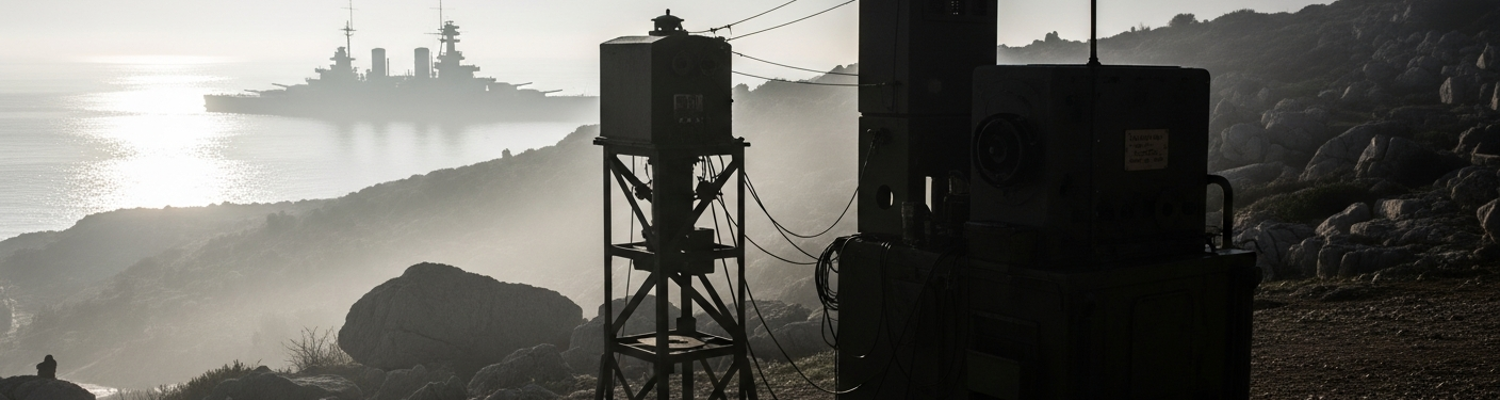
A close review of operational logs indicates that the technological core of Allied naval communication in 1915 was the spark-gap transmitter. Installed on capital ships like the HMS Queen Elizabeth, these devices were mechanically blunt instruments. Their function was predicated on generating a high-voltage electrical charge that would arc across a small air gap, producing a loud crackle and a powerful, crude burst of radio energy. This created what were known as damped waves, an electrically noisy and broad-spectrum signal that could carry information only via the clipped pulses of Morse code. Voice transmission was impossible. Each transmitter broadcast across a huge band of frequencies, making precise tuning difficult and creating massive radio frequency interference that could disrupt other nearby transmissions. Naval operators had to contend with a congested ether where friendly and merchant vessel signals often bled into one another, turning urgent messages into an unintelligible jumble. The hardware itself was robust but prone to degradation; the constant, violent sparking eroded the electrodes, requiring operators to clean and adjust them to maintain a clear signal.
The primitive signal, having escaped the ship, then had to traverse the hostile geography of the Gallipoli peninsula. Archival terrain analysis reveals a landscape uniquely suited to disrupting early radio waves. The Allied landings at Anzac Cove and Cape Helles placed troops at the bottom of steep, deeply incised slopes and winding gullies. High-frequency radio waves of the period traveled primarily by line of sight. Any solid object between the transmitter and receiver could block the signal entirely. The very ridges and hills the Allies needed to capture, such as the Sari Bair range, acted as immense physical barriers. A forward observer in a ravine attempting to contact a battleship just offshore would find his transmission absorbed by thousands of tons of rock and earth. This topographic interference was compounded by atmospheric conditions, which could cause signals to fade unpredictably. The wireless connection between the fleet’s guns and the soldiers who depended on their fire was unreliable at best and often nonexistent, forcing a reversion to slower and more vulnerable methods like signal lamps or human runners.
While the warships possessed powerful, albeit crude, transmitters, the sets available to landing parties and forward observers were significantly less capable. British Army doctrine in 1915 had only just begun to incorporate wireless, and the equipment was considered cumbersome and unreliable. The most common portable units, where available at all, were low-power spark sets like the early Trench Set, W.T., 10-watt, which had an extremely short range even in ideal conditions. These trench sets required bulky accumulators for power and long wire aerials that had to be erected, often under direct fire. A 1917 account describes a typical portable spark set as having a maximum range of just three to five miles over open ground. In the fractured terrain of Gallipoli, that effective range would have shrunk dramatically. An ANZAC signaller attempting to direct naval gunfire from the slopes of Chunuk Bair would be transmitting with a weak, battery-powered signal that the ridges and ravines could easily swallow. The failure of these messages to reach their destination had immediate, lethal consequences.
Forward Observation Post Hazards
A close review of operational logs reveals the physical challenge of establishing any viable observation post. The topography of the Gallipoli peninsula, a spine of steep, crumbling ridges and deep, winding gullies, made the task a nightmare of logistics and survival. Men from Allied signals units and designated infantry battalions were ordered to haul cumbersome equipment up slopes that were often near-vertical and completely exposed to the enemy. An analysis of terrain around the Sari Bair range, a key objective, shows that a team might carry heavy spools of telephone wire, bulky heliographs, telescopes, and the notoriously fragile early wireless sets, all while under constant threat. These were not fortified positions. Many were little more than shallow scrapes in the earth or behind a few hastily piled sandbags on places like Walker’s Ridge or Russell’s Top. The goal was to secure a vantage point, however precarious, that overlooked the Ottoman trenches and hidden artillery batteries. But this requirement for a clear line of sight meant that if an observer could see the enemy, the enemy could see him.
Once established, these posts became priority targets for Ottoman gunners and riflemen. A network of highly skilled Ottoman snipers, many of them local men who knew the terrain intimately, worked constantly to eliminate any sign of Allied leadership or specialist activity. They used the scrub and rocks for concealment and patiently waited for a single, tell-tale glint from a telescope lens or the movement of a signaller’s arm. The effect on Allied morale was corrosive; soldiers described a blinded feeling, the constant stress of wondering if one’s head was low enough. Beyond the individual marksman, Ottoman artillery batteries, guided by their own efficient observers on the high ground, engaged in relentless counter-battery duels. Any Allied gun position or observation post that became active would swiftly draw a hail of shrapnel and high-explosive shells. The very communication lines that were the observer’s lifeline were catastrophically vulnerable; a single piece of shrapnel could sever a telephone wire, instantly isolating the post and rendering the observer useless. One British officer observing for an Indian mountain battery was struck through the cheek by a bullet that tore away his teeth; he went to have the wound dressed and returned to his post.
The strain on the men in these isolated pockets was profound. Historical records and personal diaries from the period describe how it was common for men to go mad under the pressure. The forward observer was often a lone officer or NCO with a signaller, separated from the main body of troops and connected only by a fragile wire or the crackle of a temperamental wireless set. This physical isolation was compounded by an intense psychological weight. The observer’s mission was to call down fire from the massive naval guns of the fleet, such as the 15-inch cannons of HMS Queen Elizabeth, which fired shells packed with thousands of shrapnel balls. He bore the direct responsibility for directing this destructive power. A mistake in calculating grid coordinates, a simple error brought on by heat, thirst, or sheer exhaustion, could bring those shells down onto his own comrades in the trenches below. The world for these men shrank to the narrow field of view through their binoculars, the endless dust and flies, the gnawing thirst, and the constant, deafening noise of shells and rifle fire. This combination of sustained, high-stakes combat, profound isolation, and the ever-present threat of death created a psychological burden that many found impossible to bear.
Garbled Messages and Fire Direction
A technical review of the early wireless equipment in use at Gallipoli reveals a system stretched to its breaking point. The spark-gap transmitters on the warships and the much weaker portable sets ashore generated broad, noisy signals that were highly susceptible to interference. An operator sending a fire mission, a string of Morse code digits for a map grid, was broadcasting into a storm of static. That signal, already crude, was then degraded by the peninsula’s unforgiving terrain. The very hills and ravines that concealed Ottoman positions also absorbed or reflected the radio waves, turning clear transmissions into indecipherable noise. For the receiving operator on a rolling warship, the task was nearly impossible. He had to distinguish the faint, intended signal from atmospheric crackle, the bleed-over from other friendly transmitters, and the deliberate jamming efforts of the enemy. A single missed dot or dash in a coordinate, a misheard number, could be the difference between a shell on a Turkish trench and one falling among Allied troops. The entire system of naval fire support, the foundational concept that was supposed to allow the infantry to advance from the beaches, was balanced on this technological knife-edge.
The fragility of the wireless connection created severe and often fatal delays. Analysis of after-action reports (AAR, Gallipoli Sector, 1916) shows a recurring pattern: a forward observer on a ridge like Chunuk Bair would identify a critical target, such as a concentration of Ottoman reserves or a newly-sited artillery piece, and tap out an urgent fire request. The message would first have to be received by a beach station, often just a shallow dugout with an aerial stretched precariously between two poles. If the message was received at all, it was frequently garbled and required multiple re-transmissions. Each attempt ate away precious minutes and exposed the signaller to enemy fire. Once a coherent message was confirmed, it was relayed from the beach station to the designated support ship. This process could take many forms: another wireless message, a signal lamp, or even a runner. One review of the initial landings highlighted an instance where a critical message from the commander on shore took 48 hours to reach General Hamilton on the command ship HMS Queen Elizabeth. By the time the request finally reached the ship’s gunnery officer, the tactical situation on the ground had often changed completely. The target had moved.
The consequences of this broken chain of communication were frequently catastrophic. Faulty information, born from garbled signals and compounded by delays, led directly to the misidentification of targets by naval gunners. Aboard the warships, gun crews were effectively blind, relying entirely on the coordinates and descriptions radioed from shore. A simple error in transmission, a single digit transposed in a grid reference, could shift the point of impact by hundreds of yards. On at least one occasion, during the initial landings, naval gunfire had to be suspended after it was reported to be falling among British troops on 'Y' beach. The flat trajectory of the naval guns, designed for ship-to-ship combat, made them ill-suited for the steep, undulating terrain, further increasing the risk of error. Observers on the ground, often under fire and working with maps that were decades out of date, would provide what they thought were accurate coordinates. This data would be passed through the degraded communication network, finally arriving at a gunnery station where men would translate it into a firing solution. The resulting shell, sometimes from a 12-inch gun, would arc over the horizon toward a target that was, in many cases, tragically incorrect.
Ineffective Naval Gunfire Support
The gunnery logs and after-action reports reveal the paradox of the Gallipoli campaign. The Allies’ greatest asset was also one of its greatest liabilities. The naval guns of the British and French fleets, with their power to level fortifications from miles away, were frequently rendered useless or, worse, actively dangerous to their own troops. The core of the issue was a mismatch of technology and terrain. Naval fire control systems and the guns themselves were designed for ship-to-ship engagements on an open sea, firing at a low, flat trajectory. At Gallipoli, they were asked to perform as high-angle artillery, dropping shells onto precise, unseen targets hidden in the folds of steep, rugged hills or deep ravines. The results were often tragic. During the August offensive, elements of the 1st Australian Division attacking Lone Pine found themselves being shelled by their own supporting warships. The flat trajectory meant that shells intended for Ottoman trenches just over a ridge crest would instead skim the top and explode amongst the advancing Australian lines. The problem was compounded by inaccurate maps and the simple difficulty of identifying targets in a chaotic, dust-choked environment, leading to repeated instances where friendly troops were fired upon.
The futility of the situation is captured in the frantic, unanswered calls for aid from forward observation teams. A signaller, perched precariously on a ridge, would identify a crucial target, an Ottoman machine gun nest holding up an entire advance or a concentration of reserves preparing for a counter-attack, and begin the desperate process of getting a message to the fleet. The low-powered portable wireless sets were notoriously unreliable, their signals often swallowed by the very hills that concealed the enemy. Telephone lines were laid, but they were a primary target for Ottoman artillery, with a single piece of shrapnel capable of severing the connection and isolating the observers. A message that did get through, often via a runner who had to cross open, fire-swept ground, would be relayed from the beach to the command ship, a process that could take agonizingly long. By the time a coherent fire mission was calculated and executed by the gunners offshore, the tactical situation had often changed entirely. The opportunity was lost, or the unit that needed support had been annihilated.
This constant failure had a corrosive psychological impact on the men tasked with directing the fire. The forward observers were often isolated, bearing the direct responsibility for calling down the destructive power of guns like the 15-inch cannons of HMS Queen Elizabeth. Accounts from the period describe men caught between the terror of enemy fire and the crushing weight of their duty. They watched through their binoculars as Allied attacks faltered and broke against enemy fire, knowing that the firepower to save their comrades was waiting just offshore, completely unable to assist effectively. The feeling of helplessness was profound. Each unanswered call for support, each shell that fell wide of the mark, and especially each shell that fell short among their own men, was a personal and professional failure that haunted the observers. The strain was not just from enemy action, but from the unbearable knowledge that the system designed to support them was fundamentally broken.
Gallipoli: Communication Failure Legacy
The operational autopsy of Gallipoli forced a deep and painful reckoning within Allied military commands, fundamentally altering the philosophy of battlefield communication. An examination of post-campaign reports indicates a dramatic shift away from the pre-war view of wireless as a niche, unreliable novelty. The abject failure to coordinate between shore parties and naval guns, a direct result of broken communication links, provided a brutal lesson in the necessity of integrated systems. In response, military planners began prioritizing the development and issuance of more robust and standardized signaling equipment. An army that could not talk to itself was an army set up for defeat. This led to the professionalization of signals as a distinct branch of service; no longer a task for infantrymen given a flag and a lamp, but a technical role for specialists. The British Army, for instance, began a process of expanding its Royal Engineers Signal Service, a precursor to the independent Royal Corps of Signals, elevating the importance of maintaining communication under fire to a core principle of command and control.
While the British largely dismissed amphibious operations after the disaster, the United States Marine Corps studied Gallipoli intently during the interwar years. They extracted critical lessons for their own developing doctrine. A review of their analysis, particularly the work of theorists like Major Earl H. 'Pete' Ellis, shows they pinpointed the lack of a unified fire support plan and the technical inability of flat-trajectory naval guns to hit targets on reverse slopes as primary causes of failure. This directly influenced the development of the USMC’s 1934 Tentative Manual for Landing Operations. Though not mentioning Gallipoli by name, the manual is a doctrinal counter-argument to almost every failure of 1915. It called for dedicated shore fire control parties, specialized ship-to-shore communication procedures, and the use of aircraft as aerial observers to guide naval gunfire. These were all functions that were absent or improvised with lethal ineptitude at Anzac Cove and Cape Helles. The experience proved that simply having large guns was not enough. A complex system of observation, communication, and control was required to make that firepower tactically useful.
The strategic fallout of the Dardanelles failure was immediate and far-reaching. The primary objective, to force the strait, knock the Ottoman Empire from the conflict, and open a warm-water supply route to Russia, ended in complete failure. This sealed Russia’s isolation, compounding the equipment and supply shortages that plagued the Tsar’s armies and contributing to the internal pressures that would culminate in revolution. For Britain, the defeat had severe political consequences, contributing to the fall of Herbert Asquith’s Liberal government and the formation of a new coalition. The campaign’s chief architect, Winston Churchill, was forced to resign as First Lord of the Admiralty. With the Balkan option closed, Allied grand strategy was stripped of its flexibility, leaving the grinding, attritional slaughter of the Western Front as the main path to victory.