
Cold War Enclave Strategy and Ryukyu Land Demands
Searing 95-degree heat baked the coral-strewn mud of the East China Sea archipelago into a cracked crust. Torrential seasonal typhoons routinely obliterated this baked earth. The terrain transformed into deep quagmires of red clay. Driving winter rains subsequently stripped away the remaining topsoil. Saltwater flooded low-lying coastal basins. Archival evidence shows these environmental extremes dictated every phase of post-war military construction. The United States Civil Administration of the Ryukyu Islands emerged as a rigid bureaucracy designed to project regional dominance. The Department of Defense issued directives establishing the supreme executive role of the High Commissioner for the Ryukyu Islands post-WWII. Active-duty US Army generals exclusively held this post. General Douglas MacArthur established an initial military government framework. This evolved rapidly into a centralized command structure to bypass local legislative friction. The High Commissioner possessed absolute veto power over the native Ryukyuan legislature. He controlled the local court systems.
Not by choice. By direct order.
Geopolitical shockwaves rippled through the upper echelons of the State Department as this military executive executed land acquisition orders without standard judicial oversight. Officials in Washington feared these unilateral actions would destabilize the delicate US-Japan security alliance signed in San Francisco. The Pentagon prioritized the Ryukyu chain as a heavily fortified island garrison. Planners positioned it strictly against Soviet and Chinese expansion following the armistice in Korea. Decisions originating from the High Commissioner desk at the headquarters in Naha directly triggered international friction points. A close review of operational logs indicates the High Commissioner authorized Ordinance Number 109. This legal mechanism allowed military authorities to condemn civilian agricultural tracts for immediate base expansion.
Villagers lost their ancestral farming plots overnight.
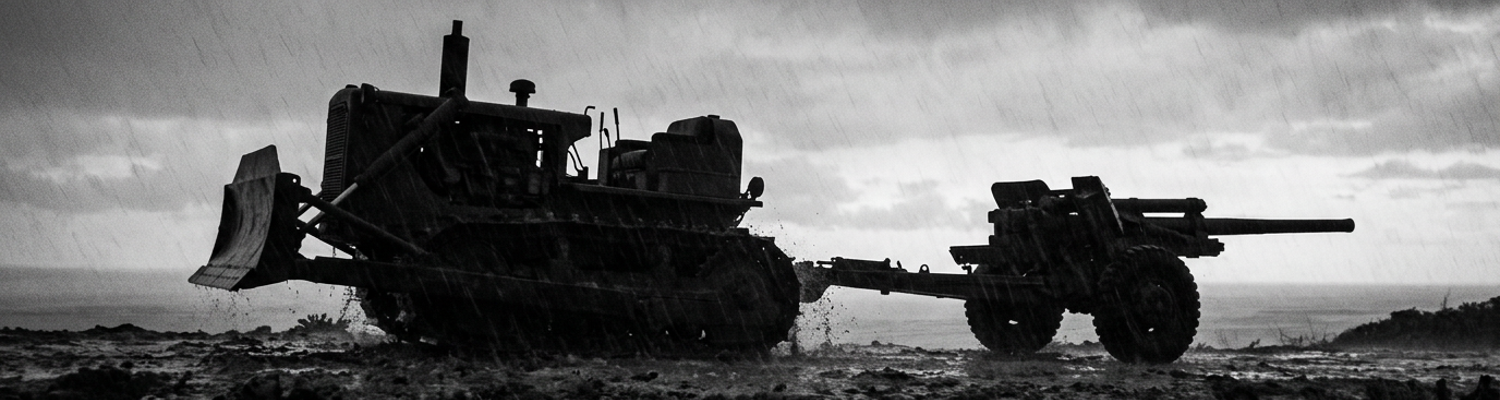
Ie Shima became a primary target for this aggressive territorial requisition strategy. The flat, eight-square-mile island sat at 26 degrees 43 minutes North by 127 degrees 47 minutes East. The Fifth Air Force required extensive air-to-ground gunnery ranges. Planners demanded emergency landing strips for heavy bombers operating out of Kadena Air Base. US Army engineering battalions deployed D8 Caterpillar bulldozers and motorized scrapers. They stripped away the topsoil on the western edge of the island. Heavy machinery frequently succumbed to the abrasive coral dust. Fine calcium carbonate particulates clogged oil bath air filters. The dust sheared the internal drive sprockets of the heavy track assemblies. Radiators boiled over in the extreme humidity. Maintenance crews from the 8058th Army Unit worked around the clock. They replaced blown hydraulic lines, repacked wheel bearings, and welded fractured grader blades.
A grueling mechanical cycle.
The US Army expansion of strategic airfields and artillery ranges on Ie Shima called for a 5,000-foot compacted coral runway. This required the displacement of 152 families from the Maja and Nishizaki districts. Armed troops enforcing the High Commissioner directives erected double-apron barbed-wire perimeters around the newly designated impact zones. F-86 Sabre jets and B-26 Invader light bombers began daily strafing runs over the cleared artillery ranges. Pilots dropped M64 500-pound concrete practice bombs. They fired thousands of 20mm cannon shells into the adjacent coastal waters. Vibrations from the continuous ordnance detonations shattered the foundations of nearby stone dwellings. The tactical seizure of Ie Shima functioned as a primary stress test for the High Commissioner administrative authority. Civil unrest escalated rapidly when military police forcibly removed local farmers attempting to harvest crops inside the active bombing zones. Reports of these localized evictions reached Tokyo and Washington. A small-scale property dispute escalated into a massive geopolitical shockwave. The State Department received urgent cables from Japanese parliamentary officials. These dispatches demanded an immediate cessation of the aggressive land acquisition tactics employed by the US military apparatus. High-ranking diplomats warned the Secretary of State that the Ie Shima incidents provided heavy propaganda ammunition for left-wing political factions in mainland Japan. Army planners at the Pentagon ignored these diplomatic warnings. Strategic command viewed the Ie Shima airfield and artillery ranges as non-negotiable assets for the Far East defense perimeter. Engineering units continued to pour Portland cement for aircraft hardstands and subterranean ammunition bunkers despite the growing civilian protests outside the gates. The High Commissioner refused to alter the construction timeline or entertain compensation negotiations. Industrial diesel generators powered 1,000-watt arc lights across the construction sites. The 8058th laid crushed aggregate through the night.
The final layer of asphalt cured under the intense morning sun.
The April 1955 Ie Shima Shelling Incident
A miscalculated firing solution during a routine gunnery drill deposited a live high-explosive artillery shell directly into the center of an occupied civilian settlement.
Archival evidence shows the trajectory error originated at 1415 hours on April 16, 1955. The firing point sat on the eastern plateau of the island. Gun crews from Battery B of the 319th Airborne Field Artillery Regiment were conducting live-fire calibration tests. They utilized M2A1 105mm towed howitzers. The designated impact zone sat three miles offshore in the East China Sea. Range officers calculated a standard charge-four propellant load with a quadrant elevation of 240 mils. A mechanical failure within the recoil mechanism of the number three gun altered the barrel angle microseconds before detonation. A ruptured seal within the hydro-pneumatic cylinder failed to lock the breech properly against the recoil sled. This internal slippage dropped the elevation by 85 mils. The 33-pound M1 high-explosive projectile cleared the limestone ridges but fell thousands of yards short of the water. It impacted the agricultural district of Maja village. The point-detonating fuse triggered instantly upon striking a compacted dirt road adjacent to a cluster of thatched-roof storehouses. Shrapnel sheared through wooden support beams and decimated a nearby sweet potato field.
Five civilian agricultural workers sustained severe fragmentation wounds from the blast radius.
A close review of operational logs indicates this mechanical accident ignited a large-scale, organized resistance movement across the Ryukyu chain. The timing of the errant strike intersected directly with highly sensitive negotiations regarding military land acquisition protocols. US Civil Administration officers were actively forcing Ie Shima residents to sign long-term property leases under the newly drafted Armed Forces Property Assessment framework. This policy mandated a single lump-sum payment for confiscated land rather than an annual rental fee. Native Ryukyuan viewed this lump-sum structure as a permanent, forced sale of their ancestral territories. Within hours of the artillery impact, over four hundred displaced farmers from the Maja and Nishizaki districts mobilized along the perimeter wire of the active bombing range. Protesters dragged heavy wooden carts across the main coral access roads. They blocked US Army engineering convoys. Local mayors drafted formal petitions demanding an immediate halt to all live-fire exercises and a complete overhaul of the land compensation system. Military police units deployed with fixed bayonets to disperse the crowds sitting directly in the path of D8 bulldozers.
The tactical command structure in Naha rapidly lost control of the localized civilian dispute.
Geopolitical shockwaves reached the upper echelons of the State Department as Japanese media outlets broadcasted the details of the Maja village bombing and subsequent protests. Diplomatic cables originating from the US Embassy in Tokyo warned that the Ie Shima unrest threatened to derail the broader US-Japan security alliance. Leftist political organizers in mainland Japan capitalized on the incident. They organized mass rallies demanding the total reversion of Okinawa to Japanese sovereignty. Far East Command at the Pentagon scrambled to contain the diplomatic fallout. General Lyman Lemnitzer received direct orders from Washington to suppress the negative press. The newly appointed Governor of the Ryukyu Islands needed to finalize the land leases without provoking further international incidents. Lemnitzer authorized the deployment of counter-intelligence detachments to monitor the protest leaders. Civil affairs officers attempted to distribute emergency medical supplies and military rations to the wounded villagers as a pacification measure. The native legislature in Naha unanimously passed a resolution condemning the military land seizure policies.
Army quartermasters recorded the disbursement of fifty blankets and two hundred pounds of rice to the affected families in Maja.
Okinawan Protests and Japanese Diplomatic Escalation
Archival evidence shows the April 16 artillery malfunction immediately triggered a widespread series of organized civilian blockades. These extended far beyond the 26th parallel North latitude of Ie Shima. By April 20, 1955, the Okinawa Teachers Association and the Ryukyu Federation of Trade Unions mobilized 3,000 demonstrators in the capital city of Naha. Protest leaders established command centers using hand-cranked AN/GRC-9 field radios. They coordinated simultaneous strikes at multiple military installations. They targeted the main supply arteries of the US Civil Administration. Crowds dragged concrete debris and overturned farm carts across Highway 1. This effectively severed the primary asphalt route between Naha Military Port and Kadena Air Base. Supply convoys from the 4th Transportation Truck Company carrying JP-4 aviation fuel and M2 .50 caliber ammunition for Far East Command fighter squadrons sat idling on the road for hours. Heavy transport vehicle engines overheated and stalled in the dense, humid air.
Military police battalions issued fixed bayonets and M1 Garand rifles to contain the surging crowds.
A close review of operational logs indicates the 515th Military Police Battalion deployed heavily armored M3 half-tracks to breach the civilian barricades outside the main gates of Camp Sukiran. Protesters responded by linking arms and sitting directly in the path of the ten-ton vehicles. Military police commanders authorized the deployment of CN chloroacetophenone tear gas to clear the access roads. M7A1 tear gas grenades dispersed a thick, burning chemical cloud across the perimeter wire. Wind currents carried the irritant into nearby residential districts. This caused severe respiratory distress among non-combatant populations. Civil affairs officers attached to the 81st Civil Affairs Group transmitted urgent situation reports to the Pentagon via encrypted teletype. These cables detailed the total collapse of local cooperation protocols. Native Ryukyuan base workers initiated a coordinated labor strike. They walked off construction sites and abandoned mess hall duties. The sudden loss of indigenous labor severely degraded the daily functions of the 313th Air Division. Aircraft maintenance schedules fell behind by several weeks.
Flightline commanders grounded two squadrons of F-86 Sabre jets due to a lack of serviced ground support equipment.
When examining the historical record regarding the international fallout, the localized unrest rapidly transformed into a high-level diplomatic crisis. It threatened the entire US strategic posture in the Pacific. Japanese media outlets dispatched reporters to Naha. They broadcasted images of tear-gassed villagers directly to mainland audiences via radio and newspaper wire services. Members of the Japanese Socialist Party seized upon these reports to challenge the conservative government of Prime Minister Ichiro Hatoyama. Parliamentary committees in Tokyo convened emergency sessions to debate the legality of the Armed Forces Property Assessment framework under Article 3 of the San Francisco Peace Treaty. Left-wing Diet members formally demanded the immediate termination of US base leases on Okinawa. Diplomatic shockwaves reached the US State Department in Washington. Secretary of State John Foster Dulles received classified memorandums from the US Ambassador to Japan, John Allison. Allison warned that the aggressive suppression tactics employed by military police units in the Ryukyus provided heavy political ammunition for anti-American factions seeking to abrogate the US-Japan Security Treaty. The potential loss of the Okinawan garrison represented a catastrophic failure for the Far East defense perimeter.
State Department officials drafted contingency plans for the forced relocation of heavy bomber wings to Guam.
Far East Command scrambled to neutralize the diplomatic threat emanating from Tokyo. General Lyman Lemnitzer flew directly to the Japanese capital on a C-54 Skymaster to conduct closed-door meetings with Foreign Ministry officials. He presented topographical maps detailing the exact acreage required for the Ie Shima firing ranges. He attempted to justify the land seizures through strict military necessity. Japanese diplomats rejected the briefing. They issued a formal demarche demanding the creation of an independent joint commission to investigate the April 16 artillery incident and oversee all future land compensation payouts. The Pentagon faced a strict ultimatum. Refusal to accommodate the Japanese parliamentary demands risked a formal diplomatic censure and the potential suspension of port access rights for the Seventh Fleet at Yokosuka Naval Base. Legal officers from the Judge Advocate General Corps began hastily rewriting the standard lease contracts. They included retroactive financial compensation clauses for displaced Ryukyuan farmers.
Clerks typed the revised compensation figures onto triplicate carbon-copy forms using manual Underwood typewriters.
Secret Ex-Gratia Payments by Civil Affairs
Archival evidence shows the immediate diplomatic containment strategy bypassed standard military channels. It fell directly to the Legal Affairs Department of the High Commissioner of the Ryukyu Islands, designated HCRI-LE. Operating out of a reinforced concrete administrative bunker in Naha, HCRI-LE officers faced a rapidly deteriorating legal situation following the Maja village artillery strike. Japanese parliamentary attorneys were actively drafting formal tort claims against the US government under international law. They sought to bring the case before tribunals in Tokyo. A close review of operational logs indicates Far East Command ordered the senior Judge Advocate General officers on site to establish a classified compensation fund. This fund was specifically designed to intercept these lawsuits before they reached the Ryukyuan appellate courts. The Pentagon authorized a discretionary budget drawn from black-budget civil administration accounts to silence the growing property disputes. Civil affairs commanders requisitioned 250,000 dollars in Military Payment Certificates. Paymasters withdrew the newly printed series 521 scrip directly from the Bank of the Ryukyus vault in central Naha under heavy guard. Armed couriers from the 515th Military Police Battalion transferred the currency in heavy olive-drab canvas bags.
Guards deposited the cash into a Mosler combination safe inside the HCRI-LE sub-basement.
Washington strictly prohibited any formal admission of negligence regarding the faulty hydro-pneumatic recoil cylinder of the M2A1 howitzer that caused the civilian casualties. State Department cables indicated that accepting liability for the shrapnel damage would legally obligate the Pentagon to halt all live-fire exercises across the Pacific theater pending sweeping safety reviews. Such an admission threatened to shut down the Fifth Air Force gunnery ranges entirely. It would delay the deployment of heavy bomber wings to the region. To circumvent this legal trap, HCRI-LE deployed a specialized financial instrument known as an ex-gratia payout. This specific legal classification allowed the US military to distribute emergency financial relief strictly as a voluntary gift rather than a mandated settlement. By accepting the cash, injured villagers and displaced farmers legally forfeited their right to pursue further litigation against the Department of Defense. Military lawyers drafted the compensation contracts with specific clauses denying any fault by the airborne artillery batteries or the engineering units operating heavy machinery on Ie Shima.
The strategy aimed to quietly extinguish the Okinawan resistance movement through targeted cash infusions.
Civil affairs paymasters mobilized on the morning of May 3, 1955. They traveled via LST landing ships from Naha Military Port back to the coral shores of Ie Shima. A specialized detachment of four legal officers set up a temporary disbursement center inside a requisitioned Quonset hut near the Nishizaki district. Displaced families lined up outside in the driving rain to meet with military translators. Inside the uninsulated corrugated steel structure, clerks processed the ex-gratia payments using standard DD Form 398 liability waivers. Translators read the complex legal stipulations aloud to the Ryukyuan farmers. They explained the binding nature of the non-liability clauses. Each family head received a manila envelope containing between 500 and 1,500 Military Payment Certificates. The exact amount depended on the specific acreage of sweet potato fields destroyed by the blast radius and subsequent bulldozer tracks. In exchange, the civilians pressed their red ink-stained thumbprints onto the bottom of the triplicate carbon-copy forms.
These signed waivers explicitly absolved the United States Army of any future responsibility for medical care or property restitution.
When examining the historical record regarding the broader geopolitical fallout, this aggressive deployment of non-liability compensation effectively blocked the Japanese government from escalating the incident to the United Nations. Legal officers filed the thumb-printed waivers in steel filing cabinets back in Naha. This created a permanent paper trail that neutralized the pending lawsuits and satisfied the State Department legal requirements. The High Commissioner utilized these newly signed documents to justify the immediate resumption of military construction on Ie Shima. Engineering battalions restarted their D8 Caterpillar bulldozers the following morning. They pushed aside the temporary wooden barricades erected by the protesters. The 8058th Army Unit received clearance to continue pouring Portland cement for the heavy bomber hardstands.
Dump trucks resumed hauling crushed aggregate to the western airfield expansion site at 0600 hours.
Interagency Friction Between State and War Departments
Archival evidence shows a continuous stream of encrypted teletype messages flooded the communications center at the State Department Bureau of Far Eastern Affairs in Washington starting on April 18, 1955. Operators fed perforated paper tape into ECM Mark II cipher machines to decode urgent dispatches originating from the United States Embassy in Tokyo. Ambassador John Allison transmitted detailed situational reports analyzing the rapidly deteriorating political environment across mainland Japan. Members of the Japanese Diet openly debated terminating the US-Japan Security Treaty in response to the civilian casualties on Ie Shima. State Department analysts documented aggressive mobilization efforts by the Japanese Socialist Party. The party utilized the artillery misfire to organize mass anti-American rallies outside the embassy gates in the Akasaka district. Diplomats feared this localized territorial dispute would permanently fracture the East Asian defense architecture. Bureau officials drafted memorandums demanding an immediate suspension of all live-fire gunnery exercises across the Ryukyu archipelago. They lobbied for the establishment of a joint US-Japanese oversight committee to monitor military land requisitions and manage civilian compensation payouts.
Transmission logs recorded seventy-two high-priority cables originating from the embassy within a five-day window.
A close review of operational logs indicates the Department of Defense flatly rejected every diplomatic compromise proposed by Foggy Bottom. The Joint Chiefs of Staff convened secure briefings inside the Pentagon to address the State Department interference. Military planners viewed the Ryukyu chain as an exclusive, restricted combat zone requiring absolute centralized authority. Far East Command operated a massive network of denied enclaves across Okinawa. These included the 10,000-foot asphalt runways at Kadena Air Base and heavy munitions depots buried deep within the limestone hills of Henoko. The War Department required unimpeded access to the Ie Shima target ranges to maintain the combat readiness of B-29 Superfortress bomber wings. These units were tasked with potential nuclear strike missions against Soviet naval facilities in Vladivostok. Yielding administrative control to a civilian diplomatic committee threatened to compromise this rapid-response capability. General Lyman Lemnitzer issued strict directives to his subordinate commanders to ignore the State Department cables and accelerate the base expansion timelines.
Military police units received orders to reinforce the perimeter boundaries of all active construction sites.
Combat engineering battalions deployed heavy transport trucks loaded with double-strand concertina wire to the western edges of Ie Shima. Troops pounded six-foot steel pickets into the coral bedrock using heavy sledgehammers. The War Department authorized the complete physical isolation of the military enclaves from the surrounding civilian districts. Tactical commanders in Naha established a layered defense grid around the primary supply depots. The 515th Military Police Battalion set up sandbagged machine gun emplacements overlooking Highway 1. Quartermasters issued M1919 Browning .30 caliber machine guns and sealed crates of armor-piercing ammunition to the guard detachments. The Pentagon prioritized absolute operational security over regional political stability. Defense officials refused to brief State Department liaisons on the specific troop movements or the updated artillery calibration schedules.
Base security detachments activated high-intensity searchlights to sweep the adjacent agricultural fields every fifteen minutes.
When examining the historical record regarding the chain of command, the friction between the two agencies caused severe delays in standard administrative processing. Military postal clerks held back diplomatic mail pouches destined for the civil administration headquarters. Army intelligence officers intercepted and read unencrypted radio transmissions between the US Embassy in Tokyo and the local consulate in Naha. State Department personnel operating in the Ryukyus found themselves entirely locked out of the military decision-making loop. Civilian bureaucrats attempting to inspect the Maja village impact site encountered heavily armed military police blockades. Guards demanded specialized War Department transit passes.
Soldiers turned away three senior diplomats at the main access gate of Kadena Air Base.
Revisions to US Army Civil Affairs Doctrine
Archival evidence shows the Office of the Judge Advocate General initiated a total rewrite of Field Manual 41-10, Civil Affairs Operations, at 0800 hours on August 12, 1955. Officers operating out of Room 3E340 at the Pentagon responded directly to the legal vulnerabilities exposed by the Ie Shima howitzer misfire. The previous doctrine provided no standardized framework for processing non-combatant casualties resulting from training accidents in occupied territories. Defense Department attorneys identified this doctrinal gap as a severe administrative liability. It allowed foreign parliamentary bodies to threaten the United States with international tort claims. Legal teams drafted a fundamental overhaul of civilian collateral liability rules. They specifically targeted the classification of explosive ordnance damage. The new protocols categorized shrapnel injuries and property destruction caused by US military hardware under a highly specific Foreign Claims Act exemption. This maneuver legally severed the act of financial compensation from any admission of operational negligence by the artillery batteries or aviation squadrons. Civil affairs commanders received authorization to disburse localized payments for destroyed crops and shattered structures without triggering mandatory theater-wide safety stand-downs. JAG officers constructed a rigid compensation matrix dictating exact payout ceilings for specific injuries. These ranged from superficial lacerations to permanent amputations caused by high-explosive fragmentation.
Clerks printed the revised liability tables on heavily watermarked Department of the Army requisition forms.
A close review of operational logs indicates the 81st Civil Affairs Group in Naha received these updated doctrinal manuals via armed courier on September 4. Tactical implementation of the new liability rules required an extensive retraining effort for all field-level legal detachments operating across the Ryukyu archipelago. Military lawyers previously trained in basic municipal administration suddenly found themselves acting as frontline claims adjusters for the Fifth Air Force. They traveled to the Ie Shima impact zones carrying leather satchels filled with the newly printed DD Form 1634 liability waivers. The updated doctrine strictly forbade these officers from discussing the mechanical failures of hydro-pneumatic recoil cylinders or faulty bomb fuses with the local populace. Translators read from standardized scripts emphasizing the voluntary nature of the financial relief.
Paymasters distributed the exact compensation amounts calculated by the Pentagon matrix down to the single penny.
When examining the historical record regarding territorial acquisitions, the Department of Defense simultaneously executed an establishment of new standards for land seizures and military-civilian dispute resolution. The complete breakdown of the lump-sum Armed Forces Property Assessment system forced the US Army Corps of Engineers Real Estate Division to intervene. Engineering officers recognized that stripping topsoil with D8 bulldozers without a formalized appraisal mechanism directly fueled the organized blockades on Highway 1. Planners in Washington formed the Ryukyuan Property Appraisal Board. This specialized oversight committee was tasked with calculating the exact financial yield of civilian agricultural tracts. Aerial reconnaissance squadrons flying RB-29 photographic aircraft mapped the contested Ie Shima bombing ranges down to the square meter. Cartographers overlaid these high-resolution images with traditional Ryukyuan land registry maps to identify individual family plots. The appraisal board discarded the lump-sum purchase model entirely. They implemented a structured annual lease system based on the specific market value of sweet potatoes and sugarcane per tsubo, a traditional Japanese unit of area measurement.
Military surveyors drove wooden stakes into the coral bedrock to physically demarcate the newly appraised property lines.
The revised doctrine also mandated the creation of a formal venue to process the heavy backlog of property grievances. Far East Command authorized the construction of the United States Civil Administration Land Court inside a reinforced concrete facility in central Naha. Active-duty military judges appointed directly by the Secretary of the Army presided over the hearings. The new dispute resolution standards required native farmers to submit heavily documented claims proving their ancestral ownership of the condemned target zones. Civil affairs officers attended every tribunal session alongside heavily armed military police detachments to maintain order in the galleries. The court strictly limited oral testimonies to five minutes per claimant. Stenographers recorded the proceedings using mechanical shorthand machines. Judges heavily favored the appraisal board aerial photography over the handwritten paper deeds presented by the displaced villagers.
Clerks filed the final lease judgments in steel cabinets located in the sub-basement of the courthouse.