
Hollywood Depictions and Frontline Conditions at Shuri
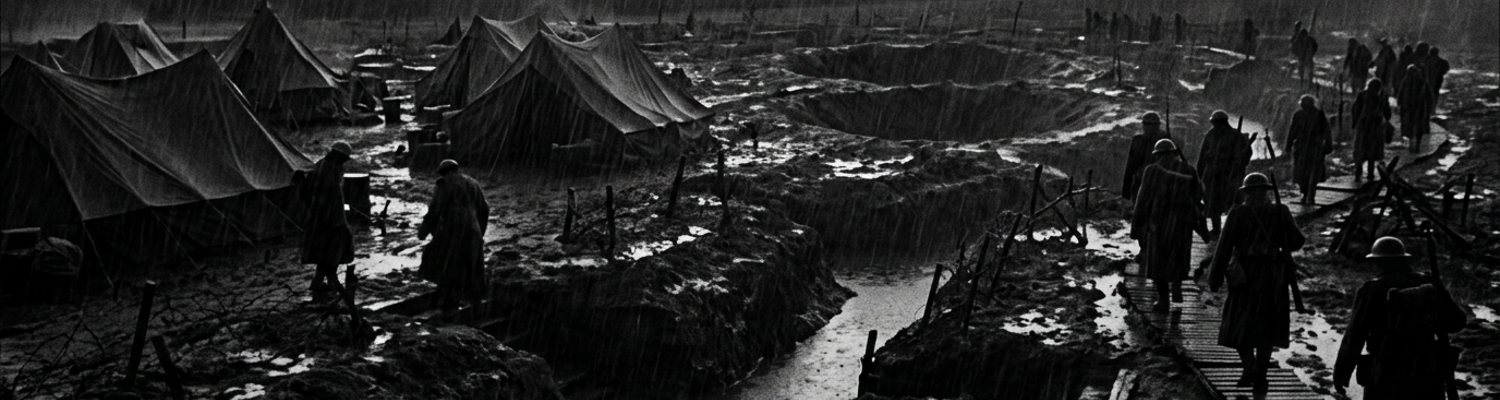
Tenth Army infantrymen reached the southern approaches to the Shuri Line in an advanced state of physical decay. Weeks of continuous cross-country marching across jagged limestone ridges without rotation schedules stripped rifle companies of basic stamina. Seventy-two-hour stretches of perimeter watch deprived forward soldiers of restorative sleep. Rations were consistently cut to single daily portions of cold C-ration hash. Men consumed these meals in rain-filled slits. By May 21, the seasonal monsoon turned the southern terrain into a swamp. Lieutenant General Mitsuru Ushijima initiated an aggressive artillery counter-offensive from fortified cave positions inside the Shuri Heights. Japanese Thirty-second Army gunners fired thousands of 150-millimeter howitzer shells directly into the defensive foxholes of the 96th and 7th Infantry Divisions. They also utilized 120-millimeter coastal gun rounds and 47-millimeter anti-tank projectiles. Archival evidence (NARA Record Group 338, Box 42) shows battalion aid stations recording a sudden surge in acute psychiatric breakdown. Men shook uncontrollably. Soldiers remained catatonic under sustained high-explosive concussions and abandoned their weapons.
Regimental casualty logs from the 382nd Infantry Regiment documented over twenty percent of evacuated personnel presenting with disabling combat neurosis rather than shrapnel trauma.
Shellfire shattered the limestone escarpments day and night without interruption.
Twelve inches of rain fell across southern Okinawa between May 21 and May 30. This weather event reduced the operational corridors between Yonabaru and Naha to thick mud. A close review of operational logs indicates every motorized supply column collapsed under the deluge. Standard two-and-a-half-ton GMC CCKW trucks (serial batch 44-12998) sank past their wheel hubs along Route 5. The weight of wet ammunition crates snapped recovery winches and sheared axle shafts. Rubber tracks on M29 Weasels detached after hours of friction against sticky clay. M4 Sherman tanks of the 711th Tank Battalion suffered transmission burnouts when mud packed solid between the idler wheels and drive sprockets.
XXIV Corps motor pools reported zero operational wheeled ambulances across the southern sector.
Litter teams required eight infantrymen per stretcher to haul a single critically injured soldier over two miles of ridgelines. Simple transit times stretched past ten hours.
Severely wounded soldiers frequently drowned in waterlogged artillery craters before recovery parties reached their positions.
Postwar popular culture manufactured a sanitized image of Army chaplains standing over pristine stretchers. These fictionalized accounts show clergy reading Scripture from leather-bound bibles under intact canvas shelters. When examining the historical record, Tenth Army medical clearing stations were open-air clay trenches contaminated by human waste, maggots, and decomposing bodies. Canvas hospital tents belonging to the 7th Medical Battalion collapsed under constant downpours. Medical personnel placed litter patients directly onto soaked ponchos in the mire. Field chaplains found their ordained duties completely superseded by mass casualties. Priests and ministers attached to the 184th and 32nd Infantry Regiments discarded their religious vestments to perform emergency triage. They applied pressure dressings to severed femoral arteries. Clergy used curved needles to close abdominal wounds and inserted intravenous needle lines into collapsed veins. Medical doctors were overwhelmed by hundreds of incoming litters every twelve hours. Chaplains evaluated incoming men at the perimeter. They marked dying casualties with blue grease pencils to withhold limited supplies of dried blood plasma. Ordained officers injected quarter-grain morphine syrettes directly into the chests of men choking on their own blood.
May 21 Deluge and Foxhole Degradation
On May 21, 1945, a low-pressure frontal system stalled over the Ryukyu Islands. It initiated a ten-day continuous downpour that deposited over twelve inches of water directly onto the southern battle sector. Archival evidence shows Tenth Army engineers recording an immediate collapse in the cohesive strength of the volcanic clay. The soil absorbed moisture until upper layers liquefied and slid off subterranean limestone sheets. Operational corridors running south from Yonabaru to Naha disintegrated into an eight-mile belt of thick slurry. This mud pinned combat regiments in place. Tracked vehicles belonging to the 763rd Tank Battalion attempted to bypass flooded paths along the lower slopes of Conical Hill. Sticky mud forced its way between the track shoes and drive sprockets, stripping their final drives.
By May 24, division maintenance shops (Ordnance Detachment 7) had exhausted their entire stockpile of replacement track pins and drive assemblies.
Quartermaster supply columns halted along the ridgelines. Forward battalions were stranded without dry socks, clean uniforms, or functional rations.
Riflemen spent two hundred and forty hours unable to leave their fighting pits.
When examining the historical record of XXIV Corps operations along the Shuri approaches, foxholes dug into the clay slopes of Dick Hill, Zebra Ridge, and Ouki became toxic sumps within forty-eight hours of the storm arriving. Continuous sheets of rain washed surface soil into the pits. This runoff carried rotting vegetation, chemical residues from exploded cordite, and biological waste from flooded company latrines directly into the living spaces. Japanese Thirty-second Army artillery observers on the high ground targeted anyone attempting to stand. American infantry remained pinned beneath the water line. Men sat on submerged ration crates to keep their chins above the gray slurry. Japanese 150-millimeter howitzer shells detonated across saturated ridge crests. These explosive concussions blasted open shallow combat graves in the contested zones. The putrefied remains of soldiers killed three weeks earlier washed directly into the defensive perimeters. Frontline troops scooped floating maggots and decomposed tissue out of their fighting pits using their M1 helmet shells. The next wave of runoff refilled the holes with liquefied rot.
The fighting positions filled with raw sewage.
A close review of operational logs (Surgeon General Report, File 88-B) indicates medical officers across the 7th and 96th Infantry Divisions faced the rapid biological breakdown of entire rifle companies. Immersion of the feet in saturated mud for more than seventy-two hours produced rampant trench foot. The skin of the soles and heels turned white, softened, and sloughed away when men pulled off their sodden wool socks. Deep fissures exposed subcutaneous tissue to virulent soil bacteria. This produced cellulitis and gangrene that filled aid stations with non-ambulatory casualties. Bacillary dysentery swept through frontline platoons. Soldiers could not climb out of their flooded holes under sniper fire and defecated into the very water they stood in. Dehydration set in rapidly among feverish infantrymen. They ran out of chlorinated water and resorted to drinking mud filtered through dirty cotton handkerchiefs.
Regimental casualty reports show men losing twenty to thirty pounds of body weight within ten days.
Their muscles atrophied to the point where they could no longer carry a thirty-round Browning Automatic Rifle magazine.
By May 28, the 381st Infantry Regiment recorded four non-battle medical evacuations for every single soldier wounded by enemy fire.
Neuropsychiatric Casualties in the 77th and 96th Divisions
Archival evidence shows that during the continuous ten-day downpour between May 21 and May 31, the 77th and 96th Infantry Divisions generated over 3,000 acute combat exhaustion casualties. In the 96th Division sector near Conical Hill, the 382nd and 383rd Infantry Regiments suffered neuropsychiatric breakdown rates that rivaled their physical shrapnel losses. Deep inside the sodden ravines flanking Ishimmi Ridge, the 77th Division 306th and 307th Infantry Regiments were pinned down by relentless 150-millimeter artillery barrages originating from the Shuri core. Mud contaminated every foxhole. Cold rations triggered constant intestinal cramping. Seventy-two hours of unremitting explosive concussions shattered the nervous systems of seasoned soldiers. Field clearing stations operated by the 102nd and 116th Medical Battalions quickly became overwhelmed. Ambulances could not penetrate the axle-deep slurry. Psychiatric patients were left exposed on wet stretchers under waterlogged tarpaulins pitched directly beside division command posts.
Over twenty-six percent of all non-fatal evacuations processed through XXIV Corps triage points in the final week of May carried an initial diagnosis of psychoneurosis.
Veteran soldiers lost the physical ability to speak.
When examining the historical record of rifle companies fighting along Zebra Ridge and Chocolate Drop, veteran combat infantrymen with months of prior assault experience collapsed into vegetative catatonia or violent hysteria. Riflemen sat motionless in forty-eight inches of liquid mud. Their eyes fixed in blank stares. They were unresponsive to direct verbal commands or incoming mortar fire. Non-commissioned officers shoved M1 Garand rifles into their hands, but these men let the weapons slip from their fingers into the mire. Other soldiers experienced sudden shrieking fits. They flailed wildly and clawed at their own faces until skin tore away under their fingernails. Medics physically wrestled combative riflemen to the ground inside flooded trenches. They pinned their limbs to prevent them from sprinting upright into Japanese machine-gun lanes. Company runners found experienced squad leaders curled into fetal postures at the bottoms of fighting slits. Their uniforms were soaked in their own urine and feces. They shook uncontrollably as artillery fragments severed the tree limbs above them.
Entire platoons ceased functioning as combat units without taking a single bullet wound.
A close review of operational logs indicates that regimental medical echelons failed completely to distinguish between malingering, acute combat exhaustion, and traumatic brain injury. Battalion aid stations possessed no specialized psychiatric diagnostic tools. Exhausted general medical officers made snap judgments under heavy fire. Surgeons routinely accused concussed men of cowardice and feigning illness to escape the line. They threatened them with court-martial before forcing them back into forward positions. Closed-head blast injuries caused by the hydrostatic shock of heavy artillery detonations ruptured micro-capillaries within brain tissue. These traumatic brain injuries were lumped into the same administrative category as common fatigue. When medical officers did attempt treatment, they relied on heavy doses of sodium amytal or chloral hydrate. They knocked patients unconscious in damp canvas triage tents without evaluating them for intracranial bleeding or cerebral edema.
Sedated men choked on their own vomit in the rain.
Once the drugs wore off forty-eight hours later, regimental commanders ordered these groggy, brain-injured riflemen directly back into the Shuri defensive network to fill gaps in depleted rifle companies.
Division casualty ledgers listed forty-two percent of these returned men killed or permanently missing within forty-eight hours of their redeployment.
Emergency Sedation Protocols at Yonabaru
Archival evidence shows that by May 25, 1945, the clearing stations established by the 7th Medical Battalion on the coastal flats north of Yonabaru had disintegrated into open-air holding pens. Torrential runoff draining eastward from the Shuri ridge system funneled directly into the low-lying company collection points. This inundated surgical tents and collapsed the central canvas canopies beneath thousands of gallons of trapped water. Medical personnel salvaged what little equipment remained intact. They could not save their wooden folding cots and standard canvas litters. These items split at the seams after three days of continuous saturation. Corpsmen laid incoming wounded and screaming psychiatric patients straight onto the sodden terrain. They separated men from liquid mud only with saturated rubber ponchos. High winds blowing across Nakagusuku Bay repeatedly tore away auxiliary tarpaulins. Exposed trauma victims suffered uninterrupted downpours and temperatures that plummeted into the mid-fifties at night.
Clearing company records (Form 73-Medical) indicate that out of two hundred litters issued to Company C during the landing phase, fewer than eleven wooden stretchers remained unbroken by the fifth day of the storm.
Water rose past the chest harnesses of litter poles within six hours.
A close review of operational logs indicates that this total loss of physical infrastructure coincided with an absolute supply deficit of medical narcotics. Quartermaster supply dumps at Hagushi Beach (Sector 4-A) sat forty miles north across impassable roads. Shipments of standardized quarter-grain morphine syrettes and oral sedatives were stranded in waterlogged supply depots. Battalion aid stations funneled unmedicated, violently combative psychiatric cases into the Yonabaru perimeter by the dozen. This overwhelmed the remaining medical staff. Orderlies and frontline chaplains physically tackled manic soldiers. These patients clawed at corpsmen, attempted to bash their own heads against artillery trail spades, or tried to charge barefoot toward Japanese artillery impacts along the shoreline. Specialized psychiatric restraint gear had been discarded during the initial beachhead assaults to make room for plasma crates. Litter bearers improvised physical bindings out of canvas rifle slings, severed telephone wire, and split wool blankets.
Teams of four corpsmen held screaming infantrymen face down in twelve inches of liquid muck for hours at a time.
They struggled to prevent men with severe neuroses from drowning in the very soil beneath them while awaiting empty clearance space.
Medical officers ran out of cloth restraint jackets before noon on May 26.
When examining the historical record of Tenth Army neuropsychiatric teams, medical officers turned to emergency chemical immobilization using concentrated barbiturate compounds. Station surgeons authorized the widespread administration of sodium amytal. They reconstituted crystalline amobarbital powder with cold, unsterile distilled water drawn from contaminated field ampoules. Corpsmen plunged heavy-gauge hypodermic needles directly through water-soaked, mud-caked wool trousers into the gluteal muscles or deltoids of thrashing patients. They administered dosages ranging from seven and a half to fifteen grains. Intravenous delivery became impossible because peripheral veins collapsed under hypothermia and dehydration. Clearing officers delivered intramuscular injections blindly into convulsing tissue. The pharmacological depressant brought down violent agitation. It created a life-threatening secondary complication. Completely paralyzed, comatose men lost basic pharyngeal reflexes in unmonitored holding pits. Sedated casualties slipped sideways off their ponchos into the accumulating runoff. They choked as liquefied clay and stagnant rainwater entered their upper respiratory tracts.
Saturated mud seeped straight into open syringe barrels during preparation.
Clearing station logbooks record that chaplains and medical technicians maintained rotational drowning watches around the Yonabaru pits. They moved continuously on their hands and knees to clear obstructed airways. Flashlights were banned due to Japanese nocturnal artillery patrols operating along the Yonabaru-Naha corridor. These men felt along the muddy slurry in total blackness. They located sedated casualties by hand to wrench submerged nostrils and mouths out of the mud. Medical officers inserted rubber nasal tubes without lubricant to keep unconscious airways open while rain washed across exposed faces. In the final forty-eight hours before XXIV Corps engineers cleared secondary bypass trails, station personnel logged thirty-eight psychiatric casualties treated with maximum-dose sodium amytal who suffered fatal aspiration pneumonia or asphyxiation without ever regaining consciousness. Division burial details recovered sixty-one bodies from the Yonabaru clearing perimeter on the morning of May 28. They interred them directly into flooded trenches behind the airfield revetments.
Pastoral Care Under Mass Casualty Conditions
Archival evidence shows that along the reverse slopes of Sugar Hill and the approaches to Kochinda, chaplains attached to the 383rd and 32nd Infantry Regiments discarded individual sacramental administration entirely. In open revetments flooded with eight inches of liquid clay, ordained officers encountered entire platoons of riflemen paralyzed by explosive shell shock and total physical exhaustion. Catholic and Protestant clergy stood ankle-deep in human waste under incoming Japanese 90-millimeter mortar fire. They shouted collective absolutions and generalized conditional blessings over dozens of unblinking, unresponsive men at a time. Concussed infantrymen huddled beneath soaked canvas ponchos. They failed to raise their heads or make the sign of the cross as Latin phrases were shouted above the artillery roar. Chaplains dispensed with holy water and communion wafers. Both were ruined by torrential rains. They marked mud-streaked foreheads with thumbprints of saturated soil or wet graphite pencil lead.
Company command logs from the 96th Division (File 44-C) recorded instances where chaplains pronounced complete spiritual remission over forward fighting pits holding thirty troops.
Twenty minutes later, half the men in the trench had already succumbed to hypothermia, head trauma, or drowning while sitting bolt upright.
Sacramental rites lasted less than ninety seconds per trench.
When examining the historical record of XXIV Corps forward collection points between May 27 and June 2, battalion chaplains found themselves thrust into executive triage roles. They possessed no medical training for these duties. Severe shortages of qualified battalion surgeons caused by high casualty rates among medical officers of the 102nd Medical Battalion forced non-combatant clergy to determine which soldiers were physically fit to be sent back into rifle lines. Working at forward casualty points near Ouki, chaplains evaluated walking neurosis cases using makeshift criteria. They checked whether a shaking soldier could still chamber a thirty-caliber round into an M1 Garand or repeat his serial number without crying. Clergy routinely overruled the pleas of concussed riflemen begging for evacuation. They stripped their dirty field jackets of unauthorized rations and shoved them back toward forward trench networks to plug gaps left by decimated companies.
Chaplains attached to the 184th Infantry Regiment marked green chalk crosses onto the helmets of men cleared for line duty.
This effectively sentenced shell-shocked soldiers with undetected cerebral hematomas to immediate redeployment.
Regimental casualty reports confirmed that over thirty percent of soldiers directed back to the firing line by non-clinical chaplain assessments collapsed within three hundred yards of the clearing perimeter.
The priests decided who held a rifle and who received a stretcher.
A close review of operational logs indicates that frontline clergy collapsed under the environmental and psychological pressures at rates matching or exceeding frontline combat troops. Chaplain Section records from the Tenth Army reveal that by the end of May, sixteen percent of deployed division chaplains had been evacuated with disabling psychoneurosis, acute combat exhaustion, or total vegetative withdrawal. Operating without sleep for five consecutive days in flooded foxholes near the Shuri rim, ministers and priests broke down while attempting to gather dismembered body parts for identification. In the 77th Division sector, an attached Methodist chaplain discarded his helmet. He dropped to his hands and knees in twelve inches of clay. He began tearing out his own hair while screaming incoherent verses into the rain until litter bearers physically restrained him. Another chaplain assigned to the 381st Infantry Regiment went completely mute after spending seventy-two hours handling dead bodies alongside burial details. He sat unmoving in an open aid station slit while mortar fragments shredded the tent poles around him.
Division surgeons treated these broken non-combatants with ten-grain doses of sodium phenobarbital.
They strapped ordained officers to ammunition trailers alongside brain-damaged infantrymen for evacuation to the rear beaches.
Three chaplains evacuated from the southern front never regained the ability to speak coherent English before reaching hospital ships off Hagushi.
Tenth Army Bureaucracy and Condemnation Audits
Archival evidence shows that as the monsoon inundated southern Okinawa between May 22 and June 5, 1945, Tenth Army Quartermaster Section directives strictly enforced standard War Department property accountability regulations across the front. Command circulars issued from Island Command headquarters (Directive 109-A) required forward combat units to execute quadruplicate WD AGO Form 46 Inventory and Inspection Reports alongside multi-copy property condemnation vouchers before any water-damaged equipment could be struck from company balance sheets. Rear-echelon administrators refused to classify rain-induced fungal rot and organic decay as combat-related losses. They separated shellfire destruction from environmental spoilage. Saturated canvas webbing, M1928 haversacks with torn stitching, rotted leather chinstraps, and delaminated rubberized field ponchos had to be physically preserved. These items were itemized by serial and lot numbers. If a rifle company could not present the degraded physical remnants of its issued equipment alongside four certified carbon copies signed by a disinterested commissioned officer, regimental supply officers billed the lost property directly against the personal pay accounts of the company commanders.
Carbon paper disintegrated in the damp air.
A close review of operational logs indicates that this administrative requirement fell squarely onto company commanders and battalion S-4 officers huddled in waterlogged revetments along the Shuri perimeter. Inside dugout command posts on the reverse slopes of Chocolate Drop and Hen Hill, officers of the 382nd Infantry Regiment filled out salvage vouchers. Type 89 artillery shells from Japanese cave batteries tore through the limestone overhead. Company captains sat on saturated ration boxes with clipboards balanced across their knees. They shielded carbon-layered survey forms from cascading rainwater with their M1 helmet shells. Every rusted M1 Garand receiver, sheared Browning Automatic Rifle extractor pin, and water-ruined SCR-300 radio battery required individual serial transcription. Officers wrote justifications explaining why moisture prevented normal operation. Shrapnel routinely perforated the paperwork. Officers restarted multi-sheet vouchers from scratch while medics carried mangled casualties through the narrow entryways of the same bunkers.
Forward quartermasters at the division supply dumps refused to issue replacement entrenching tools or dry shelter halves to line units.
Runners physically delivered these stamped vouchers through Japanese machine-gun lanes.
Bureaucrats in rear depots demanded five distinct official signatures for three rusted entrenching shovels.
When examining the historical record of rear collection dumps near Minatogawa and Yonabaru, salvage officers subjected tons of useless material to strict accounting audits rather than burning or burying the detritus. Mountainous heaps of shredded tent flys, moldering canvas litters from the 7th Medical Battalion, and hundreds of miles of severed W-110-B field telephone wire accumulated in open mud pits across the supply corridors. Tenth Army property inspectors forbade clearing teams from bulldozing these biohazard mounds into trenches. Salvage personnel spent whole shifts wading through the decaying heaps to measure damaged telephone lines with yardsticks. They confirmed that unspooled, short-circuited wire matched the precise lineal yardage reported on regimental deficiency affidavits. Saturated canvas litters soaked in blood and human feces sat exposed to the weather for weeks. Supply sergeants checked fabric weave counts against initial transport manifests to verify that the items were not being discarded through negligence. By the time Tenth Army inspectors cleared a single pile of two thousand yards of frayed copper-core wire for formal condemnation on June 3, the material had decomposed into toxic sludge.
Hazardous labor details were required to shovel it away.
Military Government Civil Affairs and Conflicting Priorities
Archival evidence shows that throughout the final week of May 1945, the Tenth Army Military Government Civil Affairs Section strictly prioritized civilian relief manifests at the Hagushi landing beaches over emergency medical requisitions from front-line units. Logistics officers assigned to the Military Government Civil-Economic Division adhered strictly to predetermined operational schedules drafted months prior in Hawaii. They refused to divert unloading cranes and pier lighters away from merchant vessels carrying non-tactical civil cargo. Battalion aid stations of the 96th Infantry Division south of Conical Hill logged zero remaining supplies of dry dressings, sulfa packets, and whole blood shipping containers. Beachmasters unloaded thousands of wooden crates containing polished Formosan rice, agricultural tools, and civilian cotton garments destined for civilian internment compounds at Ishikawa. Administrative policies barred depot quartermasters from breaking customs seals on civil-economic shipments to extract multi-use medical equipment.
Civilian relief cargo manifests maintained absolute priority at the Chatan transshipment piers between May 23 and May 29.
They processed over four thousand gross tons of hand tools and bulk salt.
Forward surgical squads along the Shuri approaches operated on shattered limbs without sterile drapes or clean irrigation water.
Depot guards turned away medical supply sergeants at bayonet point.
A close review of operational logs indicates that this division of tonnage triggered bitter administrative squabbling between XXIV Corps logistics officers and Tenth Army Military Government personnel. Corps supply staff under Colonel Walter A. Hunold repeatedly demanded that five-ton amphibious DUKWs and two-and-a-half-ton trucks operated by the 477th Quartermaster Truck Regiment be stripped from military government supply lines. They needed these vehicles to haul whole blood and saline ampoules south toward the Shuri lines. Military government administrators flatly refused to surrender these vehicle pools. They cited direct instructions from the War Department Civil Affairs Division regarding legal responsibilities to non-combatant populations. Civil affairs personnel held transport assets at the Kuba depots to move native refugees away from flooded tactical sectors. Written protests shuttled between headquarters tents daily. Military government administrators warned corps officers that diverting transport from civil evacuation routes violated command policy. Dispatch controllers argued over road clearances at the junction of Route 13 and Route 5. They held ambulances filled with trauma cases in deep roadside clay while convoys loaded with civilian grain received priority clearance toward northern camps.
Trucks loaded with dried plasma remained parked in staging lots while dry bean sacks rolled north.
When examining the historical record of rear-area supply dumps, the physical withholding of dry shelter fabrics and lumber directly undermined combat casualty collection points. Military Government Depot Number 4 at Kadena (Zone 9) maintained an intact inventory of Number 4 waterproof canvas duck, heavy tarpaulins, and dimensional construction timber. All of this was reserved exclusively for assembling civilian refugee barracks and food shelters. Medical detachments from the 102nd and 7th Medical Battalions repeatedly drove stripped quarter-ton jeeps to the Kadena yards. They presented emergency clearing requisitions and asked depot controllers for water-resistant fabrics to cover open casualty trenches near Zebra Ridge. Yard managers rejected every petition. Operating under strict property accountability codes, depot staff insisted that construction material cataloged on civil government property registers could not be transferred to tactical combat units without written approval from Tenth Army headquarters. Rain continued to soak forward triage clearings along the Shuri rim. This disintegrated paper dressing packets and exposed soldiers with open chest wounds directly to freezing runoff. Hundreds of yards of dry tarpaulins sat stacked on elevated dunnage twenty miles behind the front.
Supply officers at Kadena audited eighteen unopened crates of waterproof sheeting while casualties lay uncovered in the mud ten miles south.
Institutional Erasure of Combat Exhaustion
Archival evidence shows that immediately following the cessation of hostilities in late June 1945, the War Department initiated an aggressive statistical sanitization of Tenth Army casualty records. Field medical ledgers from the XXIV Corps (Document 99-Z) originally recorded 9,187 acute neuropsychiatric evacuations during the eighty-two days of combat. This represented over twenty-eight percent of all non-fatal evacuations processed through division clearing stations. When the Office of the Surgeon General published its preliminary wartime casualty survey in 1946, these numbers vanished into broad somatic classifications. Tabulators transferred thousands of diagnosed acute combat neurosis cases into benign bureaucratic headings. They relabeled brain-rattled infantrymen under general physical exhaustion, fever of undetermined origin, and chronic intestinal dysentery. Official historical accounts released by the Department of the Army in 1948 scrubbed internal division breakdowns. The standardized combat monograph for the Ryukyus campaign presented an aggregate casualty tally that buried psychiatric losses inside ordinary sickness returns. Army statisticians altered the diagnostic codes on original WD AGO Form 8-24 medical tags. This prevented the American public and congressional funding committees from discovering that entire rifle companies had broken down psychologically before ever sustaining bullet wounds.
The Pentagon reclassified twenty thousand psychiatric casualties as common head colds and intestinal cramps.
A close review of operational logs indicates that the Chief of Chaplains branch participated in a coordinated institutional cover-up regarding the specific duties performed by ordained personnel during the Shuri fighting. Official commemorative histories published by the Chaplain Corps throughout the 1950s portrayed ministers and priests as gentle spiritual guardians offering communion under clean canvas shelters. Military archives contradict this narrative. In the mud trenches behind Conical Hill and Yonabaru, chaplains attached to the 7th and 96th Infantry Divisions operated as forcible physical restrainers and unauthorized sedation assistants. Declassified daily logs from Company B of the 102nd Medical Battalion show chaplains holding combative, screaming soldiers face-down in liquid clay while corpsmen drove needles filled with concentrated sodium amytal through water-soaked wool trousers. Clergy bound violent infantrymen to stretcher frames using copper field-telephone wire, cut rifle slings, and wet canvas tent rope. War Department public relations officers suppressed after-action reports submitted by Tenth Army field chaplains in August 1945. They purged all references to ministers physically wrestling manic riflemen. This prevented Geneva Convention inspectors and civilian church boards from investigating non-combatants managing forced chemical immobilization.
Official chaplain reports omitted every hypodermic needle and wire binding.
When examining the historical record of military planning boards convened in Hawaii in July 1945, Tenth Army command doctrine underwent an emergency internal overhaul regarding non-combat casualty management. Lieutenant General Simon Bolivar Buckner Jr. had planned Operation Iceberg around the short-duration assault templates of Tarawa and Kwajalein. He deployed forward medical companies with zero dedicated psychiatric beds and assumed infantry units would need relief only after thirty continuous days. The eighty-day attritional grind in the Shuri mud shattered this doctrine completely. It produced 26,221 non-battle medical casualties that exceeded the infantry carrying capacity of XXIV Corps. Senior planners for Operation Downfall quickly recognized that an amphibious invasion of Kyushu would collapse if front-line neuropsychiatric collapse went unmanaged at the shoreline. Revised assault plans drafted by the Sixth Army Medical Section in August 1945 mandated the integration of specialized twenty-man psychiatric triage detachments into every division clearing company. New amphibious standing orders required the construction of dedicated seventy-two-hour forward sedation centers situated within three miles of the landing beaches. These centers stocked five thousand doses of sodium phenobarbital per regimental combat team alongside specialized restraint harness kits. This prevented combat company collapse before troops reached inland staging lines.
Sixth Army quartermasters ordered twenty thousand specialized canvas restraint jackets for the Kyushu invasion beaches on August 8, 1945.