
A Mandate Forged in Crisis
The United States Marine Corps, as it exists today, was not born from strategic foresight in a time of peace. It was re-established by the immediate pressures of a looming naval conflict. By 1798, American relations with post-revolutionary France had completely soured. The diplomatic insult of the XYZ Affair was followed by open hostilities at sea. French privateers, operating with governmental sanction from bases in the Caribbean, savaged American merchant shipping. This undeclared naval war, known as the Quasi-War, exposed the young republic's maritime vulnerability. President John Adams and his Federalist party, proponents of a strong central government and a standing military, seized the political moment. Against staunch opposition from Thomas Jefferson's Democratic-Republicans, who feared the costs and potential for tyranny, the Federalists pushed through a raft of defense legislation. This included the creation of the Department of the Navy and, critically, "An Act for the Establishing and Organizing a Marine Corps," signed into law on July 11, 1798. The act authorized a Corps of 881 officers and men, including a major-commandant, four captains, sixteen first lieutenants, twelve second lieutenants, and 720 privates. These men were designated to serve aboard the nation’s new frigates and act as a disciplined force for shore-based actions.
The day after the act became law, on July 12, 1798, President Adams moved to give the new organization its leader. His choice was William Ward Burrows, a Philadelphia lawyer and veteran of the South Carolina state troops during the Revolutionary War. Burrows was not a national military figure like a former Continental Army general. He was, however, a well-regarded member of Philadelphia society, the nation's temporary capital, and possessed the administrative acumen deemed essential for building a military service from nothing. The appointment was a practical decision reflecting the task at hand. The Corps did not need a battlefield tactician first. It needed a manager, an organizer, and a bureaucrat who could navigate the political and logistical landscape of the federal government. Burrows's charge was immense: to translate a piece of legislation into a functioning, equipped, and disciplined fighting force capable of immediately meeting the demands of a naval war.
The Commandant's Administrative Campaign
Major Burrows established the Marine Corps's first headquarters not in a formal barracks, but in a makeshift camp on the outskirts of Philadelphia in August 1798. His initial actions were not those of a field commander but of a determined administrator facing a logistical void. His most urgent task was to recruit, clothe, and arm Marine detachments for the new frigates of the U.S. Navy, such as the USS Constitution and USS United States, which were being hurriedly commissioned to counter the French threat. His correspondence from this period reveals a man consumed by the granular details of building an institution. He was fighting a war on paper, battling for requisitions and against bureaucratic inertia, long before his Marines fired a shot in anger. Recruitment proved an immediate and persistent difficulty. The Continental Marines had been disbanded in 1783, leaving no institutional memory or tradition of service. Burrows had to build a naval infantry force from a civilian population. He established recruiting stations in major port cities like Boston, New York, Philadelphia, and Baltimore, relying on newspaper advertisements and handbills to attract men. The pitch was for a three-year enlistment, promising pay, rations, and a uniform. The official standards were clear: recruits had to be at least five feet six inches tall, able-bodied, and between eighteen and forty years old.
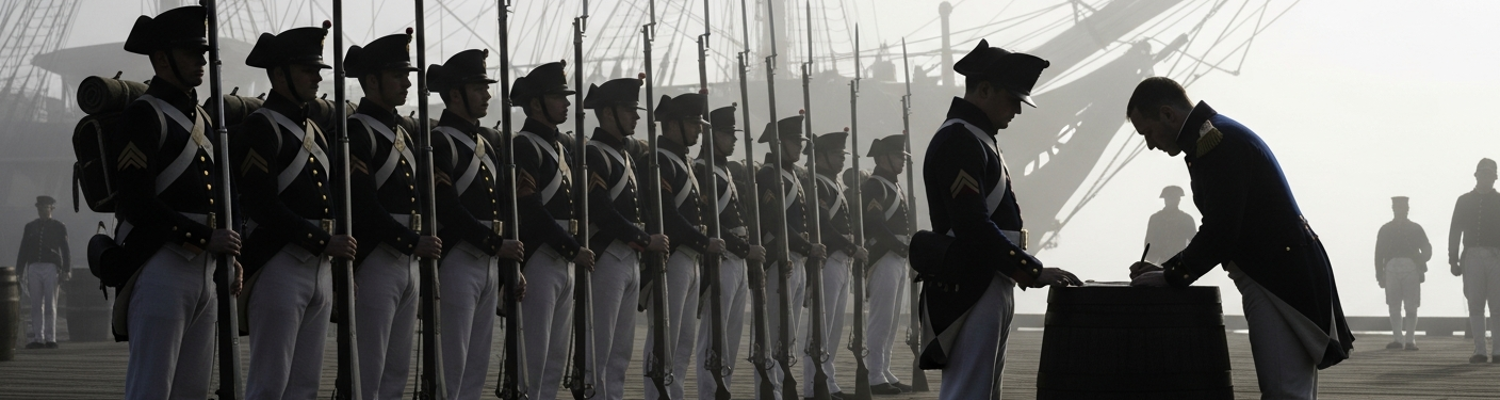
Burrows's letters reveal a clear preference for young men from rural areas, whom he considered more robust, sober, and less corrupted by the vices of the city. He instructed his recruiting officers to seek "stout, and well-made Men, who are every way fit for the most active and arduous duty." Reflecting the prejudices of the era and the Militia Act of 1792, which restricted service to "free able-bodied white male citizen[s]," Burrows instituted a policy that explicitly barred the enlistment of Black, mixed-race, and Native American individuals. This decision established a precedent of racial exclusion that would define the Corps's composition for nearly 150 years. The procurement of arms and uniforms was an equal challenge. The standard service weapon was the U.S. Model 1795 Springfield Musket, a .69 caliber flintlock based on the French Charleville pattern. These muskets, the first standardized American military long arm, were supplied by the government armories at Springfield, Massachusetts, and Harpers Ferry, Virginia. Securing a steady supply for his raw recruits required Burrows to navigate the federal government’s nascent and often inefficient ordnance system. He also had to procure bayonets, cartridge boxes, belts, and swords for his non-commissioned officers. The uniform, a critical component of discipline and identity, was defined under Burrows's direct supervision. He contracted with Philadelphia tailors to produce the iconic first uniform. It featured a dark blue wool coatee with red facings, red turnbacks, and a standing collar. It was worn with a white linen vest and white breeches, black gaiters, and a black felt cocked hat. Most famously, it included a stiff leather stock worn around the neck. This stock, intended to force a proud, head-erect posture, gave the Marines their lasting nickname, "Leathernecks." Sourcing the wool, linen, and leather in sufficient quantities was a constant struggle, and Burrows's letters are filled with complaints about delayed shipments and subpar materials.
Forging Doctrine Between Deck and Shore
To shape these new recruits into a cohesive fighting force, Burrows understood the necessity of a strict regulatory framework. The 1798 Act uniquely positioned the Corps by stipulating that Marines would be governed by the Army's Articles of War when serving on shore but by the rules established for the Navy when embarked on vessels. This dual governance structure placed the Corps at a unique institutional intersection, requiring a doctrine adaptable to both land and sea. Burrows's primary challenge was to implement a disciplinary code that ensured absolute readiness for the specific, brutal rigors of naval service in the age of sail. The early regulations implemented under his command, later codified in the 1800 "Act for the Better Government of the Navy," placed a heavy emphasis on order, cleanliness, and marksmanship. Aboard a cramped, volatile 18th-century warship, which was a wooden world of its own, discipline was the bedrock of survival. Marines served as the ship’s internal police force, enforcing the captain’s orders and guarding against mutiny, a constant fear for naval commanders. They stood sentry over the captain's cabin, the ship's armory, the powder magazine, and the spirit room, controlling access to weapons and alcohol. This role often put them at odds with the sailors, creating a necessary social and professional distance.
In combat, their role was distinct and vital. They were the ship’s primary sharpshooters, sent into the fighting tops, the platforms on the masts, to fire down onto the crowded decks of enemy vessels, targeting officers and gun crews. They were also the hardened core of any boarding party, trained to use their muskets, bayonets, and cutlasses in vicious close-quarters combat. Regulations governing the constant maintenance of muskets, the regular practice of marksmanship at sea, and the specific duties of sentinels were not merely administrative rules. They were the foundational elements of the Corps's operational doctrine. This doctrine of the disciplined shipboard soldier, equally adept as a policeman, a sharpshooter, and an assault trooper, was tested and proven during the Quasi-War. Marine detachments aboard frigates participated in every key ship-to-ship action, including the celebrated capture of the French frigate L'Insurgente by the USS Constellation in 1799. Burrows also fostered an institutional esprit de corps that went beyond combat roles. He is credited with founding the United States Marine Band, which he initially financed by levying contributions from his officers' pay. On New Year’s Day 1801, after the capital moved from Philadelphia, he marched the band to the President’s House in Washington D.C. to perform for John Adams, initiating a tradition that continues today. This was a strategic act of public relations, designed to build a unique institutional culture and present the Marine Corps as a distinguished and permanent part of the American military establishment. When Burrows's failing health forced his resignation in March 1804, he left his successor, Franklin Wharton, not just an administrative entity. He bequeathed a living military service with a defined purpose, a tested shipboard doctrine, and an emerging, distinct identity rooted in discipline, readiness, and adaptability. He had built the machine that would soon prove its worth on the shores of Tripoli.