
Posavina Corridor Mandate under Dayton Accords
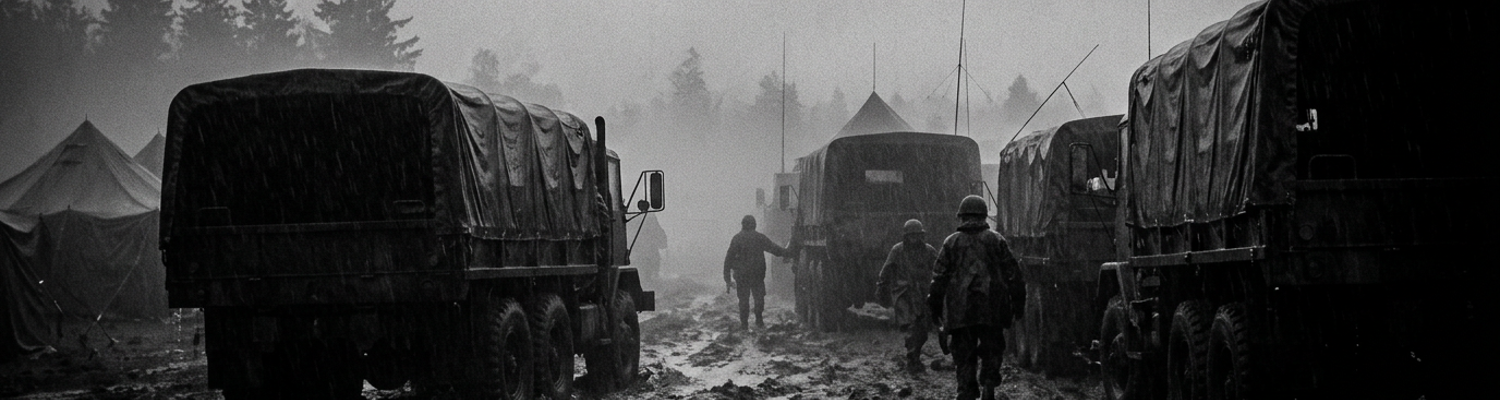
Freezing slush soaked through combat boots. Infantrymen dragged heavy gear across staging sites in late December 1995. Transport movements across Germany, Austria, and Hungary deprived vehicle crews of rest. Soldiers operated on less than three hours of broken sleep per day. Rations froze solid inside supply crates. Riflemen marched on empty stomachs. They hauled wet canvas, communication wire, and heavy weapons mounts. Thick mud stuck to uniforms. This added weight to infantry loads already exceeding eighty pounds per man. Temperatures dropped below zero. Mechanical failures delayed support trucks along rutted supply routes. Physical fatigue degraded basic coordination before the first operational patrols stepped off into contested territory.
Peacekeeping required boots on the ground despite human exhaustion.
Archival evidence shows that Task Force Eagle deployed to the Posavina Corridor in early 1996. The unit operated as part of Operation Joint Endeavor. They assumed tactical responsibility for Multi-National Division North. Built around Major General William L. Nash and the 1st Armored Division, the task force mobilized over sixteen thousand American soldiers. Scandinavian, Turkish, and Russian contingents operated alongside them. Ground movement into northern Bosnia depended on bridging the flooded Sava River between Zupanja and Orasje. On December 31, 1995, engineers from the 130th Engineer Brigade completed a 620-meter ribbon pontoon bridge. Floating ice packs and swollen riverbanks threatened the crossing. Elements of the 1st Brigade Combat Team crossed the pontoon link. They established forward operating locations around Brcko and Tuzla Airfield. Operation Joint Endeavor mandated securing a four-kilometer-wide Zone of Separation along the Inter-Entity Boundary Line. This zone separated the Army of Republika Srpska from Bosniak and Croat forces. Units established checkpoint networks at primary intersections along Route Arizona. These posts monitored narrow land corridors connecting eastern and western Serb-controlled territories. Operational logs record that heavy armor patrols maintained continuous visibility across disputed border sectors. M1A1 Abrams tanks and M2A2 Bradley fighting vehicles deterred troop massing.
Steel tracks flattened frozen mud along the cease-fire line.
A close review of operational logs indicates that joint detainee collection points were established to oversee local militia disarmament. The Dayton Accords enforced compliance across former combatants. Under Annex 1-A of the peace agreement, former warring factions had thirty days to withdraw heavy weapons. Paramilitary personnel had to vacate designated conflict sectors. American commanders designated specific collection centers and cantonment sites. Local commanders turned over light arms, mortars, and military prisoners under direct NATO supervision. Joint military commissions conducted daily inspections at weapons storage sites near Lopare, Pelagicevo, and Bijeljina. Brigade commanders from Task Force Eagle led these commissions. Disarming local militias required verifying inventory serial numbers for artillery pieces caliber 75-millimeter and above. Mortar tubes exceeding 81 millimeters required identical verification. Detainees held by regional factional leaders were processed through structured collection centers. Personnel confirmed identity and recorded physical conditions. They coordinated transfers through the International Committee of the Red Cross. Military police teams secured registration sites. They cataloged confiscated AK-47 rifles, rocket-propelled grenade launchers, and landmine caches pulled from former frontline trenches. Compliance reports flowed directly to division headquarters in Tuzla. This ensured local forces abandoned defensive positions surrounding the vulnerable Brcko gap.
Enforcing these mandates strained aviation and ground transport networks across the narrow corridor.
Mountainous terrain and dense minefields slowed land movements between isolated outposts. Intelligence officers estimated six million unmapped explosives littered the region. Winter whiteout conditions grounded observation aircraft. Unpaved supply trails frequently collapsed under forty-ton transport trucks. Patrol elements relied entirely on radio communications and air support. Medical evacuation units operated UH-60 Black Hawk helicopters out of Camp Comanche. Flight paths remained constrained by low cloud ceilings. Strict altitude restrictions prevented accidental firings by lingering air defense batteries. Small tactical adjustments made at forward collection points began imposing unseen demands on emergency medical response systems. An unexpected chain of events followed.
Camp Comanche logged forty-seven helicopter maintenance holds before February.
Joint Detainee Collection Point Operations
Elements of the 709th Military Police Battalion established co-managed checkpoint sites. They operated alongside local armed factions along key intersections of Route Arizona. Major control posts sat near Loncari and Pelagicevo. Tactical squads from the 127th Military Police Company parked M2A2 Bradley fighting vehicles directly adjacent to improvised timber bunkers. Up-armored HMMWVs flanked the positions. Local Serb and Bosniak paramilitary guards manned these bunkers. Operational coordination broke down constantly over basic security procedures. Regional guards frequently attempted to retain concealed sidearms. They hid infantry ammunition caches inside nearby farm buildings. This defied disarmament directives issued by Task Force Eagle command. Secure voice communications failed to bridge the gap between military units. American military police relied on single-channel SINCGARS radios. Paramilitary guards used unencrypted civilian VHF transceivers. Soldiers delivered operational directives through local civilian interpreters in freezing rain. At Checkpoint 4, situated near coordinates 34T CQ 389 912, American personnel discovered compromised security. Local guards had disabled vehicle search barriers using makeshift wire bypasses. This severely compromised control over incoming civilian traffic.
Cold rain degraded rubber seals on perimeter inspection cameras before mid-January.
Initial protocols governed the medical classification and custody transfer of disarmed personnel. These individuals were detained during search operations within the Zone of Separation. Task Force Eagle medical doctrine mandated a strict three-tier classification system. Corpsmen assigned to the 1st Forward Support Battalion executed this triage. Category Alpha required immediate emergency surgery for acute combat trauma. Category Bravo designated stable non-acute injuries requiring routine treatment. Category Charlie cleared fit individuals for custody handoff. Transfer procedures demanded signed physical documentation from military medical officers. This paperwork was required before releasing detainees to representatives of the International Committee of the Red Cross. Local civil authority teams required identical documentation. Severe winter conditions disrupted this administrative chain at every level. Medics operating out of unheated triage shelters struggled. Intravenous saline bags froze solid inside standard aid packs. Transport heaters inside M998 field ambulances suffered recurring heater core failures. Interior compartment temperatures dropped below freezing during thirty-mile transfers to Tuzla Airfield. Detainees suffering from advanced trench foot and frostbite frequently experienced delayed classification. Combat medics spent hours manually thawing diagnostic equipment.
Processing delays stacked ambulances behind armed barricades for hours.
Physical failures in field equipment expanded administrative backlogs into dangerous operational bottlenecks. Field phones tied to landlines along Route Arizona shorted out. Melting slush filled unsealed junction boxes near Brcko. Search teams clearing weapons caches in abandoned factory complexes frequently uncovered hypothermic detainees. Their medical stabilization required immediate evacuation assets. Flight crews from the 2nd Battalion, 227th Aviation Regiment recorded twenty-two aborted medical lift requests between January 8 and January 15. Low cloud cover and icing on rotor blades caused the cancellations. Ground transport teams lacked sufficient thermal blankets to prevent shock during extended processing holds at collection points. Medical logs from Camp McGovern note that processing paperwork for a single group of twelve disarmed fighters required up to six hours. Ambulances idled in freezing mud while burning through scarce diesel fuel reserves. Tactical radios remained saturated with priority traffic. Battalion medical regulators failed to receive real-time status updates from forward checkpoints.
Camp Comanche logged nineteen cancelled medical flights on January 14 alone.
VHF Radio Frequency Bandwidth Adjustments
Archival evidence shows that on January 18, 1996, signal officers initiated tactical frequency modifications. The 121st Signal Battalion implemented these changes across Multi-National Division North. Heavy wet snow and steep ridge lines along the Majevica mountain range degraded line-of-sight FM radio propagation. Forward operating locations lost contact with battalion command nodes at Tuzla Airfield. The division G-6 section issued a field directive to overcome continuous signal dropouts. They reassigned single-channel ground and airborne radio system (SINCGARS) nets for units operating along the Inter-Entity Boundary Line. Signal technicians modified the AN/PRC-119 manpack configurations. They altered the AN/VRC-89 vehicular transceiver settings used by forward elements of the 1st Battalion, 18th Infantry Regiment. Patrol vehicles from the 127th Military Police Company received identical modifications. Communications specialists narrowed operational channel bandwidth spacing. They reduced it from 25 kilohertz down to 12.5 kilohertz. They shifted low-band VHF tactical command frequencies into the 32.000 MHz to 38.500 MHz spectrum. These adjustments intended to force clear voice traffic through dense atmospheric interference. Heavy pine canopy coverage surrounding the Brcko gap required stronger signal penetration. The primary interference zone sat near grid coordinates 34T CQ 421 887.
Interference multiplied instantly across the spectrum.
The revised 32.000 to 38.500 MHz frequency block directly overlapped with unencrypted channels used by local paramilitary units. Former Army of Republika Srpska border guards patrolled perimeter posts around Loncari. Regional Croat defense forces operated in adjacent sectors. Both groups relied on commercial-grade Motorola GP300 and Yaesu handheld transceivers to coordinate basic guard rotations. These uncalibrated civilian radios lacked precise bandpass filters. They spilled wide radio frequency energy across adjacent spectrum lines. American infantry squads at Checkpoint 4 keyed their hand-mikes to transmit routine status reports. The narrowed 12.5 kilohertz receiver bandwidth failed to reject the higher-wattage spillover generated by nearby militia tower antennas. Local perimeter guards transmitting shift changes routinely stepped on Task Force Eagle tactical nets. This triggered automated squelch locks inside military receivers. At joint observation posts along Route Arizona, American radio operators suddenly heard garbled Serbo-Croatian speech. The civilian audio bled directly over operational command channels. This effectively blinded forward command posts to incoming field transmissions.
Signal degradation turned critical when humidity levels spiked along the Sava River valley. Thermal atmospheric inversion layers locked low-power radio signals against the valley floor.
This frequency overlap disabled emergency communications during urgent medical transfer windows. On the afternoon of January 21, an up-armored HMMWV assigned to the 3rd Platoon, 127th Military Police Company suffered a mechanical steering linkage failure. The vehicle rolled over near Pelagicevo. The crash injured two American soldiers and a detained local combatant. The convoy radioman attempted to broadcast a Category Alpha medical evacuation request to the medical regulating officer at Camp McGovern. The transmission hit a wall of solid static. Local militia guards at a nearby perimeter post were actively transmitting on an adjacent 34.125 MHz channel. They drove enough power into the airwaves to suppress the AN/VRC-89 radio receiver-transmitter unit. The automated frequency-hopping algorithms inside the SINCGARS units failed to find clear spectrum. Surrounding commercial channels occupied every fallback frequency allocated in the emergency load file. For forty-eight minutes, the injured patrol remained isolated in sub-zero mud. The transceiver continually cycled through jammed channels. It failed to establish a single stable voice link with aviation dispatchers at Camp Comanche.
Physical failures in signal routing expanded rapidly into a systemic communications blackout across the Posavina sector. Field technicians attempting to troubleshoot the radios at Checkpoint 4 discovered overheating hardware. The RT-1523 receiver units burned hot while repeatedly attempting to clear signal locks caused by militia transmitter bleed. Internal power amplifier circuits burned out under the continuous load. Patrol leaders lost backup communication assets. Ground crews relied on runner vehicles to physically carry written messages through unmapped minefield lanes. They drove for miles just to reach the nearest battalion command nodes.
By midnight, signal logs recorded ninety-four corrupted emergency transmissions across the corridor.
Triage Tag Revisions and Procedural Errors
Medical officers within the 1st Forward Support Battalion initiated unapproved modifications to standard casualty tracking documentation. This occurred on January 22, 1996, across forward collection sites. Battalion surgeons at Camp McGovern faced continuous friction. They handed off disarmed local fighters to non-English speaking militia escorts and regional civil authorities. Standard-issue Department of Defense Form 1380 field medical cards relied strictly on English text. METTAG MT-137 triage tags utilized English text alongside color-coded tear-off strips. Local command elements ordered medics to alter these standardized tags to bridge the language barrier. They applied improvised rubber stamps and hand-drawn translations. They wrote in both Latin and Cyrillic Serbo-Croatian scripts. Field corpsmen used permanent markers to write phonetic designations directly over the physiological tracking block. They obscured the treatment logs. High humidity and constant exposure to freezing rain quickly turned these modifications into an illegible slurry of black ink. The ink ran across the synthetic cardstock. It obscured baseline heart rate and blood pressure data logged during initial trauma assessment.
Waterlogged grease pencil markings smeared completely off plastic tag covers within twenty minutes of field application.
The field-level modification of standard triage tags destroyed administrative consistency across Multi-National Division North. Medics assigned to the 212th Combat Support Hospital operating near Tuzla Airfield received casualties. These patients bore conflicting diagnostic markings created by forward aid stations. At Checkpoint 4, located near grid coordinates 34T CQ 398 905, battalion personnel began modifying the tear-off severity strips on the MT-137 tags. They wanted to prevent local paramilitary guards from tearing off the red Immediate status tabs. Medical technicians added handwritten Roman numerals and localized cross-hatch symbols to indicate secondary triage categories. They intended to streamline joint handoffs. Local militia commanders interpreted these non-standard markings through their own military framework. They mistook cross-hatched red tags for high-security prisoner classifications rather than life-threatening medical priority. Ground ambulances from the 57th Medical Company arrived to pick up stabilized patients. Drivers found that local guards had re-sorted casualties based on these improvised symbols. Guards placed stable Category Charlie detainees into priority transport slots. They left internal bleeding victims behind in unheated storage tents.
Confusing hand-drawn security symbols directly stalled emergency medical transport along Route Arizona.
Unstandardized symbology created severe cross-referencing errors between medical staff and military police guards. These guards oversaw detainee collection points. On January 24, military police personnel from the 709th Military Police Battalion attempted to process an intake convoy. Nineteen disarmed personnel arrived at the Loncari holding area. Guard forces utilized a local security tracking sheet that relied on numerical codes ranging from one to four. This ranked detainee escape risks. Medical personnel from the 47th Forward Support Battalion worked out of the same facility. They simultaneously marked medical urgency on modified DD Form 1380 tags using an identical one-to-four numerical scale. The absence of a single standardized reference key caused guards to route Category One medical emergencies into high-security detention enclosures. Patients requiring immediate surgical intervention were locked away. Guards assumed the number indicated high-risk combatants. Military police guards released four high-risk security detainees to civilian ambulance drivers. They misinterpreted low-risk security digits for Category Four deceased markings. The cross-referencing disaster forced battalion commanders to halt all casualty transfers across the Posavina Corridor for sixteen hours. Medical personnel conducted manual headcounts and physical re-examinations at every checkpoint.
Tactical Signal Jamming and MEDEVAC Paralysis
Signal congestion along the Posavina Corridor blocked routine emergency communications.
By late January 1996, signal officers had narrowed channel spacing to 12.5 kilohertz. This drove military frequencies into direct collision with regional civilian and militia radio transmissions across northern Bosnia. Tactical operations logs from the 1st Battalion, 18th Infantry Regiment record continuous collisions. Low-band VHF signals operating between 32.000 MHz and 38.500 MHz collided with high-output commercial broadcasts from nearby towns like Pelagicevo and Brcko. Medical regulating officers at Camp Comanche attempted to receive incoming 9-line Medical Evacuation (MEDEVAC) requests. Automated squelch mechanisms inside AN/VRC-89 transceivers locked onto continuous radio frequency bleed. Local Motorola GP300 and Yaesu handheld transceivers flooded the receivers. The automated frequency-hopping routines of the SINCGARS system hit a hard wall. The pre-programmed emergency hop sets contained frequencies already saturated by local radio stations and paramilitary observation posts. Radio operators trying to dispatch air units watched their receiver-transmitters register continuous interference. This cut off voice channels for up to fifty minutes at a time. High atmospheric humidity locked these stray transmissions low to the ground in the Sava River valley. It magnified signal bleed across every forward checkpoint along Route Arizona.
Static locked down the airwaves across three military sectors.
This total loss of reliable signal routing brought both air and ground medical response networks to a complete operational standstill. Flight crews of the 2nd Battalion, 227th Aviation Regiment stationed at Tuzla Airfield were forced to ground six UH-60 Black Hawk MEDEVAC helicopters. Flight dispatchers could not verify landing zone security or patient stability status over jammed FM nets. Ground ambulances from the 57th Medical Company faced an identical paralysis along Route Arizona. Drivers operating M998 and M1035 soft-top ambulances received orders to halt at Checkpoint 4 and Checkpoint 7. They could not enter uncleared minefield sectors without active radio coverage from battalion dispatchers. On January 25, a three-vehicle patrol sustained casualties from an unmapped PROM-1 bounding antipersonnel mine. The blast occurred near grid coordinates 34T CQ 412 895. The complete signal freeze prevented aid dispatchers from confirming the exact geographic grid coordinates for over an hour. Stationary vehicles idling at Loncari burned through thirty gallons of fuel while awaiting verbal clearance. They could not move forward without risk of driving straight into active secondary minefields. Medical control stations reported zero successful automated patient transmissions across the entire sector for twelve consecutive hours.
Emergency transport lines collapsed entirely across the division.
Command staff at Multi-National Division North instituted emergency radio silence protocols for non-essential units. Signal corps technicians re-flashed receiver circuits on forty-eight AN/PRC-119 manpack radios. Dispatch officers resorted to sending armed HMMWV runners from the 709th Military Police Battalion along frozen supply routes. They physically delivered paper casualty evacuation forms to Camp McGovern. By January 26, eighteen separate urgent medical evacuations across the Posavina Corridor suffered delays. The average delay reached ninety-two minutes per request. Mechanical cooling fans inside RT-1523 transceivers seized up. They ran continuously for thirty-six hours while trying to clear jammed channels. This destroyed twelve primary radio units at forward aid stations. Transport regulators suspended all non-critical ambulance movements between Tuzla Airfield and forward collection posts until 1800 hours on January 28. Medical teams depended entirely on hard-wired field phones and physical couriers traversing snow-filled drainage ditches along the cease-fire line.
Detainee Transfer Breakdown along Checkpoint Lines
Detainee holding yards swelled past maximum holding capacity within forty-eight hours of the communications collapse.
Between January 26 and January 29, 1996, the complete shutdown of medical evacuation flights and ambulance ground transport forced forward elements of the 709th Military Police Battalion to halt all outward detainee handoffs. The Loncari Joint Detainee Collection Point sat near grid coordinates 34T CQ 391 908. Military police squads from the 127th Military Police Company held disarmed combatants in unheated razor-wire holding pens. These pens were designed for temporary processing stays under twelve hours. Combat medics assigned to the 1st Forward Support Battalion could not evacuate forty-three Category Bravo and Category Charlie casualties. This included disarmed local militia members suffering from shrapnel wounds, severe trench foot, and blast trauma. Medical personnel lacked the supplies to maintain long-term care inside field shelters. They consumed their limited medical reserves of sterile dressings, morphine tartrate, and broad-spectrum antibiotics within thirty-six hours. By January 28, the holding area at Loncari contained eighty-seven disarmed fighters. This was more than four times its authorized sixty-person limit. Guard crews ran low on MRE rations and clean drinking water. Supply trucks remained stranded at Camp McGovern due to uncleared landmine risks along Route Arizona. Ground mud mixed with human waste inside the overcrowded pens. Sub-zero temperatures rapidly accelerated hypothermia among non-ambulatory wounded prisoners.
Overcrowded holding enclosures turned into explosive tactical vulnerabilities along the cease-fire line.
Local paramilitary guards and low-ranking American military police personnel took matters into their own hands when radio links failed completely. At Checkpoint 4 near Pelagicevo, grid coordinates 34T CQ 389 912, American squad leaders were unable to contact battalion dispatchers at Camp Comanche. They could not reach security coordinators at Tuzla Airfield on their AN/PRC-119 manpack radios. They faced hostile crowds of armed local civilians and deteriorating medical conditions inside the collection compound. Local Serb militia guards and American military police detachment commanders initiated unauthorized, off-the-record prisoner transfers. On the morning of January 29, guard personnel loaded twenty-two wounded and high-security detainees into unarmored civilian trucks and local police vehicles. They did not log custody transfer documents. They did not obtain clearance from the International Committee of the Red Cross. Military police escorts used hand signals and paper notes translated by local civilians to coordinate routes with militia drivers. They bypassed established military police checkpoints along Route Arizona. These convoy movements occurred completely blind to division command. They moved vulnerable detainees through disputed territory where Bosniak and Croat paramilitary cells actively maintained hidden sniper positions.
Command posts across the division remained entirely unaware that prisoner convoys were moving without armed military escorts.
This communication vacuum allowed six unauthorized vehicle convoys to cross the Inter-Entity Boundary Line between Loncari and Bijeljina over a thirty-six hour window. Mechanics operating out of the 201st Forward Support Battalion discovered the aftermath. Local militia trucks utilized to haul detainees suffered from severe fuel line freezing and bald tires. Two trucks broke down directly inside an unmapped minefield lane near grid coordinates 34T CQ 405 899. Without active VHF radio links to dispatch emergency recovery vehicles, guards abandoned the disabled vehicles on the roadside. They left eleven detained fighters locked inside cargo beds in freezing rain for nine hours. A combat engineer patrol from the 130th Engineer Brigade stumbled upon the stalled convoy at 1430 hours on January 30. They found three detainees unconscious from severe hypothermia. Local militia guards had fled on foot toward Pelagicevo. Division headquarters in Tuzla only discovered the extent of the unauthorized transfers when brigade commanders conducted an unscheduled headcount at Camp McGovern. They discovered forty-one missing detainee registration files.
IFOR Command Tensions and Protocol Restructuring
Unannounced prisoner movements across the Inter-Entity Boundary Line pushed military commanders and local warlords to the brink of open warfare by early February 1996.
The disappearance of forty-one detainee registration files during the signal blackout triggered a severe diplomatic confrontation. Major General William L. Nash faced off against regional paramilitary leaders. Local Army of Republika Srpska commanders near Pelagicevo and Bijeljina accused Task Force Eagle of operating secret detention sites. They threatened to cancel joint mine-clearing details along Route Arizona if missing personnel were not produced within twenty-four hours. An emergency meeting occurred on February 1 at a joint military commission site near coordinates 34T CQ 402 911. Serb civilian representatives refused to coordinate further weapons containment protocols with 1st Brigade Combat Team staff. Bosniak military leaders in Tuzla simultaneously charged IFOR with aiding unlawful militia transfers across the Zone of Separation. They claimed American military police had surrendered wounded fighters to hostile factions without international oversight. Red Cross officials suspended joint medical handoffs across the Posavina Corridor. They cited a complete loss of confidence in Task Force Eagle casualty tracking mechanisms. The administrative fallout reached the highest NATO diplomatic levels. Deputy Supreme Allied Commander Europe demanded an immediate explanation from Multi-National Division North regarding unlogged prisoner movements.
Division headquarters faced a total breakdown of authority along the cease-fire line.
Major General Nash responded on February 3 by stripping tactical commanders of the authority to modify radio configurations. He revoked the January signal directives issued by the 121st Signal Battalion. The division G-6 section re-established direct command over all single-channel ground and airborne radio system (SINCGARS) parameters. They ended the 12.5 kilohertz channel narrowing experiment across Multi-National Division North. Technical teams from the 22nd Signal Brigade systematically re-flashed receiver-transmitters. They updated every vehicle and manpack radio in the 1st Battalion, 18th Infantry Regiment and 709th Military Police Battalion. Signals specialists restored original 25 kilohertz channel separation. They reallocated tactical command frequencies completely out of the troubled 32.000 MHz to 38.500 MHz band. Emergency medical evacuation requests were locked to a single, dedicated high-power SINCGARS hop set. This bypassed commercial VHF spillover entirely. Signal officers established continuous monitoring stations at Camp Comanche and Tuzla Airfield to detect spectrum interference. They ordered immediate disciplinary reviews for any unit transmitting on unauthorized frequencies along the Sava River valley.
Signal technicians replaced seventy-four damaged RT-1523 power amplifiers within forty-eight hours.
IFOR leadership enacted an absolute ban on localized modifications to medical tracking documentation. Division Surgeons issued Directive 96-14. This made the unaltered DD Form 1380 field medical card and standard METTAG MT-137 tag the sole authorized medical triage identifiers within the Posavina sector. Field medics were forbidden from adding Cyrillic or Latin script annotations. Rubber stamp impressions and custom cross-hatch shading to diagnostic cards were strictly prohibited. Task Force Eagle deployed bilingual medical regulation teams directly to collection posts near Loncari and Pelagicevo to resolve language barriers without compromising standardization. A centralized Joint Medical Regulating Cell was established at Camp Comanche. This required dual sign-offs from both an American medical officer and an accredited Red Cross observer before any detainee could be transferred across organizational lines. Military police inspectors stationed at Checkpoint 4 received authority to impound any vehicle attempting casualty movement without centralized tracking clearance from division dispatchers.
Operational logs at Camp McGovern recorded zero unverified medical transfers during the final two weeks of February.