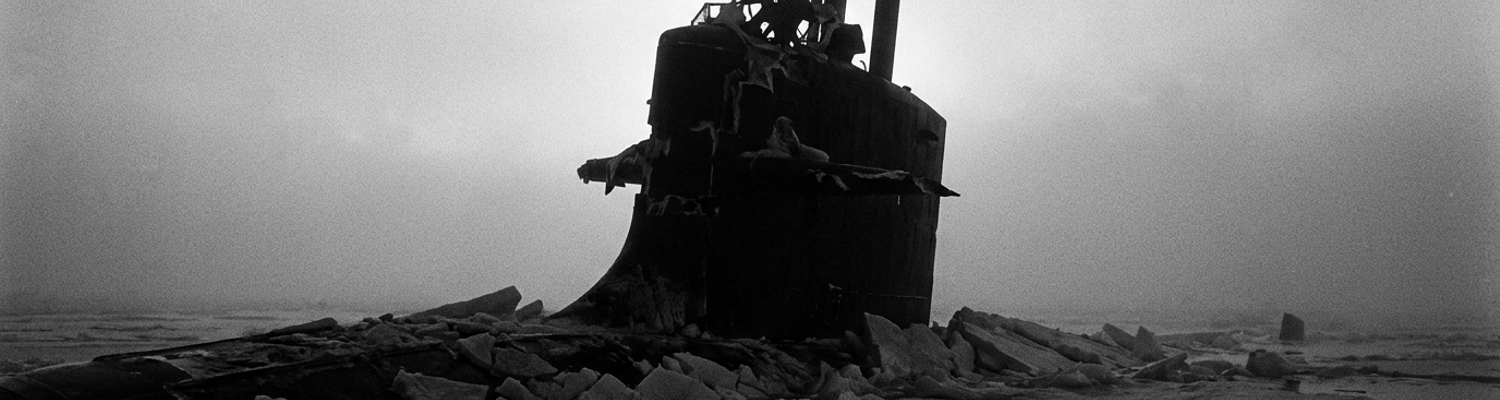

Submerged Impact in the Arctic Marginal Ice Zone
A sonar technician sat hunched inside the forward compartment of USS Grayling. He adjusted the gain control knob on the AN/BQQ-5 passive array console by a fraction of a millimeter. Ambient ocean noise registered on the displays as a flat frequency line. Watchstanders logged routine bearing calculations into paper tracking binders every ninety seconds. Outside the pressure hull, forty-two-degree Arctic seawater slid past the steel skin at eight knots.
A tactical blind spot had opened in the acoustic record.
Archival evidence shows that at 00:35 local time on March 20, 1993, the Sturgeon-class fast-attack submarine USS Grayling collided with the Russian Northern Fleet ballistic missile submarine K-407 Novomoskovsk. The American vessel carried a submerged displacement of 4,780 tons. Grayling had been operating in a trail position. The objective involved gathering acoustic intelligence on Russian submarine movements. The Russian vessel was a 15,500-ton Project 667BDRM Delfin platform. NATO designated this specific hull class as a Delta IV. Novomoskovsk had departed the Sayda Bay base complex to conduct scheduled torpedo launch exercises. Sonar tracking teams on Grayling monitored the Russian target intermittently across several hours. They lost the primary acoustic signature when the Russian vessel reduced speed. The American attack boat continued forward along its projected interception vector.
Submerged acoustics in the northern latitudes degraded target tracking rapidly.
When examining the historical record, the physical geography of the patrol box explains the rapid tactical failure. The collision occurred approximately 100 miles north of Murmansk. This location sat inside an active Russian naval training polygon near the shifting boundary of the Arctic marginal ice zone. Overhead pack ice fragments and drifting floes generated continuous acoustic interference. The ice popped and ground together. This ambient noise masked low-frequency machinery emissions. Meltwater layers from the ice fringe created severe thermal gradients. These temperature shifts bent passive sonar waves downward. The acoustic data cast shadows beneath the seasonal halocline. Grayling operated under strict rules of covert surveillance. These orders prohibited active pinging. The watch team depended exclusively on passive hydrophone arrays while trailing within range of the Russian shoreline.
Two nuclear-powered hulls shared the exact same coordinates at a depth of seventy-four meters.
Novomoskovsk turned across Grayling's projected path during an unannounced heading shift. The maneuver was intended to clear its acoustic baffles. Grayling's fiberglass bow sonar dome struck the forward upper starboard side of the Russian submarine. Novomoskovsk suffered deep gouges across its outer hull casing. Localized tears appeared in its rubberized sound-absorbing anechoic tiles. Structural dents deformed its sail fairwater. Grayling sustained heavy structural scraping along the bow. Mechanical damage compromised its forward ballast tank framework. Fractured internal mounts failed to support the passive sonar array. Neither submarine breached its inner high-yield steel pressure hull. Neither vessel experienced reactor scram anomalies or hull flooding. Novomoskovsk returned under diesel and auxiliary power to Olenya Bay for structural drydock inspection. Grayling broke contact and cleared the Kola Peninsula area on an unescorted transit back to Naval Submarine Base New London.
Arctic Hydroacoustics and Environmental Blind Spots
Archival evidence shows that northern latitude acoustics completely degraded passive sonar detection ranges during the late winter months of 1993. In the shallow waters along the edge of the Barents Sea shelf, sea ice sheet mechanics generated a relentless barrier of broadband acoustic noise. Giant slabs of multi-year drift ice converged. They ground their irregular underwater keels together. The ice fractured under wind shear to radiate sound spikes across the lower kilohertz bands. Calving ice floes toppled into open leads. These events produced acoustic transients that flooded hydrophone transducers with sharp pressure pulses. This ambient Arctic background noise frequently exceeded eighty decibels in the exact frequency windows US Navy sonar operators used to isolate Russian steam plant frequencies. Hydrophones on the American boat picked up millions of cracking ice fissures echoing across hundreds of square miles of shallow sea floor.
The marginal ice zone produced high decibel interference.
A close review of operational logs indicates that oceanographic physics stripped the trailing attack submarine of its primary tactical advantage. Melting sea ice along the boundary layer dumped vast sheets of low-salinity runoff into the surface water. This runoff created a sharp halocline at shallow depths. Below this surface cap, solar radiation was nonexistent. Sub-zero Arctic currents settled beneath warmer Atlantic drift water pushed northward from Norway. This interaction produced an extreme thermal inversion layer between forty and ninety meters down. Sound waves traveling through these unstable layers bent aggressively toward the seabed rather than traveling along predictable horizontal vectors. When K-407 Novomoskovsk slipped into these sound-refracting gradients, its acoustic signature curved downward into the mud bottom. The sound dissolved inside acoustic shadow zones. Sonar beams shot downward at sharp angles. The Russian ballistic missile submarine vanished from passive sensors despite its physical proximity to the American boat.
Seawater refraction created undetectable zones where multi-thousand-ton combatants could operate unseen.
Technical logs reveal the limits of the AN/BQQ-5 passive sonar suite mounted inside Grayling's bow dome and hull flanks (Naval Sea Systems Command Report 93-04). Signal processors inside the BQQ-5 system relied on beamforming networks to separate mechanical machinery signatures from natural oceanic noise. The Arctic shelf overwhelmed the analog filters. Deep ice keels scraping bottom banks generated low-frequency rumblings. These rumblings matched the hydrodynamic profile of Novomoskovsk's twin five-bladed bronze propellers rotating at low revolutions. Pods of migrating harp seals and beluga whales populated the shallow leads above the submarines. The animals emitted continuous high-frequency clicks and broadband squeals. These biological sounds registered across the ship's spherical array as false contacts. Hydrophone channels could not cleanly isolate the Russian boat's main reduction gears from the constant rubbing of submerged ice blocks. Sonar watchstanders altered gain settings and shifted processing modes on their display consoles. The returned data remained a chaotic wash of overlapping signals.
The computer displays could not differentiate iron machinery from frozen sea ice.
Grayling advanced blindly into the Russian operating box under strict directives prohibiting the use of active sonar transmissions. Every minute spent attempting to correlate degraded hydrophone bearings dragged the American attack submarine along an intercept vector based on outdated target-motion analysis. Novomoskovsk ran silently through the lower thermal layer at a depth of seventy-four meters. The environmental noise floor and sound-bending temperature gradients masked the Russian vessel until the two hulls occupied the exact same coordinate track.
Tactical Baffle Maneuvers and Ranging Failures
Archival evidence shows that USS Grayling intentionally positioned itself inside the acoustic baffle zone behind K-407 Novomoskovsk. The American boat maintained a trail stance roughly three nautical miles astern. In standard submarine doctrine, this sector forms a sixty-degree cone directly behind a boat's rudder where hull-mounted sensors cannot listen. Novomoskovsk's twin bronze screws churned the freezing seawater into a broad wake of turbulent bubbles. This action generated continuous hydrodynamic flow noise that overwhelmed its own stern listening equipment. Commander Richard Houck held Grayling steady at eight knots. He exploited this blind angle so his combat team could gather acoustic intelligence without detection. Inside Grayling's sonar room, operators monitored the BQQ-5 spherical array display. They tracked low-frequency harmonics produced by the Russian boat's main propulsion reduction gears. Target-motion analysis teams updated manual dead-reckoning sheets every few minutes. The trailing position protected the American attack boat from counter-detection. Every sound emitted by Novomoskovsk travelled straight into Grayling's bow hydrophones. The Russian boat operated completely unaware of the American vessel riding in its acoustic shadow.
Novomoskovsk was deaf directly behind its rudder.
A close review of operational logs indicates that at 00:30, the Russian bridge watch executed a sudden tactical clearing maneuver to inspect this dead zone. Known in Western naval intelligence as a crazy Ivan, the standard Soviet-era clearing drill forced the 15,500-ton Delta IV to swing its rudder hard over. The submarine cut a sharp arc through the water. This maneuver swept its bow-mounted MGK-500 Skat sonar array across its own baffles. Commander Andrey Bulgakov directed the turn without warning or active sonar transmissions. He shifted the boat from an orderly northerly heading directly onto a southern reciprocal track. Heavy rudder deflection tilted the Russian submarine's massive steel casing. The twin screws swung outward. The bow angled straight back toward Grayling. This heading change eliminated the trailing separation distance within minutes. A cautious trailing operation converted into a direct head-on closure at combined speeds exceeding fifteen knots. Novomoskovsk swept through the water along a direct collision bearing. Its outer hull sliced toward the exact coordinate space occupied by the trailing American boat.
The geometry of the trail inverted instantly.
When examining the historical record, Grayling's watch team miscalculated the closing range. Severe acoustic masking erased the target's physical turn from their consoles. Sound rays echoing off shallow seabed banks and jagged ice floes bounced the Russian machinery noise across multiple false bearings. American plotting officers recorded that Novomoskovsk was still maintaining its original heading miles ahead. The absence of active pinging from the Russian sonar dome hid the aggressive course reversal from the BQR-21 passive array. Flow noise, intense hull turbulence, and Doppler pitch increases eventually registered on Grayling's audio monitors. By that time, Novomoskovsk was less than five hundred yards away and advancing forward at depth. Sonar technicians ripped off their headsets as catastrophic levels of propeller cavitation flooded the hydrophone circuits. This noise signaled emergency proximity. Watchstanders in Grayling's attack center scrambled to issue emergency throttle commands. The hydroacoustic contact had developed too late for the officer of the deck to reverse propulsion or blow emergency ballast tanks.
Grayling's reinforced bow dome struck Novomoskovsk's forward upper starboard casing at seventy-four meters beneath the ice.
Structural Damage and Emergency Ascent Protocols
The physical impact between the two nuclear submarines transferred thousands of tons of kinetic energy through both hulls. Grayling's bow struck the upper starboard quadrant of Novomoskovsk at a shallow upward angle. The American submarine's fiberglass sonar dome absorbed the initial shock. This composite structure shattered instantly upon contact with the Russian vessel's outer steel casing. Seawater flooded the free-flooding bow compartment housing the BQQ-5 spherical sonar array. The collision sheared off external hydrophone mountings and crushed the forward ballast tank structural ribs. Inside Grayling's pressure hull, the impact threw crew members to the deck. Unsecured equipment launched across the combat information center. The officer of the deck immediately ordered the main ballast tanks blown. High-pressure air rushed into the forward and aft tanks to force seawater out. This emergency blow procedure was designed to drive the submarine to the surface and prevent an uncontrolled plunge toward the crush depth.
Damage control parties rigged the forward compartments for severe flooding.
A close review of the damage reports indicates that the HY-80 high-yield steel of Grayling's inner pressure hull held firm. No seawater breached the habitable spaces. The S5W pressurized water reactor maintained normal operating parameters. Engineers in the maneuvering room verified that the primary coolant loops showed no pressure drops. Grayling achieved positive buoyancy and began a rapid ascent toward the surface. Aboard Novomoskovsk, the situation mirrored the American experience. The Russian Delta IV class utilized a double-hull design. An outer hydrodynamic casing surrounded a thick titanium and steel inner pressure hull. Grayling's bow gouged a massive trench along this outer casing. The impact ripped away dozens of thick, rubberized anechoic tiles. These tiles, known as Cluster Guard in NATO terminology, were designed to absorb active sonar pulses. The American submarine's sail fairwater scraped along the Russian hull to leave deep structural dents. Novomoskovsk's inner pressure hull remained completely intact.
The Russian crew experienced violent shaking and immediate loss of acoustic tracking.
Commander Bulgakov ordered an emergency ascent. The Russian submarine blew its own ballast tanks and drove toward the surface. Both submarines broke the surface of the Barents Sea within minutes of each other. They established visual contact through their periscopes. Neither vessel transmitted distress signals on open radio frequencies. The commanding officers visually assessed the damage to their respective boats. Satisfied that neither vessel was in immediate danger of sinking, both submarines cleared the area. Novomoskovsk engaged its auxiliary diesel generators and began a slow surface transit back to Olenya Bay. Grayling remained submerged and initiated a long, unescorted transit back to Naval Submarine Base New London.
The physical evidence of the collision remained etched into the steel of both hulls.
Congressional Inquiries and Revised Patrol Restrictions
The submerged impact spurred immediate congressional inquiries in Washington. News of the collision leaked to the press within days. The incident occurred during a highly sensitive geopolitical window. The Soviet Union had collapsed less than two years prior. The Clinton administration was actively attempting to build a cooperative relationship with Russian President Boris Yeltsin. A collision between two nuclear-armed submarines threatened to derail these diplomatic efforts. The Pentagon faced intense executive scrutiny regarding the necessity of aggressive intelligence-gathering operations in Russian coastal waters. Secretary of Defense Les Aspin demanded a full accounting of the incident from the Chief of Naval Operations. The Navy convened a closed-door board of inquiry to review the tactical logs and sonar recordings from Grayling.
The political fallout was immediate and severe.
Archival evidence shows that the Pentagon was forced to declassify sensitive submarine surveillance protocols to answer congressional oversight committees. Naval intelligence officers testified before the Senate Armed Services Committee. They detailed the specific acoustic masking conditions in the Barents Sea. They explained the mechanics of the crazy Ivan maneuver and the limitations of passive sonar in the marginal ice zone. The hearings revealed that American fast-attack submarines routinely trailed Russian ballistic missile submarines at extremely close ranges. These trailing operations were designed to ensure American submarines could immediately sink Russian vessels in the event of a nuclear launch order. Members of Congress questioned the risk-versus-reward calculus of these operations in the post-Cold War environment. The Navy defended the practice as a necessary component of strategic deterrence. The diplomatic pressure from Moscow proved impossible to ignore. The Russian Foreign Ministry issued a formal protest. They accused the United States of reckless behavior in Russian territorial waters.
The incident forced a fundamental shift in American naval policy.
A close review of operational directives indicates that the Navy formally restricted close-proximity Russian patrol trailing. The Chief of Naval Operations issued new standoff distance regulations for all fast-attack submarines operating in the Barents Sea. Commanders were ordered to maintain a minimum separation distance of several miles when tracking Russian ballistic missile submarines. The new directives explicitly prohibited trailing inside the acoustic baffle zones of Russian vessels. The rules of engagement were rewritten to prioritize collision avoidance over continuous acoustic contact. The era of aggressive, close-quarters underwater surveillance in the Arctic ice margins ended with the Grayling incident. The Navy prioritized standoff acoustic intelligence gathering utilizing towed array sonar systems. The physical damage to Grayling required extensive repairs in drydock. The submarine was eventually decommissioned in 1997. The collision remains a documented case study in the limits of hydroacoustic technology. Naval War College curriculums incorporated the incident into their tactical training modules. The event forced a reevaluation of acoustic physics in shallow, ice-covered waters. The revised patrol restrictions altered the operational tempo of the silent service for the next decade. Submarine commanders operated under strict new mandates. The standoff distances were logged and verified by naval intelligence. The Barents Sea patrol boxes were redrawn.
The minimum separation distance was set at five nautical miles.