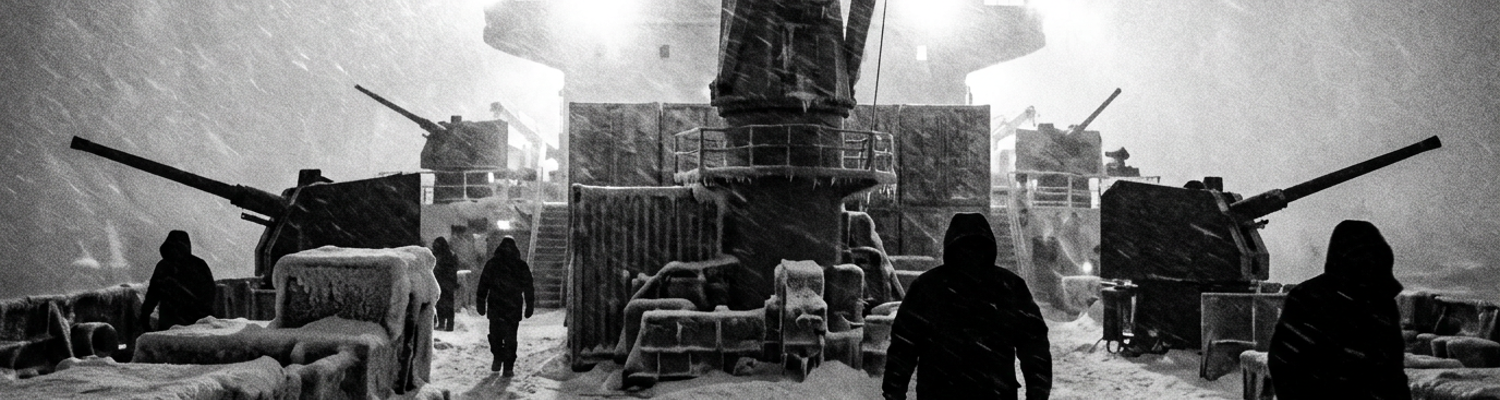

Convoy JW-61 Arrival at Kola Inlet
High-pressure steam lines running along the weather deck of a cargo transport cracked open under violent internal water hammer. Crewmen opened the bypass valves. Sub-zero air turned exhaust condensation into solid ice plugs within the cylinder blocks of the forward windlass. Gauge pressure dropped from one hundred twenty pounds per square inch to zero in five seconds. The operator forced the reverse lever. The teeth of the cast-iron intermediate spur gear shattered with a sharp mechanical crack. This stripped the drive shaft and immobilized the starboard anchor assembly mid-drop. Archival evidence shows that this specific mechanical breakdown repeated across multiple hulls as Convoy JW-61 entered the Kola Inlet anchorage on October 28, 1944.
Thirty merchant vessels.
Protected by a heavy British escort force. The convoy reached the mouth of the inlet after an eight-day passage from Loch Ewe, Scotland. Ships heavily loaded with military vehicles, sheet metal, bulk industrial chemicals, and crated ordnance lined up in a column. The column stretched for miles along the dark, granite-walled waterway. Temperatures hovered near zero degrees Fahrenheit.
Thirty laden freighters brought over two hundred thousand tons of Allied war material directly into a geographic choke point.
A close review of operational logs indicates that the physical environment turned simple ship handling into an administrative nightmare. Thick Arctic sea smoke rolled off the Barents Sea. It blanketed the Vaenga roadstead and blinded the lookouts of the US Navy Armed Guard detachments stationed on the exposed gun platforms. Men stood four-hour watches on 20mm Oerlikon mounts and five-inch stern guns. They chipped sheets of sea spray ice off the traverse tracks with brass mallets while scanning into gray zero-visibility murk. The anchorage lacked adequate shore markers and radio-direction transmitters. Incoming merchantmen drifted dangerously close to one another in the narrow channel. The roadstead at Vaenga quickly filled beyond capacity. This inlet pocket was framed by steep rocky ridges. Freighters dropped both bower anchors into poor-holding mud and shale. Anchor chains fouled continuously. Swirling tidal currents swung five-hundred-foot hulls across each others berths. This risked chain snaps and mid-channel collisions that would have blocked the entire naval artery.
No spare harbor tugs existed to separate colliding merchant hulls.
Soviet naval authorities operating under the Northern Fleet command at Polyarnoye maintained rigid control over all inlet vessel movements. They forbade Allied skippers from shifting berths or deploying harbor lighters without stamped written permits (Northern Fleet Directive 44-A). US Navy liaison officers stationed at Murmansk clashed repeatedly with Soviet harbor masters over the allocation of qualified pilots and offloading priority. Communication between the American mission and the Soviet port directorate broke down over language barriers and cumbersome security protocols. Telegraph messages dispatched across the five-mile roadstead frequently took twelve hours to clear administrative review. Soviet commanders routinely seized priority berthing spaces for local patrol craft and domestic coasters. Deep-draft American cargo carriers loaded with high-explosive depth charges were left riding at anchor in exposed positions. American naval attaches lodged formal complaints regarding the chronic shortage of unloading booms, diesel bunker barges, and shore cranes at the receiving docks. The Soviet administrative bureaucracy refused to permit American officers direct access to the dockside manifests or unloading timetables. Local transport security superseded convoy discharge speed.
Munitions Handling and Frozen Winch Failures
Ice formed across the weather decks of the Liberty ships anchored in the Kola Inlet faster than the boiler steam could disperse it.
Archival evidence shows that temperatures dropping to fifteen degrees below zero Fahrenheit immobilized the five-ton steam cargo winches mounted between Hatch Two and Hatch Three on freighters like the SS Francis Scott Key. Exhaust steam left inside the double-acting cylinders condensed and froze into solid ice plugs within minutes of shutdown. Pressure gauges climbed beyond two hundred pounds per square inch before bypass valves locked in place. Merchant marine engineers carried pressurized kerosene blowtorches directly onto the ice-slicked open decks. They directed bare flames onto frozen cylinder heads and cast-iron manifold castings to restore circulation. Applying intense local heat to sub-zero iron repeatedly fractured the valve casings through severe thermal shock. Escaping high-pressure steam instantly froze on contact with deck plates. This coated the winch controls in thick ice rime and created dense clouds of vapor that obscured the open hatch squares. Open flames operated within yards of exposed munitions hatches containing hundreds of tons of loose cordite and TNT charges.
Metal fatigue under Arctic conditions struck the cargo rigging without warning.
A close review of operational logs indicates that the standard carbon-steel wire rope used for cargo runners lost almost all tensile elasticity once ambient temperatures dropped below zero. The six-by-nineteen plow steel cables were designed to hoist five-ton drafts out of the lower holds. They underwent a sudden ductile-to-brittle transition in the polar cold. Winches jerked frozen cargo nets loaded with crated aircraft parts or ammunition pallets. The shock load shattered the brittle wire strands instead of flexing. Cable runners parted with loud explosive snaps. Severed wire ropes whipped across the steel hatch coamings. They struck deckhands and sliced through canvas weather screens. In several cargo holds, parted topping lifts dropped entire forty-foot wooden boom assemblies directly onto the lower deck beams. This crushed crated materiel and disabled the cargo gear for days. Replacement wire drums remained buried beneath snowbanks on the Murmansk wharves.
Mechanical failure stripped the ships of their lifting capacity.
When examining the historical record of discharge operations at the Rosta and Murmansk berths, US Navy Armed Guard gunners abandoned their defensive battle stations to manually clear the stranded holds. Soviet port authorities pushed unpowered wooden harbor lighters against the ship hulls. They demanded immediate transfer of field artillery ammunition despite the breakdown of all mechanical tackle. Armed Guard sailors descended sixty-foot vertical steel ladders into the unheated lower holds of ships like the Benjamin Schlesinger. They formed human chains along wooden staging planks slick with frost. Men wearing stiff sheepskin coats and soaked woolen mittens manually passed sixty-pound 122mm high-explosive fragmentation shells and ninety-five-pound 152mm naval artillery projectiles hand to hand up from the bilge deck. Ropes secured to canvas cargo slings were hauled over deck rails by sheer physical exertion. Crewmen dragged the uncrated projectiles across iced bulwarks before lowering them into the pitching lighters below. Dropping a single fuse-nosed projectile onto the steel tank tops risked catastrophic detonation inside an enclosed cargo space holding four thousand tons of war materiel. Frozen spray soaked through the gunners wool uniforms. Finger numbness caused multiple shells to slip from crewmens grips. The ordnance tumbled twenty feet through open hatchways into the lower cargo compartments.
Bunker Fuel Sludging and Distribution Bottlenecks
Archival evidence shows that temperatures plunging toward zero degrees Fahrenheit rapidly altered the physical properties of Navy Special Fuel Oil and commercial Bunker C carried in the double bottoms of American freighters. The surrounding sea temperature in Kola Inlet dropped to twenty-nine degrees. Uninsulated hull plating chilled deep fuel stowage compartments far below the oils pour point of fifty degrees. The heavy residual fuel petrified into an asphaltic, semi-solid gelatin with a viscosity exceeding tens of thousands of Saybolt Universal seconds. Routine gravity-fed ship-to-ship fueling operations ground to an absolute halt. Deckhands aboard auxiliary supply ships opened eight-inch sea manifold discharge valves to feed British and Soviet escort destroyers moored alongside. The dense black mass refused to move through the internal piping. Suction lines lost their prime within minutes. Hydrostatic head pressure generated by fifty vertical feet of unheated fuel in the deep tanks proved entirely incapable of forcing the sludge past the internal intake strainers.
Liquid fuel had turned into solid tar.
When examining the historical record of base facilities at Polyarny, the operational gridlock stemmed from an acute deficit of shallow-draft oiling tenders and intact boiler-heating coils. Escort vessels defending the inbound JW-61 freighters carried narrow fuel margins. Deep-draft American tankers could not safely negotiate the granite shallows and unbuoyed shoals of Olenya Bay to reach the inner berths at Polyarnoye. Soviet Northern Fleet units operated only three unheated harbor barges in the sector. These craft lacked internal steam piping systems required to inject ninety-pound boiler steam into their cargo tanks to reduce fuel viscosity before pumping. A close review of operational logs indicates that Allied engineering officers repeatedly requested specialized copper and iron heating coils to retrofit local lighters. Supply depots in Murmansk possessed no spare piping assemblies. American merchantmen attempting to offload reserve fuel had to route primary steam through temporary topside bypass lines to thaw their own hull tanks. They burned up to fifteen percent of their remaining propulsion reserves simply to keep their bunker suction chests clear.
Boilers starved while millions of gallons of oil sat frozen in adjacent hulls.
Faced with immobilized fuel lines, watch officers ordered reciprocating steam cargo pumps driven up to discharge pressures exceeding one hundred seventy-five pounds per square inch. This was an attempt to force the thick sludge through the transfer circuits. Reinforced four-inch synthetic neoprene and natural rubber fueling hoses slung between the pitching hulls could not withstand the mechanical load. Sub-zero polar air had induced severe cold embrittlement throughout the elastomer layers. This stripped the flexible rubber of its tensile give and turned the outer casings brittle. The reciprocating pump pistons delivered violent pressure surges into the stiffened conduits. Radial stress fractures ripped through the canvas-wrapped outer jackets. Hoses burst along their longitudinal seams with explosive force. High-velocity streams of viscous black petroleum sprayed across snow-covered decks. The oil coated steam winches, soaked mooring lines, and dumped hundreds of barrels of fuel into the frozen inlet. Deck gangs working in heavy winter gear slipped across oil-slicked ice plates. They were unable to man the manual cutoff valves before line pressure emptied the manifold lines.
By November 1944, three British escort destroyers sat immobilized at Polyarny for forty-eight hours awaiting hand-pumped drum transfers of light diesel oil.
Replenishment Rig Ruptures in Sub-Zero Gales
Archival evidence shows that Force Nine Arctic gales blowing across the outer approaches to Kola Inlet generated thirty-foot following seas that disrupted alongside fueling operations. Escort destroyers rolling up to thirty degrees attempted to maintain a sixty-foot separation alongside fleet oilers steaming at six knots into blinding sleet. The vessels yawed out of alignment. Asynchronous roll cycles overstressed the five-eighths-inch high-line cables suspended between the kingposts. An escort pitching downward into a wave trough while the adjacent tanker heaved upward caused instantaneous tension on the steel span-wire to surge beyond forty-two thousand pounds. Counterweight bobs bottomed out against their stops. Steam brake drums on the receiving winches glazed over and seized from exposure to freezing sea spray. Cold embrittlement stripped the plow-steel wire rope of its tensile resilience at temperatures below minus fifteen degrees Fahrenheit. Steel whip lines parted with sharp mechanical reports. Fragmented steel cables whipped into the sea and dropped the fuel hose saddles directly into the freezing chop between the churning hulls.
Rigging shattered under loads it was designed to survive.
A close review of operational logs indicates that the kinetic snapback of severed high-lines inflicted severe casualties across exposed weather decks before lookouts could react. Wire ropes under tons of tension rebounded instantly when terminal shackles failed at the padeyes. Coiling steel whips swept across iced forecastles at speeds exceeding two hundred feet per second. They cut through canvas spray shields and smashed into replenishment details. Seamen handling the inhaul lines were struck down instantly by the jagged cable ends. Heavy blowback threw crewmen against gun sponsons and steam manifold casings. This produced catastrophic crush injuries and compound fractures of the femur and pelvis. Cold-stiffened winter foul-weather gear provided zero absorption against the concussive blunt impact. Medical officers set shattered bones in pitch-dark sick bays while ship hulls rolled through thirty-five-degree arcs. They administered morphine to sailors with open skeletal wounds while salt spray leaked through buckled companionway hatches.
Deck gangs hauled mangled line-handlers below while fuel lines continued to thrash overhead.
When examining the historical record of winter convoy escort operations off Murmansk, surging cross-swells frequently forced adjacent hulls together during fueling runs. Deep Arctic swells rolling beneath the tankers displacement hull created a Venturi suction pocket. This dragged lighter escort vessels directly toward the oilers armored plating. Helmsmen applied hard rudder toward the open sea. Reduced steerageway at low transfer speeds rendered standard twin-screw deflection useless against the suction draft. Steel plating ground together from forecastle to quarterdeck with heavy shuddering impacts. Contact sheared away hull-mounted twenty-millimeter Oerlikon gun tubs. It crushed structural framing and flattened exterior depth charge projectors mounted along the escorts main deck. Buckled frames cracked external riveted seams below the waterline along the escorts forward boiler room. This flooded the port void spaces with freezing seawater and forced engineers to secure damaged fuel transfer manifolds while listing eight degrees.
Seawater filled the forward bilges faster than the auxiliary bilge pumps could discharge it.
Damage control parties hammered wooden wedge plugs into split hull seams while temperatures inside the flooded compartments plunged below twenty-five degrees Fahrenheit. Portable submersible pumps froze solid before crews could lower suction hoses into the bilges. British and American engineering logs record that three escort vessels required emergency drydock support at Rosta to weld doubler plates over crushed frames before they could clear Kola Inlet for the return voyage.
Makeshift US Navy Dispensaries at Polyarny
Archival evidence shows that casualties brought ashore from escort vessels and bombed freighters at Polyarnoye overwhelmed the small naval dispensary within hours of Convoy JW-61s arrival. Lacking heated buildings near the water, US Navy medical personnel attached to the port liaison party took over abandoned Soviet coastal defense slit trenches and subterranean earthen dugouts carved directly into the permafrost of the granite bluffs. These timber-shored earthworks, known locally as zemlyankas, sat three feet below grade with uninsulated dirt floors that stayed frozen solid at eight degrees Fahrenheit. Enlisted corpsmen stretched heavy canvas tarpaulins across open overheads to block driving sleet. They anchored the edges with discarded artillery crates and field stones. Inside these damp underground holes, soot from unvented kerosene lanterns coated the rough birch support logs and irritated the bronchial tracts of wounded sailors. Stretcher bearers rested wire-mesh Stokes litters directly on frozen ground because there were no sawhorses or folding cots available. Frost formed on the inner wool blankets of men lying on these litters within thirty minutes. This accelerated secondary hypothermia in blast-concussion casualties before surgeons could assess their primary wounds.
Sub-zero dirt floors bled body heat faster than blankets could trap it.
A close review of operational logs indicates that extreme cold crippled the standard medical supplies issued to US Navy hospital corpsmen. Half-grain morphine tartrate syrettes, packed in cardboard five-unit sleeves, petrified into unyielding crystalline blocks inside medical kits. Corpsmen stripped off heavy gloves to insert the rigid lead tubes directly into their mouths or under their armpits. They utilized body heat to liquefy the analgesic solution before driving the needle into frozen flesh. Syrette needles frequently bent or snapped when corpsmen tried to penetrate cold-stiffened skin. Supplies of dried normal human blood plasma failed under identical thermal stresses. Distilled water bottles packed in the twin-canister vacuum sets routinely froze. This cracked the glass containers and ruined the sterile diluent. When water remained liquid, mixing it with the desiccated plasma powder took up to twenty minutes in ambient temperatures below zero. This yielded an undissolved suspension that clogged intravenous filter needles. Peripheral veins in patients suffering from severe exposure and blast trauma collapsed completely. Corpsmen had to perform venous cutdowns on the long saphenous vein at the ankle with bare, trembling fingers beneath the flickering beam of an angle-head flashlight.
Intravenous lines froze before fluid reached the catheter.
When examining the historical record of base administration at Polyarny, the surge of multi-casualty incidents forced US Navy surgeons into complex operational arrangements with Soviet naval field clinics. Senior American medical officers negotiated direct access to the subterranean surgical shelter operated by the Soviet Northern Fleets Sanitary Directorate. This facility was located inside a blasted rock cavern half a mile north of the main jetty. American and Soviet naval doctors established a joint triage station at the cave entrance. They divided casualties into three categories based strictly on immediate transportability. Language barriers forced doctors to annotate patient foreheads with grease pencils. They wrote Cyrillic letters for Soviet hospital trains and Latin numerals for shipboard berths. Treatment philosophies clashed immediately over wound management and shock therapy. Soviet military surgeons relied almost exclusively on regional novocaine nerve blocks developed by Alexander Vishnevsky. They reserved rare whole blood reserves for domestic military personnel. Earthen dugouts offered no sterile surgical field. American doctors transferred all thoracic blast injuries, compound fractures, and extensive immersion gangrene cases directly to Soviet surgical tables. Orderlies in the cavern stripped off oil-soaked woolens and scrubbed open burns with carbolic soap solutions before packing the wounds with dry gauze and applying unpadded plaster casts.
Arctic Trauma and Frostbite Medical Triage
Archival evidence shows that German acoustic torpedo strikes in the approaches off Kildin Island and the Kola bar inflicted massive concussive trauma before casualties ever reached shore stations. U-boats firing G7es Zaunkoenig electric torpedoes targeted the acoustic signatures of escort screws. They detonated six-hundred-pound hexonite warheads against the stern sections of vessels maneuvering at eight knots. The kinetic energy did not dissipate in the freezing water. Non-compressible shock fronts hammered directly through thin outer hull steel. They rocketed through deck beams into the skeletal frames of crewmen standing at their action stations. Deck plates whipped upward with explosive velocity. Men suffered bilateral comminuted calcaneus fractures and shattered tibial plateaus without a single fragment of shrapnel penetrating their skin. US Navy and Royal Navy medical officers boarding crippled hulls encountered sailors displaying profound blast concussion alongside internal organ rupture. High-pressure displacement waves tore through pulmonary air spaces. This created extensive alveolar capillary hemorrhage and fatal air embolisms in crewmen stationed near lower-deck machinery flats. Triage orderlies separated blast-lung victims spitting bright red arterial foam from men displaying rigid, board-like abdominal walls caused by occult liver tears and ruptured spleens.
Water shock waves pulverized visceral organs without penetrating the hull.
A close review of operational logs indicates that survivors hauled out of the Kola approaches faced immediate circulatory collapse when sea temperatures plunged to twenty-nine degrees Fahrenheit. Immersion hypothermia set in within five minutes of exposure. This locked limbs in tetanic flexor spasms and dropped core rectal temperatures below eighty-four degrees. American medical detachments discarded older, gradual rewarming doctrines that had caused massive circulatory failure during previous winter runs. Rescuers cut ice-sheathed wool watch coats and petroleum-soaked life vests off comatose merchant mariners using heavy trauma shears. They immediately carried the men into heated engine spaces or dispensary rewarming bays. Corpsmen immersed the patients trunks in galvanized steel scuttlebutts and canvas immersion troughs filled with seawater heated to precisely one hundred six degrees Fahrenheit. Direct heat application to peripheral limbs was strictly forbidden. Medical officers knew that rapid dilation of extremities flushed cold, acidotic venous blood back into the cardiac chambers. This physiological phenomenon was known as rewarming shock. It repeatedly triggered fatal ventricular fibrillation. Corpsmen kept arms and legs elevated outside the hot water baths. They administered warm physiological saline via rectal tubes and applied heated sandbags exclusively to the groin, neck, and axillae until shivering reflexes resumed.
Core body temperatures continued to drop even after men left the water.
When examining the historical record of casualty clearing stations at Polyarnoye, advanced frostbite presented surgical teams with widespread ischemic tissue death. Lookouts and raft survivors brought ashore after six hours of exposure suffered severe fourth-degree frostbite. This had completely frozen cutaneous, muscular, and neurovascular layers into rigid, bloodless blocks. Rapid vascular thrombosis followed tissue thawing. This occluded digital arteries and starved extremities of oxygenated blood. Within forty-eight hours, exposed feet and hands turned mottled purple before collapsing into black, foul-smelling dry mummification. Bacterial contamination from sodden wool socks and bilges frequently transformed these injuries into invasive wet gangrene. American surgeons working alongside Soviet medical officers in the underground rock clinics carried out emergency surgical debridement on wooden operating tables illuminated by battery lamps. Operators used straight-bladed Liston knives to slice through necrotic skin down to viable bleeding tissue. They resected liquefied muscle bellies while preserving as much functional bone as possible.
Invasive wet gangrene demanded rapid bone resection to halt systemic sepsis.
Surgeons employed Gigli wire saws to execute rapid open-guillotine amputations through the transmetatarsal joints and distal thirds of the tibia. Flaps were intentionally omitted. Anaerobic Clostridium bacteria thrived in devitalized Arctic frostbite wounds. Medical personnel left stumps entirely open. They packed the raw bone ends and bleeding muscle beds with crystalline sulfanilamide powder before applying dry petroleum gauze. Pressure dressings anchored the open stumps. This prevented secondary hemorrhage while casualty transport details loaded the amputees onto unheated coastal cutters bound for base hospitals at Vaenga.
Anchorage Perimeter Defense and Winter Operations
Archival evidence shows that German Type VIIC and IXC submarine patrol lines off Kildin Island and the shoals of Cape Poganets routinely ambushed Allied hulls using electric G7es Zaunkoenig acoustic homing torpedoes. To defeat the weapons passive acoustic seeker heads, Royal Navy and US Navy vessels entering the Kola approaches streamed Foxer noise-maker arrays four hundred yards astern. The apparatus consisted of paired hollow bronze or steel pipes perforated to generate violent cavitation clatter when towed at eleven knots. This drowned out ship screw signatures. Severe sub-zero temperatures transformed this routine countermeasure into an engineering failure. Towed wire cables running off stern fairleads accumulated thick rime ice. This increased drag until half-inch wire ropes snapped under tens of thousands of pounds of tension. Winch motors on escort sterns froze mid-recovery. This left dead steel tubes dragging across shallow rocky bottoms where they snagged granite ledges and stripped entire deck fittings. The acoustic noise generated by the clattering pipes completely blinded shipboard Type 144 ASDIC sonar sets. Destroyers attempting to protect vulnerable freighters lost the ability to ping submerged contacts. Escorts were forced to alternate between acoustic decoys and active tracking in a narrow sea channel barely five miles wide.
Towed noisemakers snapped off into the freezing wake within hours of deployment.
When examining the historical record of Armed Guard detachments stationed across the roadstead, the onset of perpetual polar night on November 27 eliminated all natural light. This cast the Kola Inlet into unbroken blackness for two months. Temperatures dropped past twenty-five below zero as gale-force Arctic squalls swept across open gun tubs. American gunners stood watch on exposed 20mm Oerlikon and 40mm Bofors mounts. They wore heavy wool coats under sheepskin jackets that severely restricted movement inside cramped gun rings. Standard ordnance lubricating oils petrified into solid wax inside gun recoil cylinders. This froze the elevation and traverse gears. Gun crews washed mechanisms with straight gasoline and aviation kerosene to strip the grease. Bare steel parts were left to grind together in the sub-zero wind. Lookouts scanned pitch-black horizons through heavy deck binoculars. The warmth of their breath coated the optical glass in instant sheets of white frost. Four-hour watches had to be compressed into twenty-minute shifts to prevent lookouts from succumbing to frostbite on their corneas and facial skin. Soviet shore batteries opened unannounced antiaircraft barrages against unidentified radar plots. Concussive muzzle flashes blinded night-adapted American lookouts for minutes at a time.
Ice welded gun barrels to their elevation stops.
A close review of operational logs indicates that coordinated German pressure along the outer perimeter systematically wrecked Allied discharge schedules at the Murmansk quays. Junkers Ju 88 reconnaissance aircraft staging from Banak and Bardufoss in occupied Norway tracked convoy movements. They seeded the narrow approach channels with magnetic TMB bottom mines. Soviet Northern Fleet minesweepers lacked sufficient acoustic sweep gear to clear the deep granite channels. Port directors were forced to close the mouth of Kola Inlet for three days at a time. Inbound merchant ships carrying heavy artillery, explosive powder, and disassembled aircraft were diverted into holding boxes off Tyuva and Vaenga. They sat anchored under constant threat from U-boat wolfpacks prowling the approaches. Each air-raid alert ordered across the port sent civilian dockworkers and lighter crews scrambling into underground granite blast shelters. This instantly halted all steam cranes and manual cargo holds. Laden freighters sat tied to offshore moorings for twelve to eighteen days awaiting empty rail wagons and qualified channel pilots. Stationary vessels continued burning tons of reserve bunker fuel simply to keep their auxiliary boilers fired and internal heating circuits thawed.
Ten thousand tons of raw explosives sat frozen in the channel while rail depots at Rosta stood empty. The survival of the Eastern Front did not depend on battlefield heroics. It depended entirely on the mechanical tolerance of cast-iron winch gears and the freezing point of human blood.