
Close Air Support Failures of Task Group 52.14
At 0740 hours, emergency radio traffic erupted across amphibious control frequencies. Front-line observers transmitted urgent demands to cease firing immediately. Navy aircraft were raking friendly foxholes with machine-gun fire.
Rear Admiral Gerald F. Bogan commanded Task Group 52.14. His escort carriers operated twenty miles off Saipan. They pushed flights of FM-2 Wildcats and TBM-1C Avengers into the overcast morning air.
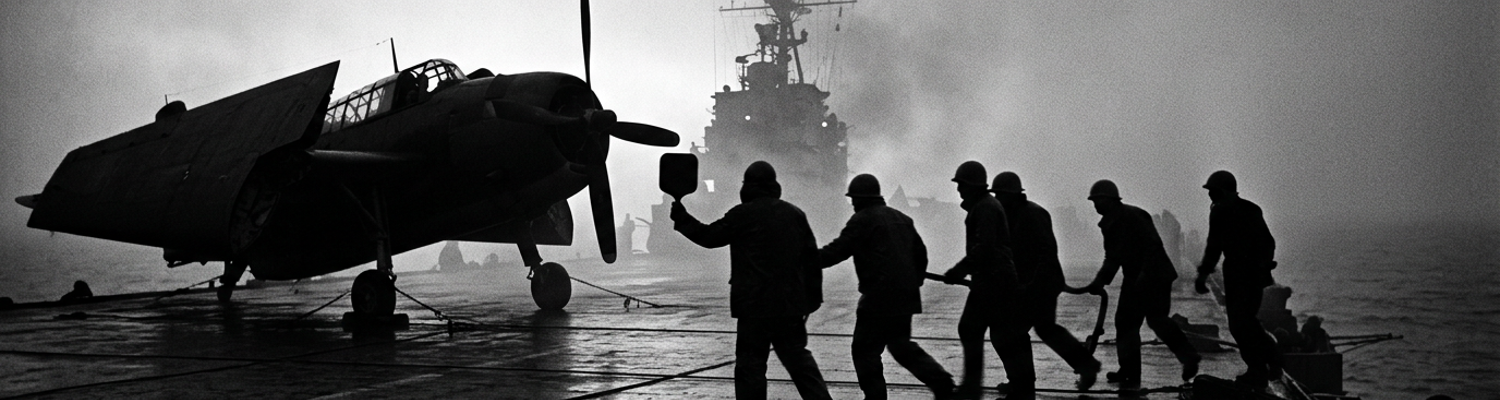
Flight deck crews on escort carriers like Gambier Bay, Kitkun Bay, and Fanshaw Bay locked 500-pound general-purpose bombs to the hardpoints. They attached 20-pound fragmentation clusters. Racks of five-inch high-velocity aircraft rockets were armed.
Naval aircrews operated Wright Cyclone radial engines at full combat throttle. They banked toward the jagged limestone crags flanking Mount Tapochau.
Close air support over this rugged interior terrain presented an extreme operational mismatch. Naval aviators were trained to spot wakes on open water. Visual flight paths forced pilots into steep gliding dives over unbroken canopies. Hidden Japanese defensive positions were indistinguishable from American staging lines.
Target markers on the ground vanished entirely beneath thick clouds of pulverized coral and sulfurous debris.
A close review of operational logs indicates that visual obscurity quickly merged with acute tactical disorganization. Heavy bombardment from naval cruisers and army artillery threw continuous blankets of white phosphorus across the ridges. This obscured the bright cloth recognition panels frontline infantry staked to the earth.
Discrepancies between navigation systems worsened the situation. Aircrews carried outdated 1:62,500 naval hydrographic charts displaying crude topography. Ground controllers plotted coordinates using provisional 1:20,000 army terrain maps with different baseline meridians.
Calculations between the two systems regularly drifted by more than one thousand yards.
Radio failures sealed the tactical error. Escort carrier transmitters operated across specific VHF frequencies. These could not communicate with the portable SCR-284 or SCR-300 radios carried by forward air liaison parties. Ground units were cut off while aircraft were already diving toward the tree line.
Air directors aboard the amphibious command ship Rocky Mount logged frantic cancellation transmissions. These messages never reached the strike leaders in flight.
Archival evidence shows that friendly assault echelons caught in the open absorbed the full blast of this technical failure. Assault companies of the 4th Marine Division pushed toward the ridge systems east of Charan Kanoa. They dove for cover as flights of FM-2 Wildcats opened fire with six .50-caliber wing guns.
Heavy machine-gun rounds tore into shallow foxholes. Trailing TBM-1C Avengers released 20-pound fragmentation clusters directly across the 24th Marine Regiment forward command post.
Across the adjacent sector, elements of the Army 27th Infantry Division faced identical friendly strikes. Exploding ordnance struck staging areas occupied by the 165th Infantry Regiment. Fragmentation bombs blasted shrapnel through communication wire. They severed field telephone lines. They inflicted severe trauma on infantry platoons waiting to advance.
Panicked forward observers fired green and red recognition flares to halt the dive bombers. Pilots mistook the pyrotechnics for Japanese defensive fire. They pressed their attacks deeper into the company perimeters.
By early afternoon, thirty-three soldiers and Marines lay dead.
Fratricide Casualties Along the Mount Tapochau Front
A close review of operational logs indicates that the rocky approaches to Mount Tapochau turned into a direct slaughter zone for friendly troops. Between June 21 and June 23, assault elements of the 27th Infantry Division found themselves pinned down beneath jagged limestone cliffs. The 2nd and 3rd Battalions of the 106th Infantry Regiment took the brunt of the damage.
American riflemen staked daylight-fluorescent fabric panels into the pulverized coral and brush. These standard orange and yellow identification markers were meant to show aircrews their forward positions.
Pilots flying FM-2 Wildcats and TBM Avengers from Task Group 52.14 escort carriers descended through heavy haze and sulfurous cordite smoke. They misread the markers against the torn terrain.
Naval aviators operated at over two hundred knots. They mistook the bright cloth squares for Japanese supply points. Some thought they were camouflaged bunker lids.
Wildcat pilots banked hard and throttled forward. They opened fire with quadruple Browning M2 .50-caliber machine guns. They raked the foxholes of Company E and Company F.
Heavy half-inch slugs pulverized rock ledges and chewed through shallow dirt berms.
Terrified infantrymen bolted from their positions to escape the aerial barrage. They were cut down by Japanese Type 92 machine-gun nests firing from caves above.
Cloth panels pinned to the dirt offered zero protection against aerial machine guns.
Archival evidence shows that this slaughter persisted because forward air liaisons had no direct mechanical line to the cockpits above. Ground liaison teams operating with the 106th Infantry carried low-frequency SCR-284 radio sets. They also used backpack-mounted SCR-300 FM transceivers operating between 40 and 48 megacycles.
Navy aircraft from the escort carriers operated exclusively on very-high-frequency gear. They used AN/ARC-1 or TR-1143 radios built for narrow crystal-controlled channels between 100 and 156 megacycles.
This technical frequency split left forward air controllers completely mute.
When a flight leader tipped his wings into a strafing run, forward observers could only transmit urgent warnings back through an absurd chain. Messages went from field telephones to division headquarters. They traveled outward by ship-to-shore circuit to the command ship Rocky Mount. Finally, they went out to the escort carrier flight directors.
The message routing took twenty minutes.
Aircraft had already emptied their ammunition bays and climbed back into the clouds before wave-off orders cleared the airwaves. Pistol-fired pyrotechnic flares shot from the ground failed just as miserably. Carrier pilots routinely mistook red and green flares for Japanese anti-aircraft tracer bursts. They pressed their attacks right into American command posts.
Controllers stood in the brush with dead handsets. American bombs detonated on friendly foxholes.
When examining the historical record, the command response to this aerial bombardment reveals why the entire central offensive stalled. Colonel Russell G. Ayers of the 106th Infantry Regiment and division commander Major General Ralph C. Smith halted forward progress across the Tapochau ravines. They wanted to keep their men from being wiped out by their own carrier support.
Field officers ordered exhausted rifle companies to pull back to reverse slopes. They ceased daylight movement. They constructed reinforced overhead log shelters.
Battalion commanders deliberately chose to pause offensive operations rather than expose riflemen to uncoordinated friendly air strikes.
These operational pauses created a deep gap in the center of the American battle line. This stranded the 2nd Marine Division and 4th Marine Division attacking along the exposed coastal flanks.
Marine Lieutenant General Holland M. Smith viewed the stationary 27th Division with fury. He mistook defensive safety measures against naval fratricide for a systemic lack of combat aggressiveness.
That fundamental misunderstanding resulted in Holland Smith summarily relieving Ralph Smith of command on June 24. This sparked a bitter interservice conflict that reached the Joint Chiefs of Staff.
Command Discord Between Holland Smith and Ralph Smith
A close review of operational logs indicates that V Amphibious Corps headquarters received field reports showing the 106th and 165th Infantry Regiments pinned down. They were stuck across the rough, cave-riddled corridor dubbed Death Valley, south of Mount Tapochau.
Marine Lieutenant General Holland M. Smith refused to accept that friendly air strikes from escort carriers, severed radio lines, and sheer limestone cliffs had immobilized the New York National Guardsmen.
His tactical perspective centered entirely on speed. He viewed the methodical doctrine of the 27th Infantry Division as evidence of command hesitation. The Army doctrine mandated extensive reconnaissance, artillery preparation, and coordinated flank security.
Major General Ralph C. Smith halted forward elements on June 23 to reorganize shattered assault companies and protect riflemen from errant Navy bombs. The corps commander attributed the delay to deficient Army leadership rather than technical chaos.
Senior Marine staff officers dismissed battalion reports of strafing carrier aircraft as standard combat friction. They believed resolute ground officers should have overcome this through aggressive maneuver.
Holland Smith viewed stationary units on tactical maps as evidence of personal incompetence.
Archival evidence shows that this institutional frustration culminated on the morning of June 24, 1944. Holland Smith boarded a landing craft before 0900 hours to confer with Admiral Raymond A. Spruance aboard the heavy cruiser USS Indianapolis.
The corps commander argued that the lagging 27th Division endangered the flanks of the 2nd and 4th Marine Divisions. He demanded Ralph Smith be relieved immediately.
Spruance was an ocean strategist hesitant to overrule his primary ground commander on amphibious tactics. He approved the measure without consulting Army authorities.
Written orders reached the 27th Division command post near Charan Kanoa by midday. They summarily removed Ralph Smith and transferred division leadership to Major General Sanderford Jarman.
Field clerks processed the relief before Ralph Smith received any opportunity to present telephone transcripts or liaison logs detailing the friendly aerial barrages.
Ralph Smith surrendered command and departed Saipan on an evacuation transport before dusk.
When examining the historical record, this unprecedented relief of an Army division commander by a Marine corps commander split the Pacific military hierarchy along severe interservice lines.
Lieutenant General Robert C. Richardson Jr. commanded Army forces in the Central Pacific Area. He flew to Saipan on June 29 and established an administrative board that formally condemned the dismissal as arbitrary.
Senior naval commanders, including Chester W. Nimitz, defended the corps commander and his authority to dictate combat leadership. Army Chief of Staff General George C. Marshall received urgent demands from field generals to withdraw soldiers from Marine Corps control.
Unfiltered accounts reached mainland newspapers. This provoked public accusations between service branches and sparked congressional inquiries into Pacific command structures.
Army leadership resolved that no soldier would serve under Holland Smith during the subsequent invasion of Okinawa.
The Richardson Inquiry and Inter-Service Clashes in Hawaii
Archival evidence shows that the conflict exploded into open administrative warfare once the principal commanders converged on the Hawaiian island of Oahu.
Lieutenant General Robert C. Richardson Jr. commanded U.S. Army Forces in the Central Pacific Area from his headquarters at Fort Shafter. He refused to let the summary relief of Major General Ralph C. Smith stand unchallenged.
Richardson flew directly into the Saipan combat zone on June 29 to inspect the forward lines. He clashed violently with Vice Admiral Richmond Kelly Turner and Marine Lieutenant General Holland M. Smith over theater authority.
Upon returning to Honolulu, Richardson issued special orders on July 7, 1944. He formally convened a military board of inquiry to review the entire operation.
He appointed Lieutenant General Simon Bolivar Buckner Jr. to lead the five-officer panel. Buckner was joined by Major General Donald C. Cubbison and Brigadier General Robert H. Dunlop.
The board met inside secure briefing rooms at Fort Shafter. They interrogated staff officers. They collected front-line casualty rosters. They gathered sworn depositions to determine whether Holland Smith had relieved an Army division commander on arbitrary and unfounded grounds.
Fort Shafter became an armed camp of hostile testimony.
A close review of operational logs indicates that the Buckner Board focused its primary investigation on the severe mechanical and communications breakdown between ground troops and carrier aircraft.
The inquiry entered hundreds of pages of action reports into the record. These detailed how misdirected strikes from Task Group 52.14 escort carriers crippled the 27th Infantry Division during its advance toward Mount Tapochau.
Testifying officers showed that when the 106th and 165th Infantry Regiments moved through the jagged limestone cuts of Death Valley between June 21 and June 23, Navy FM-2 Wildcats and TBM-1C Avengers bombed friendly positions repeatedly.
Technical exhibits presented by signal specialists demonstrated that frontline Army tactical radios could not transmit across the very-high-frequency bands used by naval aircraft radios like the AN/ARC-1. The Army relied primarily on low-frequency SCR-300 and vehicular SCR-284 units.
Grid-coordinate errors compounded the destruction. Naval aviators flew with 1:62,500 hydrographic charts while Army artillery batteries plotted fire missions using 1:20,000 combat maps.
Forward observers spent up to forty minutes relaying air-abort messages through intermediate headquarters to the amphibious flagship Rocky Mount.
Senior investigators concluded these uncoordinated strikes, rather than command timidity, pinned down American rifle platoons in reverse-slope ravines and caused the central line delays.
Radio silence between cockpits and foxholes had paralyzed the advance.
When examining the historical record, this aggressive Army inquiry triggered an immediate institutional counterstroke from Admiral Chester W. Nimitz at Pearl Harbor.
Nimitz operated his Pacific Fleet command from Makalapa. He viewed Richardson and his board as an unacceptable encroachment upon Navy and Marine Corps operational prerogatives.
Naval leadership defended Holland Smith and Fifth Fleet commander Admiral Raymond A. Spruance. They stated that unified command doctrine gave amphibious force leaders absolute authority to remove subordinate field commanders during an active assault without consulting outside administrative bodies.
Richardson submitted a scathing report accusing Holland Smith of deep-seated anti-Army prejudice and tactical mismanagement.
Fleet dispatches to Chief of Naval Operations Ernest J. King formally rejected the document. They condemned Richardson for meddling in combat commands outside his administrative jurisdiction.
Fleet headquarters warned Washington that Army attempts to bypass naval command structures threatened the future command hierarchy of joint Pacific landings.
Nimitz placed the entire Buckner report into classified archives. He barred Richardson from visiting the Saipan battlefront a second time.
War Department Inquiries and National Press Fallout
Archival evidence shows that encrypted teletype machines inside the Pentagon began chattering on July 10, 1944. Lieutenant General Robert C. Richardson sent raw investigative findings directly to the desk of Army Chief of Staff General George C. Marshall.
Marshall immediately confronted Chief of Naval Operations Admiral Ernest J. King inside the Joint Chiefs of Staff conference room at the Public Health Service Building in Washington.
In a sequence of sharp memoranda, Marshall challenged the operational legitimacy of Holland Smith and his actions. He argued that naval and amphibious commanders possessed no unilateral mandate to remove an Army division commander without formal concurrence from the Army service component.
Marshall pointed directly to the failed air support logs of Task Group 52.14. These documented that escort carrier aviators flying off small CVE decks lacked the radio gear, map coordinates, and tactical training needed to support infantry assaults through deep ravines.
King struck back with equal venom.
King stood behind Admiral Chester W. Nimitz and Admiral Raymond A. Spruance. He informed Marshall that Spruance held absolute authority over all ground and naval units assigned to Operation Forager.
Tactical command on an active beachhead could never be subordinated to administrative Army channels twelve hundred miles away in Oahu.
The Joint Chiefs had split down the middle.
A close review of operational logs indicates that the Pentagon attempted to bury the feud under strict wartime secrecy. Uncensored details broke into the public domain through press leaks.
Time and Life war correspondent Robert Sherrod had come ashore with assault troops on Saipan and witnessed the friction across the front lines. He filed uncensored dispatches describing Holland Smith and his outrage over the slow movement of the 27th Infantry Division.
Pro-Army and pro-Navy syndicates back home seized on the controversy.
The September 1944 print runs of Time magazine brought the bitter interservice row into millions of American households. They printed accounts that portrayed the New York National Guard soldiers as hesitant under fire while Navy and Marine Corps units drove ahead.
Life magazine followed with pictorial essays highlighting Marine assault doctrines while casting doubt on Army infantry tactics in rugged terrain.
Hearst newspapers countered with syndicated columns written by defense correspondents who leaked classified counter-findings. They claimed that reckless carrier air strikes and uncoordinated naval gunfire had actually butchered Army rifle companies pinned inside Death Valley.
National newsstands turned into an active ideological battleground.
When examining the historical record, this explosive publicity triggered immediate outrage on Capitol Hill.
Democratic Representative Andrew J. May of Kentucky, chairman of the House Military Affairs Committee, joined ranking members of the Senate Military Affairs Committee in demanding closed-door explanations from War Department officials.
Lawmakers expressed alarm that interservice rivalry had degraded combat efficiency. It produced friendly-fire casualties. It led to the public disgrace of an Army general without a court-martial.
Congressional leaders warned the Roosevelt administration that unless the War Department and the Department of the Navy settled their command protocols, Congress would launch formal legislative oversight into theater unified command structures. They threatened to freeze appropriations for upcoming Pacific offensives.
Representative James E. Van Zandt, an active naval reserve officer serving in Congress, traded barbed floor statements with Army partisans over command prerogatives in joint operations.
Marshall dispatched senior legislative liaisons to the Capitol to prevent formal committee subpoenas. He reassured nervous committee chairmen that unified operational control would be rewritten before ground echelons embarked for the invasion of the Philippines.
War Department couriers delivered classified files to committee rooms under armed escort.
Amphibious Air Support Revisions for Subsequent Campaigns
A close review of operational logs indicates that the communications blackout over Saipan drove an immediate overhaul of frontline air control doctrine across the Pacific Fleet.
Ground echelons embarking for late-1944 operations received full allocations of newly activated Joint Assault Signal Companies.
These specialized seventy-man JASCO air liaison parties were assigned to army divisions and marine regiments alike. They carried waterproofed AN/VRC-1 radio jeeps. They used modified crystal-tuned SCR-522 transceivers capable of broadcasting directly across the 100-to-156 megacycle very-high-frequency band used by carrier aircraft.
Signal teams no longer relied on twenty-minute telephone relays through flagship switchboards.
Forward air controllers climbed forward ridges alongside infantry rifle companies. They gripped remote microphone handsets that established immediate two-way voice contact with strike leaders orbiting overhead.
At the battalion level, trained naval aviators served as ground observers. They evaluated ridgelines, wind shear, and gun positions through trench periscopes while talking pilots down through terminal dive angles.
Technical coordination replaced administrative silence.
Infantry platoons finally held direct control over naval cockpits.
Archival evidence shows that Pacific Fleet headquarters followed this technical fix with rigid operational directives governing ordnance delivery. CINCPAC tactical bulletins issued after August 1944 banned all unverified close-support runs. They mandated that carrier pilots establish positive visual identification before releasing ordnance within one thousand yards of friendly forces.
Frontline troops discarded ad-hoc cloth strips in favor of standardized fluorescent AL-140-A ground recognition panels.
Rifle squads carried numbered, double-faced daylight markers in brilliant cerise and yellow. They secured them to flat terrain with iron stakes along predetermined compass orientations specified in morning air support code sheets.
Firing handheld pyrotechnic flares to mark frontlines was strictly prohibited. This eliminated the tragic errors that saw escort carrier pilots strafing American command posts south of Mount Tapochau.
Division artillery batteries assumed exclusive responsibility for target marking. They fired single base-ejection smoke shells filled with colored dye or white phosphorus onto enemy revetments sixty seconds prior to an air run.
Strike leaders had to orbit the designated coordinates until both the smoke pillar and ground panel configurations aligned perfectly with grid maps.
Any flight leader unable to sight the panel code aborted his dive instantly.
When examining the historical record, the administrative warfare between Robert Richardson and Holland Smith forced the Joint Chiefs of Staff to dismantle fragmented theater commands. They constructed rigid joint operational hierarchies.
Planners preparing Operation Detachment against Iwo Jima stripped Holland Smith of operational field authority over army echelons. They relegated him to an administrative post as Commanding General, Expeditionary Troops.
Navy Vice Admiral Richmond Kelly Turner maintained centralized air coordination aboard amphibious flagships until landing force air control units established shore-based radar and wire networks.
This institutional redesign culminated during the April 1945 invasion of Okinawa under Operation Iceberg.
Lieutenant General Simon Bolivar Buckner Jr. took command of the newly activated Tenth Army. He had personally led the Fort Shafter inquiry into the Saipan relief.
Buckner exercised absolute authority over both Major General Roy S. Geiger and his Marine III Amphibious Corps, as well as Major General John R. Hodge and his Army XXIV Corps.
Under this unified theater structure, Marine Colonel Vernon E. Megee established a joint landing force air support control center ashore. This coordinated Navy escort carrier air groups, Marine tactical squadrons, and Army infantry radios under a single unified strike doctrine.
No single service branch could unilaterally alter tactical boundaries on the ground.
Field reports from Tenth Army forward observer posts near the Shuri Line demonstrated the precision of this rebuilt machine. TBM-3 Avengers from Task Group 52.1 escort carriers worked through JASCO liaison teams attached to the 96th Infantry Division. They dropped high-explosive ordnance within two hundred yards of American trenches without friendly casualties.
Escort carrier pilots received daily topographic revisions plotted on uniform 1:25,000 target grid charts. These matched Army artillery firing boards down to twenty-yard coordinates.
Flight leaders tuned AN/ARC-1 transceivers to common air support net frequencies. They received real-time vector aborts directly from ground observers buried in mud sixty yards from the target bunkers.
Strike aircraft carried delayed-fuse 500-pound bombs calibrated to penetrate reinforced cave systems. They released their ordnance exclusively on positive radar and smoke markers verified by the joint operations room aboard the amphibious command ship Eldorado.