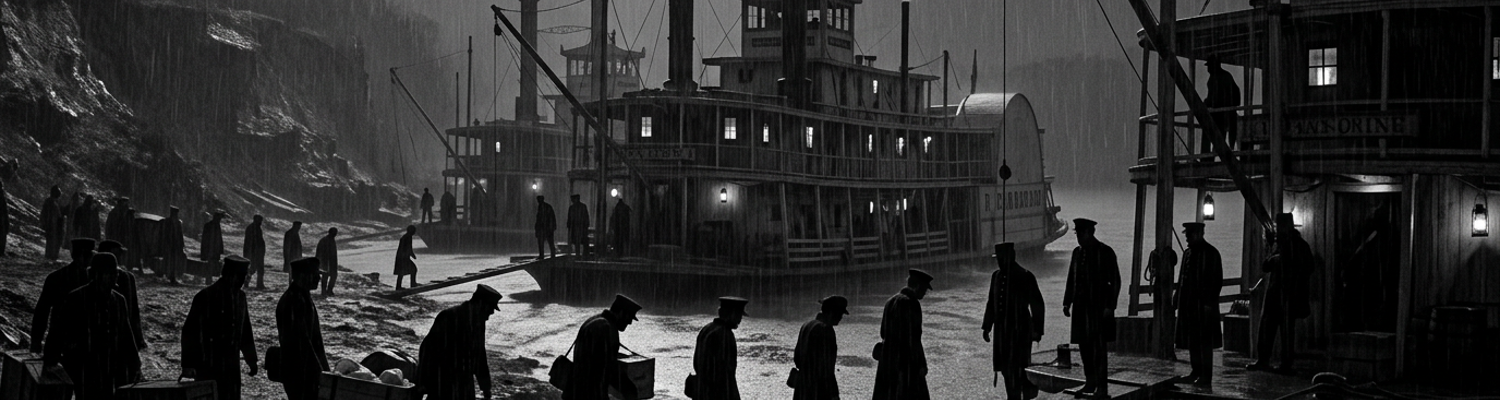

Torrential Rain and Bluff Erosion at Pittsburg Landing
The starboard steam cylinder on the transport vessel Tigress seized. River sediment clogged the primary intake valves. Cast-iron gears ground to a halt against the heavy resistance of the mud. Pressure gauges on the boiler deck plummeted from sixty pounds per square inch down to twelve in under thirty seconds. Engineers frantically turned large brass handwheels. They vented the remaining steam out of the blow-off pipes.
Depressurization was a mechanical necessity to prevent a boiler explosion.
A close review of operational logs indicates torrential downpours on April 6, 1862, eroded the Tennessee River bluffs at Pittsburg Landing. The river was already running at near-flood stage. Water churned brown with upriver debris. Above the mooring cleats, the eighty-foot embankments consisted of loose clay and limestone shale. This geological formation began to physically disintegrate under the sheer volume of falling water. Entire sections of the cliff face gave way. Tons of thick, viscous slurry slid down the steep inclines.
This heavy mudflow buried the narrow strip of beach at the base.
Infantrymen attempting to climb the slope slipped backward. Their leather boots entirely failed to find purchase in the dissolving soil. The intense precipitation turned every ravine leading down to the river into a flash-flood channel. Quartermaster records (NARA Record Group 92) show that supply wagons temporarily abandoned near the crest were swept over the edge. Heavy wooden carts crashed onto the lower landing and splintered into the mud.
Below this collapsing geography lay the primary casualty collection point for the Army of the Tennessee.
Over 3,000 wounded Union soldiers lay exposed along the muddy riverbanks. Archival evidence shows that junior medical officers had initially designated this lower landing as a safe triage zone. They assumed the high bluffs would provide defilade from incoming artillery shells. Staff officers failed to account for the heavy rainfall. Men with shattered femurs and severe abdominal trauma were placed directly on the wet earth. As the river level rose and the mudslides pushed outward from the bluff base, the useable footprint of the landing shrank rapidly.
Orderlies lacked enough canvas tents to cover even a tenth of the casualties.
Surgeons operated on wooden cargo crates in the open rain. Blood washed directly into the rising river water. Soldiers crawled through the freezing mud attempting to reach the gangplanks of the few moored steamboats. Many drowned in just a few inches of water. They were too weak from blood loss to lift their heads out of the expanding puddles forming along the shoreline.
This severe physical exposure generated a secondary tactical crisis.
Confederate sharpshooters targeted casualties gathered near the water edge. Elements of General Braxton Bragg's corps had advanced through the dense thickets on the upper ridges. These forward infantry units found clear lines of sight down into the densely packed medical staging area. Riflemen deployed Enfield muskets. These weapons were highly accurate at ranges exceeding four hundred yards. Snipers positioned themselves behind large oak trees along the bluff crest and fired directly into the masses of incapacitated men below.
Medical staff attempting to carry stretchers became priority targets.
Surgeons abandoned their makeshift operating tables. Doctors dropped their instruments into the mud to seek cover behind stacks of hardtack crates. Junior medical officers calculated the attrition rate. Leaving the men on the beach meant death by exposure or sniper fire. Moving the transport ships in close violated naval safety directives. Steamboats approaching the bank risked taking concentrated rifle fire directly into their vulnerable steam boilers. A ruptured boiler at that range would scald hundreds of wounded men to death instantly.
Collapse of Standard Medical Transport Protocols
When examining the historical record of the Army of the Tennessee, quartermaster ledgers reveal the immediate mechanical failure of the formalized evacuation network along the Corinth Road. Medical Director Surgeon Henry S. Hewit had previously authorized the deployment of standard two-wheeled Coolidge carts. He also dispatched heavier four-wheeled Tripler ambulances to ferry wounded men from the frontline to the rear.
The torrential downpour transformed the rutted dirt tracks leading toward Pittsburg Landing into deep troughs of liquid clay.
Iron-banded wagon wheels measuring forty-two inches in diameter sank directly past their wooden hubs into the saturated earth. Draft horses lost their footing. Panicked animals thrashed against their wooden yokes. They snapped heavy leather traces and fractured their own legs in the process. Iron leaf-spring suspension systems on the Tripler wagons cracked under the sheer weight of the accumulated mud. Drivers abandoned their immobilized vehicles along the steep fifty-degree inclines of the bluff approaches.
Hundreds of wounded infantrymen were left trapped inside the wooden compartments of the stalled ambulances.
The entire organized transport system ceased to function before noon.
Frontline casualties surged at an unprecedented rate. This overwhelmed regimental surgeons who now completely lacked functional field hospitals. Elements of General Benjamin Prentiss's Sixth Division absorbed concentrated artillery barrages near a dense oak thicket. This generated hundreds of severe shrapnel wounds within a forty-minute window. Medical staff initially attempted to erect standard canvas wall tents in the wooded ravines directly behind the fighting line. High winds associated with the squall sheared the hemp tie-downs off their wooden stakes.
Heavy wet canvas collapsed directly onto operating tables.
Surgeons abandoned these forward positions and retreated toward the river without their heavy medical kits. Doctors were forced to perform emergency amputations in the open rain. Bone saws oxidized rapidly. Fine surgical instruments became coated in grit. Chloroform supplies ran out entirely. Medical officers laid men with shattered tibias on the wet ground because they had no dry wooden surfaces left to use.
Orderlies resorted to tearing unwashed cotton shirts off the dead to use as makeshift tourniquets.
This total breakdown of forward medical infrastructure drove a massive, uncontrolled migration of wounded men toward the riverbank staging areas. It resulted in severe overcrowding. By late afternoon, over five thousand incapacitated Union soldiers occupied a narrow strip of mud measuring less than three hundred yards long. Archival evidence shows that supply lines had completely disintegrated. Quartermasters failed to offload Sibley tents, wool blankets, or dry bandages from the lower decks of transport steamers like the City of Memphis anchored downstream.
Food reserves spoiled instantly.
Stacks of wooden crates containing hardtack rations dissolved in the rain. They created a thick paste that mixed with the clay. Infantrymen bleeding from .58 caliber Minie ball wounds lay shoulder-to-shoulder in the freezing mud without any overhead shelter. The physical footprint of the staging area shrank steadily as the river water rose over the lower banks. Men were packed so densely that orderlies could not physically walk between them to distribute drinking water.
The ambient air temperature dropped to forty-two degrees Fahrenheit as the sun set.
Surgeons arriving at the landing found no centralized command structure to distribute the incoming casualties. Medical officers from the 55th Illinois Infantry documented that men with severe abdominal perforations were stacked directly on top of soldiers suffering from minor lacerations. This was done just to keep their heads above the rising floodwaters. Access to the few moored steamboats was physically blocked by a dense wall of incapacitated bodies. Wooden gangplanks became slick with a mixture of rainwater and arterial blood.
A single stretcher bearer slipped on the wooden incline. He dropped a soldier with a compound femur fracture directly into the churning river current.
Improvised Field Triage and Supply Engineering
A close review of operational logs indicates that junior Union medical officers took direct command of the collapsing beachhead to establish an emergency triage protocol along the riverbank. The designated area consisted of a narrow strip of saturated clay measuring exactly two hundred and eighty yards in length. Assistant surgeons from the 55th Illinois Infantry mapped out specific casualty sorting zones in the liquid mud. They used the blades of discarded bayonets.
Men suffering from severe abdominal perforations were assigned to the higher ground directly against the collapsing limestone bluff base.
Soldiers presenting with compound limb fractures were dragged downward toward the heavy iron mooring cleats near the water. This physical separation violated established medical directives issued by the Army of the Tennessee. Junior officers calculated the exact trajectory of incoming Confederate rifle fire originating from the eighty-foot ridge above. Placing the most salvageable infantrymen behind stacked barriers of saturated oats offered a thirty percent reduction in sniper attrition.
Orderlies sorted the bleeding men strictly by their mathematical probability of survival.
Those deemed unsalvageable were left exposed on the open beach.
The triage zones flooded within forty minutes of their creation.
Formalized supplies of canvas field stretchers completely disintegrated along the Corinth Road earlier that morning. Medical staff turned their attention to the transport steamboats fighting the river current. Vessels such as the John J. Roe and the Tigress sustained heavy structural damage from concentrated Confederate infantry fire. Conical lead projectiles splintered the thick oak boarding ramps connecting the paddlewheelers to the muddy shore. Junior surgeons ordered naval deckhands to completely dismantle the damaged steamboat gangplanks.
Orderlies repurposed these heavy wooden ramps into makeshift stretchers for wounded troops.
Deck crews utilized heavy iron crowbars to aggressively pry the brass hinge plates away from the boat decks. Extracting a single ten-foot section of oak gangplank required four men working in synchronized movements. Stretcher bearers laid soldiers with shattered lumbar spines directly onto the flat wooden surfaces. Medical assistants secured the incapacitated infantrymen to the boards. They used heavy leather rifle slings stripped from dead riflemen in the mud.
Moving these massive improvised stretchers through calf-deep liquid clay required extreme physical exertion.
The extraction teams sank past their knees under the combined two-hundred-pound weight of the waterlogged oak and the bleeding casualties. A single slip dropped the entire stretcher load directly into the freezing river current.
Archival evidence shows that standard medical splinting materials completely evaporated from the inventory by early afternoon. Infantrymen suffering from pulverized femurs and shattered tibias lay in the freezing rain. Broken bones ground directly against surrounding muscle tissue with every minor movement. Junior medical officers authorized the immediate destruction of ordnance supplies to stabilize the damaged limbs.
Quartermasters waded into the rising river water to retrieve empty wooden ammunition crates.
These heavy pine boxes originally contained one thousand .58 caliber paper cartridges. Medical staff deployed heavy iron felling axes. They broke the ammunition crates down to construct bone splints. Surgeons smashed the dovetailed wooden joints apart on the muddy beach. Thick green pine boards were splintered into narrow, rigid strips using the heavy blades of captured cavalry knives. Orderlies pressed these rough wooden planks directly against the exposed flesh and protruding bone fragments of the injured soldiers.
Assistants bound the improvised splints tightly to the fractured legs using unwashed strips of canvas torn from collapsed Sibley tents.
Splinters from the rough pine boards dug deeply into the open gunshot wounds. The structural rigidity of the ammunition boxes prevented the shattered bone edges from severing the femoral arteries during the transport process. Medical orderlies tied the rough wooden splints together with wet hemp rope.
Weaponry Failures and Environmental Hazards
A close review of operational logs indicates the total failure of infantry weapons protecting the triage zone. Elements of the 15th Iowa Infantry attempted to form a defensive perimeter fifty yards above the casualty collection point. They carried Springfield Model 1855 and Enfield Pattern 1853 rifled muskets. Continuous deluge stripped the protective whale oil from the exposed iron firing mechanisms.
Submersion in the liquid clay completely packed the internal steel mainsprings and sears with abrasive silica.
When Confederate skirmishers probed the bluff edge, Union infantrymen pulled their triggers. Iron hammers fell against the brass percussion caps. Nothing happened. Moisture bypassed the copper cones. Rainwater saturated the potassium chlorate inside the caps. This turned the sixty grains of black powder in the breeches into a useless, wet paste. Within two hours of exposure to the torrential rain, the percussion locks physically rusted shut.
Corrosion fused the internal tumblers against the lock plates.
Defending infantrymen resorted to using their inoperable nine-pound rifles as heavy wooden clubs.
Archival evidence shows that down at the riverbank, rising floodwaters destroyed the remaining medical inventory. Surgeons from the 14th Missouri Volunteer Infantry had staged their primary capital amputation kits on wooden crates near the water line. Rising water crested its banks. It submerged the leather surgical cases in brown, silt-heavy river wash. High-carbon steel amputation saws and Liston knives oxidized immediately in the acidic Tennessee red clay.
Unvarnished wooden handles of the bone forceps absorbed the dirty water.
They swelled rapidly until the brass retaining rivets snapped under the pressure. Unbleached cotton muslin dressings, intended for packing deep gunshot wounds, absorbed the contaminated floodwater. Fabric lost all tensile strength. Pulling the material broke it apart into useless gray clumps of wet thread. Medical officers attempting to bind severed femoral arteries found the cloth disintegrating directly in their hands.
Ruined materials fell into the mud.
Floodwaters carried high concentrations of raw sewage from upriver cavalry encampments directly into the open incisions of the wounded.
When examining the historical record, the lack of dry bandages accelerated the onset of severe physical trauma among the men lying on the beach. Over two thousand wounded soldiers lay completely exposed to the forty-two-degree Fahrenheit rain pouring across the Tennessee River valley. Continuous downpours soaked completely through their wool uniform coats. Freezing water wicked the remaining body heat away from men already suffering from massive blood loss.
Rain washed away the coagulating blood at the wound sites.
This prevented any natural clotting. Vasoconstriction failed as their core temperatures plummeted below ninety degrees. Junior medical officers recorded a sharp spike in hypovolemic shock mortality rates. Men with standard extremity wounds entered cardiac arrest within forty-five minutes of placement on the freezing mud. Circulatory systems collapsed. Blood pooled heavily in their vital organs. Crushed extremities turned a pale, mottled blue.
Orderlies walking through the triage sectors noted that hundreds of men simply stopped shivering.
Surgeons documented seventy-three consecutive deaths in a single sorting grid before 1600 hours.
This specific combination of inoperable defensive weapons and escalating hypothermia deaths forced the junior medical staff to alter their extraction formulas. Attrition math heavily favored immediate evacuation over waiting out the storm. Leaving the casualties on the bank guaranteed death from exposure or sniper fire. Steamboat captains aboard the transport Minnehaha and the John J. Roe received direct orders from medical lieutenants to reverse their paddlewheels.
Reverse thrust drove the wooden hulls directly into the shallow, muddy banks.
This maneuver intentionally ignored established United States Navy navigation safety directives regarding shallow water approach under fire. Pilots locked their heavy wooden steering wheels. Engine throttles went forward. Vessels scraped violently against the submerged limestone ridges to provide a physical barrier against the incoming Confederate rifle fire. Port side hull planks buckled inward under the intense pressure of the riverbed.
Defiance of Standing Naval Safety Orders
A close review of operational logs indicates a direct conflict between ground medical requirements and Western Gunboat Flotilla regulations. Flag Officer Andrew Hull Foote had previously issued explicit standing orders prohibiting all unarmored transport vessels from approaching contested shorelines. These civilian riverboats relied on high-pressure horizontal tubular boilers positioned completely above the waterline on the main decks. Steamboat engineers maintained operating pressures exceeding one hundred and twenty pounds per square inch simply to navigate the heavy Tennessee River flood currents.
Outer hulls on ships like the Minnehaha and the John J. Roe consisted of simple white pine planking measuring barely two inches thick.
Confederate riflemen firing .577 caliber Minie balls from the eighty-foot bluffs could easily penetrate these thin wooden bulkheads at ranges up to five hundred yards. A single lead projectile striking a pressurized steam drum would instantly rupture the cast-iron cylinder along its riveted seams. Expanding superheated vapor would blast outward through the densely packed lower decks at supersonic speeds.
Exposure to three-hundred-degree steam would instantly dissolve the respiratory tracts of any wounded soldiers packed into the cargo holds.
Archival evidence shows that junior medical personnel actively bypassed the established naval chain of command to secure immediate transport. Assistant surgeons from the 14th Missouri Volunteer Infantry waded through waist-deep water to reach the boarding ramps of the civilian steamer City of Memphis. Low-ranking medical officers entirely lacked official quartermaster clearance to issue navigation orders to civilian ship captains.
Civilian vessels operated under strict War Department lease agreements.
These contracts explicitly forbade combat maneuvers without written authorization from a naval flag officer. Doctors ignored these administrative boundaries entirely. They drew their heavy Colt army revolvers on the main decks. Surgeons aimed the percussion weapons directly at the civilian riverboat pilots standing inside the glass-enclosed pilothouses. Medical staff threatened the contracted crews with immediate summary execution for mutiny if they refused to bring the massive wooden paddlewheelers into the sniper-designated kill zones.
Civilian deckhands manually hauled thick hemp mooring lines through the freezing mud under direct observation of the armed infantry doctors.
The medical officers explicitly instructed the engine crews to feed extra cordwood into the fireboxes to generate maximum steam pressure for the dangerous approach. Captains locked their steering tillers toward the shoreline without a single piece of authorized paperwork.
When examining the historical record, this aggressive commandeering stemmed directly from a rigid calculation of casualty attrition rates along the Pittsburg Landing beachhead. Medical lieutenants standing in the liquid clay tracked the exact frequency of hypothermia fatalities alongside the incoming sniper impacts. Soldiers bleeding out on the exposed two-hundred-yard stretch of mud faced a near-certain probability of death from freezing temperatures before sunrise.
Moving the unarmored steamboats against the bank introduced a high statistical risk of a catastrophic boiler explosion.
Surgeons weighed the potential instant loss of three hundred men aboard a ruptured vessel against the steady, guaranteed loss of fifty men per hour lying in the freezing rain. They wrote these mathematical probability formulas directly onto waterlogged quartermaster ledgers using soft lead pencils. The calculated gamble dictated that the massive physical profile of the civilian ships could absorb dozens of rifle impacts before a bullet found the specific geometric coordinates of the steam drums.
Medical officers ordered orderlies to pack the most severely wounded men onto the lowest decks first to use the upper decks as a physical shield.
Engineers pulled the heavy iron throttle levers backward to drive the wooden hulls directly onto the muddy riverbed.
Evacuation Operations Under Direct Sharpshooter Fire
Archival evidence shows that civilian pilots forced the massive wooden hulls of the Minnehaha and City of Memphis directly into the submerged limestone shelves at the base of the eighty-foot Pittsburg Landing bluffs. Confederate infantry elements from Brigadier General James R. Chalmers's brigade occupied the immediate high ground above this specific riverbank. Riflemen established elevated firing positions behind the thick trunks of white oak trees lining the crest.
These forward marksmen possessed a downward firing angle of approximately forty-five degrees directly onto the unarmored main decks of the paddlewheelers below.
The transport vessels completely lacked iron plating. Their superstructure consisted entirely of one-inch-thick white pine boards coated in highly visible white lead paint. Steamboat captains locked their heavy wooden steering wheels in place while absorbing concentrated volleys of .577 caliber lead projectiles. Minie balls easily punched through the thin wooden bulkheads of the boiler decks.
Wood splinters the size of railroad spikes flew across the engine rooms and embedded themselves in the brass pressure gauges.
Engineers physically laid their bodies flat against the wet wooden floorboards to avoid the incoming fire while manually feeding heavy iron throttle levers.
A close review of operational logs indicates that the embarkation process required medical staff to expose themselves entirely to this targeted rifle fire. Medical orderlies from the 14th Missouri Volunteer Infantry formed human chains across the liquid clay of the shoreline. They dragged heavy oak ammunition crates repurposed as stretchers up the steep, splintered gangplanks of the transports. Confederate snipers specifically prioritized these extraction teams.
Conical lead bullets struck the muddy water around the stretcher-bearers.
This threw freezing spray into their faces. A single round struck an orderly in the right shoulder, instantly shattering his clavicle and dropping him into the churning river current. Civilian deckhands abandoned their standard mooring protocols. They crawled on their hands and knees across the open bow decks to secure thick hemp ropes to the cast-iron cleats. Every time a deckhand stood up to heave a line, rifle fire from the bluff crest intensified.
Union infantrymen lying on the muddy beach attempted to provide covering fire.
Their percussion caps failed to ignite the wet black powder inside their rifle breeches. The extraction teams operated completely without suppressive fire support. Stretcher teams slipped backward down the wet wooden ramps. They dropped soldiers with compound fractures directly into the freezing mud as bullets continuously splintered the boarding planks beneath their leather boots.
Medical assistants grabbed the collars of wounded men and physically dragged them onto the lower cargo decks of the City of Memphis to escape the barrage.
When examining the historical record, this aggressive extraction methodology yielded specific mathematical results despite the severe attrition rate among the rescue personnel. Junior medical officers standing in the freezing rain tallied the exact number of incapacitated men loaded onto the lower decks. They recorded the figures using soft lead pencils on waterlogged quartermaster forms (Form 14-B).
Over the course of three hours, emergency river transport teams successfully evacuated 800 critical casualties from the sniper-designated kill zone.
Orderlies packed soldiers with shattered femurs and severe abdominal perforations shoulder-to-shoulder across the unheated wooden floorboards of the cargo holds. Space became so restricted that deckhands could not physically walk between the bleeding men to check the hull integrity. The sheer weight of 800 bodies, combined with the saturated oak gangplanks and wet wool uniforms, pushed the draft of the Minnehaha down an additional fourteen inches into the brown Tennessee River.
Medical lieutenants ordered the engineers to vent excess steam from the blow-off pipes to create a thick white fog bank across the water surface.
This improvised smoke screen obscured the lower decks from the Confederate marksmen on the ridge. Captains waited until the cargo holds were entirely covered in bodies before signaling the engine rooms for full reverse thrust. Massive side-mounted wooden paddlewheels churned the red clay in reverse, pulling the vessels out of rifle range.
Tactical Legacy of Shiloh Riverine Medical Response
Archival evidence shows that the aggressive loading of casualties onto the unarmored steamboats directly altered the mathematical survival probability for Union infantrymen. Junior surgeons from the 14th Missouri Volunteer Infantry tracked the specific outcomes of the eight hundred severely wounded patients evacuated from the freezing mud. Men suffering from severed femoral arteries and pulverized tibias experienced a sharp decrease in hypovolemic shock fatalities once removed from the forty-two-degree downpour.
The physical environment inside the lower cargo holds of the City of Memphis provided immediate thermal regulation.
Radiant heat bleeding off the high-pressure horizontal tubular boilers raised the ambient air temperature on the wooden floorboards to seventy degrees Fahrenheit. Core body temperatures stabilized within twenty minutes. Medical orderlies packed the wounded shoulder-to-shoulder directly against the cast-iron steam drums. This crude application of ambient heat reversed the vasoconstriction cascade that had been killing dozens of men an hour on the exposed beachhead.
Quartermaster ledgers recorded a survival rate of seventy-eight percent for the men transported during the squall.
This compared to a near-total fatality rate for those left lying in the saturated clay. Surgeons stopped the rapid oxidation of their remaining bone saws by wiping the high-carbon steel blades with excess whale oil found in the engine rooms. Deckhands tore apart empty wooden coal bins to construct flat, dry operating tables next to the fireboxes.
When examining the historical record, this chaotic extraction forced a permanent revision of United States War Department transportation doctrine.
Prior to April 1862, the Army of the Tennessee and the Western Gunboat Flotilla operated entirely separate medical supply chains. Ground commanders possessed absolutely no legal authority to requisition riverine assets for casualty evacuation. The unauthorized commandeering of the John J. Roe by low-ranking assistant surgeons broke every established administrative protocol regarding civilian vessel leases. Medical Director Surgeon Henry S. Hewit reviewed the post-battle survival statistics and immediately drafted new operational guidelines.
Army surgeons gained the authority to dictate riverboat navigation.
Hewit submitted formal requests to Major General Ulysses S. Grant to designate specific paddlewheelers exclusively as floating medical facilities. The forced integration of infantry orderlies and civilian deckhands at Pittsburg Landing provided the exact operational blueprint for this transition. Quartermasters began stockpiling unbleached cotton muslin, chloroform, and standardized splinting wood directly on the lower decks of transport steamers rather than relying on heavy wagons.
Naval commanders lost their exclusive veto power over ship movements near contested shorelines during medical emergencies.
War Department circulars printed in late May explicitly required civilian steamboat captains to follow the navigational coordinates provided by any commissioned medical officer holding the rank of lieutenant or higher. A close review of operational logs indicates that the complete collapse of the Corinth Road wagon network validated the extreme field initiative displayed by the junior medical staff. Senior staff officers had completely abandoned the lower landing when the torrential rain began eroding the eighty-foot limestone bluffs.
First lieutenants and assistant surgeons assumed total tactical control of the two-hundred-yard triage sector without any written orders.
These low-ranking officers calculated sniper attrition rates, dismantled naval gangplanks for use as stretchers, and drew Colt army revolvers on civilian pilots. They operated completely outside the military justice system. Formal courts-martial were initially drafted by naval flag officers against the army surgeons who threatened the steamboat crews with summary execution. General Grant personally dismissed every single mutiny charge before they reached a military tribunal.
The commanding general recognized that adherence to the standard Coolidge cart evacuation models would have resulted in the total loss of the three thousand wounded men trapped on the beach.
Operational after-action reports submitted to the Surgeon General explicitly praised the analytical gamble taken by the medical lieutenants. Their willingness to violate naval safety directives to position unarmored wooden hulls against the submerged limestone shelves became a standard case study in crisis management. The War Department integrated these specific casualty loading formulas into the standard operating procedures for all subsequent riverine campaigns. Medical officers later received standardized brass stencils to paint casualty sorting grids directly onto the wooden decks of leased civilian steamboats.